





Sending Logs, Alerts, and Telemetry Through a Data Diode

Find Out How
We utilize artificial intelligence for site translations, and while we strive for accuracy, they may not always be 100% precise. Your understanding is appreciated.

Securing Modern Data Centers in the Age of IT-OT Convergence

By Ankita Dutta, Senior Product Marketing Manager
Share this Post

Data centers are increasingly becoming critical infrastructure that underpin financial systems, industrial operations, telecommunications, and national economies. As AI helps scale cloud infrastructure and energy-intensive digital services continue to expand, data centers’ OT (operational technology) environments are becoming increasingly interconnected, complex, and exposed to cyber risk.

A recent analysis from the World Economic Forum (WEF) highlights how tighter integration between IT, OT, and energy systems is creating new cybersecurity and resilience challenges for modern data centers. The report emphasizes that organizations must move beyond traditional perimeter-based security models and adopt continuous monitoring, cyber-physical resilience planning, and coordinated protection strategies across interconnected systems. For security teams, one issue stands at the heart of the challenge, and that issue is visibility.

The Expanding OT Attack Surface Inside Data Centers

Historically, many OT environments have operated in isolation. Today’s digital transformation initiatives and the growing demand for centralized management have increased IT/OT convergence across critical infrastructure sectors. While this convergence improves operational efficiency, it also significantly expands the cyberattack surface.

Modern data centers rely heavily on OT systems to maintain operational continuity and energy efficiency. These environments include:

  • Power generation and backup systems
  • Cooling and HVAC infrastructure
  • Building management systems (BMS)
  • Industrial control systems (ICS)
  • Environmental monitoring sensors
  • Physical access control systems
  • Network-connected IoT devices

The WEF report specifically warns that disruptions impacting interconnected data center and energy systems could lead to cascading failures across essential services. As AI-driven demand accelerates the construction of new data centers and on-site energy infrastructure, organizations must secure not only traditional IT assets but also operational systems that directly impact physical processes and uptime.

Why Visibility is the Foundation of OT Security

One of the most significant challenges in OT cybersecurity is that many organizations lack a complete inventory of the assets within their environments.

Unlike traditional IT networks, OT ecosystems often contain:

  • Legacy systems and protocols with limited security controls
  • Proprietary industrial protocols
  • Unmanaged or undocumented devices
  • Flat network architecture
  • 24/7 systems that cannot tolerate downtime for scanning or patching

Without accurate visibility into connected assets, security teams struggle to identify vulnerabilities, detect anomalous activity, or assess operational risk in real time.

The WEF analysis highlights that cybersecurity in modern data centers requires “visibility across the system of systems,” including power plants, backup power, cooling infrastructure, and physical access systems. Monitoring these environments independently is no longer sufficient. Organizations need correlated visibility across interconnected OT and cyber-physical systems to quickly identify high-consequence anomalies before they escalate.

The Need for Purpose-Built Solutions to Strengthen Cyber Resilience

As organizations modernize critical infrastructure environments, security teams need purpose-built solutions for OT visibility and threat detection that do not disrupt operations.

Comprehensive Asset Visibility

A tailored solution should enable security teams to build accurate asset inventories and understand the relationships between interconnected systems across operational environments. This provides passive asset discovery across industrial networks, helping organizations identify:

  • OT and ICS devices
  • Industrial protocols
  • Firmware and operating systems
  • Communication patterns
  • Unauthorized or unmanaged assets

Threat Detection for Industrial Networks

Continuous monitoring is especially critical in environments where uptime requirements limit the use of intrusive scanning or aggressive endpoint controls. Modern OT threats target industrial protocols and cyber-physical systems, increasing the need for a solution to continuously monitor network traffic for:

  • Suspicious communication patterns
  • Anomalous device behavior
  • Indicators of compromise (IOCs)
  • Policy violations
  • Potential lateral movement activity

Vulnerability and Risk Identification

OT environments often contain legacy systems that cannot be patched immediately. As a result, organizations need solutions to prioritize remediation efforts by identifying vulnerable assets and mapping risks across industrial networks.

This risk-based visibility supports stronger cyber resilience planning while helping organizations reduce exposure to operational disruption.

Support for IT/OT Convergence Security

As data centers increasingly integrate operational systems with enterprise IT infrastructure, organizations require centralized visibility across both domains.

A solution that bridges this gap by enabling security teams to correlate OT telemetry with broader cybersecurity operations is necessary. This improves incident detection and response across converged environments.

Moving Beyond Perimeter Security

Resilience is becoming just as important as prevention. Cybersecurity strategies focused solely on perimeter defense are no longer sufficient for modern industrial and critical infrastructure environments.

Organizations must assume that threats can emerge from:

  • Third-party integrations
  • Supply chain exposure
  • Remote access systems
  • Insider activity
  • Misconfigured industrial assets
  • AI-assisted cyberattacks

Organizations must adopt a proactive approach to threat events with pre-emptive hardening, active response, and solutions like network segmentation with industrial firewalls paired with network visibility and threat detection tools, enabling this.

Building Resilient Critical Infrastructure

As data centers continue to evolve into strategic national infrastructure, cybersecurity and operational resilience will become increasingly interconnected.

Protecting these environments requires:

  • Continuous OT asset visibility
  • Real-time threat detection
  • Cross-domain monitoring
  • Coordinated IT/OT security operations
  • Proactive resilience planning

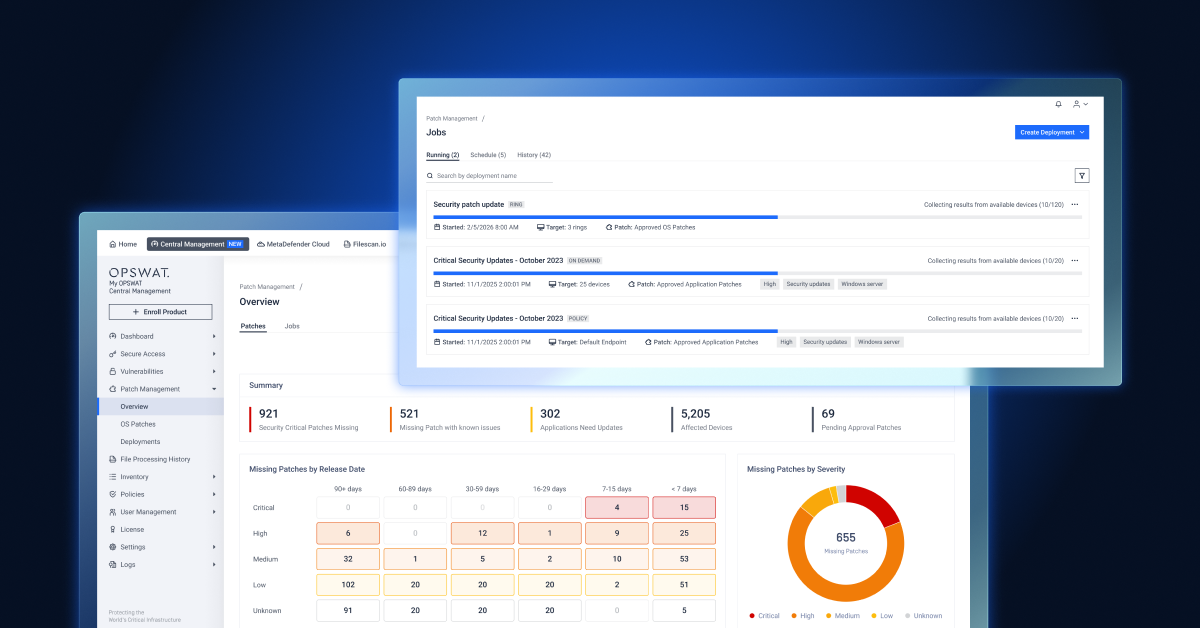
Purpose-Built OT Asset Discovery, Inventory, and Patch Management

A solution like MetaDefender OT Security™ helps organizations strengthen cyber resilience by providing the visibility and threat detection capabilities needed to secure modern industrial and cyber-physical environments.

To discover how OPSWAT’s purpose-built solutions help secure your data centers, critical infrastructure, and converged OT environments against modern cyberthreats, talk to one of our experts today.

Stay Up-to-Date With OPSWAT!

Sign up today to receive the latest company updates, stories, event info, and more.