Enterprise patch management has more tooling and automation available than at any point in its history. Yet, administrators still struggle to monitor and retain control over patch execution across their environment. According to the Verizon 2026 Data Breach Investigations Report, organizations are falling behind as the median time to patch a critical vulnerability has increased from 32 to 43 days, while full remediation of vulnerabilities in the CISA (Cybersecurity and Infrastructure Security Agency) Known Exploited Vulnerabilities catalog has dropped from 38% to 26%.
This guide breaks down why enterprise patch management is getting harder to control, what capabilities actually close that gap, and how the Patch Management solution from OPSWAT empowers security teams to strengthen patching operations from a single console.
Key Takeaways
- The three growing pressures of enterprise patch management are accelerating CVE volume, slow deployment cycles, and poor coordination across fragmented tools.
- A modern enterprise-grade solution must do more than surface vulnerabilities; it must give teams a structured workflow from detection to deployment without switching consoles or disrupting operations.
- The Patch Management solution in My OPSWAT™ Central Management provides a unified console to identify exposure, prioritize by real-world risk, deploy in controlled stages, and prove compliance across cloud, on-premises, and air-gapped environments.
Why Enterprise Patch Management Is Getting Harder to Control
Enterprise patch management is the process of maintaining software integrity across an organization's endpoint fleet through identifying, prioritizing, testing, and deploying security patches. Effective enterprise patch management reduces the window between vulnerability disclosure and remediation, minimizing exposure to known exploits across IT and OT environments.
In practice, enterprise patch management is becoming increasingly reactive and inconsistent each year, driven by three converging pressures.
The Volume of Vulnerabilities Keeps Climbing
Data from the National Vulnerability Database (NVD) indicates more than 42,000 CVEs were published in 2025, a 20% increase from 2024, averaging over 130 new vulnerabilities every single day.
The rapid adoption of AI is accelerating vulnerability discovery. Security researchers, vendors, and threat actors are now using AI-assisted analysis and large-scale code inspection to identify flaws faster than traditional manual methods allow. The result is a discovery pipeline that keeps expanding and a remediation burden that grows with it.
Deployment Cycles Are Falling Behind
According to Verizon's 2026 Data Breach Investigations Report, which analyzed remediation data across more than 13,000 organizations, the median time to fully remediate a known exploited vulnerability climbed to 43 days in 2025, up from 32 days the year before, and organizations fully remediated only 26 percent of the vulnerabilities in CISA's Known Exploited Vulnerabilities catalog.
Those timelines held regardless of organizational maturity, investment, or tooling: a full week after detection, 60 to 70 percent of known exploited vulnerabilities remained open. Most administrators cannot produce accurate deployment timelines for their own environments without spending days reconciling reports from different tools.
Coordination Remains the Core Bottleneck
In large enterprises, detection and remediation often happen in separate tools, which makes patching harder to coordinate and risk harder to track. The 2026 Hybrid Cloud Security Survey founds that 93% of organizations have invested in new detection and visibility tools, yet 40% say it now takes longer to investigate breaches as environments grow more complex. When evidence is scattered across consoles and formats, teams spend more time reconciling data than closing gaps, and it becomes harder to prove patching compliance through a consistent, centralized process.
What to Look for in an Enterprise Patch Management Solution
Most patch management tools are good at showing you what's wrong. Fewer give you a safe, structured way to remediate it at scale.
A modern enterprise-grade patch management solution should give administrators unified, real-time visibility into patching operations across environments, with the capability to prioritize, stage, and deploy patches without causing business disruption or breaking a critical system.
When evaluating an enterprise patch management solution, these are the capabilities that matter most.
| Capability | Why This Matters | What It Means in Practice |
| Cross-platform coverage | Enterprise environments use multiple operating systems. A patching solution must cover them all so teams can find and fix vulnerabilities consistently without gaps. | Support for patching Windows, macOS, and Linux from one console without switching tools. |
| Multi-environments support | Different environments have different patching requirements. A good solution should work in cloud, on-premises, and air-gapped setups so teams can patch securely without changing tools. | Secure patching across cloud, on-premises, and air-gapped environments. |
| Third-party app patching | Many exploited vulnerabilities are in third-party apps such as browsers and productivity tools. Patching only the operating system leaves these common attack paths open. | Automatically patch high-risk apps such as Chrome and Adobe Acrobat Reader. |
| Pilot deployment | Pilot deployment reduces rollout risk by validating patches on a limited device group before broad deployment. This helps teams catch compatibility issues, failed installs, or operational disruption early. | Start with a pilot group, validate patch performance, then expand deployment in controlled rings to the broader environment. |
| Risk-based prioritization | CVSS scores alone do not show which vulnerabilities pose the most immediate threat. Teams need additional context such as active exploits and asset criticality to focus on the highest-risk threats. | Use CVSS scores together with indicators like CISA Known Exploited Vulnerabilities status, affected devices, and vulnerability age to prioritize patches more accurately and act faster on the most actively exploited risks. |
| Flexible deployment options | Administrators need flexible deployment options for different situations. Routine patches should run on a schedule, while critical vulnerabilities and zero-days may need immediate, on-demand deployment. | Support scheduled deployment for regular patching and on-demand deployment for urgent threats. |
| Centralized patch visibility | Fragmented patch data across multiple tools makes it difficult to answer basic questions: What is exposed? What has been patched? Are we compliant? Consolidating this view saves hours of manual reconciliation. | A single dashboard to track patch status, deployment progress, access to logs and audit-ready reports. |
How My OPSWAT Delivers Proactive Enterprise Patch Management
My OPSWAT Central Management is OPSWAT’s centralized security management platform for managing and monitoring MetaDefender™ product deployments across distributed environments. Its Patch Management solution unifies OS and third-party application patching in one console, giving administrators end-to-end control over the entire patching lifecycle.
Eliminate Coverage Gaps Across Platforms and Environments
OPSWAT’s patch management solution supports patching across Windows, macOS, and Linux, as well as automates updates for operating system and third-party applications, covering the full scope of a modern enterprise endpoint fleet.
Air-gapped networks present one of the hardest patching challenges in enterprise security. They’re isolated by design, but not immune to vulnerabilities. The patch management solution supports secure offline patching, giving administrators a controlled way to update managed endpoints running MetaDefender Endpoint™ without compromising network separation.
Everything is managed through the My OPSWAT Central Management console, ensuring a unified workflow from configuration to deployment. This makes it a practical solution for manufacturing, energy, and utilities organizations where air-gapped infrastructure is a compliance requirement, not an exception.
See Your Full Patching Landscape in Real Time
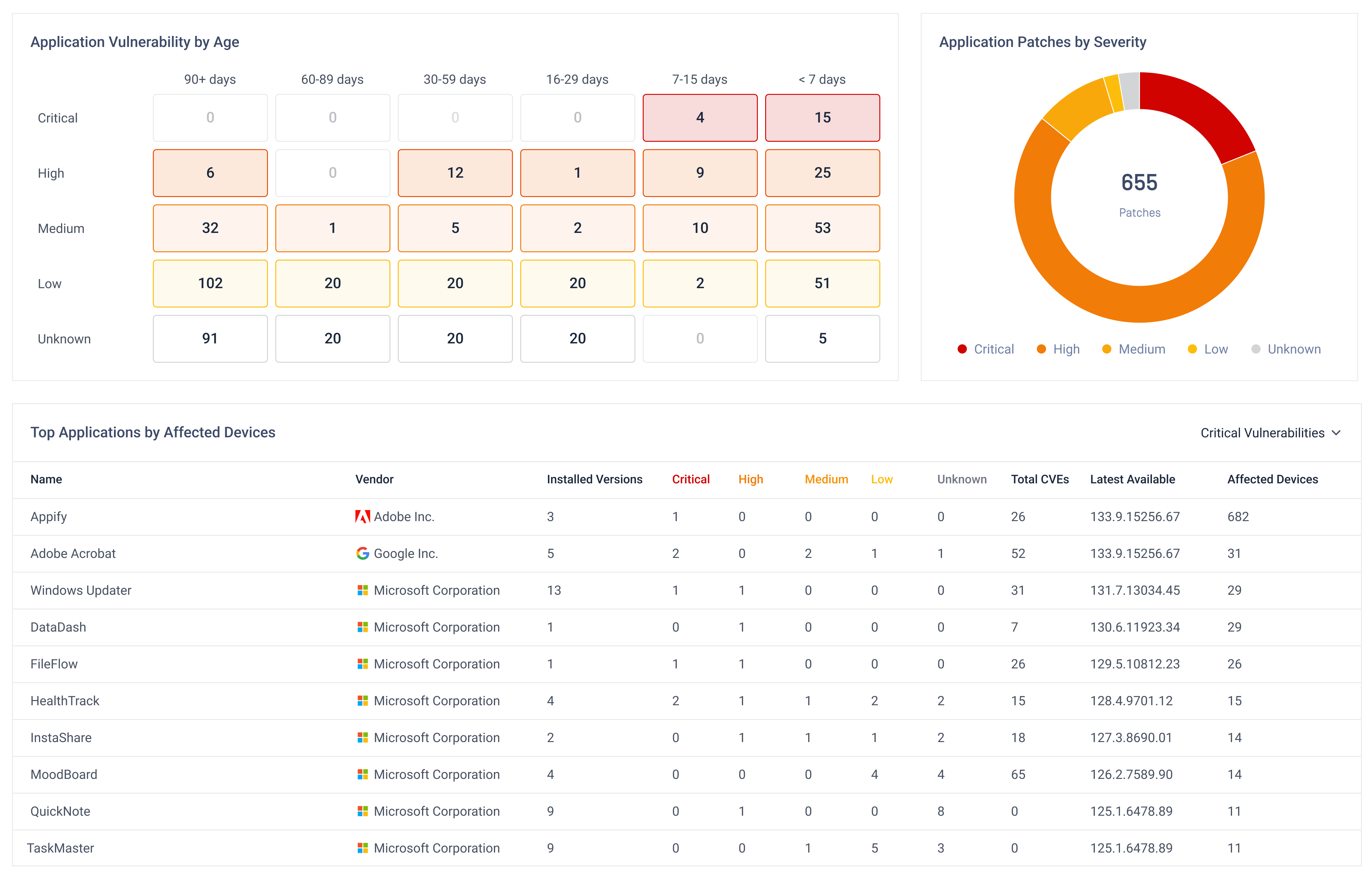
My OPSWAT Central Management provides a real-time view of the organization’s patching landscape. It surfaces risk summaries, deployment results, and installation success rates across every endpoint, operating system, and third-party application.
Administrators can identify an exposure, track its remediation progress, confirm successful deployment, and troubleshoot updates failures from one screen, before a missed patch becomes an exploited vulnerability.
Focus Remediation with Risk-Based Prioritization
The Patch Management solution adopts a risk-based prioritization approach to enhance decision-making and optimize remediation efforts. It evaluates vulnerabilities through a combination of CVSS scores, severity, impacted assets, and vulnerability age to present a more comprehensive view of risk.
This approach enables organizations to focus remediation efforts on vulnerabilities with the highest likelihood of exploitation, rather than treating all patches with the same level of urgency.
Ring-Based Deployment to Protect Operations
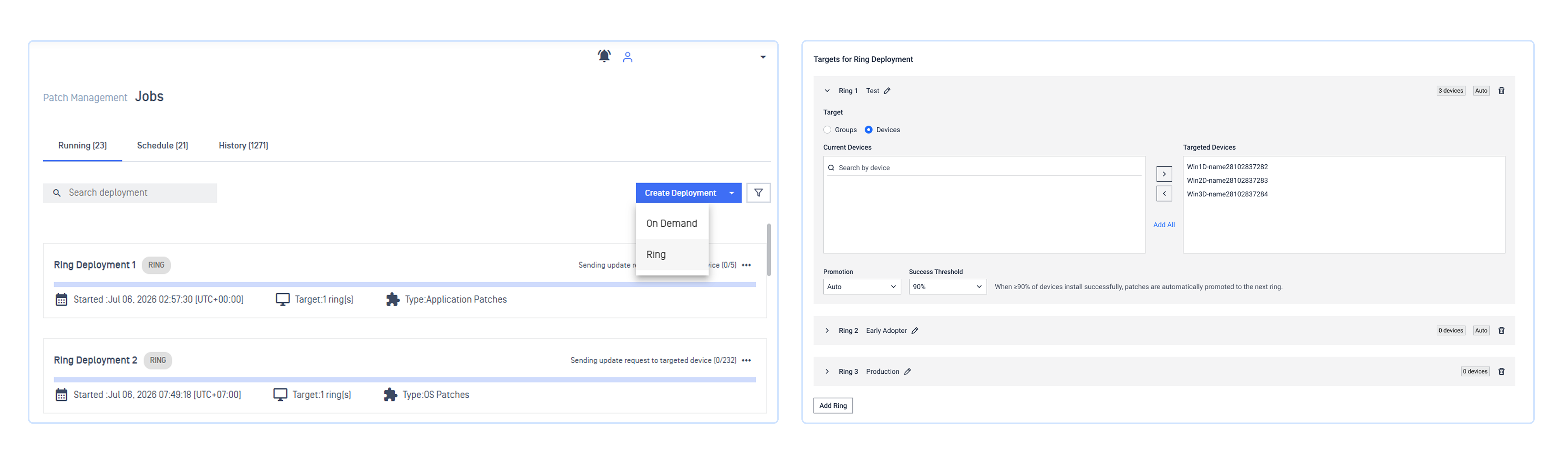
The Patch Management solution supports ring-based deployment natively, pushing updates in progressive waves rather than all at once. A standard workflow starts with a small pilot group, expands to a validation ring following initial verification, and graduates to the full production fleet.
Ring-based deployment is especially critical in manufacturing and critical infrastructure environments, where unplanned downtime carries immediate operational and safety consequences.
Flexible Deployment Options
Patch Management supports both on-demand deployment for critical vulnerabilities and automated policy-based scheduling for routine updates.
Administrators can tailor patch settings to the specific needs of different device groups: schedule off-peak deployment windows to minimize user disruption, target specific locations or endpoint types, and adjust policies by group without affecting the broader deployment.
Patch Reporting to Prove Compliance
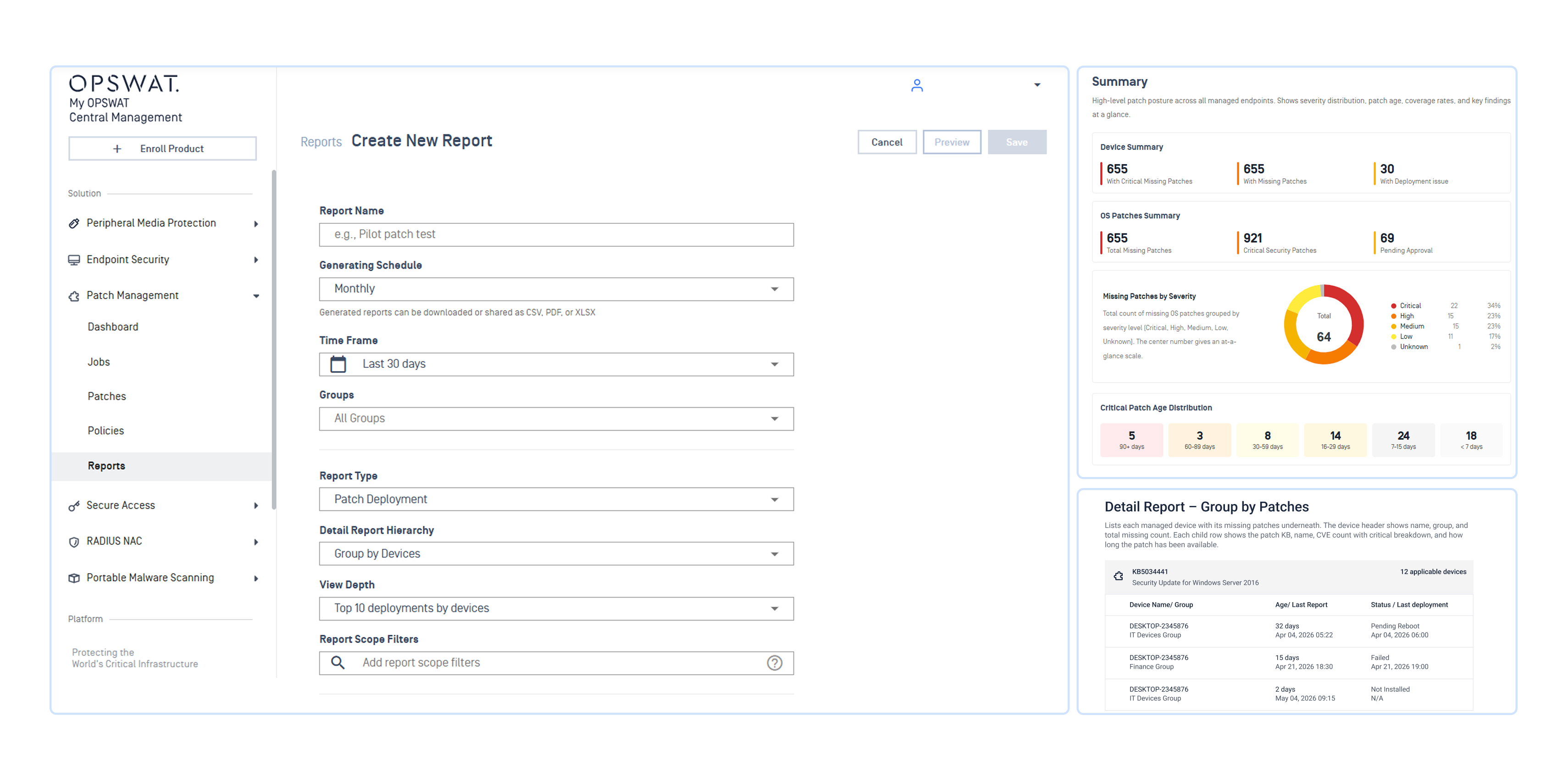
Patch reporting lets administrators build customized reports scoped to their specific compliance and operational needs:
- Application vulnerability reports: which applications are exposed, at what severity, and across which devices.
- Patch deployment performance: how patches are progressing across the environment.
- Group-based missing patch reports: which device groups are still exposed and to which vulnerabilities.
Reports can be filtered by severity level, endpoint group, or deployment name, and exported in formats aligned to major compliance frameworks including NERC CIP, NIS2, and NIST CSF. Rather than spending hours assembling audit documentation from fragmented sources, administrators can generate what auditors need directly from the same console they use to manage patching.
Discover How Patch Management Fits Your Infrastructure
The gap between detecting a vulnerability and deploying a fix is where risk accumulates. The Patch Management solution in My OPSWAT Central Management is designed to close that gap, giving your team centralized control over the full patching lifecycle.
See how Patch Management works across On-Premises, Air-Gapped, and Cloud environments, or contact an OPSWAT expert to discuss your patching strategy.