Rapid Zero-Day Detection
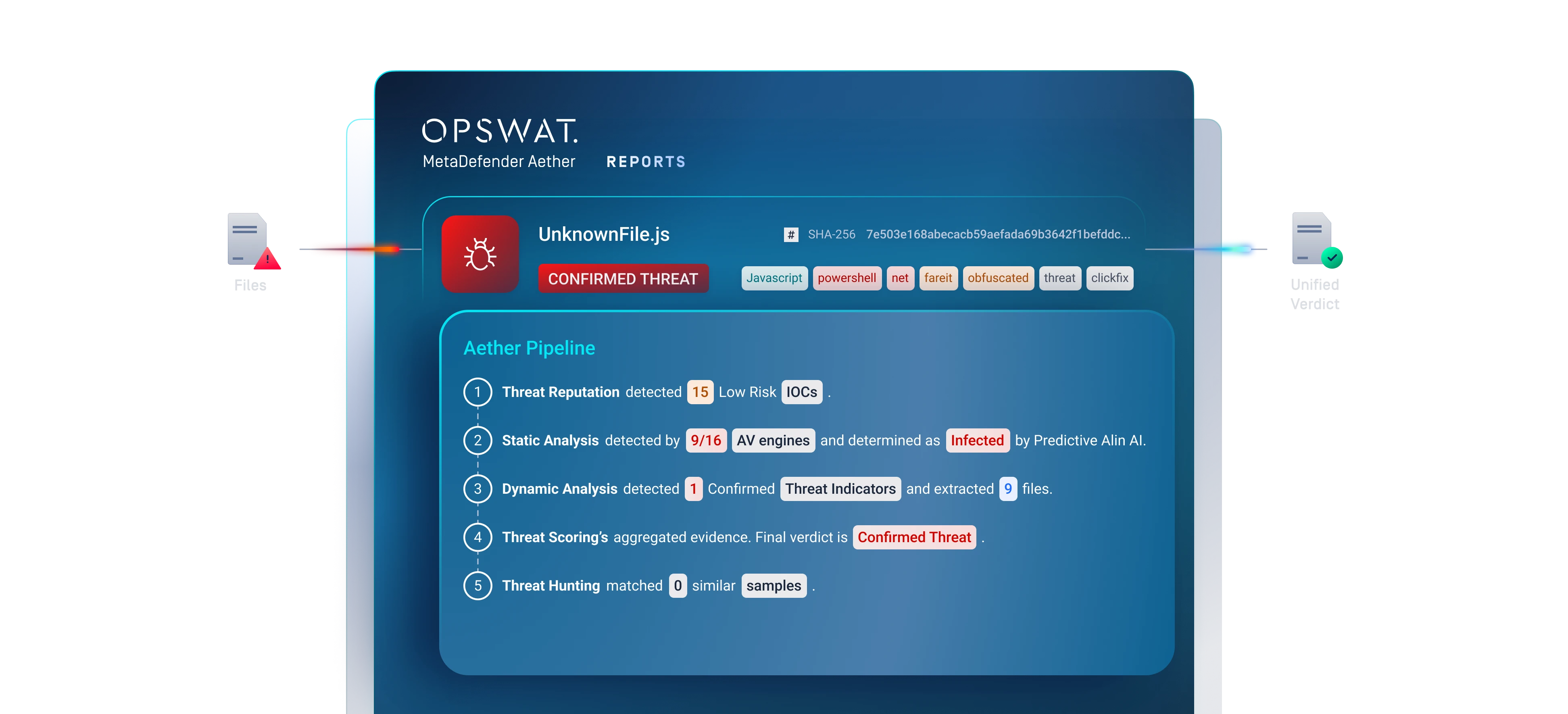
OPSWAT’s AI-driven unified five-layer zero-day detection solution combines Threat Reputation, Predictive AI, Adaptive Sandbox, Threat Scoring, and ML-powered Threat Hunting to detect known, unknown, and evasive malware before it reaches users and systems.
Benefit from a single, consolidated verdict per file, helping SOC teams respond faster, reduce alert noise, and strengthen SIEM, SOAR, and threat-hunting workflows across cloud, hybrid, on-premises, and air-gapped environments.
- 99.5% Zero-Day Efficacy
- 40x Faster than Traditional Tools
- 50K+ Analyzes Per Day
OPSWAT is Trusted by
























Unified Zero-Day Detection
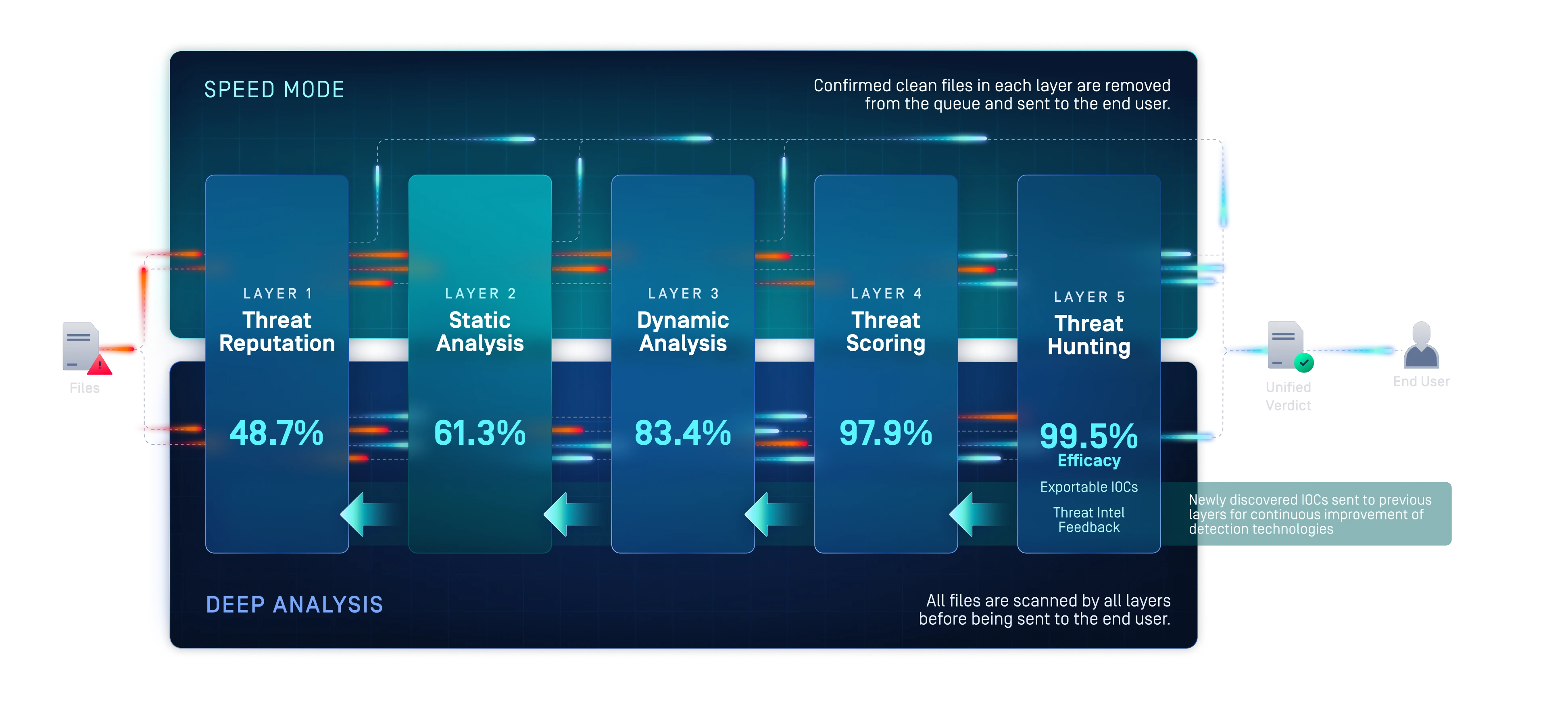
Layer 1: Threat Reputation
Expose Known
Threats Fast
Stop known threats before deeper analysis.
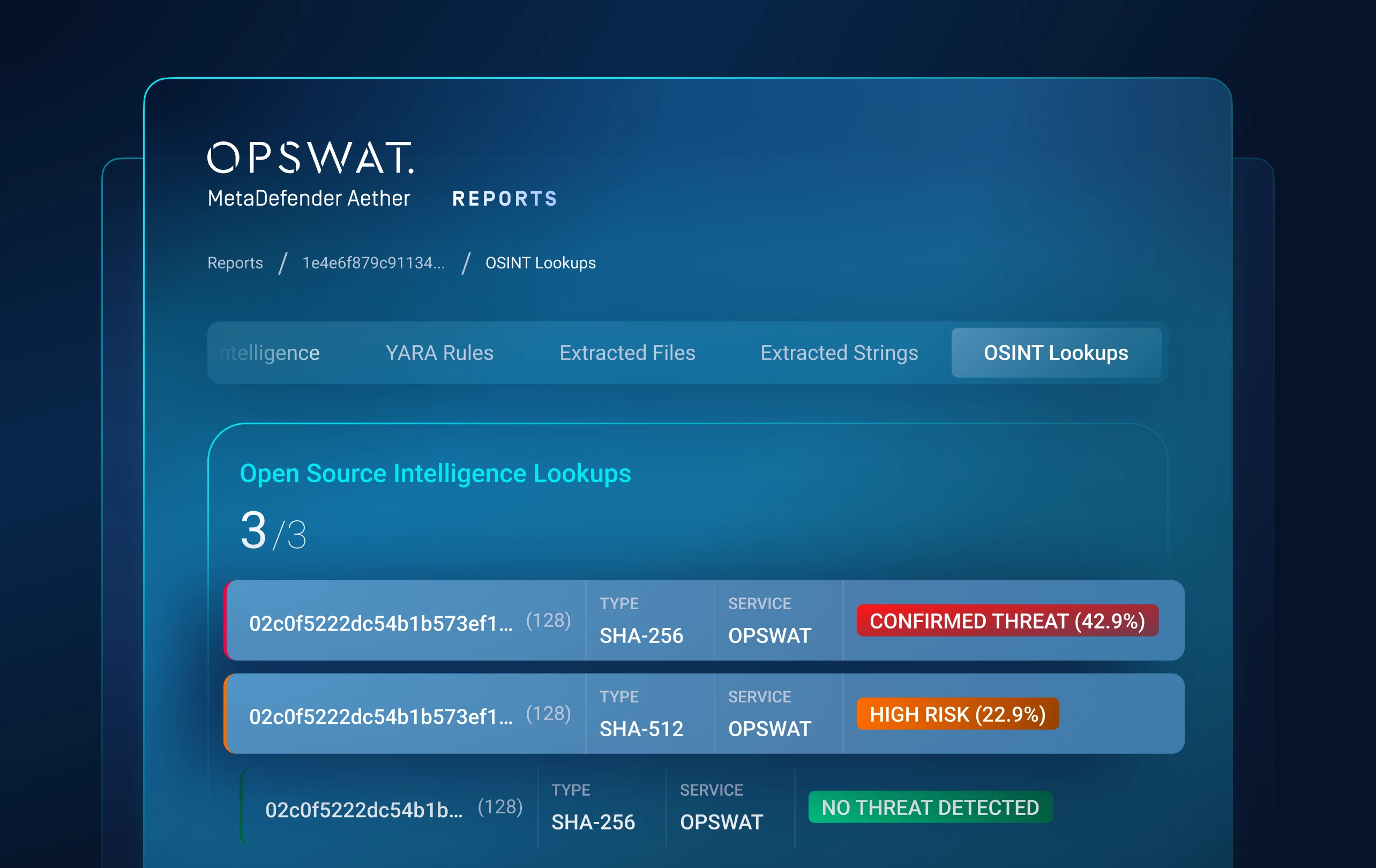
Checks files, URLs, IPs, and domains against continuously updated reputation intelligence, online or offline.
Blocks reused malware and attacker infrastructure, forcing adversaries to rotate indicators and rebuild delivery paths.
Layer 2: Static Analysis
Predict Unknown Threats Before Execution
Close the Pre-Execution detection gap.
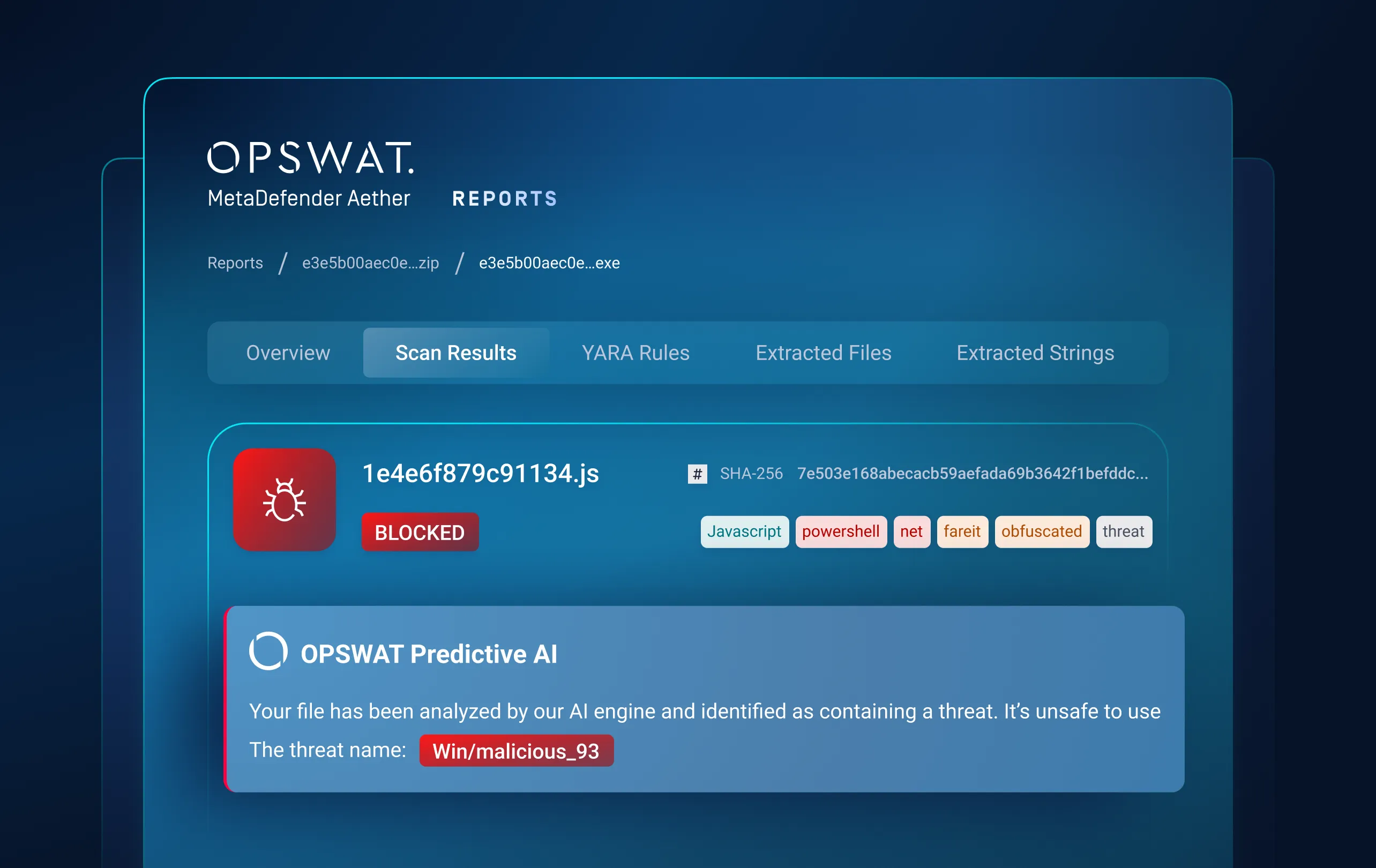
Predictive Alin AI analyzes file structure and behavioral features to predict malicious intent in milliseconds, without signatures or detonation.
Detects never-before-seen and polymorphic malware before it runs, reducing downstream sandbox demand while keeping file flows fast.
Layer 3: Dynamic Analysis
Force Hidden Threats to Reveal Themselves
Expose evasive malware that static and VM-based tools miss.
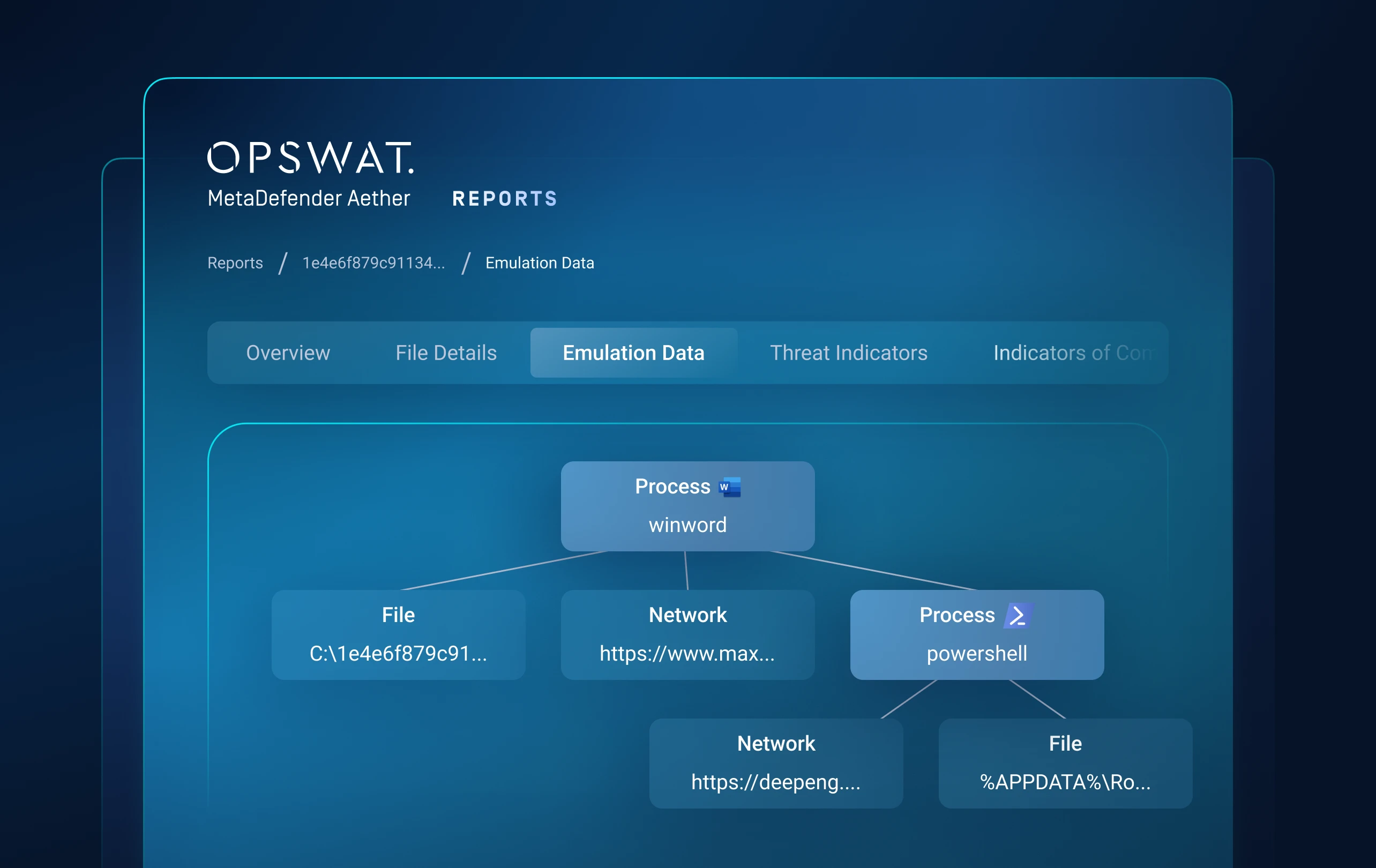
An emulation-based Adaptive Sandbox triggers malicious behavior and explores alternate execution paths without relying on a detectable virtual machine.
Reveals loader chains, runtime artifacts, obfuscated scripts, multi-stage payloads, and evasion techniques.
Layer 4: Threat Scoring
Prioritize What Matters Most
Turn complex threat behavior into an actionable verdict.
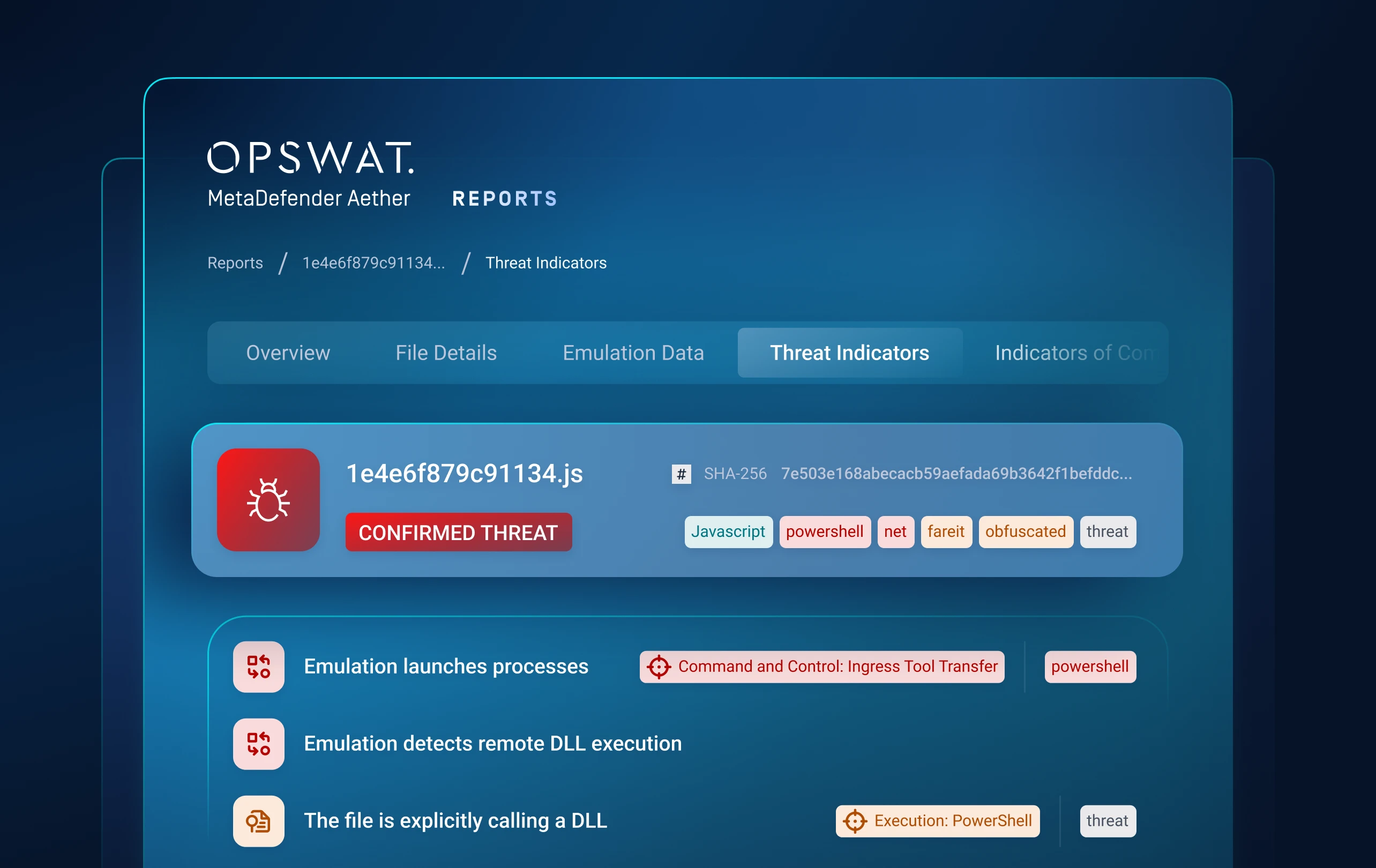
Correlates reputation, static, and dynamic analysis signals to assign a confidence-based risk score.
Highlights the highest-risk threats in real time, reducing false positives, alert noise, and analyst triage time.
Layer 5: Threat Hunting
Connect Threats to Campaigns
Move from isolated file detection to campaign-level intelligence.
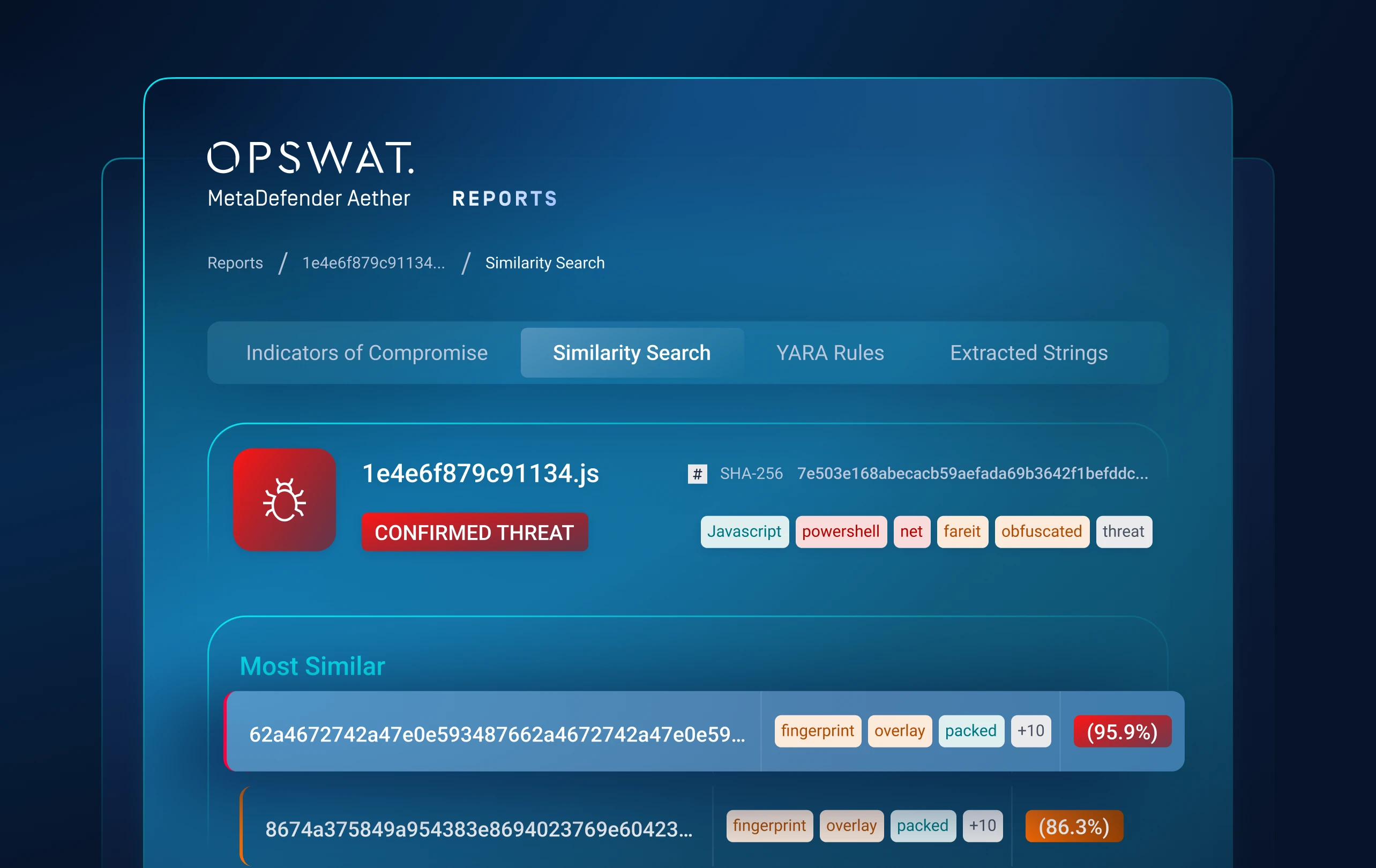
ML-powered similarity search and Threat Pattern Correlation connect unknown samples to known malware, infrastructure, tactics, and related variants.
Uncovers malware families and attacker campaigns, forcing adversaries to overhaul their tools, infrastructure, and tradecraft.
Product Overview
Learn how MetaDefender Aether uses AI-powered adaptive sandboxing to detect and stop zero-day attacks
that traditional security tools miss.
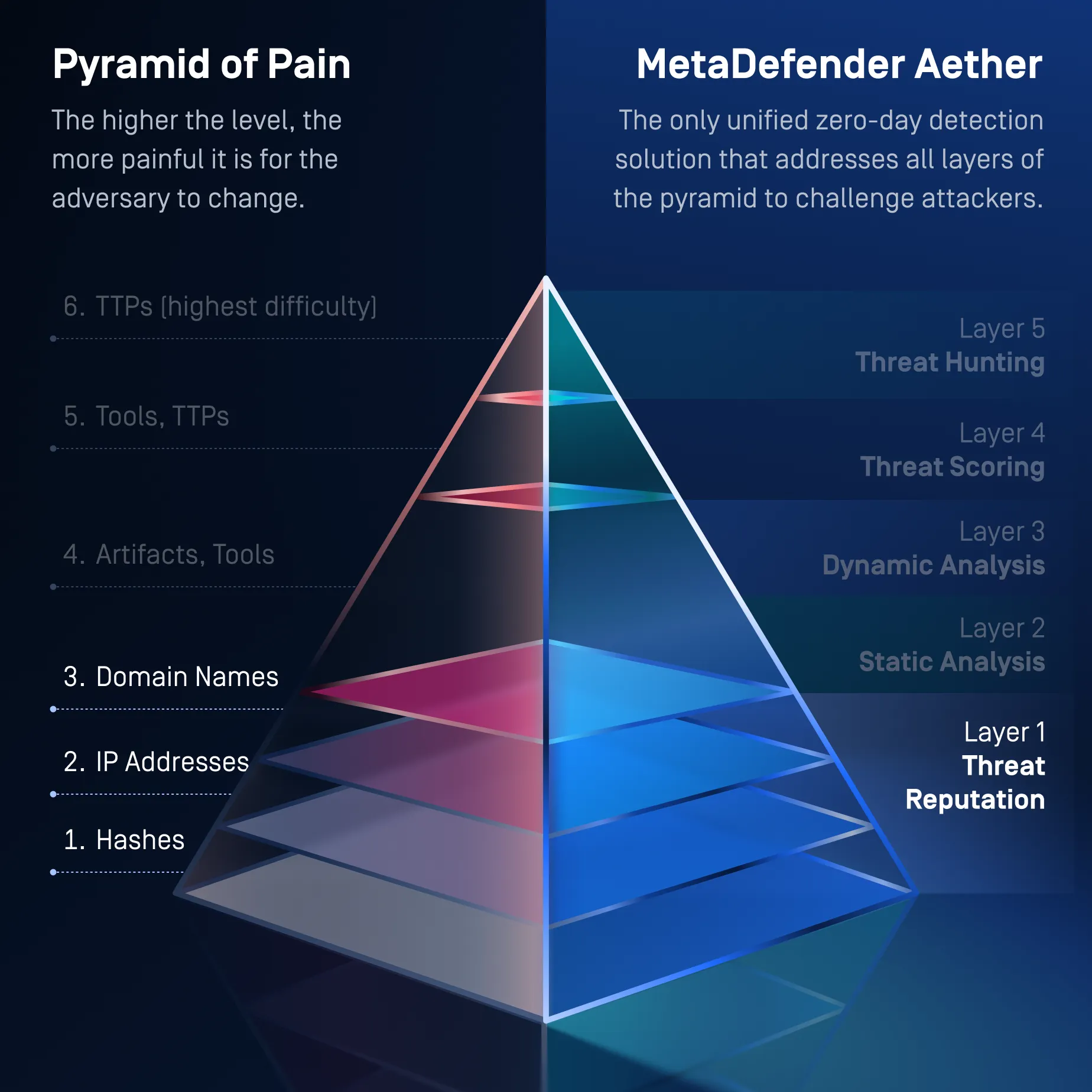
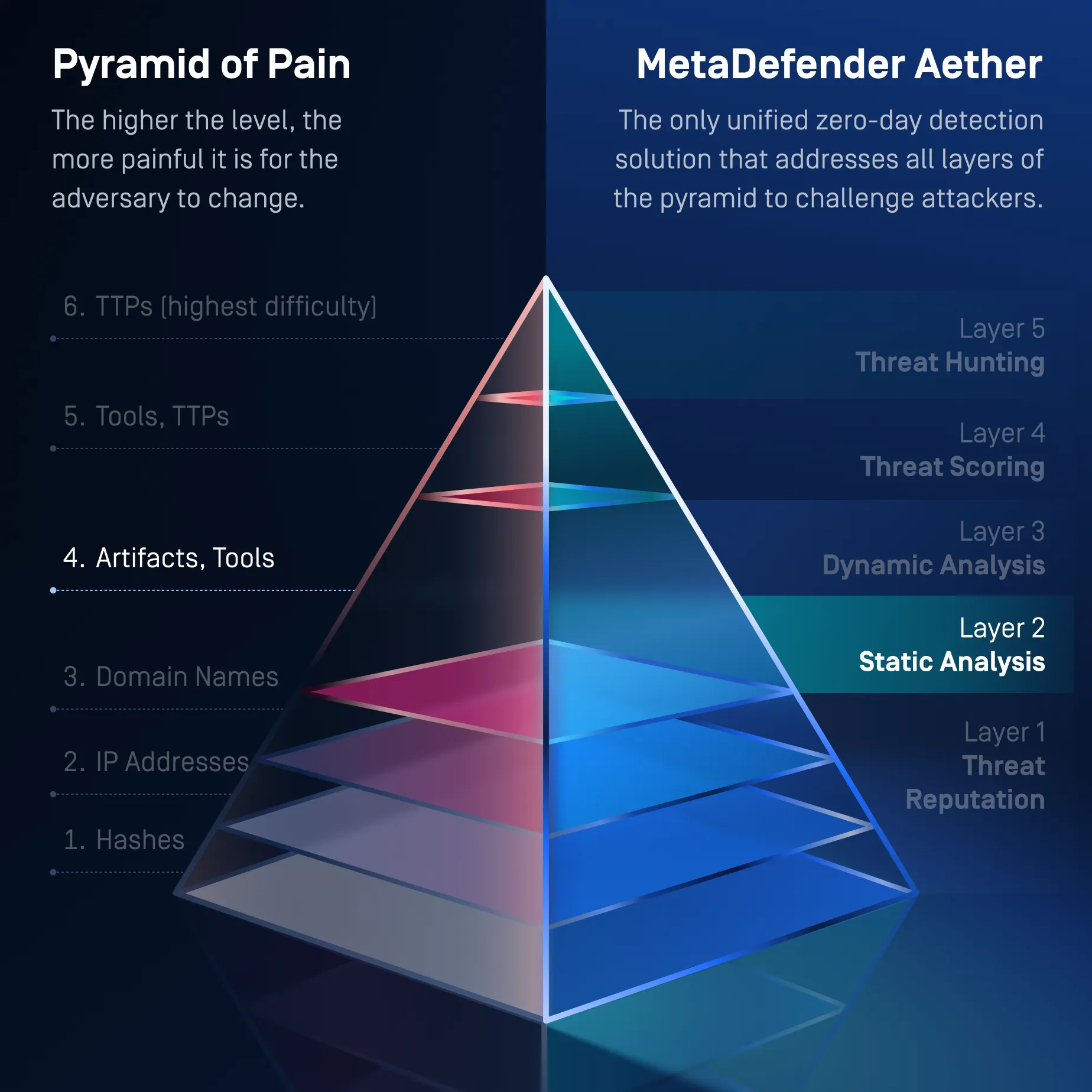
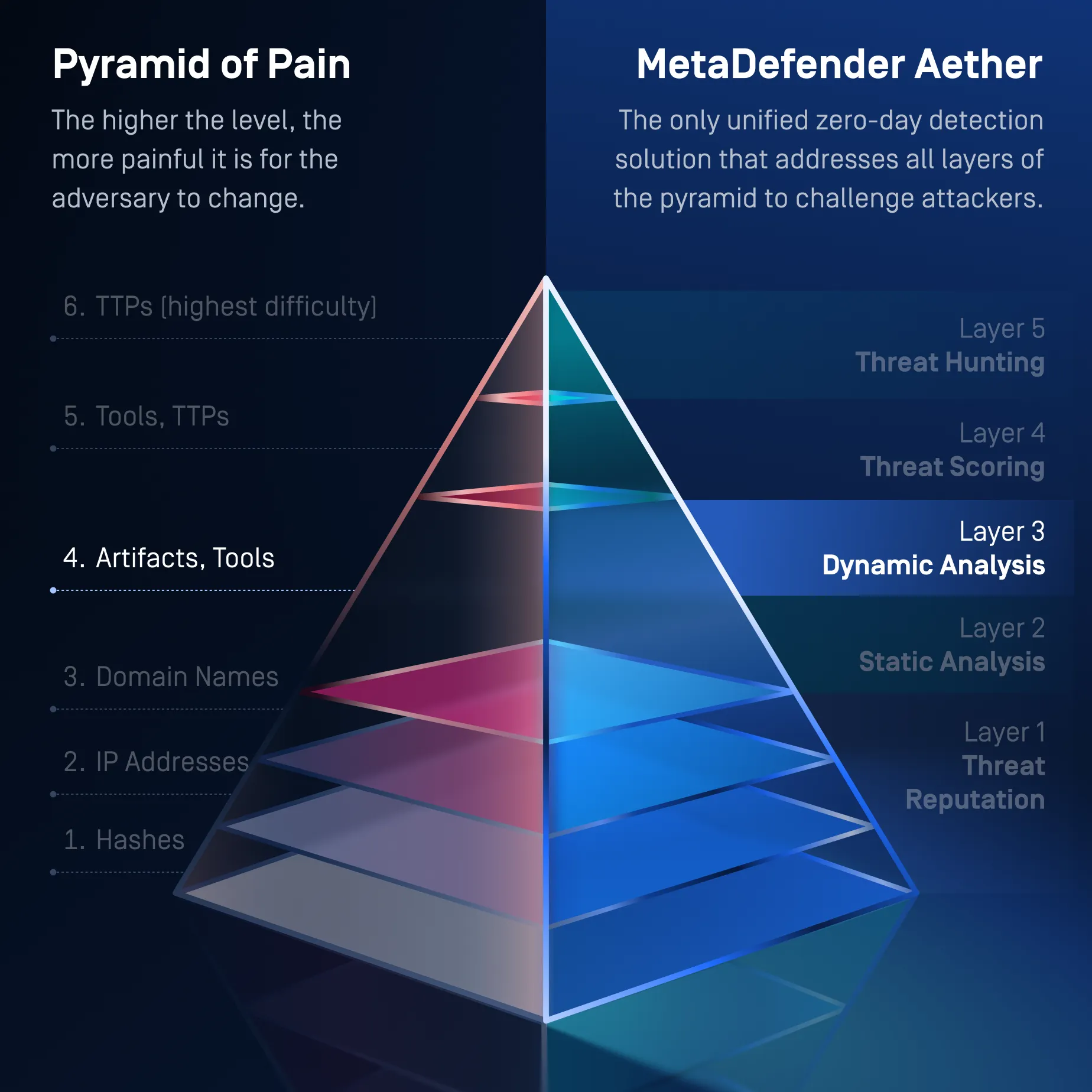
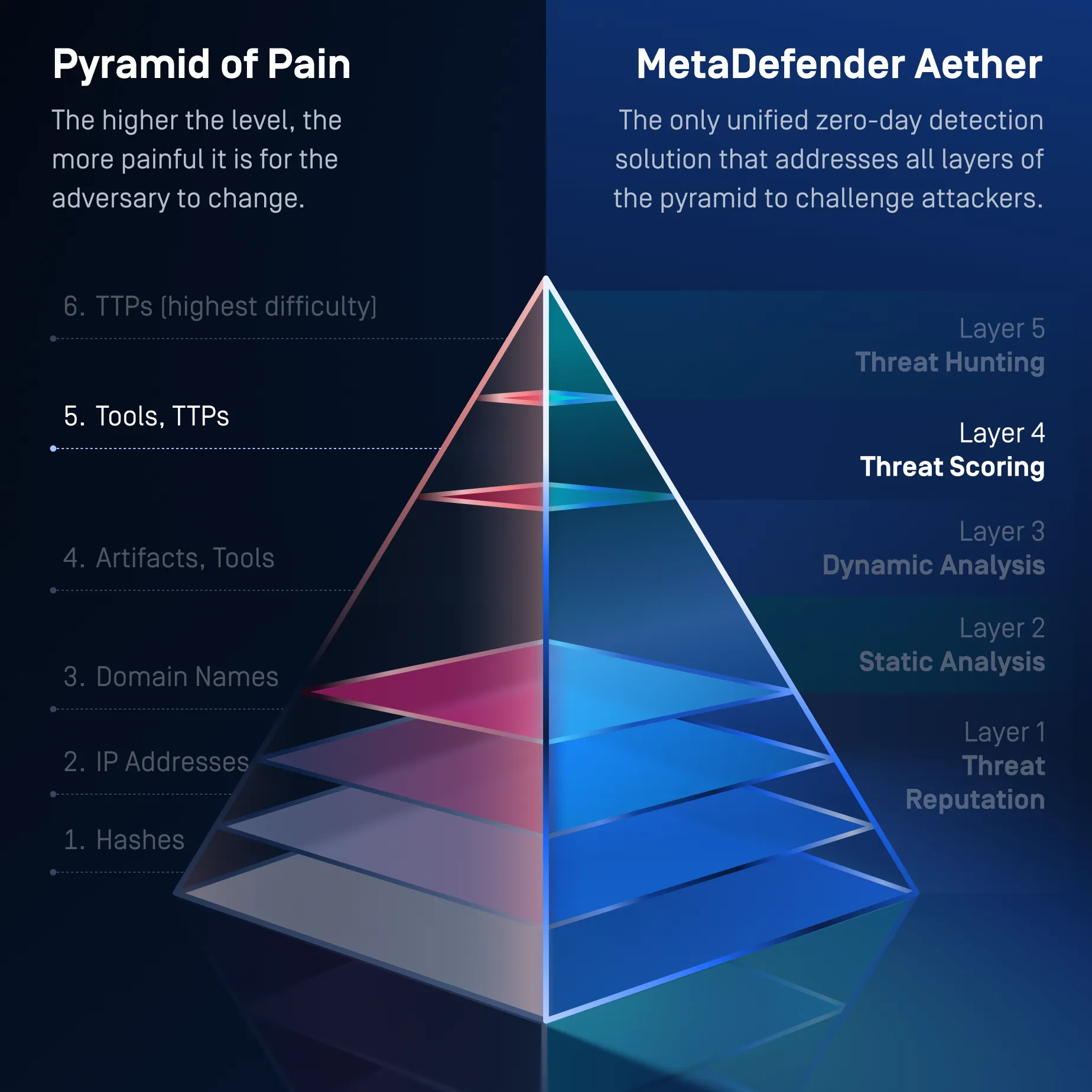
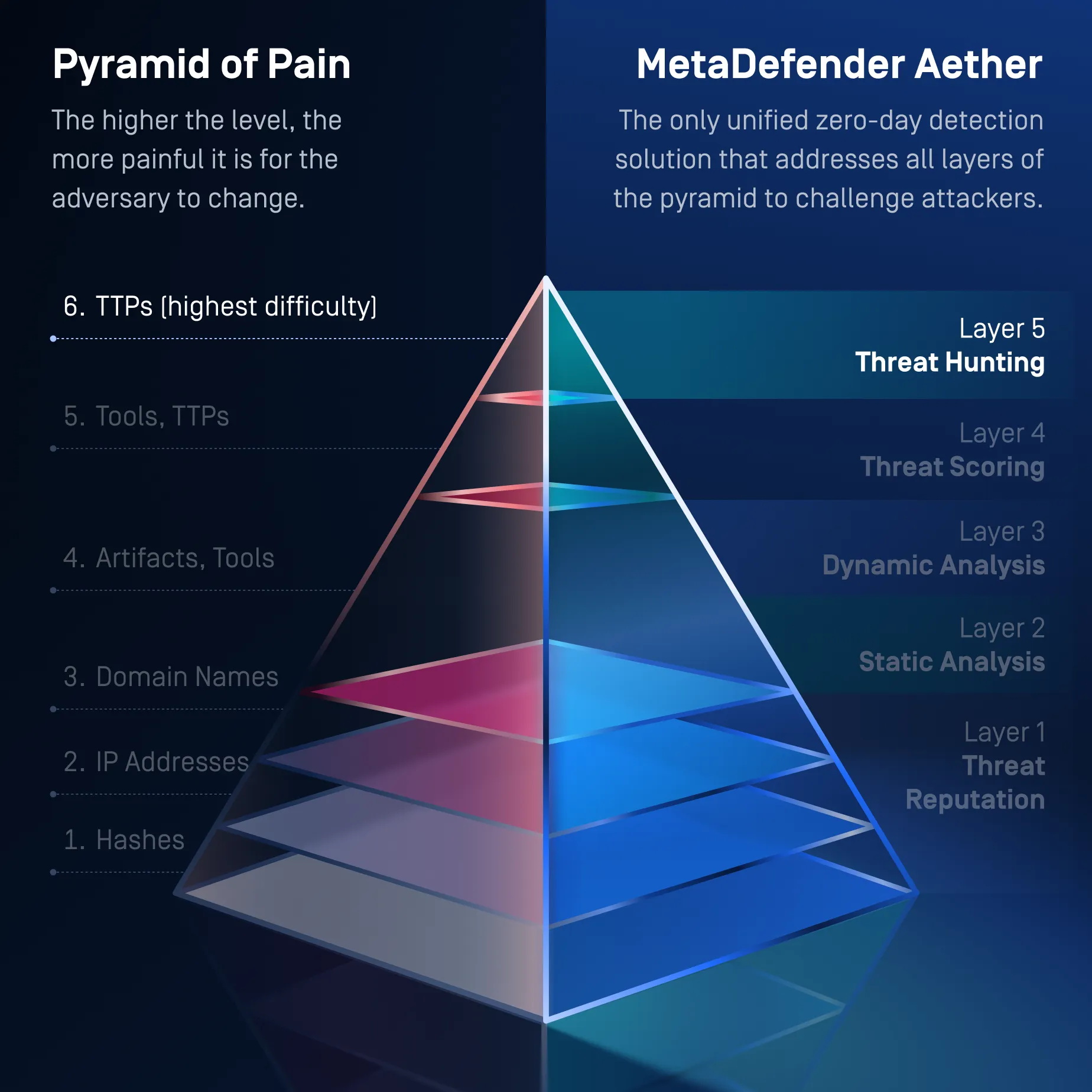
One Solution for the Entire Pyramid of Pain
MetaDefender Aether addresses the whole Pyramid of Pain, from commodity indicators at Level 1 to advanced TTP disruption at Level 6, forcing attackers to continually rewrite their infrastructure, tools, & behaviors in order to evade detection.
Pyramid Levels 1,2, and 3
Hashes, IP addresses, and domains
- How Layer 1 Disrupts Attacks
- Hash lookups identify reused malware binaries.
- URL, domain, and IP reputation block known malicious infrastructure.
- Brand detection and ML-based URL classification identify phishing infrastructure.
- Online and offline reputation checks stop known threats before deeper analysis.
- New indicators discovered by later Aether layers continuously strengthen reputation intelligence.
- How It Applies Pressure to Attackers
- Forces attackers to rotate infrastructure and delivery domains.
- Makes reused malware hashes and indicators ineffective.
- Breaks automated phishing, malware distribution, and botnet workflows.
- Increases the cost of maintaining disposable attack infrastructure.
Pyramid Level 4
Network and host artifacts, tools
- How Layer 2 Disrupts Attacks
Predictive Alin AI analyzes structural, behavioral, and object-level file features without executing the file.
- Identifies suspicious code structures, embedded objects, scripts, imports, and payload characteristics.
- Predicts malicious intent in milliseconds without signatures or detonation.
- Detects never-before-seen and polymorphic threats before they run.
- Stops files before they can create registry changes, dropped files, process injections, or C2 connections.
- Escalates uncertain files to Dynamic Analysis while reducing unnecessary sandbox demand.
- How It Applies Pressure to Attackers
- Forces attackers to redesign file structures and embedded attack components.
- Makes superficial code changes and signature evasion less effective.
- Detects patterns that remain consistent across recompiled or modified malware.
- Prevents attackers from relying on execution to reveal malicious behavior.
- Raises the cost of producing variants that appear structurally benign.
Pyramid Level 4
Network and host artifacts, tools
- How Layer 3 Disrupts Attacks
Adaptive Sandbox uses instruction-level emulation to analyze suspicious files and force evasive code paths to execute.
It reveals:
- Behavior logs
- Registry changes
- Dropped files
- Process injection
- C2 callbacks
- Loader and script behavior
- Memory-only payloads
- Multi-stage execution chains
- Packers, stagers, and droppers
- Anti-analysis and sandbox-evasion techniques
- How It Applies Pressure to Attackers
- Forces attackers to redesign payloads and loader chains.
- Exposes second-stage artifacts and hidden execution paths.
- Defeats anti-VM, timing, environment, and user-interaction checks.
- Forces attackers to rewrite anti-analysis logic.
- Reveals artifacts and behaviors that static analysis alone cannot confirm.
Pyramid Level 5
Tools and TTPs
- How Layer 4 Disrupts Attacks
Threat Scoring correlates evidence from Threat Reputation, Static Analysis, and Dynamic Analysis to identify malicious intent and prioritize risk.
It evaluates:
- Malicious execution flows
- Loader and injection patterns
- Script obfuscation
- Persistence techniques
- C2 behavior
- Malware family characteristics
- Behavioral indicators
- MITRE ATT&CK and Malware Behavior Catalog mappings
- Relationships between file structure and runtime behavior
- How It Applies Pressure to Attackers
- Forces attackers to modify how their tools behave, not just how files look.
- Makes reused execution patterns easier to detect.
- Exposes malicious intent across multiple weak signals.
- Reduces the effectiveness of minor payload modifications.
- Forces more expensive changes to tool logic and behavioral techniques.
Pyramid Level 6
Tactics, techniques, and procedures
- How Layer 5 Disrupts Attacks
ML-powered similarity search and Threat Pattern Correlation connect unknown threats to related malware, infrastructure, behaviors, and campaigns.
They correlate:
- Malware families
- Recompiled variants
- Polymorphic mutations
- Shared code sections
- Behavioral similarities
- Infrastructure clusters
- Related files and payloads
- Common tactics and techniques
- Campaign-level activity
- How It Applies Maximum Pressure to Attackers
- Detects related attacks even when hashes, payloads, and infrastructure change.
- Connects isolated files to broader attacker operations.
- Exposes repeated tradecraft across malware variants and campaigns.
- Forces attackers to change tools, infrastructure, behavior, and operating methods.
- Makes incremental evasion ineffective, requiring a broader overhaul of the attacker's toolkit and TTPs.
- Threat ReputationLayer 1Breaks commodity attack infrastructure by invalidating reusable indicators
Pyramid Levels 1,2, and 3
Hashes, IP addresses, and domains
- How Layer 1 Disrupts Attacks
- Hash lookups identify reused malware binaries.
- URL, domain, and IP reputation block known malicious infrastructure.
- Brand detection and ML-based URL classification identify phishing infrastructure.
- Online and offline reputation checks stop known threats before deeper analysis.
- New indicators discovered by later Aether layers continuously strengthen reputation intelligence.
- How It Applies Pressure to Attackers
- Forces attackers to rotate infrastructure and delivery domains.
- Makes reused malware hashes and indicators ineffective.
- Breaks automated phishing, malware distribution, and botnet workflows.
- Increases the cost of maintaining disposable attack infrastructure.

- Static AnalysisLayer 2Predicts malicious intent before execution and prevents artifacts from emerging
Pyramid Level 4
Network and host artifacts, tools
- How Layer 2 Disrupts Attacks
Predictive Alin AI analyzes structural, behavioral, and object-level file features without executing the file.
- Identifies suspicious code structures, embedded objects, scripts, imports, and payload characteristics.
- Predicts malicious intent in milliseconds without signatures or detonation.
- Detects never-before-seen and polymorphic threats before they run.
- Stops files before they can create registry changes, dropped files, process injections, or C2 connections.
- Escalates uncertain files to Dynamic Analysis while reducing unnecessary sandbox demand.
- How It Applies Pressure to Attackers
- Forces attackers to redesign file structures and embedded attack components.
- Makes superficial code changes and signature evasion less effective.
- Detects patterns that remain consistent across recompiled or modified malware.
- Prevents attackers from relying on execution to reveal malicious behavior.
- Raises the cost of producing variants that appear structurally benign.
- Dynamic AnalysisLayer 3Forces hidden behavior into view and exposes operational tooling
Pyramid Level 4
Network and host artifacts, tools
- How Layer 3 Disrupts Attacks
Adaptive Sandbox uses instruction-level emulation to analyze suspicious files and force evasive code paths to execute.
It reveals:
- Behavior logs
- Registry changes
- Dropped files
- Process injection
- C2 callbacks
- Loader and script behavior
- Memory-only payloads
- Multi-stage execution chains
- Packers, stagers, and droppers
- Anti-analysis and sandbox-evasion techniques
- How It Applies Pressure to Attackers
- Forces attackers to redesign payloads and loader chains.
- Exposes second-stage artifacts and hidden execution paths.
- Defeats anti-VM, timing, environment, and user-interaction checks.
- Forces attackers to rewrite anti-analysis logic.
- Reveals artifacts and behaviors that static analysis alone cannot confirm.
- Threat ScoringLayer 4Turns multi-layer evidence into a confidence-based risk verdict
Pyramid Level 5
Tools and TTPs
- How Layer 4 Disrupts Attacks
Threat Scoring correlates evidence from Threat Reputation, Static Analysis, and Dynamic Analysis to identify malicious intent and prioritize risk.
It evaluates:
- Malicious execution flows
- Loader and injection patterns
- Script obfuscation
- Persistence techniques
- C2 behavior
- Malware family characteristics
- Behavioral indicators
- MITRE ATT&CK and Malware Behavior Catalog mappings
- Relationships between file structure and runtime behavior
- How It Applies Pressure to Attackers
- Forces attackers to modify how their tools behave, not just how files look.
- Makes reused execution patterns easier to detect.
- Exposes malicious intent across multiple weak signals.
- Reduces the effectiveness of minor payload modifications.
- Forces more expensive changes to tool logic and behavioral techniques.
- Threat HuntingLayer 5Connects isolated detections to malware families, campaigns, and attacker tradecraft
Pyramid Level 6
Tactics, techniques, and procedures
- How Layer 5 Disrupts Attacks
ML-powered similarity search and Threat Pattern Correlation connect unknown threats to related malware, infrastructure, behaviors, and campaigns.
They correlate:
- Malware families
- Recompiled variants
- Polymorphic mutations
- Shared code sections
- Behavioral similarities
- Infrastructure clusters
- Related files and payloads
- Common tactics and techniques
- Campaign-level activity
- How It Applies Maximum Pressure to Attackers
- Detects related attacks even when hashes, payloads, and infrastructure change.
- Connects isolated files to broader attacker operations.
- Exposes repeated tradecraft across malware variants and campaigns.
- Forces attackers to change tools, infrastructure, behavior, and operating methods.
- Makes incremental evasion ineffective, requiring a broader overhaul of the attacker's toolkit and TTPs.
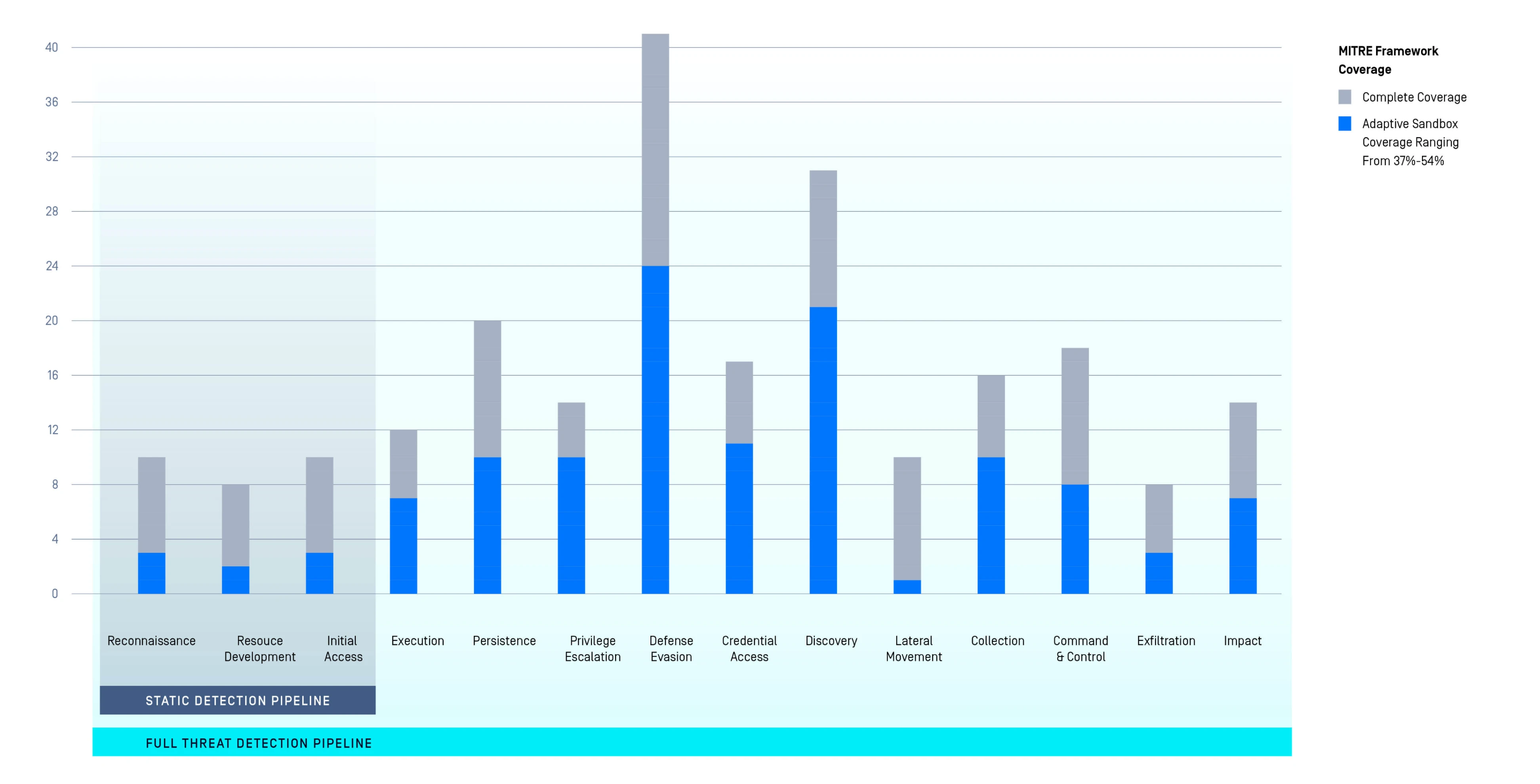
MetaDefender Aether's Impact on
the MITRE ATT&CK Framework
- Layered visibility across the entire attack chain.
- Pre-execution (static) & runtime (dynamic analysis) detection mapped to MITRE Tactics.
- +60% additional detection coverage.
“Fastest Speed We’ve
Ever Tested.”
Venak Security
330+
Detectable Brands
for ML-Based
Phishing Detection
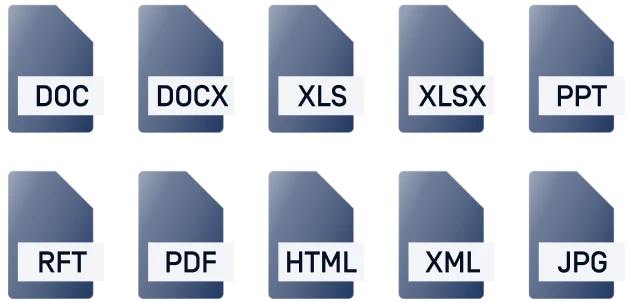
120+
File Types
Extract artifacts,
images, & more
>14
Automated Malware Family Extraction
Integrate Easily
We stop the attacks that no one knows exist
40x
Faster than Traditional Solutions
MetaDefender Aether Features
The table below highlights the core capabilities of the MetaDefender Aether engine.
To explore how these features work together in real-world deployments, contact us to schedule a technical presentation.
MetaDefender Aether Integrations
| Implementation | Appliance | |
|---|---|---|
| Integration | API & Web Interface Integration |
|
| Email Integrations & Format Support |
| |
| Security Orchestration, Automation, and Response (SOAR) Integrations |
| |
| SIEM Integrations | Common Event Format (CEF) Syslog Feedback | |
| Deployment | OPSWAT Threat Detection & Prevention Platform |
|
| Report Format/ Data Export | Report Formats |
|
| Scripting & Automation Tools | Python |
|
MetaDefender Aether Reports
Overview of our cybersecurity software's capabilities, including sample analysis, malware family decoding, disassembly unpacking, similarity search, and more.
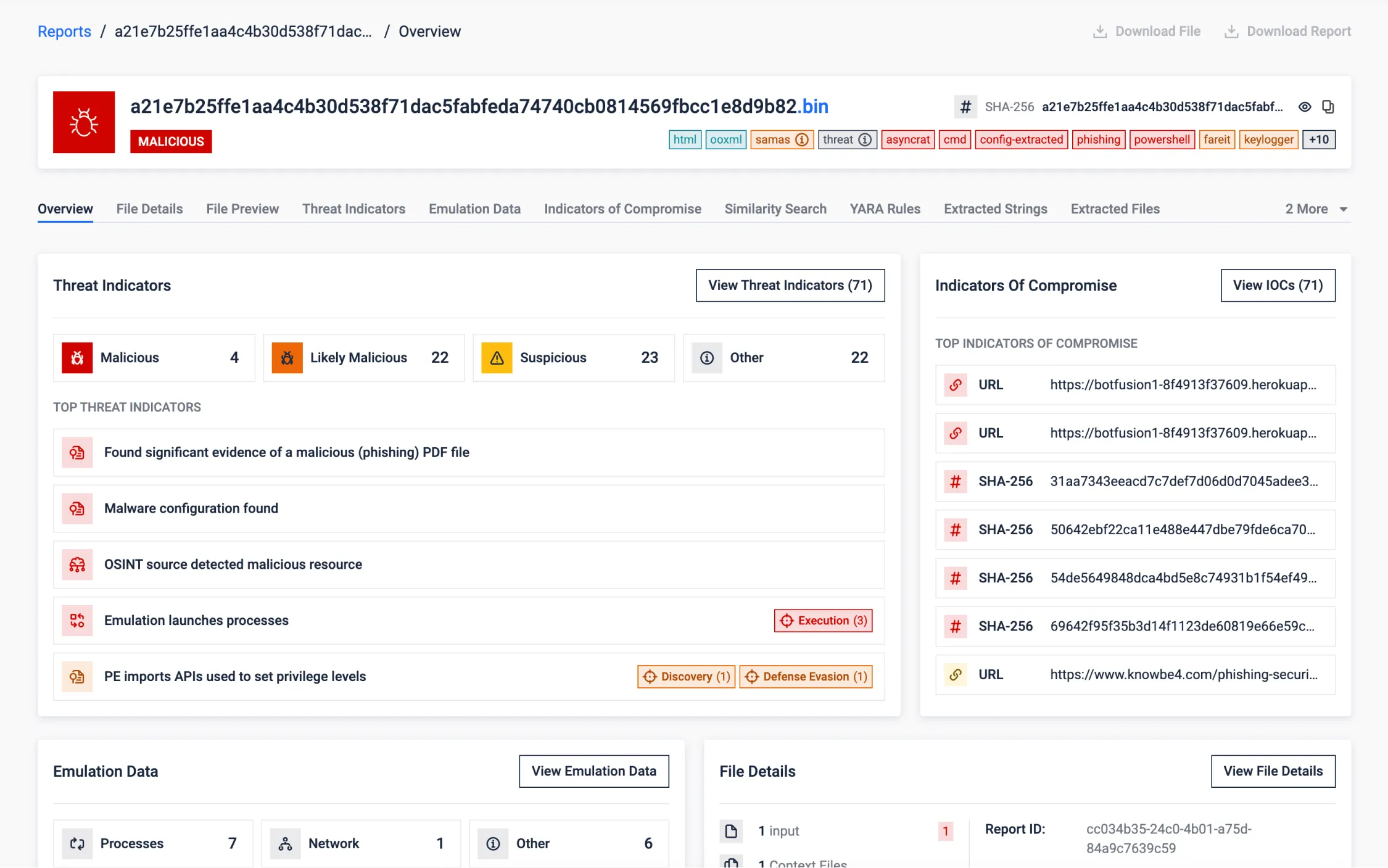
Synthetic (Fabricated) Sample
This sample stands as a purpose-built example to highlight the diverse capabilities of MetaDefender Aether (previously known as OPSWAT Filescan Sandbox).
Crafted to show-off real-world cyber threats, embedding multiple files and file-types into each other. This effectively demonstrates our solution's prowess in adaptive threat analysis, behavioral analysis, and advanced security measures.
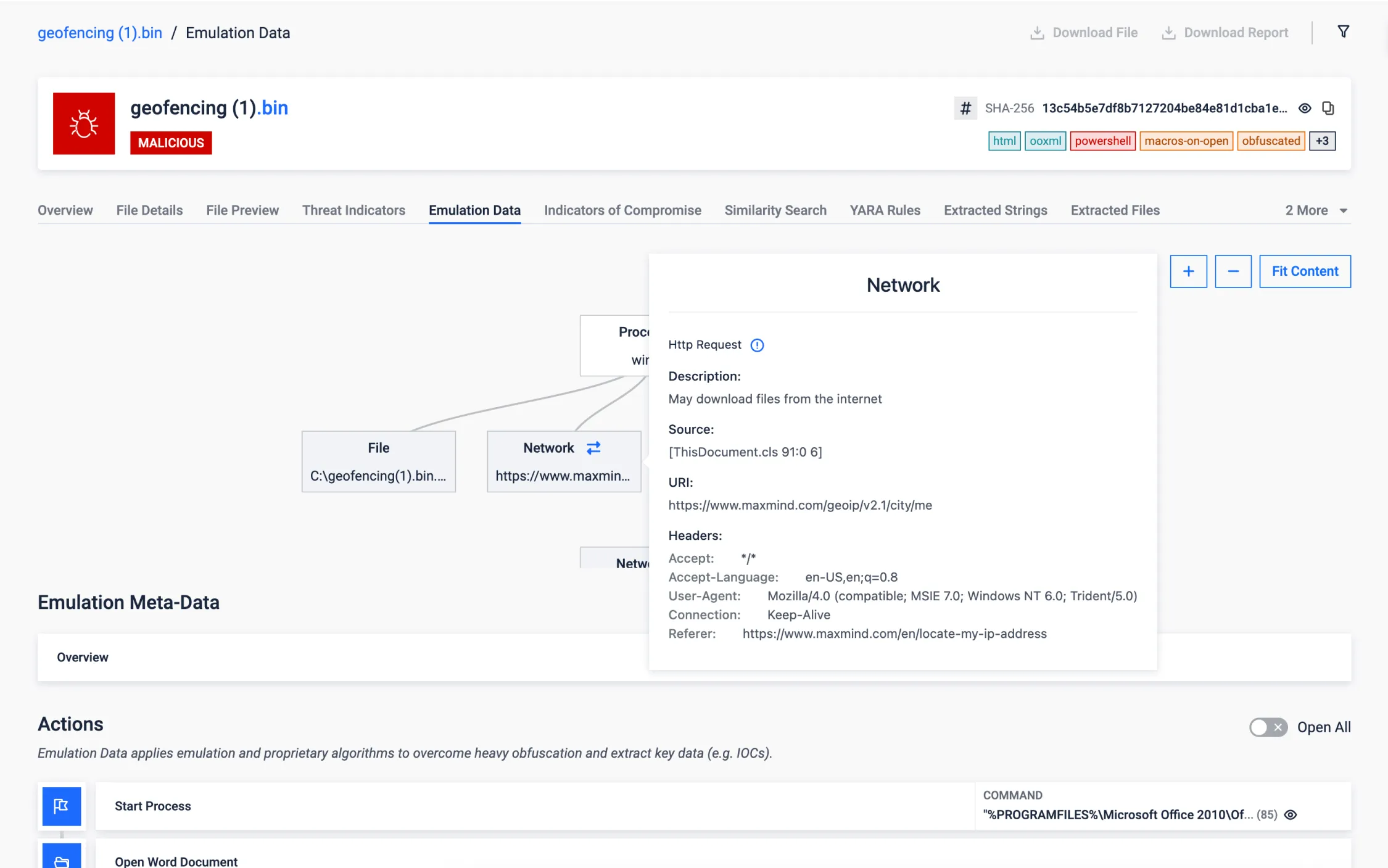
Geofencing
Malware documents employing geofencing have become a significant threat to cybersecurity. These malicious files often employ location-based triggers, making detection and mitigation a challenging task. However, Adaptive Threat Analysis stands out from traditional approaches by offering the capability to accurately emulate and falsify the expected geolocation values, effectively neutralizing the tactics employed by malware, thus enhancing our ability to protect against such threats.
In the sample provided below, we can observe a geofencing malware attempting to execute exclusively within a specific country. However, our innovative solution successfully bypasses this restriction, as previously mentioned, by emulating the desired geolocation values, demonstrating our superior capability in countering such geofencing-based threats.
Phishing Detection
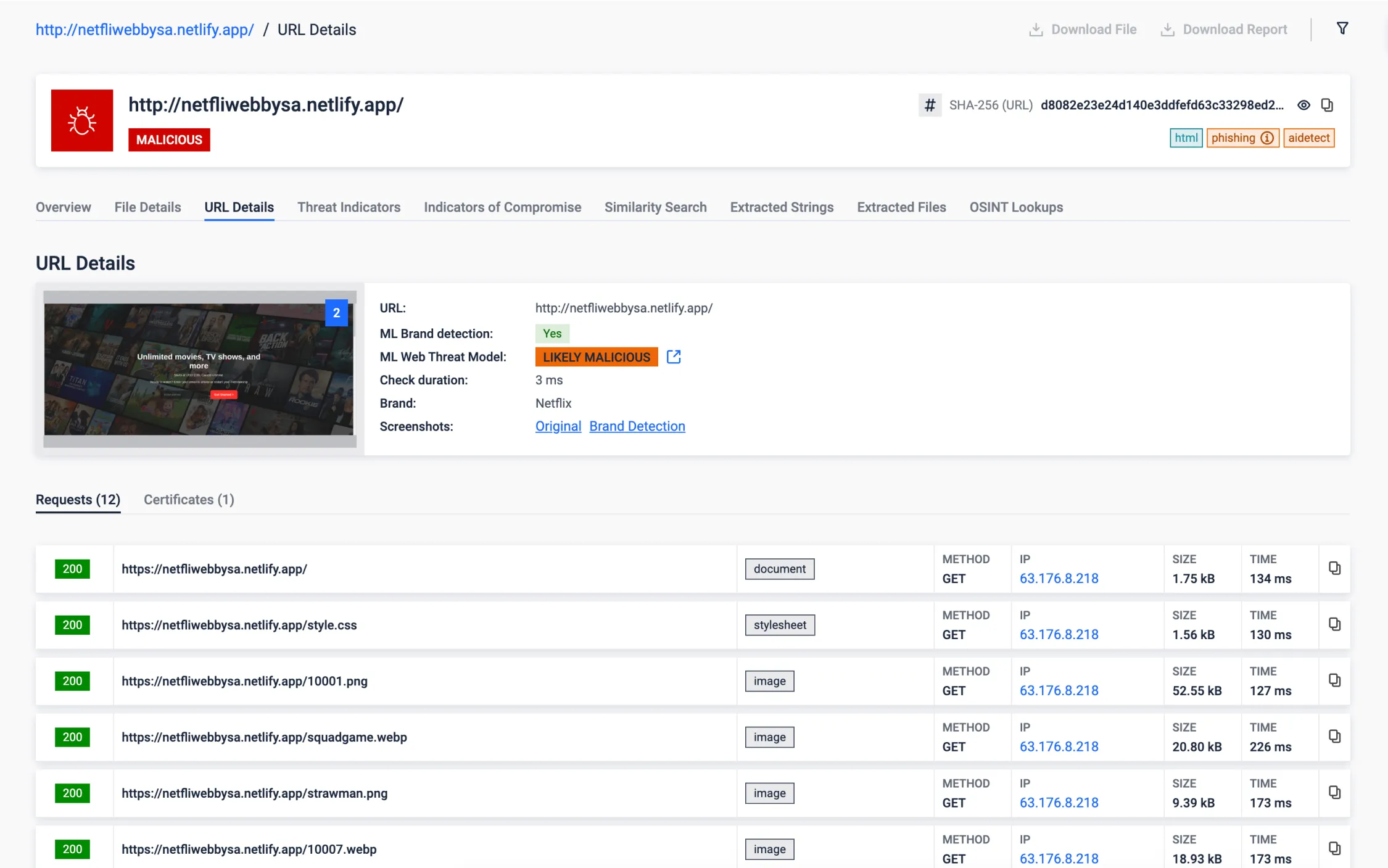
- Brand Detection: By rendering suspicious websites and subjecting them to our advanced machine learning engine we're capable of identifying nearly 300 brands. In the example provided below, you can witness a website masquerading as a streaming company known as Netflix. Our solution excels in comparing the site's content to the genuine URL, swiftly identifying such fraudulent attempts to safeguard your digital assets and personal information. Learn more.
- AI-driven analysis: We have an AI-driven solution analyzing the network traffic, structural and textual content of the rendered page. Verdict of the joint model outcome can be seen after 'ML Web Threat Model'.
Offline URL Reputation
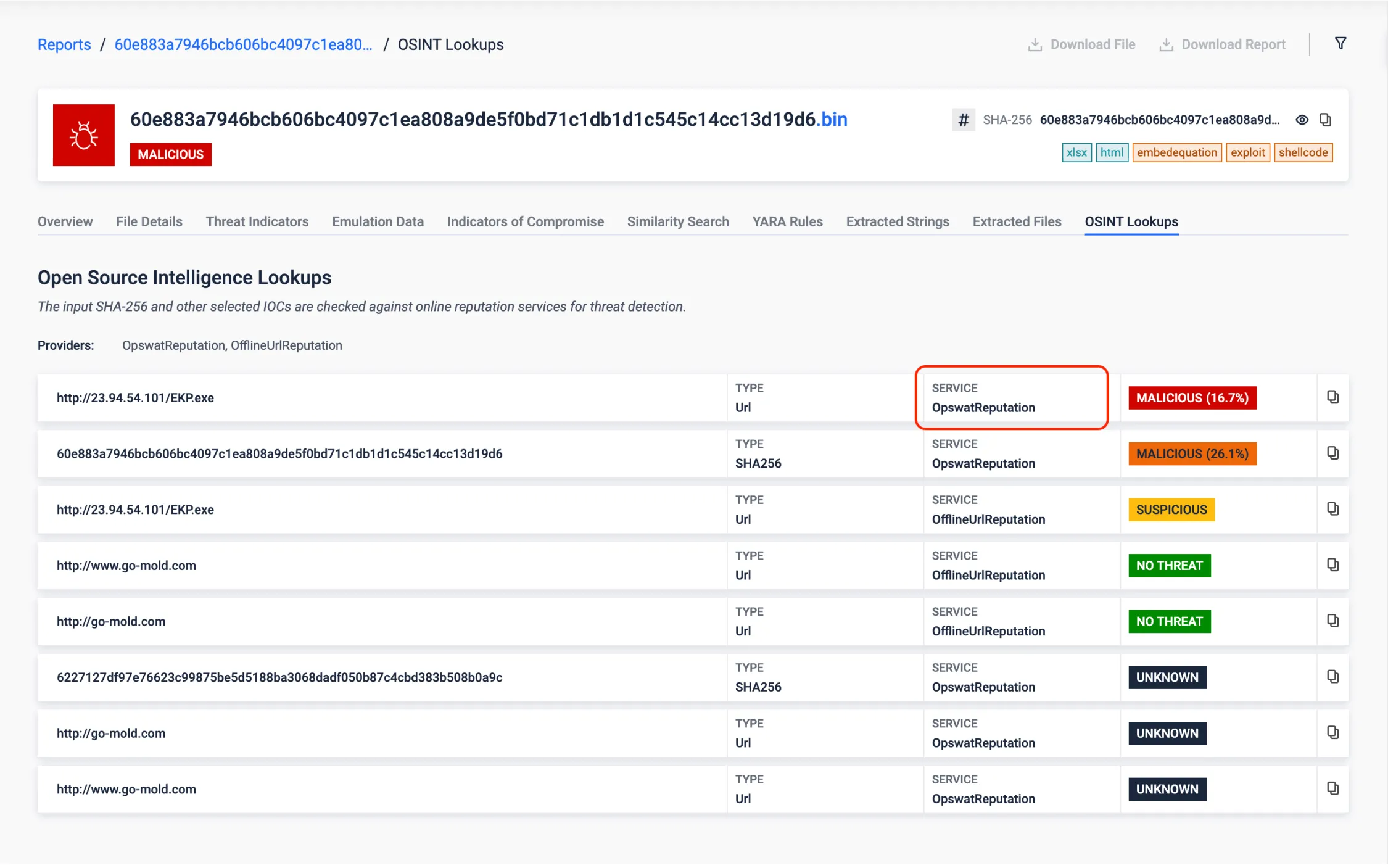
The offline URL detector ML model provides a new layer of defense by effectively detecting suspicious URLs, offering a robust means to identify and mitigate threats posed by malicious links. It leverages a dataset containing hundreds of thousands of URLs, meticulously labeled as either no threat or malicious by reputable vendors, to assess the feasibility of accurately detecting suspicious URLs through machine learning techniques.
It is important to note that this feature is particularly useful in air-gapped environments where online reputation lookups are not available.
Malware Config Extraction of a Packed Sample
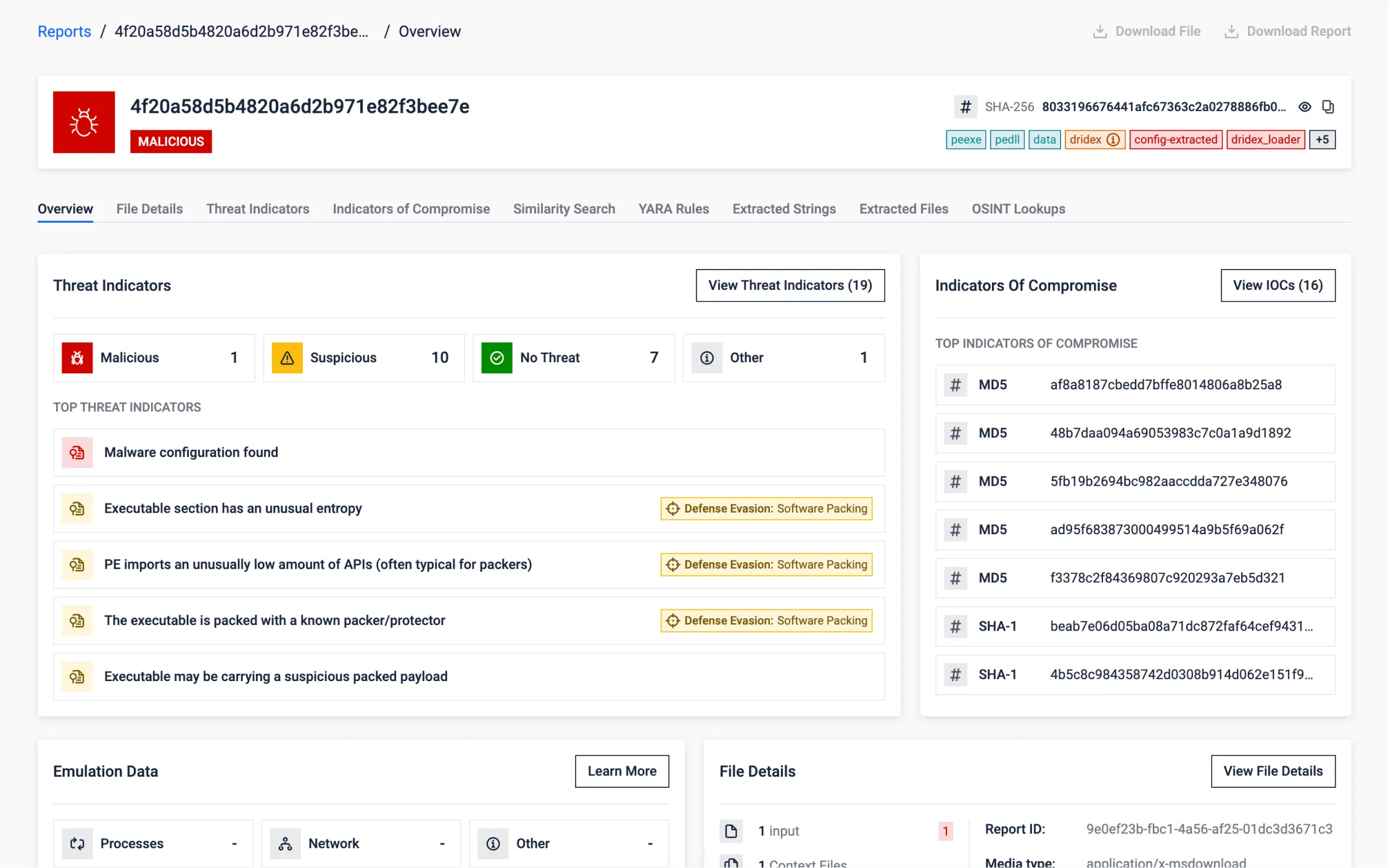
The sample below reveals a malware that was packed using the UPX packing technique. Despite its attempt to evade detection and defenses, our analysis successfully unpacked the payload, exposing its true identity as a Dridex Trojan. We were able to uncover the malware configuration, shedding light on the malicious intent behind this threat, extracting valuable IOCs.
Similarity Search
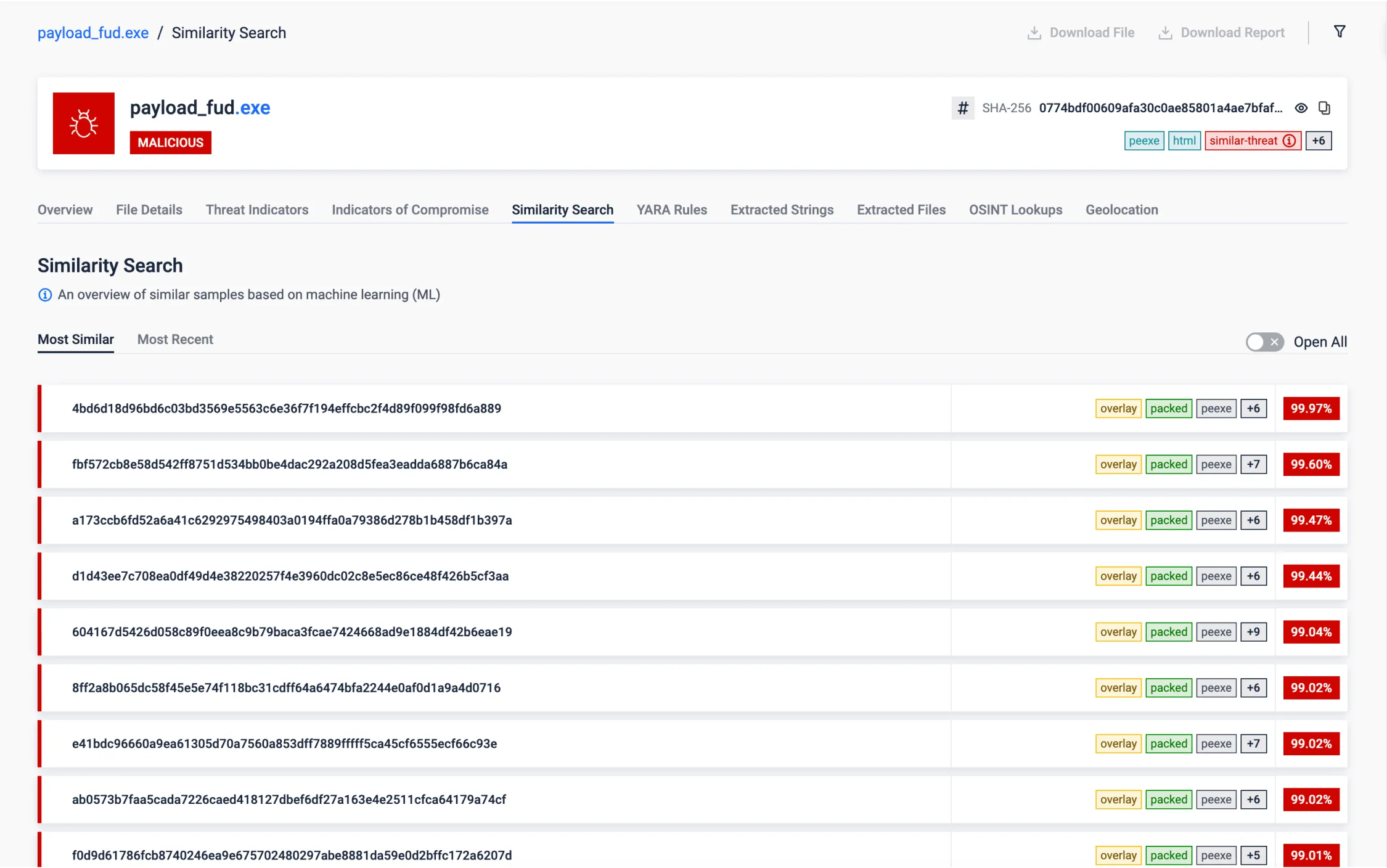
Employing Similarity Search functionality, sandbox has detected a file remarkably resembling a known malware. Notably, this file had been previously marked as non-malicious, revealing the potential for false negatives in our security assessments. This discovery empowers us to specifically target and rectify these overlooked threats.
It is important to highlight that Similarity Search is highly valuable for threat research and hunting, as it can help uncover samples from the same malware family or campaign, providing additional IOCs or relevant information about specific threat activities.
Native Executable
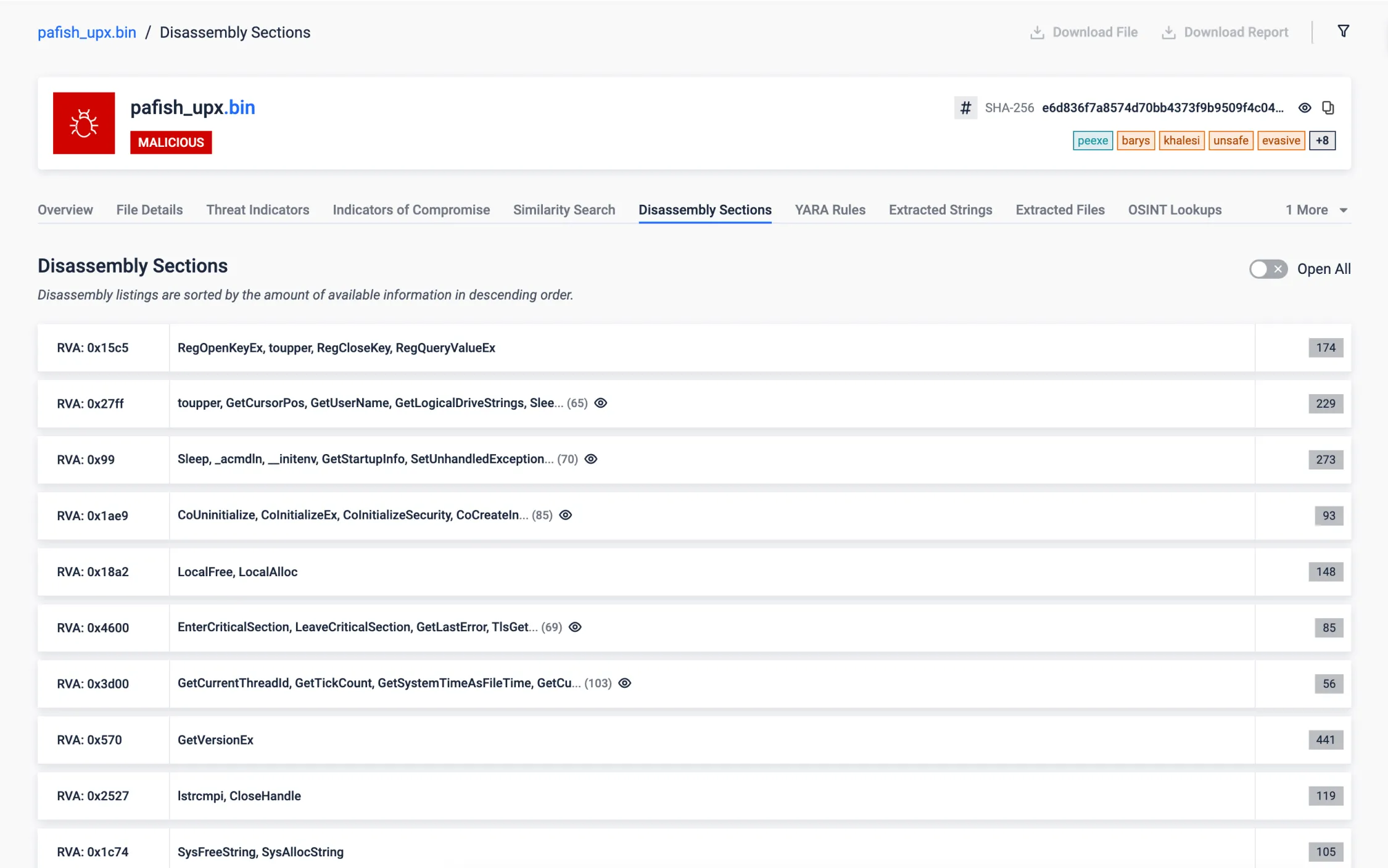
Our disassembling engine revealed intriguing findings within the target sample. Surprisingly, this sample monitors the system time using the uncommon <rdtsc> instruction and accesses an internal, undocumented structure in Windows, commonly used for different malicious tricks. These unusual actions raise questions about its purpose and underscore the need for further investigation to assess potential risks to the system.
.NET Executable
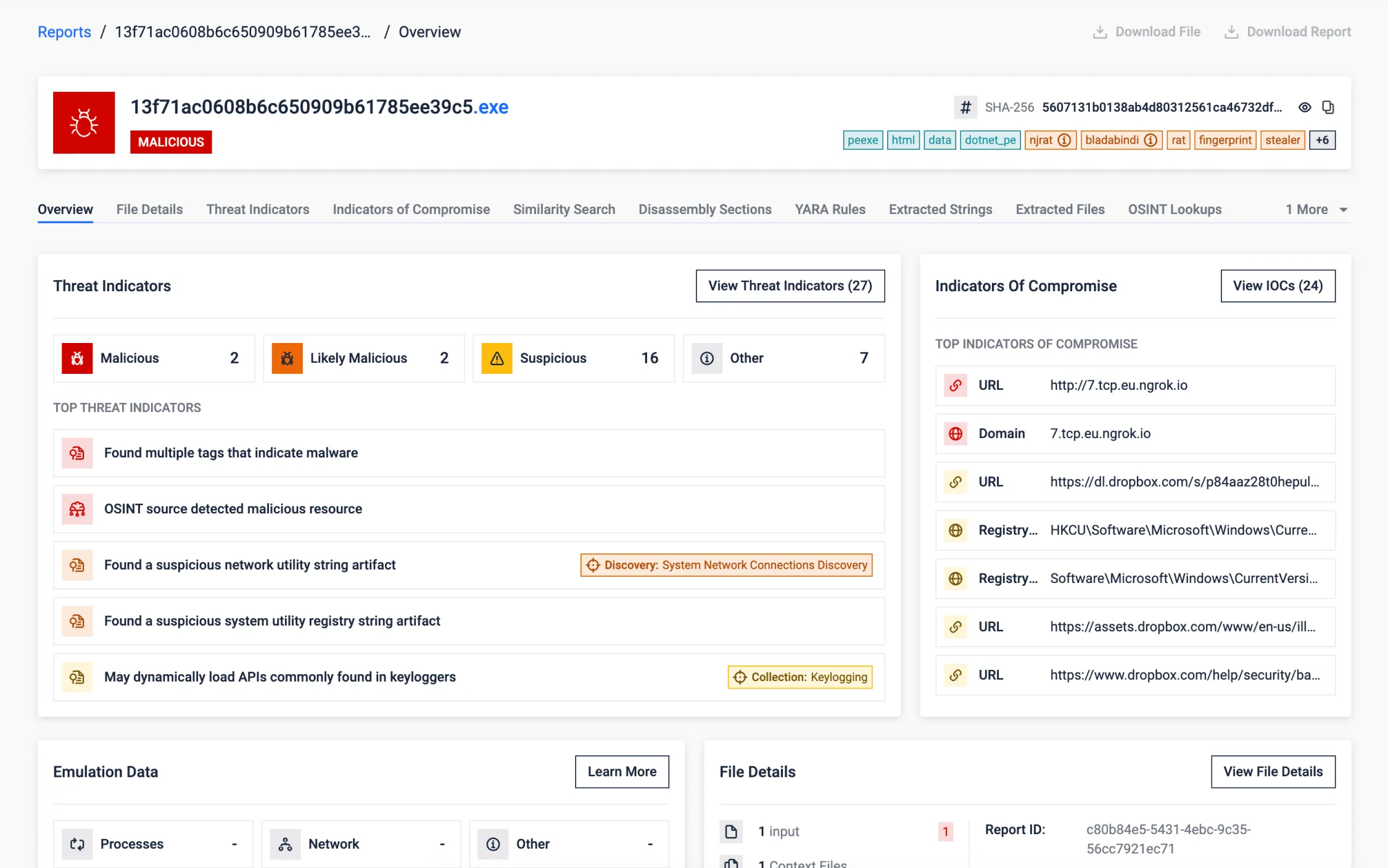
The sample under examination was built using .NET framework. While we refrain from displaying the actual CIL, our decompilation process extracts and presents noteworthy information, including strings, registry artifacts, and API calls.
Besides that, we parse the .NET metadata to identify .NET-specific functions and resources. This process allows to extract detailed information about the assembly, such as methods, classes, and embedded resources, which is critical for analyzing the behavior and structure of .NET applications.
Shellcode Emulation
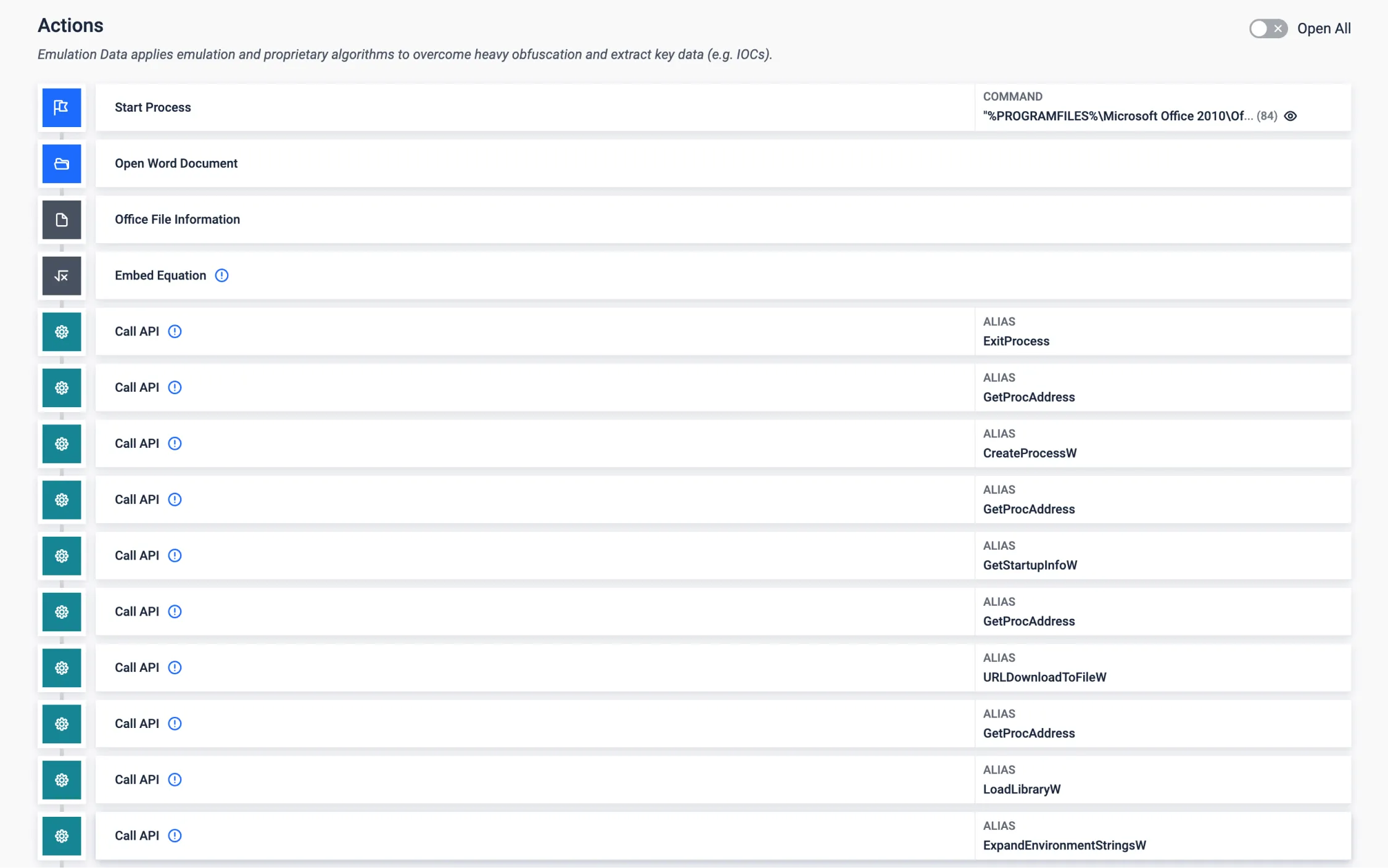
Many application exploits bring their final payload in raw binary format (shellcode), which might be an obstacle when parsing the payload. With our shellcode emulation we are able to discover and analyse the behaviour of the final payload, in this example for a widely leveraged Office vulnerability in the equation editor. Hence opening the door to gathering the relevant IOCs.
Highly Obfuscated VBA Macro
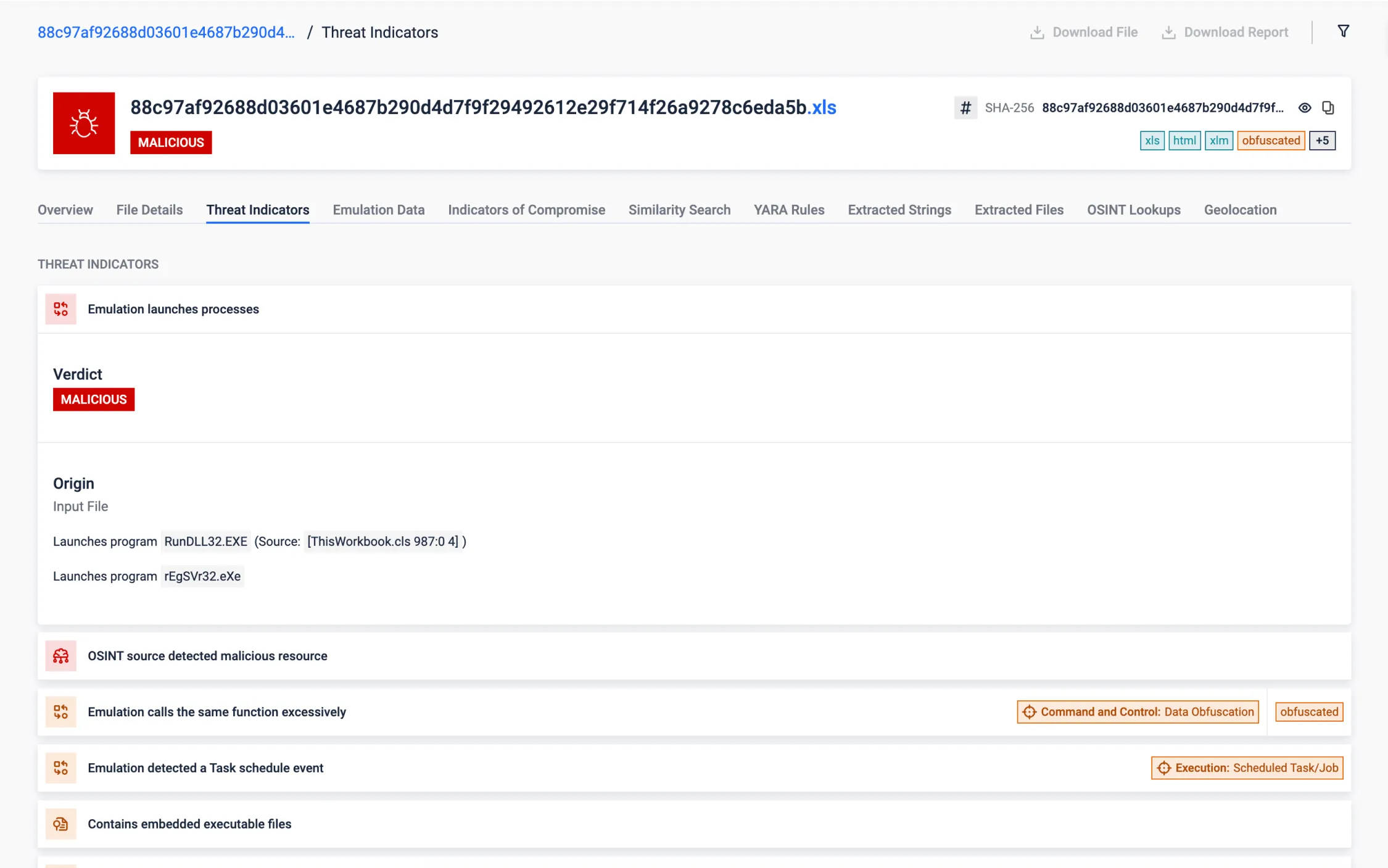
Obfuscated VBA macros present a significant challenge to deliver a reasonable response time of active threats. This unclear code makes the analysis and understanding of threats a high complex task that demands a lot of time and efforts. Our cutting-edge VBA emulation technology is able to overcome these challenges and provides a comprehensive analysis of obfuscated VBA macro together with clear insights into its functionality in seconds.
The analyzed sample is an Excel document with highly obfuscated VBA code that drops and runs a .NET DLL file, together with a LNK file in charge of continuing the malware execution chain. After VBA emulation, MetaDefender Aether identifies launched processes and the main deobfuscating function, automatically extracts obfuscated strings and saves dropped files (previously hardcoded and encrypted in the VBA code). This rapidly show the main purpose of the malware and give us the possibility of a further analysis of this threat.
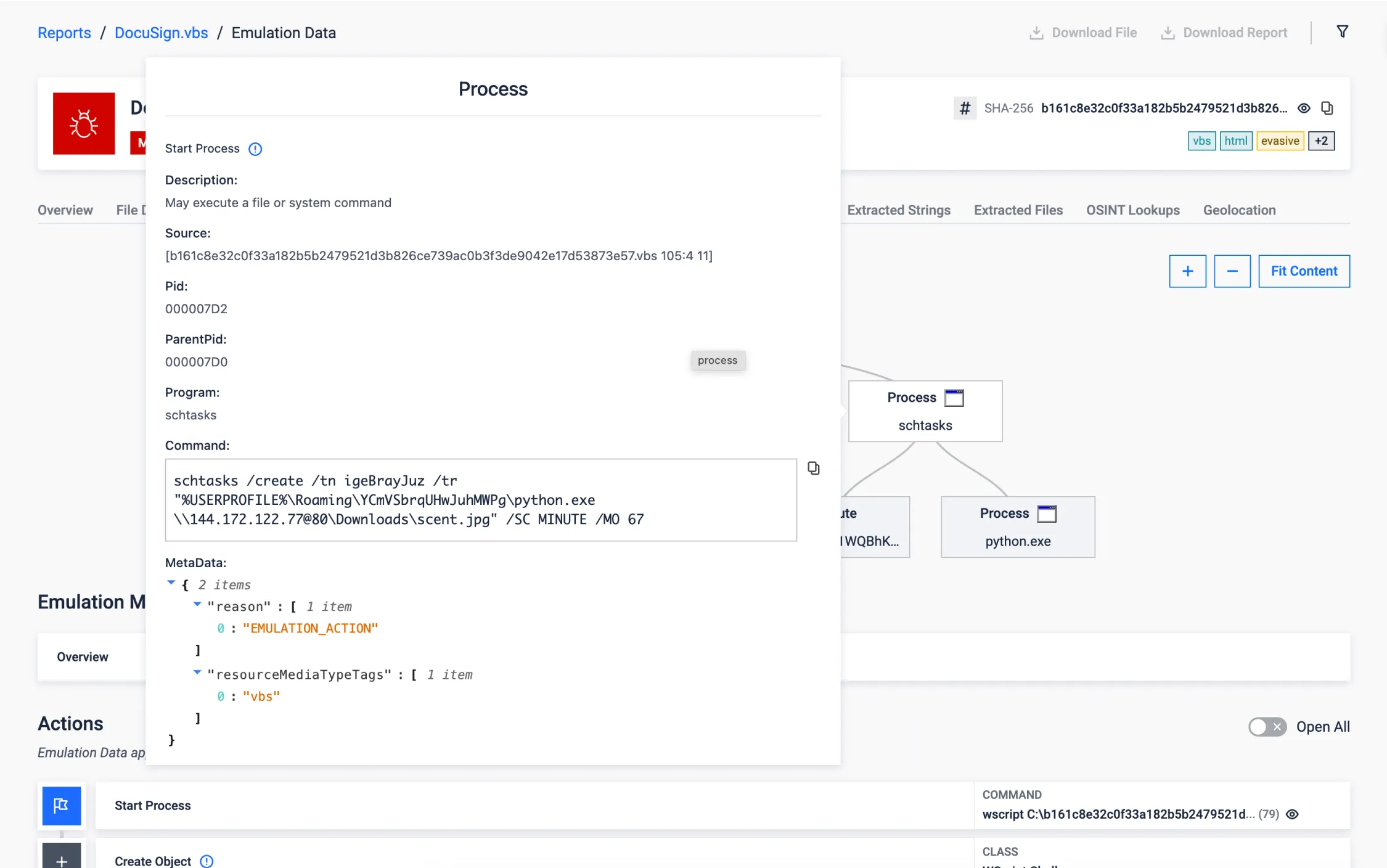
Sandbox Evasion via Task Scheduler
Using Windows Task Scheduler to execute malicious payloads at a later time is a stealthy technique to evade sandbox environments seen in recent threats. It exploits the delay in execution to effectively bypass the short analysis window typical of sandboxes.
The following sample is an obfuscated VBScript that downloads the malicious payload and creates a scheduled task to run it 67 minutes later. Traditional sandboxes maintain the execution for only a few minutes and the malicious behavior would be never exposed. In the other hand, our VBScript emulator is able to detect and overcomes this evasion technique (T1497), adapting the execution environment to continue with further analysis, and getting the full report in 12 seconds.
.NET Reflection
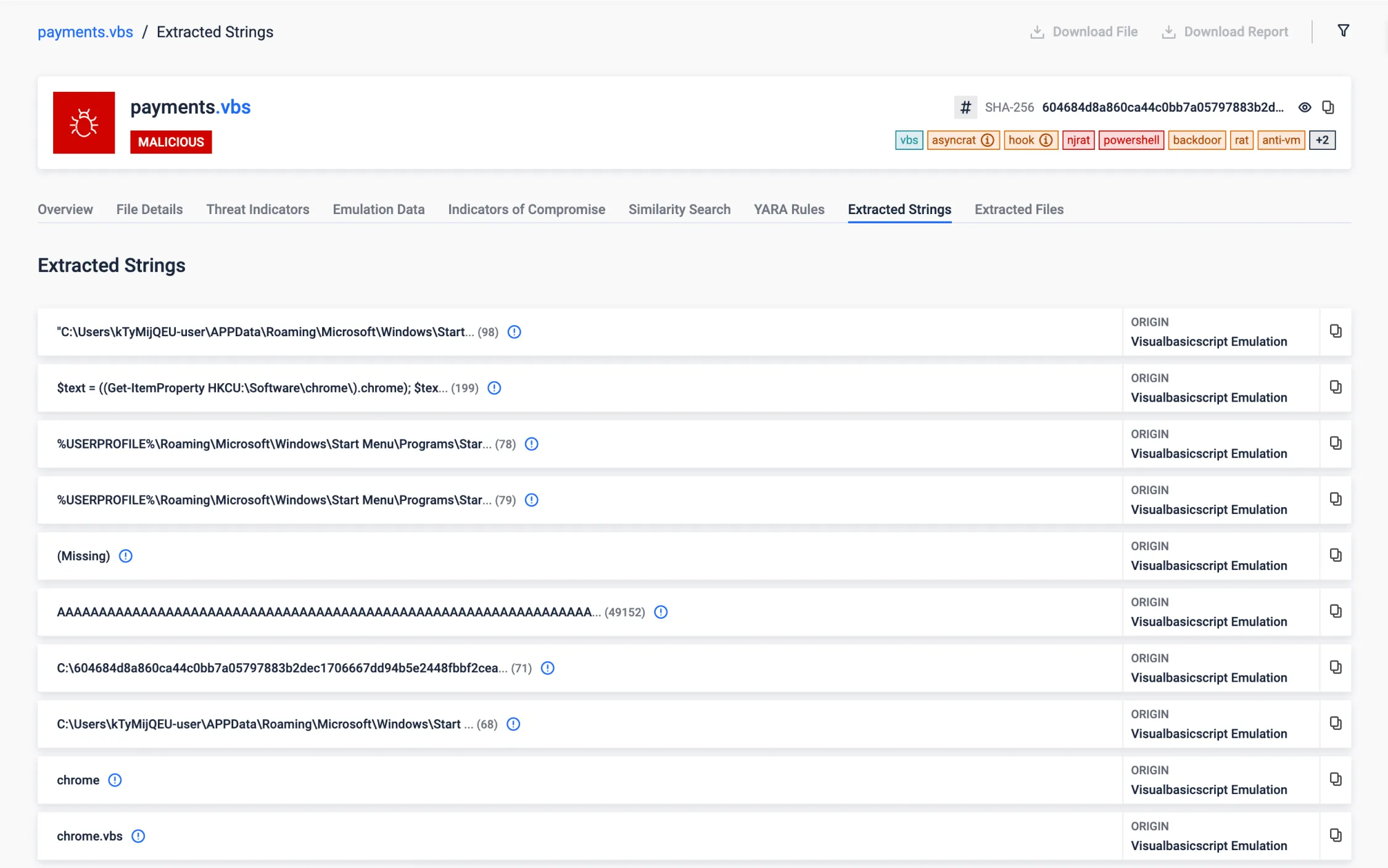
NET Reflection is a powerful feature provided by the .NET framework that allows programs to inspect and manipulate a .NET file structure and behavior at runtime. It enables the examination of assemblies, modules, and types, as well as the ability to dynamically create instances of types, invoke methods, and access fields and properties.
Malware can use reflection to dynamically load and execute code from assemblies that are not referenced at compile time, allowing to fetch additional payloads from remote servers (or hidden in the current file) and execute them without writing them to disk, reducing the risk of detection.
In this case, we can see how the analysed VBScript loads and runs a .NET assembly into memory directly from bytes stored in a Windows register.
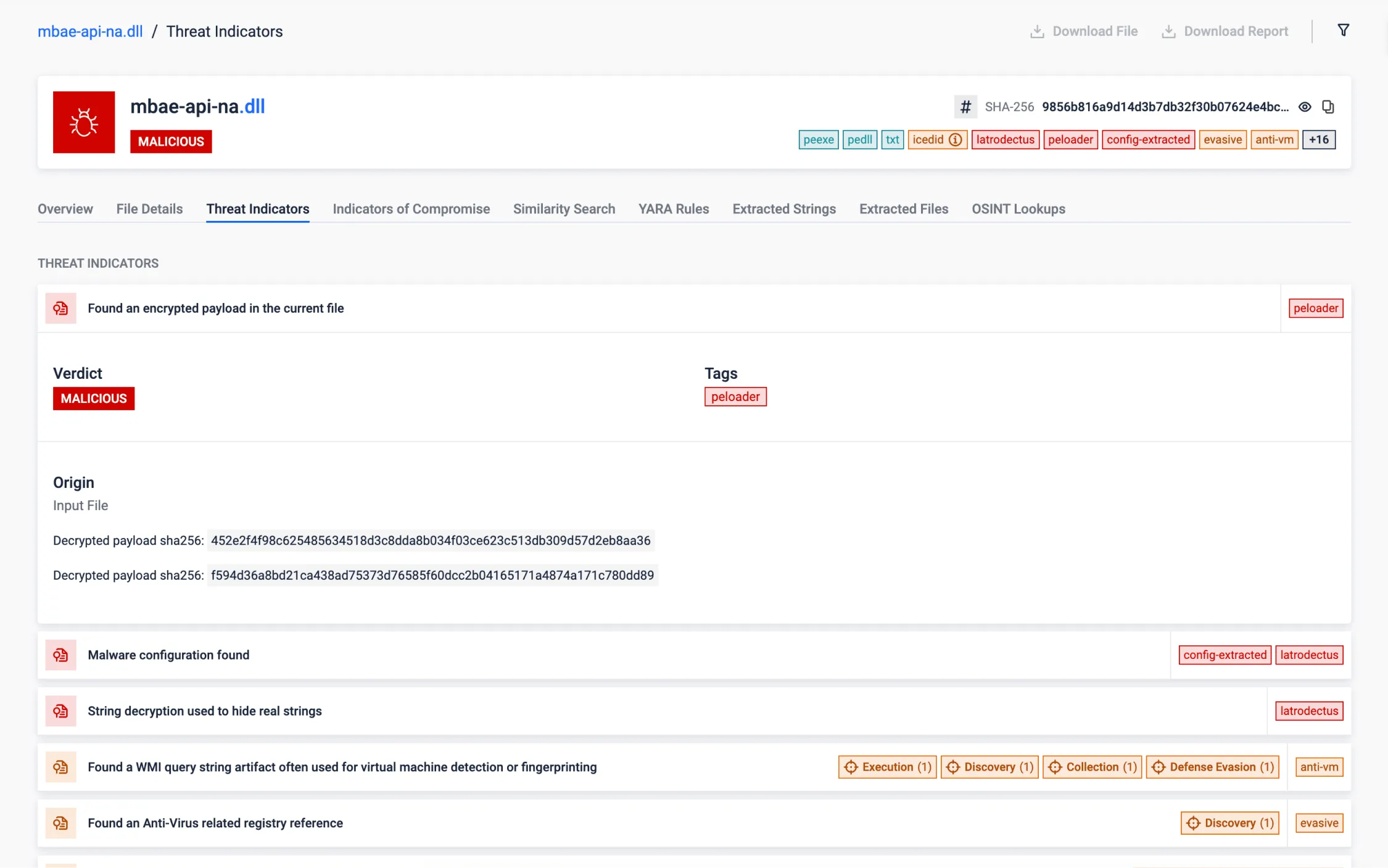
XOR Decrypting Payload Stored in PE Resource
This feature enables to reveal hidden artifacts encrypted within PE resources. Malicious artifacts are often encrypted to evade detection and obscure the true intent of the sample. Uncovering these artifacts is essential, as they typically contain critical data (as C2 information) or payloads. By extracting them, the sandbox can deliver a deeper scan, with higher chance of identifying the most valuable IOCs.
This sample stores that encrypted artifacts using the XOR algorithm, simple but efficient to evade detection. By analyzing patterns in the encrypted data, the encryption key can be guessed, allowing to decrypt the hidden.
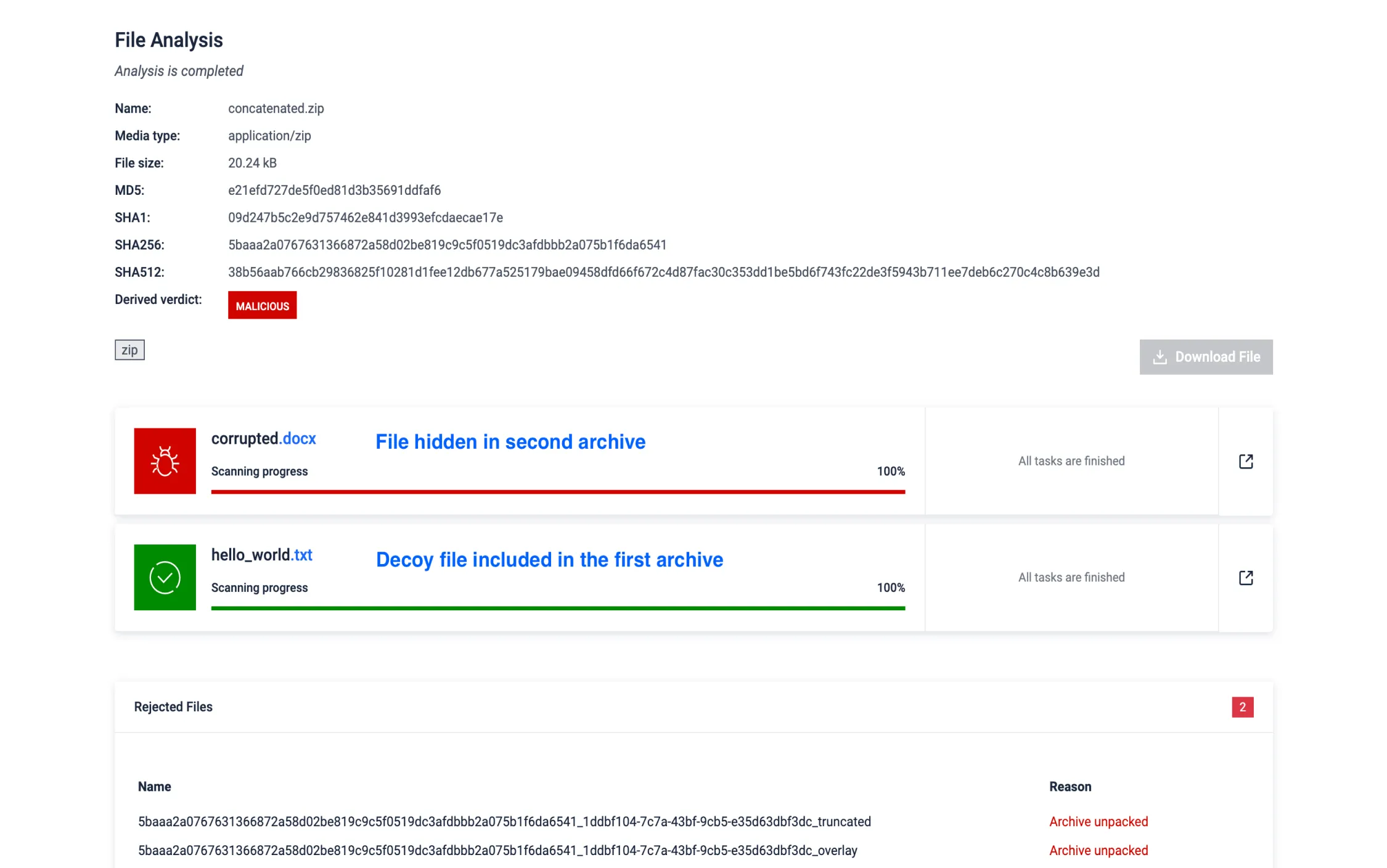
Evasive Archive Concentration
Attackers use archive concatenation to hide malware by appending multiple archives into a single file, exploiting how different tools process them. This technique creates multiple central directories - key structural elements used by archive managers - causing discrepancies during extraction and enabling the bypass of detection for malicious content hidden in overlooked parts of the archive.
MD Sandbox detects and extracts content from all concatenated archives, ensuring no file is missed and effectively neutralizing this evasive technique.
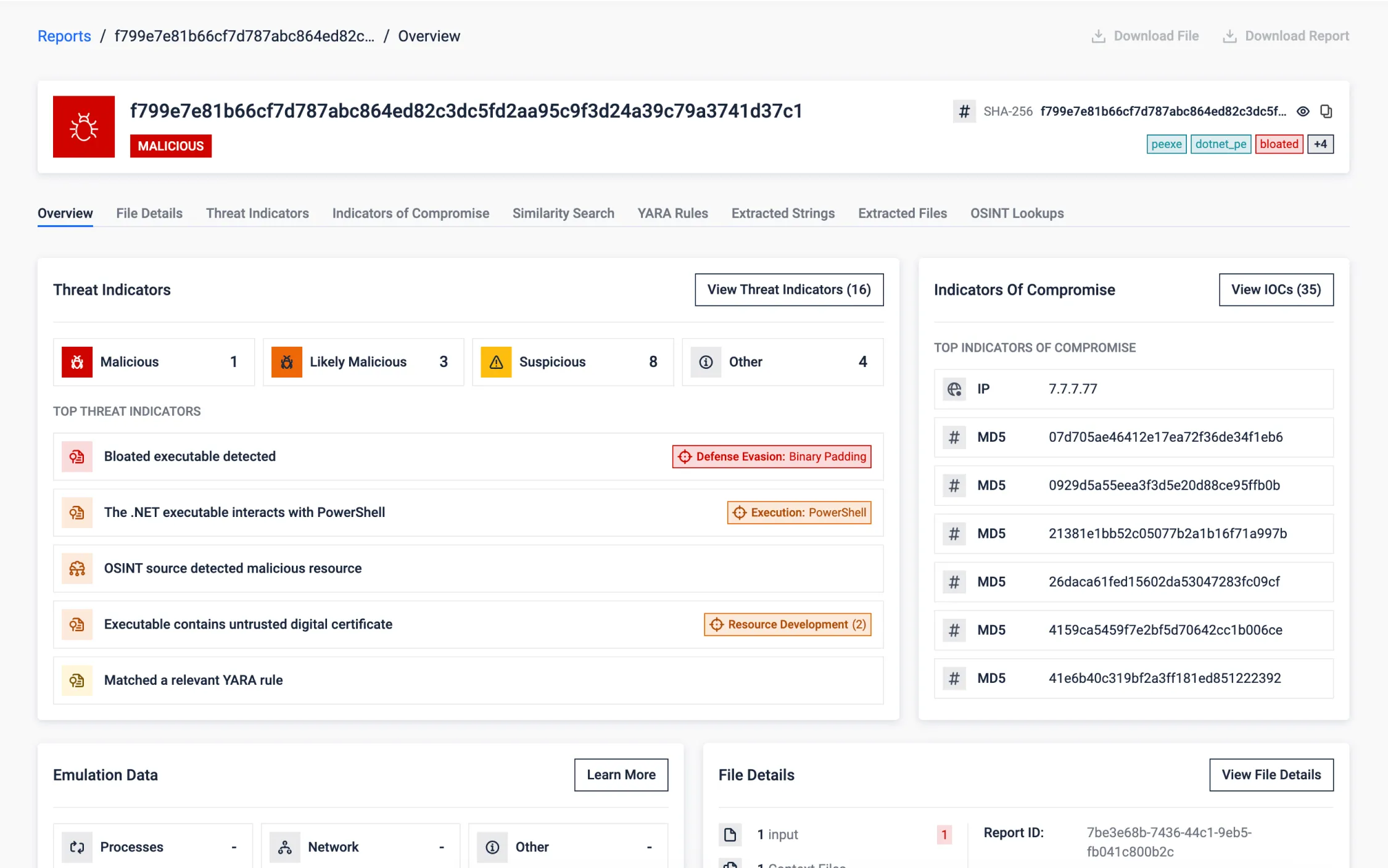
Mitigating Bloated Executables
Threat actors bloat intentionally executables with junk data to evade detection by exploiting resource limitations and analysis time constraints in sandboxes. This evasion technique looks to overwhelm tools or bypass scans by exceeding time limits.
MD sandbox detects bloated executables early, removes junk data, and processes a smaller file for efficient analysis. This debloating process targets various methods, including junk in overlays, PE sections, and certificates, ensuring accurate detection while conserving original resources.
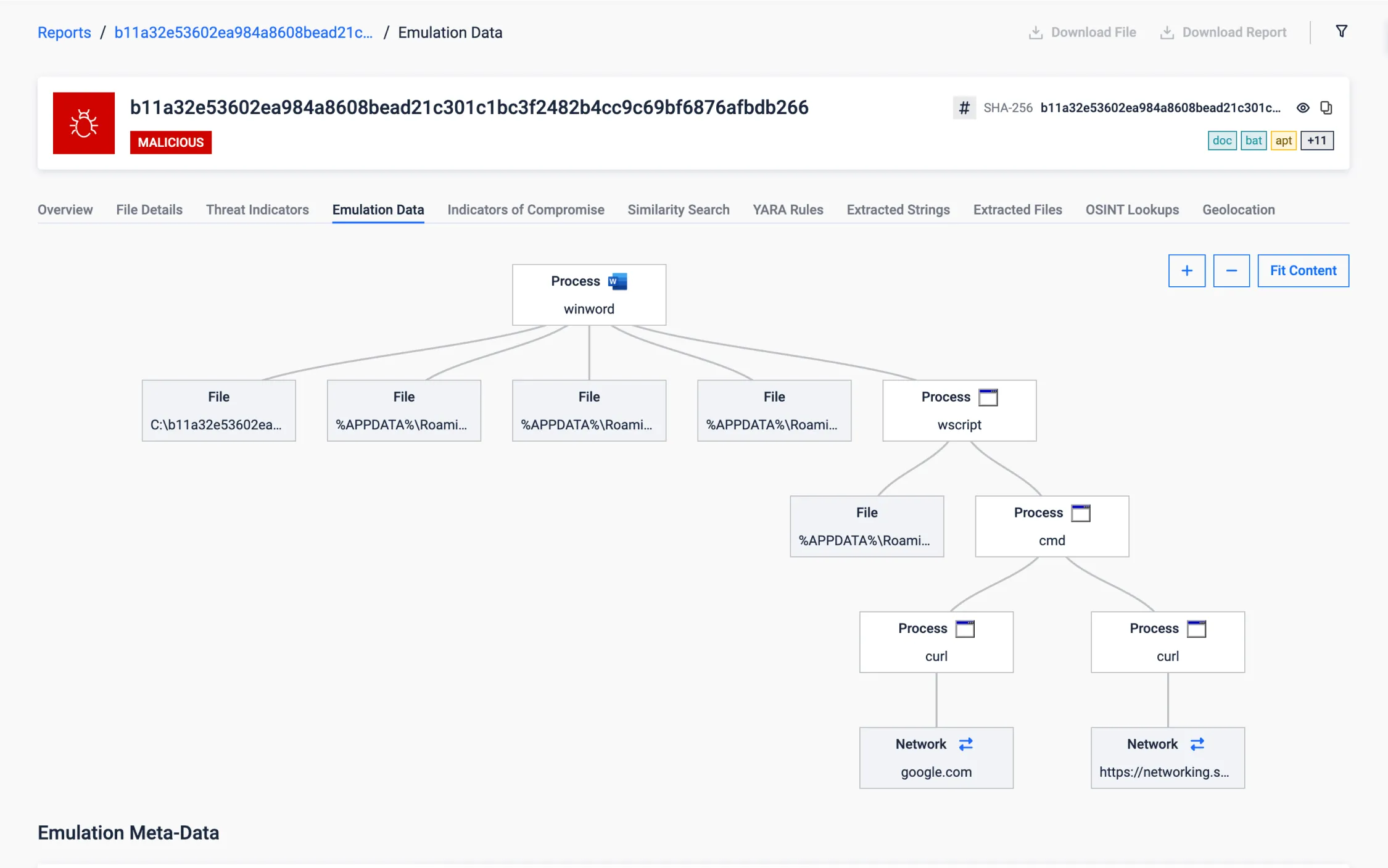
Document Targeting Critical Infrastructures
This Office document targets critical infrastructure in Iran (with content in Persian) to steal sensitive information, such as credentials and documents, and periodically takes screenshots, potentially for espionage purposes.
After establishing persistence, it performs a stealthy initial internet connectivity check (against a trusted domain like google.com) to ensure a reliable connection, delaying further actions until network conditions allow the attack to proceed. This is a tactic commonly observed in attacks on critical infrastructure, environments where internet access may be intermittent or restricted.
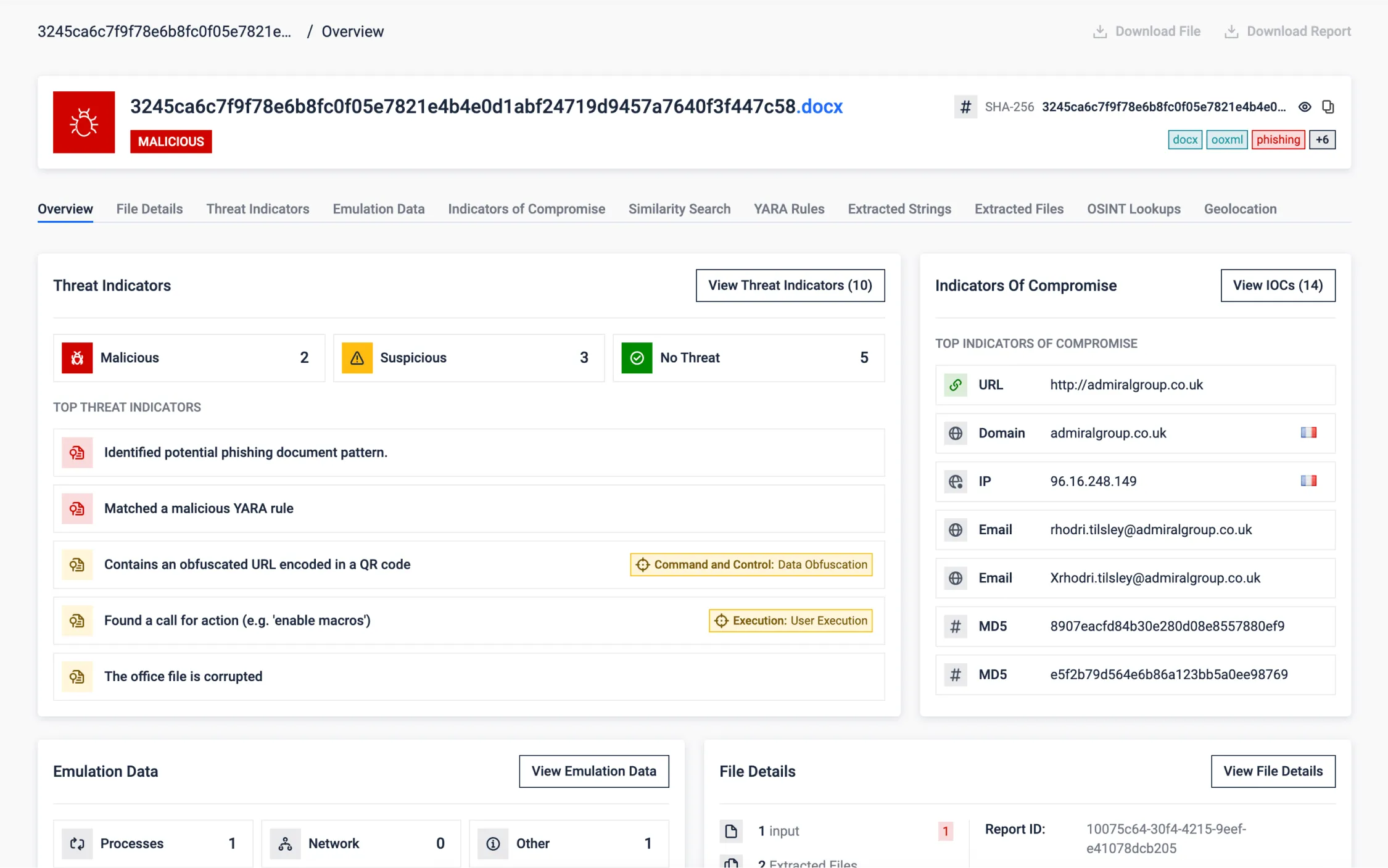
Evasion Through Corrupted OOXML (Office) Documents
Researchers discovered intentionally corrupted OOXML documents (modern office documents). By modifying the binary content near the internal file headers, the purposely broken files may be misdetected as ZIP files by automatic scans which will attempt to extract compressed files.
Document viewers will automatically repair the document upon opening. At this point, despite the document containing phishing content, it may have effectively bypassed defenses. Automated analysis will not be able to read its content and therefore miss the relevant indicators.
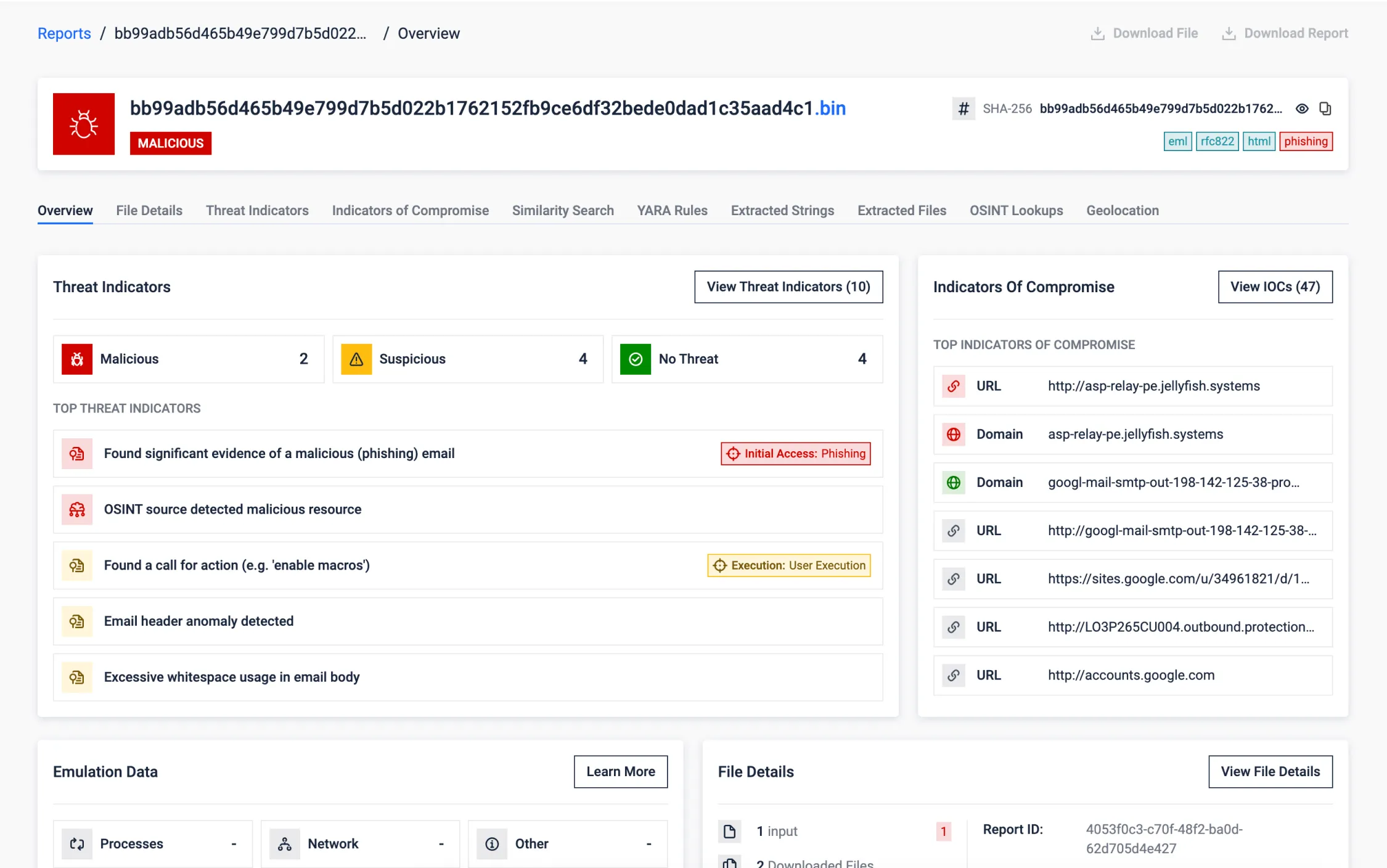
Google DKIM Replay Attack Detection
Email authentication mechanisms like SPF, DKIM, and DMARC are essential, but sophisticated attackers can sometimes bypass them. This example showcases a scenario where an email, despite being authentically signed by Google and passing standard checks, was identified as malicious by MetaDefender Aether.
MetaDefender Aether detected several anomalies along with other indicators:
- DKIM Boundary Violation: Identified content added beyond the scope of the DKIM signature.
- Obfuscation Techniques: Detected excessive whitespace used to hide malicious intent.
- Phishing Patterns: Recognized urgent calls-to-action characteristic of phishing attempts.
- Header Analysis: Flagged anomalies in email headers associated with OAuth application abuse.
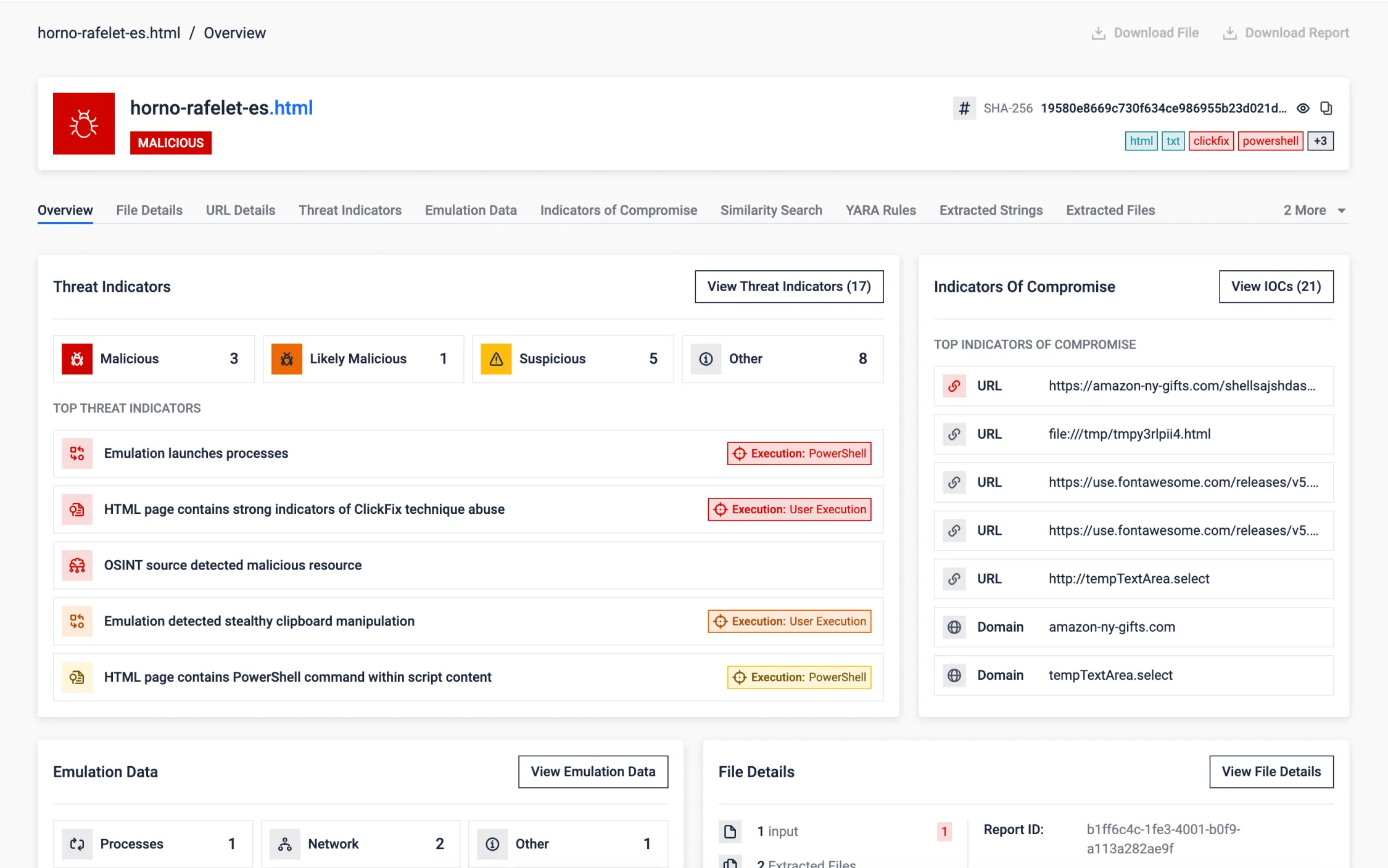
ClickFix, a Trending Social Engineering Technique
ClickFix is an emerging web-based threat that leverages social engineering to silently trick users into executing malicious commands. Unlike traditional phishing, ClickFix operates through deceptive UX elements and clipboard manipulation rather than file downloads or credential theft.
The ClickFix website presents a fake reCAPTCHA or "bot protection" screen to appear legitimate. The user is then asked to verify themselves—often through a harmless-looking interaction—while, in the background, obfuscated JavaScript code silently runs. This script dynamically decodes a malicious command and copies it directly to the system clipboard. Next, the user is presented with misleading instructions and guide to execute the malware, unaware of the danger.
ClickFix highlights how simple web techniques, combined with user deception, can effectively bypass traditional security layers—making sandbox analysis critical for uncovering stealthy, low-footprint attacks like this one.
MetaDefender Aether analyses this threat end-to-end. The sandbox begins by rendering the malicious URL and applying phishing detection models to identify suspicious content. It then extracts and emulates the JavaScript, simulating user actions to reach the critical moment when the clipboard is modified. Once the hidden command is captured, it is emulated, allowing the sandbox to fully trace the malicious execution flow. This not only exposes the clipboard-based tactic but also reveals the payload’s behavior and infection chain.
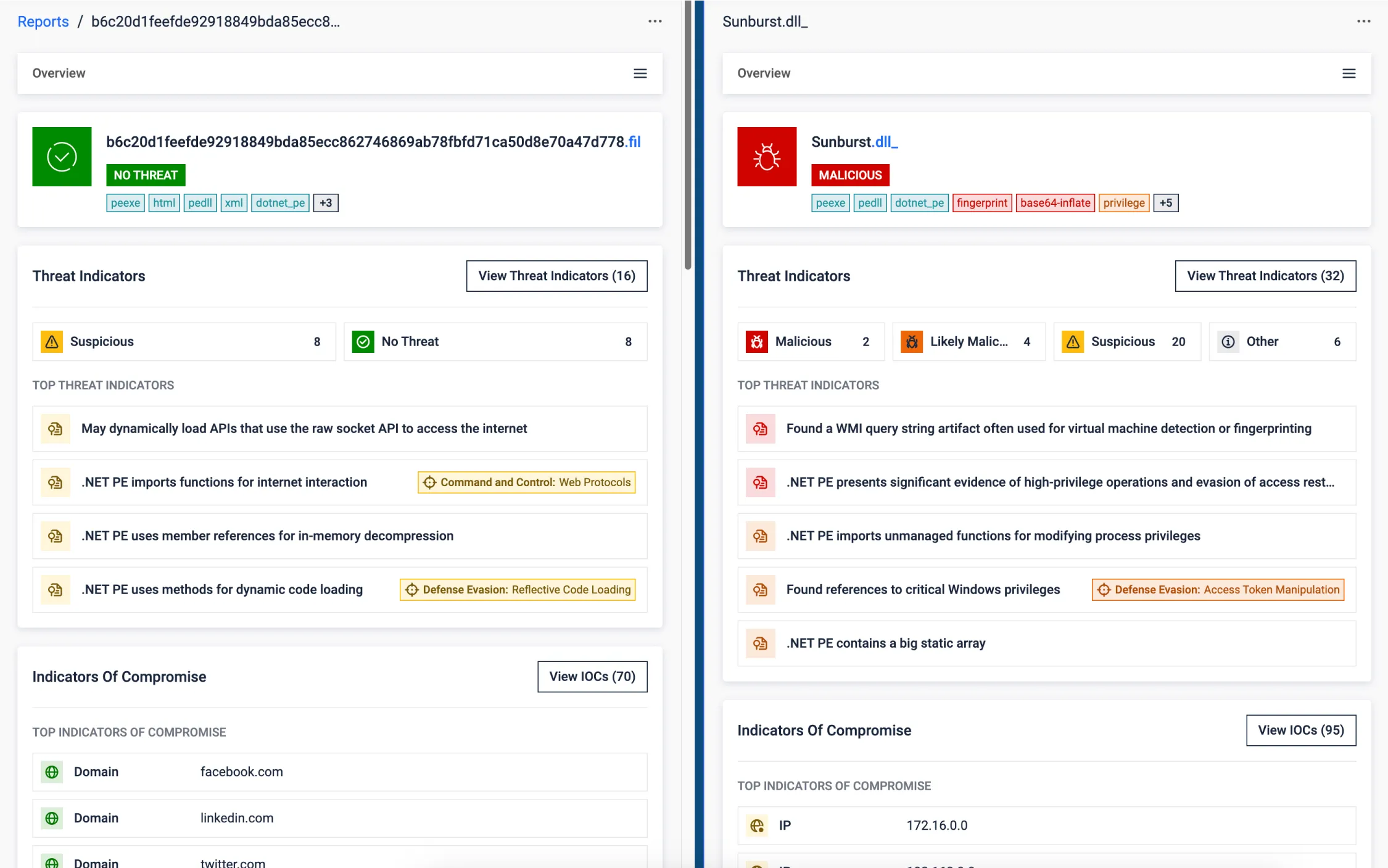
Supply Chain Attack
The SolarWinds supply chain attack exemplifies how minimal code changes in trusted software can enable massive breaches while bypassing traditional security defenses. Threat actors injected a stealthy backdoor into a legitimate DLL, embedding malicious logic while preserving original functionality. The payload ran silently in a parallel thread mimicking legitimate components. With a valid digital signature and seamless behavior, the DLL evaded detection and granted covert access to thousands of high-profile victims. The compromise of the build pipeline turned trusted updates into a vehicle for global intrusion.
While a 4,000-line backdoor might seem significant, in the context of a large enterprise source code, it’s easily overlooked. This is where MetaDefender Aether excels: it doesn’t just inspect the code, it observes what the software does. It flags deviations from normal behavior, guiding analysts to what really matters—cutting through the noise to spotlight threats that traditional reviews would likely miss.
Detonator - The Endless Quest
for Zero-Day Detection
The Story Behind OPSWAT’s Industry-Leading Dynamic Analysis Technology
Trusted Globally to Defend What's Critical
OPSWAT is trusted by over 1,900 organizations worldwide to protect their critical data, assets, and networks from
device and file-borne threats.


Clalit Health Services

- By implementing MetaDefender Aether, the agency modernized its approach to malware analysis. Instruction-level emulation exposed hidden behaviors. Built-in threat intelligence and ML-powered similarity search enriched every analysis. A single, trusted verdict replaced fragmented reporting.
- “With OPSWAT’s multiscanning capabilities and emulation-based sandbox, we get both depth and speed. Files are cleared or flagged in minutes, not hours.”A Government’s Cybersecurity Specialist
- By deploying OPSWAT’s Metascan Multiscanning and MetaDefender Aether, the bank reinforced its cybersecurity framework without disrupting critical workflows. The seamless integration of these technologies enhanced threat detection, streamlined behavioral analysis, and ensured compliance with strict financial security regulations.
- “With OPSWAT we are confident that the sensitive data and information of our customer is secure.”Zahi Ben-AbuHead of Security and Infrastructure Communication,
Clalit Health Services - “We needed a solution that could scale to meet our growing demands while keeping costs under control. Traditional sandboxing was effective but became unsustainable as our data processing needs grew.”The Security Operations Lead
- The organization addressed its SOC and risk challenges by replacing its VM-based sandbox with OPSWAT’s MetaDefender Aether, a unified zero-day detection solution built on instruction-level emulation. This architectural shift allowed the security team to move dynamic analysis out of the SOC and into the perimeter where threats could be stopped before reaching users or endpoints.
FileScan.io Community
Uncover hidden threats with insightful malware analysis
powered by OPSWAT’s MetaDefender Aether
technology—try it free.
Support Compliance
with Regulatory Requirements
As cyberattacks and the threat actors that carry them out become more sophisticated, governing bodies around the world are
implementing regulations to ensure critical infrastructure is doing what’s necessary to stay secure.






Get Started in 3 Simple Steps




Connect with Our Experts
Fill out the form and an OPSWAT specialist will reach out within 24 hours. Together, we'll review your zero-day detection strategy and identify how MetaDefender Aether can integrate into your SOC or hybrid environment.
Integrate Seamlessly
Deploy MetaDefender Aether as a standalone solution or connect it through REST APIs and SOAR/SIEM integrations. With flexible deployment options and emulation-ready architecture, setup is fast and fully supported by OPSWAT experts.
Detect What Others Miss
MetaDefender Aether continuously analyzes files through its four-layers of threat detection – threat reputation, emulation, prioritization, and correlation - to uncover hidden zero-day threats and deliver enriched, actionable intelligence across your security stack.
Recommended Resources

The Invariants of Cybersecurity

MetaDefender Aether

SANS Detection & Response Survey

2025 OPSWAT Threat Landscape Report

Scan What Matters: 99.9% Precision AI Engine Improves Your Security Stack

Security-First MFT: AI-Native & Emulation-Driven Defense Against File-Based Attacks

Energy Provider Eliminates Alert Floods and Improves Zero-Day Detection with OPSWAT
0 results. Please try again.
FAQs
MetaDefender Aether is OPSWAT's unified five-layer zero-day detection solution, combining Threat Reputation, Predictive Alin AI static analysis, Adaptive Sandbox dynamic analysis, Threat Scoring, and ML-powered Threat Hunting to deliver a single, consolidated verdict per file.
Traditional sandboxes begin only after a file has been selected for detonation. Aether starts earlier and continues further.
Threat Reputation stops known threats, Predictive Alin AI predicts malicious intent Pre-Execution, Adaptive Sandbox exposes evasive runtime behavior, Threat Scoring prioritizes risk, and Threat Hunting connects individual detections to related malware families, infrastructure, and campaigns.
Its instruction-level emulation also avoids the detectable VM surface and boot-and-teardown overhead associated with conventional VM-based sandboxing, enabling faster analysis and greater scalability.
Adaptive Sandbox is the emulation-based dynamic analysis technology used in Layer 3. It executes suspicious files, forces hidden code paths to run, and extracts runtime behaviors and IOCs.
Aether is the complete five-layer zero-day detection solution built around that engine. It adds reputation intelligence, Predictive Alin AI Pre-Execution analysis, confidence-based Threat Scoring, and ML-powered Threat Hunting in one integrated workflow.
Adaptive Sandbox = dynamic analysis engine Aether = complete five-layer zero-day detection solution
Analysts receive a single consolidated verdict with confidence-based risk scoring, supported by evidence from across the five-layer pipeline.
Reports can include:
- Static and runtime indicators
- MITRE ATT&CK and Malware Behavior Catalog mappings
- Unpacked payloads and extracted malware configurations
- Network, C2, registry, process, and dropped-file indicators
- Exportable IOCs for MISP, STIX, SIEM, and SOAR workflows
- ML-powered similarity results connecting the file to related variants, families, and campaigns
- This gives analysts both an immediate decision and the context needed for investigation, blocking, and threat hunting.
Aether supports standalone, MetaDefender Core, and cloud-based deployment models across on-premises, hybrid, cloud, and fully air-gapped environments.
Teams can integrate it through REST APIs, SIEM and SOAR connectors, CEF Syslog, MISP, STIX, and supported identity services such as SAML 2.0. Deployment and management depend on the selected model, allowing organizations to retain local control or use a managed cloud service.
Run a two-to-four-week pilot against a real file workflow, such as email attachments, inbound managed file transfers, software packages, or files entering an air-gapped environment.
Measure:
- Known threats stopped by reputation
- Unknown threats identified Pre-Execution
- New detections confirmed through dynamic analysis
- Time to verdict
- Reduction in unnecessary sandbox submissions
- False-positive and alert-volume reduction
- IOC and campaign intelligence generated
- Analyst investigation time saved
- This shows the operational value of the full five-layer pipeline, not just the detection rate of one engine.
