Securely transferring data between trusted and untrusted environments presents significant challenges, especially when the transit network cannot be trusted. A cross-domain file transfer architecture can securely move data between environments by combining unidirectional data flow, cryptographic signing, and mutually authenticated transport. By assuming a hostile transit network and eliminating bidirectional communication, this design provides a robust and auditable approach to maintaining data integrity, authenticity, and system isolation.
Rethinking Trust in Cross-Domain Data Transfers
Cross-domain data transfer systems must balance the operational need to share data with security controls that prevent unauthorized access, data leakage, and command-and-control pathways. Because adversaries may observe or compromise the transit network, security cannot rely solely on traditional network-based protections.
The architecture presented here is designed around the assumption that the transit network is untrusted and potentially compromised, and security is enforced through physical isolation and cryptographic verification.
Assumptions, Threat Model, and Architecture
Assumptions
- The transit network is untrusted and may be actively hostile
- Attackers may intercept, modify, replay, delay, or inject traffic
- No bidirectional communication between trusted and untrusted domains is permitted
- Trust is limited to designated cryptographic keys and verification logic
Threats to Address
- Man-in-the-middle attacks
- Data tampering and forgery
- Replay attacks
- Remote command execution
- Covert feedback channels
Architecture Overview
The architecture consists of three security zones, where at no point does the system allow bidirectional connectivity across security boundaries:
- Trusted Zone (for signing)
- Untrusted Transit Network
- Untrusted Zone Verification Domain
How this Diode-Based Architecture Works
Trusted Zone as the Signing Domain
All data originates in a trusted signing zone. Prior to release, files are validated according to policy and digitally signed using a protected private key on the data diode. The signature establishes cryptographic proof of origin and integrity. Once signed, files are immutable from a trust perspective, and any subsequent modification will be detected downstream.
This zone has no inbound network connectivity, signing operations are tightly restricted, and private keys are protected using hardware-backed storage. Content inspection or sanitization can also be performed before signing to ensure only approved data is released.
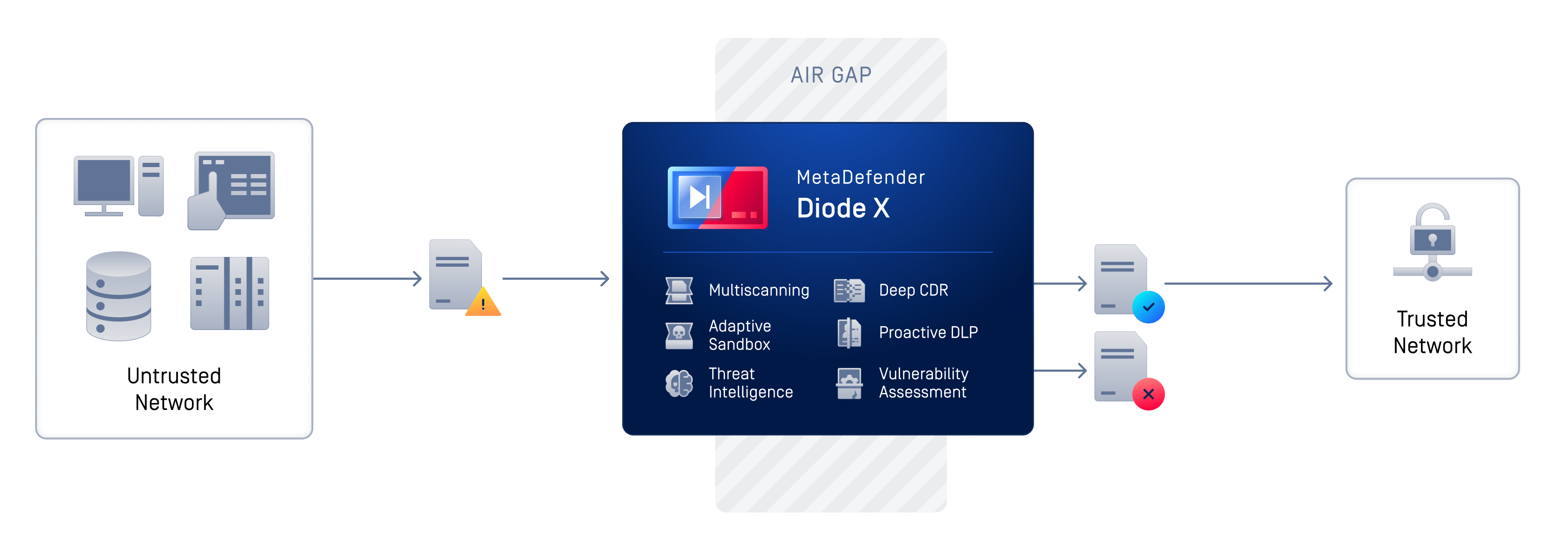
Physical Enforcement Using Data Diodes
Outbound Diode Component
The first data diode component enforces one-way flow out of the trusted environment. It physically prevents any data, signaling, or protocol feedback from returning to the source domain.
Inbound Diode Component
The second data diode component enforces one-way ingress into the untrusted domain. This prevents untrusted networks from establishing bidirectional relationships with internal systems and simplifies security accreditation by enforcing fixed information flow.
Secure Communication Across the Untrusted Network
Between the diode endpoints, data traverses an untrusted network. Transport communication is protected using mutual TLS (mTLS) to authenticate endpoints and encrypt data in transit.
mTLS is explicitly treated as a defense-in-depth control, not a trust anchor. It reduces exposure to impersonation and passive interception but is not relied upon to ensure data integrity or authenticity.
Untrusted Verification Domain
In the untrusted domain, received files undergo cryptographic verification. The diode validates digital signatures, certificate chains, and policy constraints before accepting data. Failing validations are rejected and logged.
Trust in this domain is limited to approved public keys or certificates, as well as verification logic and policy enforcement. As a result, no trust is placed in the network or transport layer.
Security Assurances and Outcomes
This architecture delivers strong security assurances. Even if the transit network is fully compromised, attackers cannot forge trusted data or influence trusted systems. Key security assurances include:
- Physically enforced unidirectional data flow
- Cryptographic integrity and authenticity independent of transport
- Elimination of interactive attack surfaces
- Resilience against interception, replay, and modification
- Clear separation of duties and audit boundaries
Purpose-Built Solutions to Enable Secure Cross-Domain Data Transfers
By combining data diodes, such as MetaDefender Optical Diode™, digital signatures, and layered transport security, this architecture enables secure cross-domain file transfer without relying on network trust. The design is well-suited for trusted environments, critical infrastructure, and regulated systems requiring strong assurance, minimal trust assumptions, and auditable controls.
To learn more about how OPSWAT can help you implement this architecture, talk to an expert today.