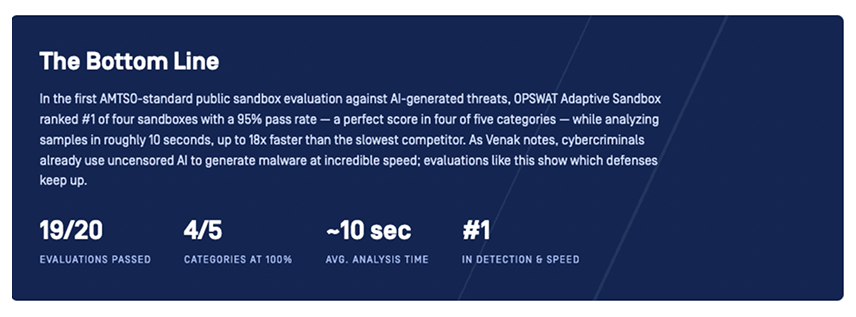
Adaptive Sandbox is OPSWAT's malware analysis technology that uses emulation-based dynamic analysis to detect advanced threats. It is part of MetaDefender Aether™, OPSWAT's unified zero-day detection solution, that combines threat reputation checks, pre-execution machine-learning verdicts, file detonation in an emulated sandbox environment, and similarity matching against known malware families across five detection layers. In Venak Security's 2026 AMTSO-aligned test, Adaptive Sandbox detected 19 of 20 AI-generated malware samples.
TL;DR / Key Takeaways
- OPSWAT’s Adaptive Sandbox scored 95% (19 of 20) in Venak Security's 2026 test, the top result among four tested sandboxes
- CrowdStrike Falcon Sandbox placed second at 80% (16 of 20), followed by Malwation THREAT.ZONE at 75% (15 of 20) and ANY.RUN at 25% (5 of 20)
- The test used twenty samples across five threat categories, built with Venak's AI Malware Simulator and mapped to MITRE ATT&CK techniques
- OPSWAT’s Adaptive Sandbox averaged roughly ten seconds per sample, the fastest analysis time among all four vendors tested
- The evaluation followed the AMTSO Sandbox Evaluation Framework v1.0, with results published July 3, 2026 under AMTSO Test ID AMTSO-LS1-TP204
Venak Security's 2026 AI Malware Sandbox Test
Venak Security tested four commercial sandboxes against twenty AI-generated malware samples in 2026, and OPSWAT’s Adaptive Sandbox returned the highest pass rate at 95%. The evaluation drew on Venak's AI Malware Simulator, a tool the firm introduced in September 2024 to build both private and public benchmark tests for cybersecurity vendors.
This year's test ran on the AMTSO Sandbox Evaluation Framework v1.0. Venak developed the framework the prior year in collaboration with several cybersecurity vendors, and that earlier test is recapped later in this article and in OPSWAT's prior post, "Validated Speed & Security: Venak Security's AMTSO-Aligned Test Confirms OPSWAT's Adaptive Sandbox Leadership." Venak ran the test window from June 1 to June 15, 2026, and published its final report on July 3, 2026, under AMTSO Test ID AMTSO-LS1-TP204.
Test Scope and Sandbox Vendors
Venak Security started with eight sandboxes in scope, then narrowed the field to four for final testing. The original scope included OPSWAT’s Adaptive Sandbox, VMRay TotalInsight, Malwation THREAT.ZONE, ANY.RUN Malware Sandbox, ReversingLabs Spectra Analyze, Check Point SandBlast, Joe Sandbox Cloud, and CrowdStrike Falcon Sandbox.
Joe Sandbox, ReversingLabs, and VMRay opted out of the final test. Check Point was removed after encountering technical difficulties during the evaluation window. Four vendors completed testing: OPSWAT’s Adaptive Sandbox, CrowdStrike Falcon Sandbox, Malwation THREAT.ZONE, and ANY.RUN Malware Sandbox.
Methodology Behind Venak Security's 2026 Sandbox Test
Venak Security built the test around twenty malware samples spread across five threat categories, run against each of the four sandboxes for a total of eighty evaluations. Samples were generated with Venak's AI Malware Simulator and mapped to MITRE ATT&CK techniques to reflect realistic adversary behavior.
5 categories
- Zero-day Ransomware (6 samples)
- Infostealer Malware (4 samples)
- DLL Sideloading Exploits (1 sample)
- Obfuscated Malware (4 samples), and
- Sandbox Evasion Detection (5 samples)
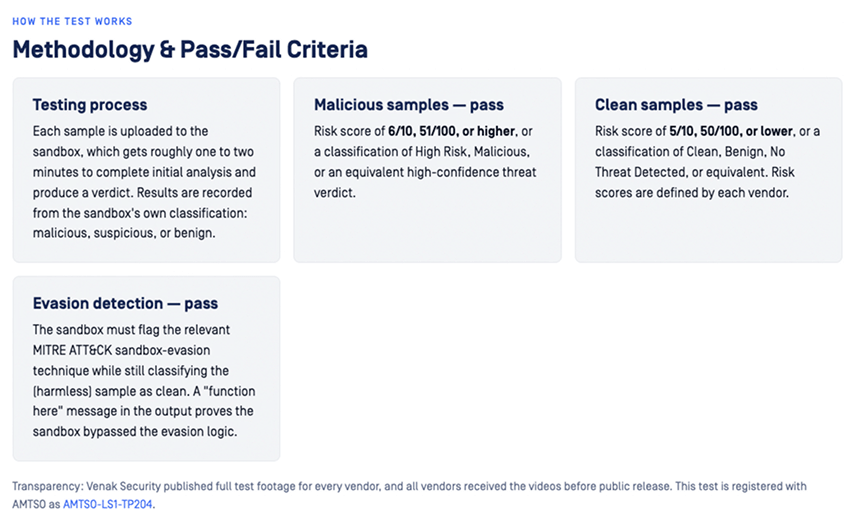
Venak scored malicious samples as a pass when a sandbox returned a risk score of six or higher out of ten (or fifty-one or higher out of one hundred), or a verdict of "Malicious" or "High Risk." Clean samples passed when a sandbox returned a risk score of five or lower out of ten (or fifty or lower out of one hundred), or a verdict of "Clean" or "Benign." The Sandbox Evasion Detection category carried an added rule: a sandbox had to both recognize the evasion technique in use and still correctly classify the clean sample as clean.
Overall Results: OPSWAT’s Adaptive Sandbox Leads the Field
The eighty evaluations across all four vendors and five categories produced a combined pass rate of 68.8%. Venak Security noted that OPSWAT’s Adaptive Sandbox and Malwation THREAT.ZONE "did a fantastic job detecting the samples," while CrowdStrike Falcon Sandbox and ANY.RUN detected only three and one sample, respectively.
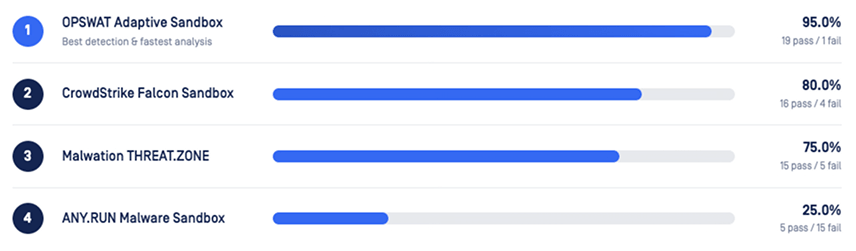
Overall Pass Rate by Sandbox
Sandbox | Pass Rate | Samples Passed |
OPSWAT’s Adaptive Sandbox | 95.0% | 19 of 20 |
CrowdStrike Falcon Sandbox | 80.0% | 16 of 20 |
Malwation THREAT.ZONE | 75.0% | 15 of 20 |
ANY.RUN | 25.0% | 5 of 20 |
Test Results by Threat Category
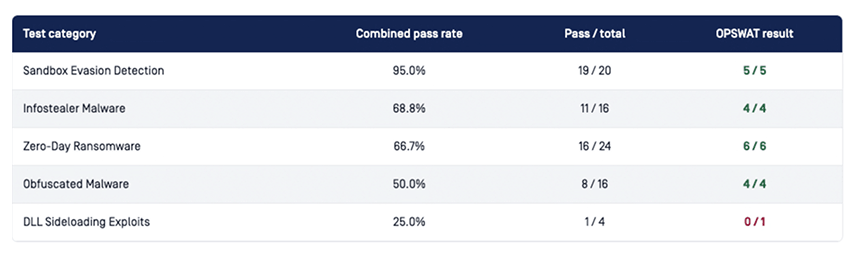
OPSWAT's Adaptive Sandbox's per-category results show consistent strength across ransomware, infostealers, and obfuscated malware, with variation only in the DLL Sideloading Exploits category.
1. Zero-Day Ransomware
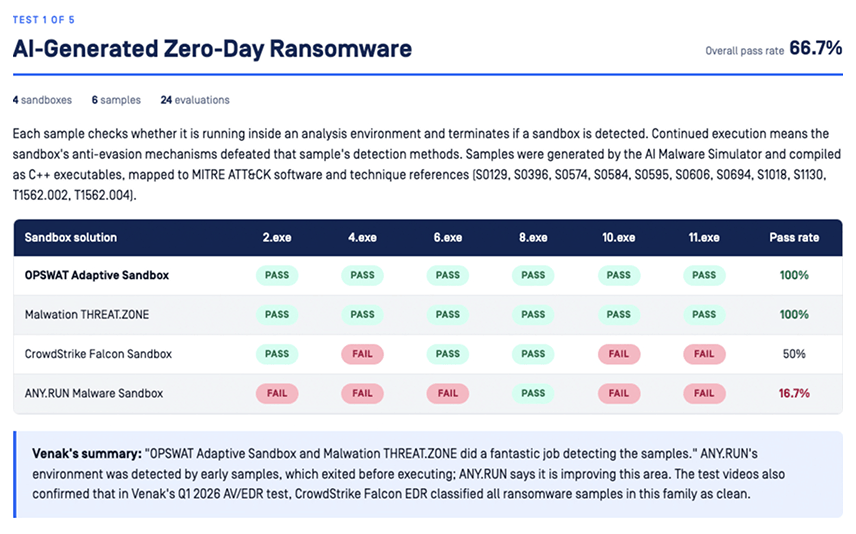
In the Zero-day Ransomware category, OPSWAT’s Adaptive Sandbox and Malwation THREAT.ZONE each passed six of six samples. CrowdStrike Falcon Sandbox passed three of six, and ANY.RUN passed one of six.
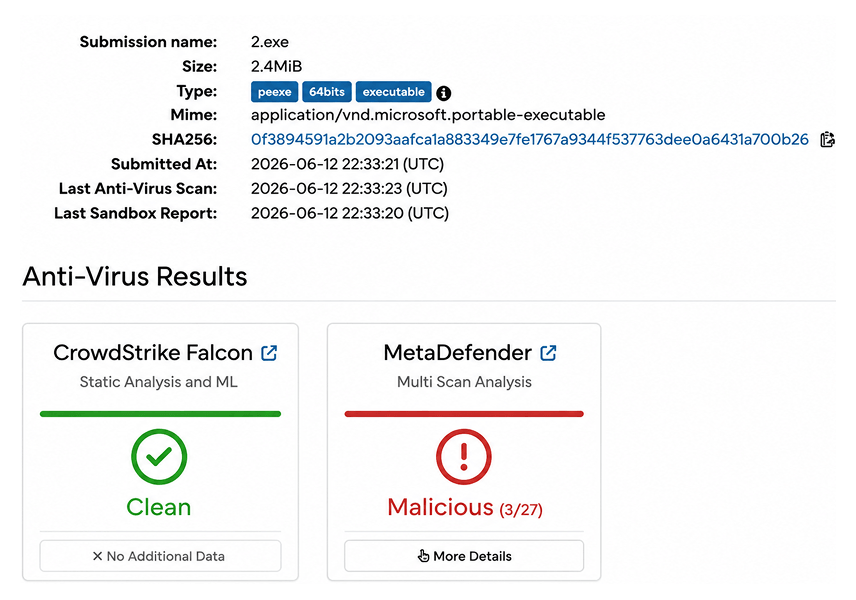
Our experts have examined and documented ransomware campaigns like Interlock and Qilin delivered through ClickFix attacks, where instruction-level emulation caught anti-VM checks and sleep timers before the payload reached an endpoint. The same exposure shows up in OT environments, where we've tracked active ransomware groups targeting ICS and OT networks grow from 80 in 2024 to 119 in 2025.
In healthcare, we've written about why endpoint protection alone falls short against a zero-day exploit that leads to ransomware, and why emulation-based sandbox analysis catches what needs deeper behavioral inspection.
2. Infostealer Malware
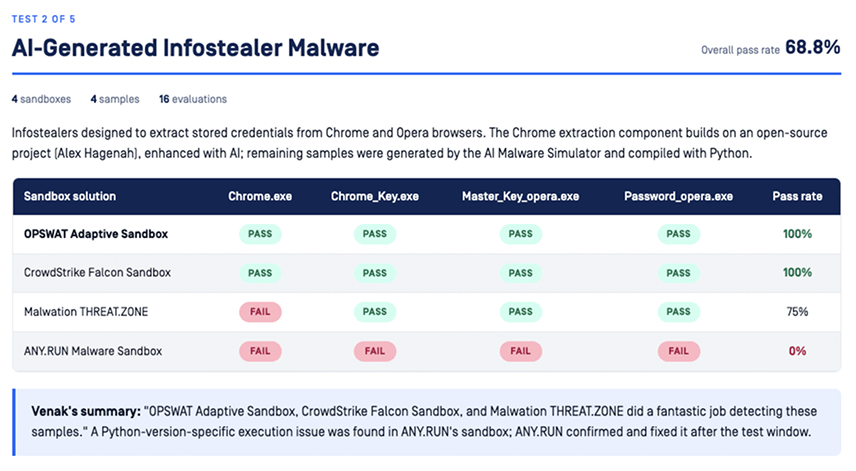
In the Infostealer Malware category, OPSWAT’s Adaptive Sandbox and CrowdStrike Falcon Sandbox each passed four of four samples. Malwation THREAT.ZONE passed three of four, and ANY.RUN passed zero of four. Infostealers remain a common real-world payload. We have documented cases where a phishing-delivered backdoor installed a .NET infostealer to harvest credentials from browsers and applications.
We’ve seen the same techniques in ClickFix campaigns, which have delivered infostealers including Lumma, StealC, Vidar, AMOS, and Odyssey.
3. DLL Sideloading Exploits
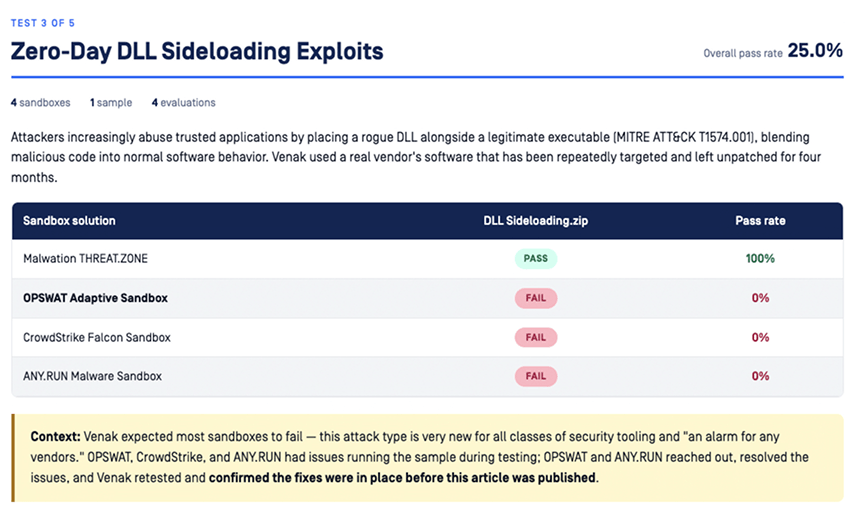
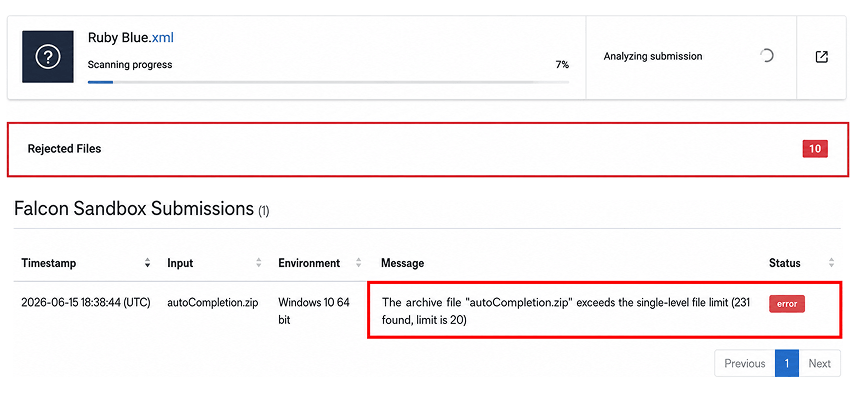
In the DLL Sideloading Exploits category, Malwation THREAT.ZONE was the only vendor to pass the single sample tested. DLL sideloading is an active technique in the wild; our experts have tracked a real-world campaign where a threat actor hijacked a legitimate signed Canon utility to sideload a malicious DLL and deploy the PlugX backdoor, a chain that only our Adaptive Sandbox exposed at runtime.
4. Obfuscated Malware
In the Obfuscated Malware category, Adaptive Sandbox and CrowdStrike Falcon Sandbox each passed four of four samples. Malwation THREAT.ZONE and ANY.RUN each passed zero of four. Venak Security noted the two "have done fantastic jobs in these two tests."
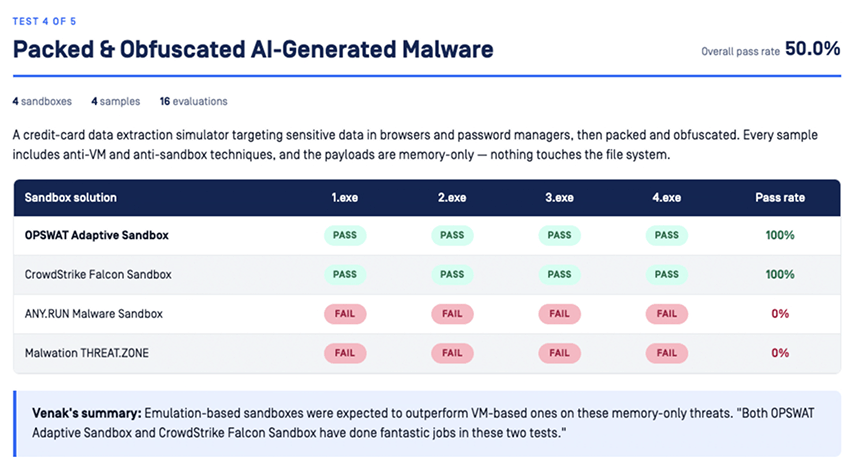
This is a pattern we track closely: packed, encrypted, and polymorphic malware forces instruction-level emulation to decrypt and expose the payload static tools miss. We saw the same approach in a Lazarus Comebacker campaign in aerospace and defense, where custom XOR and bit-swap obfuscation, ChaCha20 loader stages, and memory-only execution were exposed through emulation.
5. Sandbox Evasion Detection
In the Sandbox Evasion Detection category, Adaptive Sandbox, CrowdStrike Falcon Sandbox, and Malwation THREAT.ZONE each passed all five samples. ANY.RUN passed four of five.
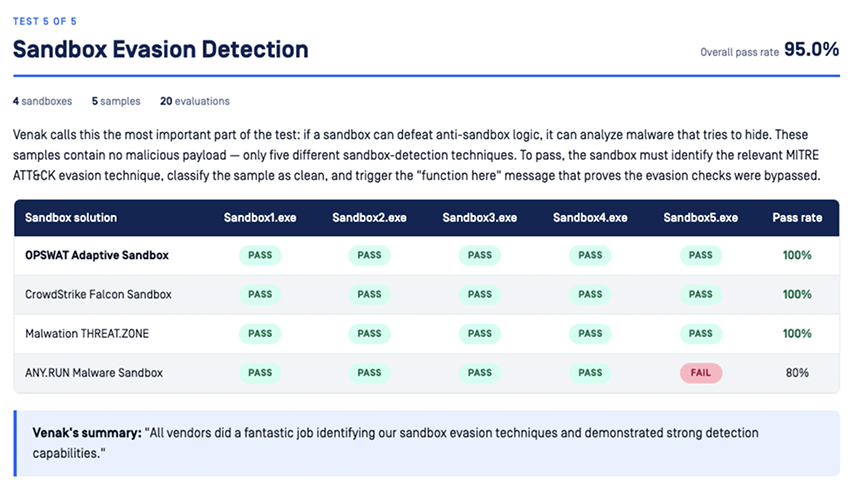
We've written extensively about how instruction-level emulation defeats debugger checks, time delays, and hardware fingerprinting used to stall automated analysis, and we’ve argued that evasive malware has outgrown VM-based detection built on anti-VM checks, delayed execution, and user-interaction requirements. The same runtime evasion drives LNK-based intrusions like a recent PlugX campaign we broke down, where obfuscated commands, signed-binary abuse, and delayed execution were built specifically to stall analysis.
Analysis Speed Comparison
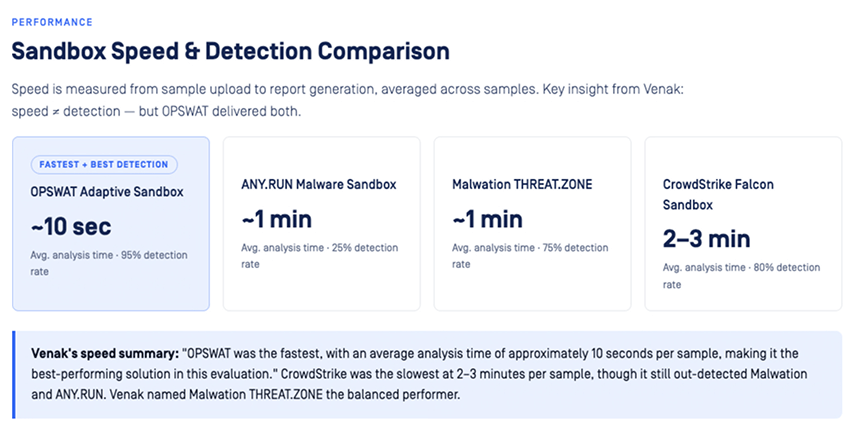
OPSWAT’s Adaptive Sandbox was the fastest sandbox tested, averaging roughly 10 seconds per sample. Venak Security called it "the best-performing solution in this evaluation," while CrowdStrike Falcon Sandbox was the slowest of the four vendors, averaging 2 to 3 minutes per sample.
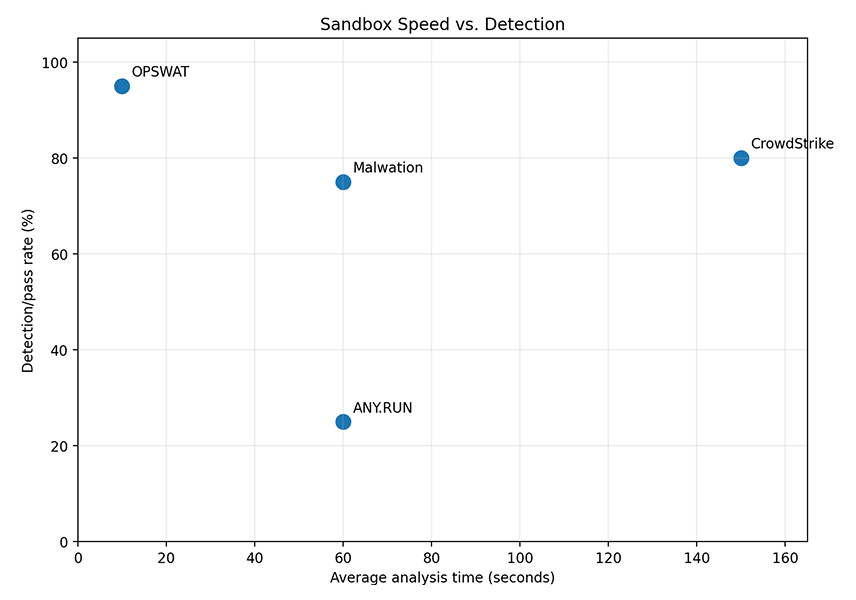
Speed matters directly to SOC throughput. A sandbox that returns a verdict in seconds rather than minutes can process far more files during peak volume without creating analysis queues or delaying downstream automation in SIEM and SOAR workflows.
Year-Over-Year Comparison and What It Means for SOC Teams
Venak Security introduced its AI Malware Simulator in September 2024 and has since evaluated cybersecurity products through both private and public tests. This year's Q2 2026 evaluation is Venak's first public sandbox test built on the AMTSO Sandbox Evaluation Framework v1.0, following the private evaluation referenced in our earlier post.
OPSWAT’s Adaptive Sandbox Year-Over-Year Test Results
Metric | 2025 Test | 2026 Test |
Detection rate | 90% (AI-generated malware) | 95% (19 of 20 samples) |
Wildlist detection | 91% (5% false-negative rate) | Not measured in this test |
Anti-evasion accuracy | 100% | 95.0% (Sandbox Evasion Detection category) |
Average analysis speed | 8.2 seconds/sample | ~10 seconds/sample |
The two tests used different methodologies, so the results aren't directly comparable as a hard percentage change. Detection outcomes improved while analysis speed stayed in the same range.
For SOC and threat hunting teams, that consistency across two independent test cycles matters more than either single result. A sandbox that performs well across categories, ransomware, infostealers, and obfuscated malware alike, reduces the blind spots attackers could otherwise exploit by shifting technique. Combined with roughly 10-second average verdicts, this points to fewer missed detections and less queue backlog at the perimeter, keeping automated SIEM and SOAR response running without manual intervention.
Adaptive Sandbox Inside MetaDefender Aether's Five-Layer Pipeline
MetaDefender Aether™ is OPSWAT's unified zero-day detection solution that runs Adaptive Sandbox as one of five layers in a single detection pipeline. Files pass through Layer 1 – Threat Reputation and Layer 2 – Predictive Alin AI, delivering pre-execution machine-learning verdicts, then Layer 3 – Dynamic Analysis, powered by Adaptive Sandbox's emulation-based detonation, Layer 4 – ML Threat Scoring, and Layer 5 – AI Threat Hunting to produce an actionable verdict.
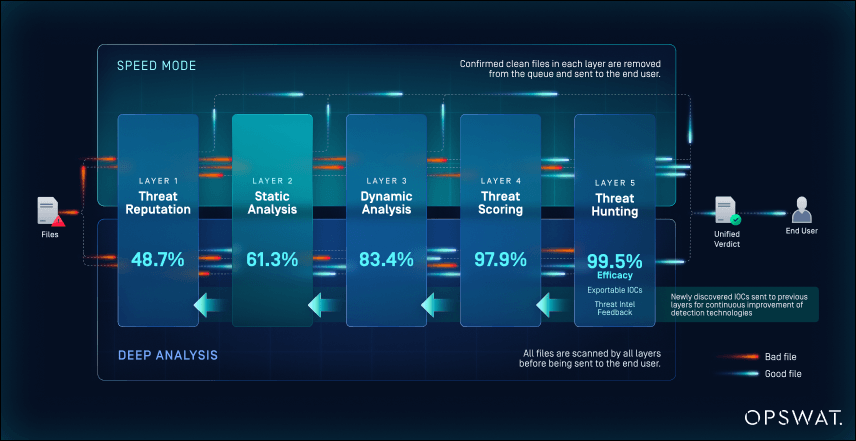
Each layer narrows down what needs deeper inspection before escalating to the next. Predictive Alin AI flags high-risk files in milliseconds without detonation, reducing the volume of files that reach Adaptive Sandbox's dynamic analysis stage. Files that clear dynamic analysis move to threat scoring and, finally, similarity-based threat hunting, which correlates results against known malware families and campaigns.
The results in Venak Security's test reflect the detection strength of Adaptive Sandbox. Inside MetaDefender Aether, that same detection strength operates alongside four additional layers, giving SOC and threat hunting teams a single, consolidated verdict per file instead of separate outputs to correlate manually.
Adaptive Sandbox's results in Venak Security's independent test reflect the same detection engine at the core of MetaDefender Aether, OPSWAT's unified zero-day detection solution. Chat with an Expert to see how MetaDefender Aether's five-layer pipeline fits into your security stack.
Frequently Asked Questions
What is Venak Security's AI Malware Simulator?
Venak Security's AI Malware Simulator is a testing tool the firm introduced in September 2024 to generate AI-modified malware samples for evaluating cybersecurity products. It builds samples mapped to MITRE ATT&CK techniques across categories such as ransomware, infostealers, and evasive malware, and Venak uses it for both private and public vendor benchmarks.
What sandboxes were tested in Venak Security's 2026 evaluation?
Venak Security's 2026 test evaluated four sandboxes: OPSWAT's Adaptive Sandbox, CrowdStrike Falcon Sandbox, Malwation THREAT.ZONE, and ANY.RUN Malware Sandbox. Four additional vendors, Joe Sandbox, ReversingLabs, VMRay, and Check Point, were part of the original scope but opted out or were removed due to technical difficulties.
How does OPSWAT’s Adaptive Sandbox differ from VM-based sandboxes?
Adaptive Sandbox uses instruction-level CPU and operating system emulation instead of virtual machines to detonate files. This approach helps expose evasive behavior that malware often conceals when it detects a VM-based analysis environment.
How fast is OPSWAT’s Adaptive Sandbox compared to other tested sandboxes?
Adaptive Sandbox averaged roughly 10 seconds per sample in Venak Security's test, the fastest of the four vendors evaluated. CrowdStrike Falcon Sandbox was the slowest, averaging 2 to 3 minutes per sample.
What is the AMTSO Sandbox Evaluation Framework?
The AMTSO Sandbox Evaluation Framework v1.0 is a standardized testing methodology Venak Security developed with three major cybersecurity companies, aligned with Anti-Malware Testing Standards Organization (AMTSO) principles. Venak Security's 2026 test ran under this framework, registered as AMTSO Test ID: AMTSO-LS1-TP204.
How does OPSWAT’s Adaptive Sandbox fit into MetaDefender Aether?
Adaptive Sandbox powers Layer 3, Dynamic Analysis, within MetaDefender Aether's five-layer detection pipeline. Aether combines this emulation-based detonation with threat reputation, pre-execution machine-learning verdicts, threat scoring, and threat hunting to deliver a single, actionable verdict per file.