In June 2025, Cisco disclosed CVE-2025-20282, a maximum-severity vulnerability in its Identity Services Engine. The root cause was a missing file validation check at the upload point, which could allow an unauthenticated attacker to place a crafted file in a privileged directory and execute it as root. The failure sat upstream of detection, in what the system accepted before any scanning engine ran.
That pattern is not unique to one product. The count of engines in a stack is rarely the constraint. A file must be parsed before it can be assessed, and modern formats nest content in ways that parsing does not always reach.
Why the Scan Came Back Clean
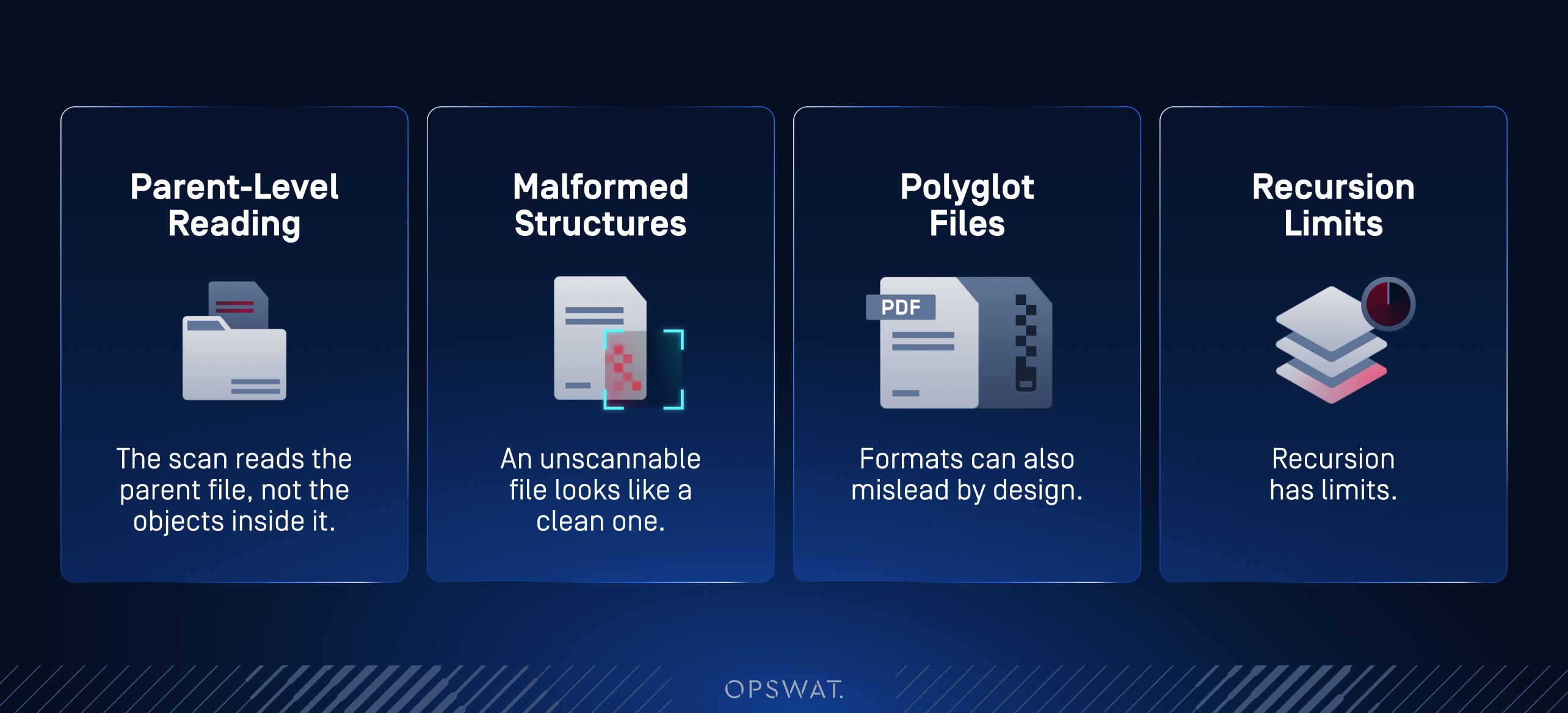
Signature-based scanning works by matching bytes. An engine holds a database of hashes and byte patterns drawn from known malware, and a file has to present matching bytes to be caught. A few things stop that from happening with nested content.
- The scan reads the parent file, not the objects inside it. A scan takes the file in front of it as a single binary object and matches it against the signature database. Nested content is held in compressed or encoded form, so an executable sitting inside a document stream shares almost no byte sequence with the same executable on disk. The pattern the database is looking for is absent from the file as stored, and it only becomes matchable once that stream is unpacked.
- An unscannable file looks like a clean one. Malformed structure breaks the parse. The engine cannot finish its assessment, so the file is skipped rather than blocked, and a result meaning "could not be evaluated" travels downstream indistinguishable from a result meaning "nothing found."
- Formats can also mislead by design. A polyglot file satisfies two format specifications at once, so one parser claims it while the file behaves as something else entirely.
- Recursion has limits. Nested containers are bounded by depth caps and scan timeouts, for good reason, since unbounded recursion is its own denial-of-service risk. A payload placed below that boundary is never evaluated, and sitting deeper than the engine reaches takes far less effort than defeating it.
The result is a verdict that says less than it appears to. A clean result means no known pattern matched in the portion of the file the engine was able to parse. It carries no statement about the components inside the file, and no statement about the layers the engine never opened.
Each Layer Has a Job. One Was Missing
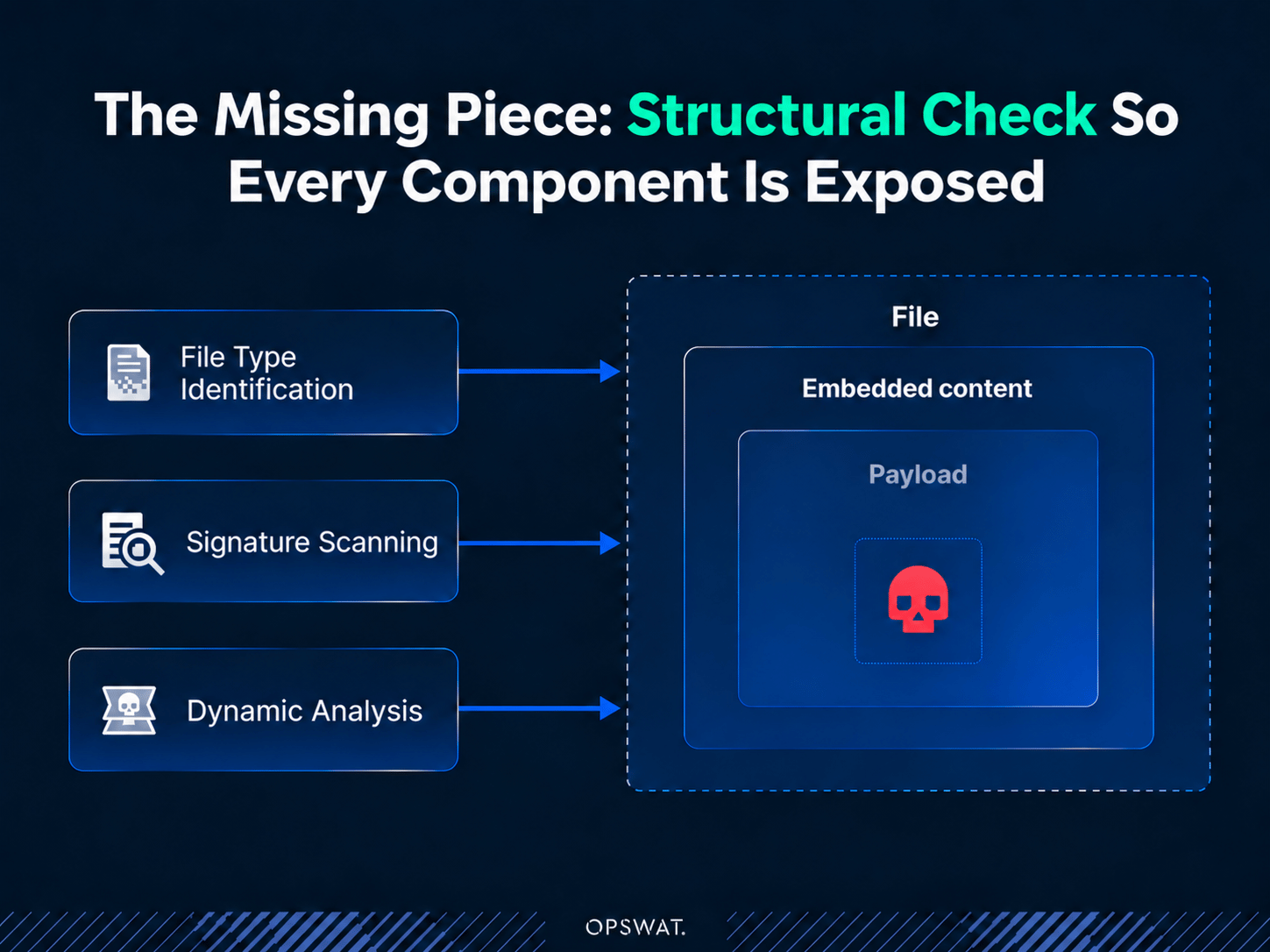
Signature-based scanning never sits alone. Modern file security stacks are often layered by design, and the layers around it exist to cover what pattern matching cannot.
File type identification determines a file's true type from its header rather than its declared extension. It is fast and surface-level by design, built to decide where a file goes rather than what is inside it. Dynamic analysis observes file behavior in a controlled environment. It is the right tool for unknown threats, and it is most effective when applied selectively rather than to every file.
Each layer does its job, but when a payload is never separated from the file that carries it, or sits below a depth limit, that content never reaches any of these layers, so additional layering does nothing to compensate. The blind spot propagates the furthest in the formats that have no sanitization path at all: database files, GIS data, AI model files. Those formats cannot be rebuilt, so the layer that would normally catch an unknown threat is unavailable by definition.
The missing piece is a layer whose entire job is establishing structural ground truth first: parsing a file against its format specification, pulling out every embedded component, and making those components individually available to everything downstream. That is the problem File Structure Validation was built to solve.
How File Structure Validation Closes the Gap
File Structure Validation runs before the rest of the stack engages. It validates a file against its format specification across 160+ file types, including GIS, database, and AI model formats, decomposes it into its components, and applies policy to each one.
Objects are routed to the engine equipped to assess them: Metascan™ Multiscanning, Adaptive Sandbox, Proactive DLP™ Technology, or OPSWAT Alin AI. The parent file continues to Deep CDR™ Technology for sanitization where applicable.
What matters here is the effect on scanning. Signature matching remains the fastest and most economical way to identify known malware, and File Structure Validation replaces none of that work. It changes what the engines are handed. The payload arrives as a standalone file, already unpacked and already classified, so the engine matches against the object itself instead of a compressed fragment buried inside a parent. Detection engines are given the exact bytes their databases were built to recognize, at which point they do what they have always done well.
See It on a File
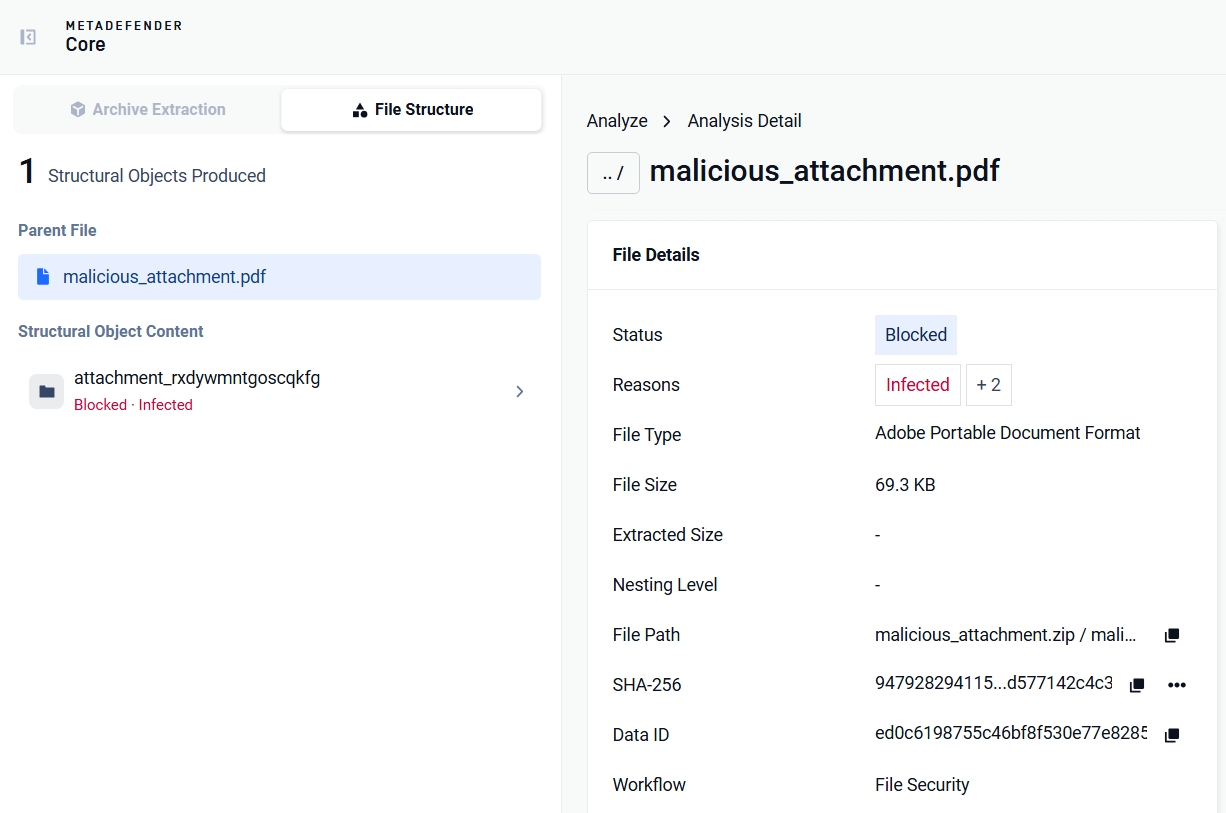
The clearest way to show this is a file that passes scanning and still carries a payload. We create a proof of concept where a malicious payload is hidden inside a benign PDF file. The sample then ran against a collection of anti-malware engines, which returned a clean result.

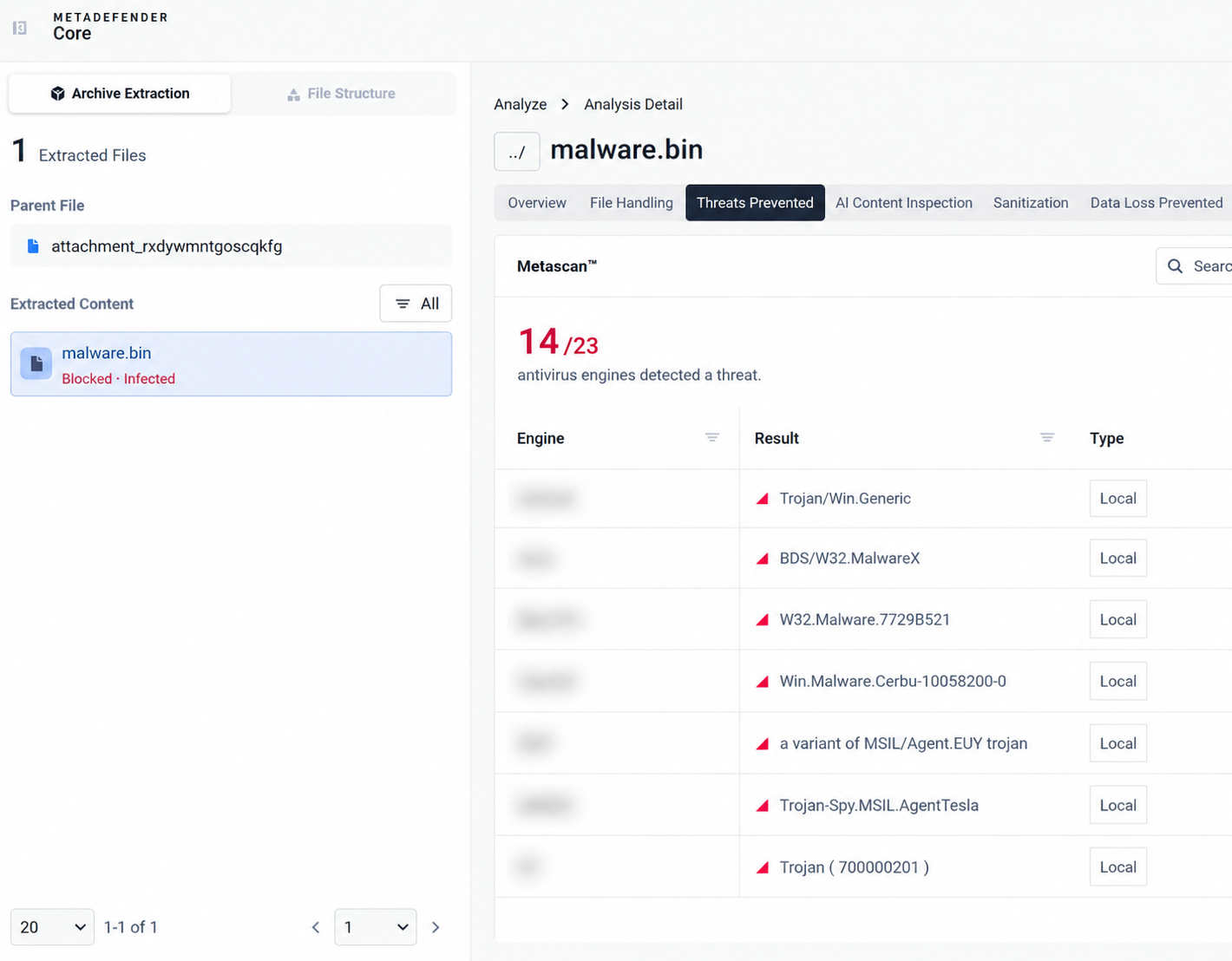
The next step, we scan this file in MetaDefender Core™ with File Structure Validation enabled. After extracting the nested components of the parent file, File Structure Validation sends the output objects to downstream engines for further analysis.
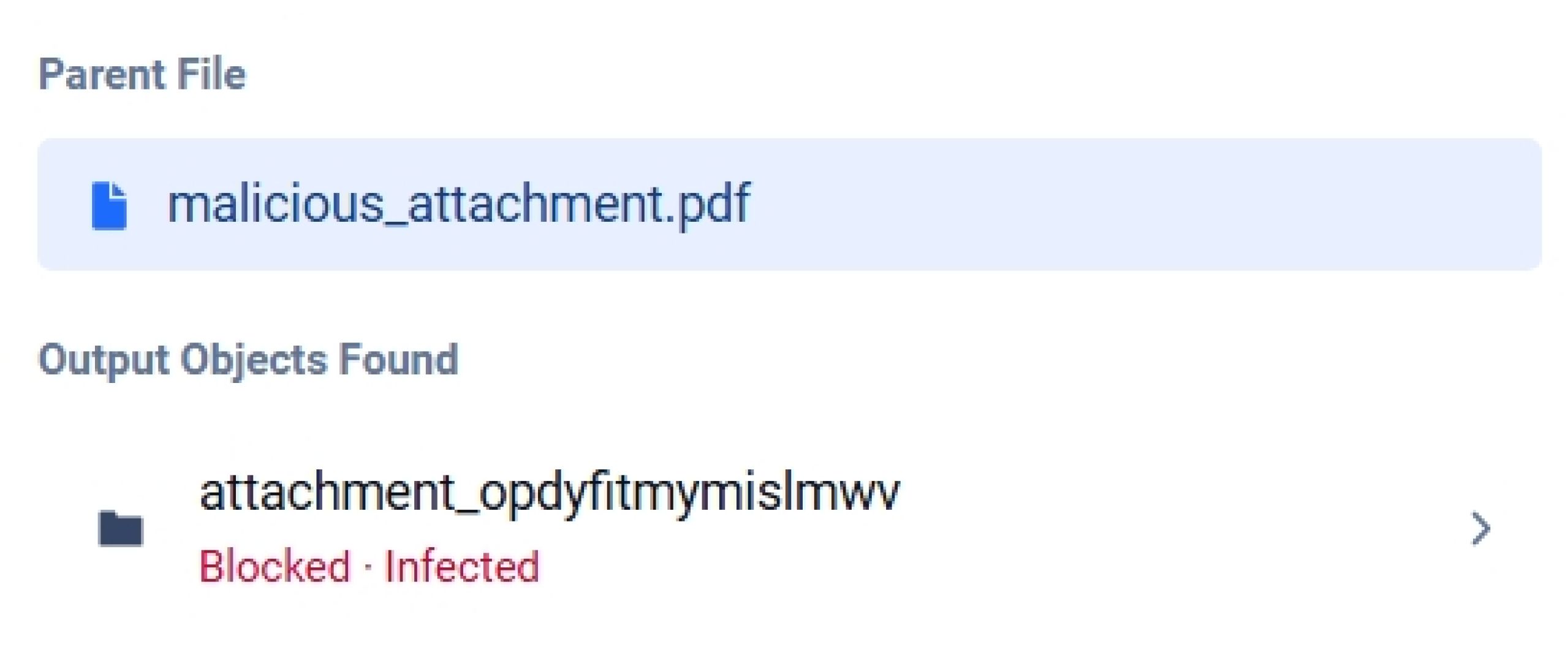
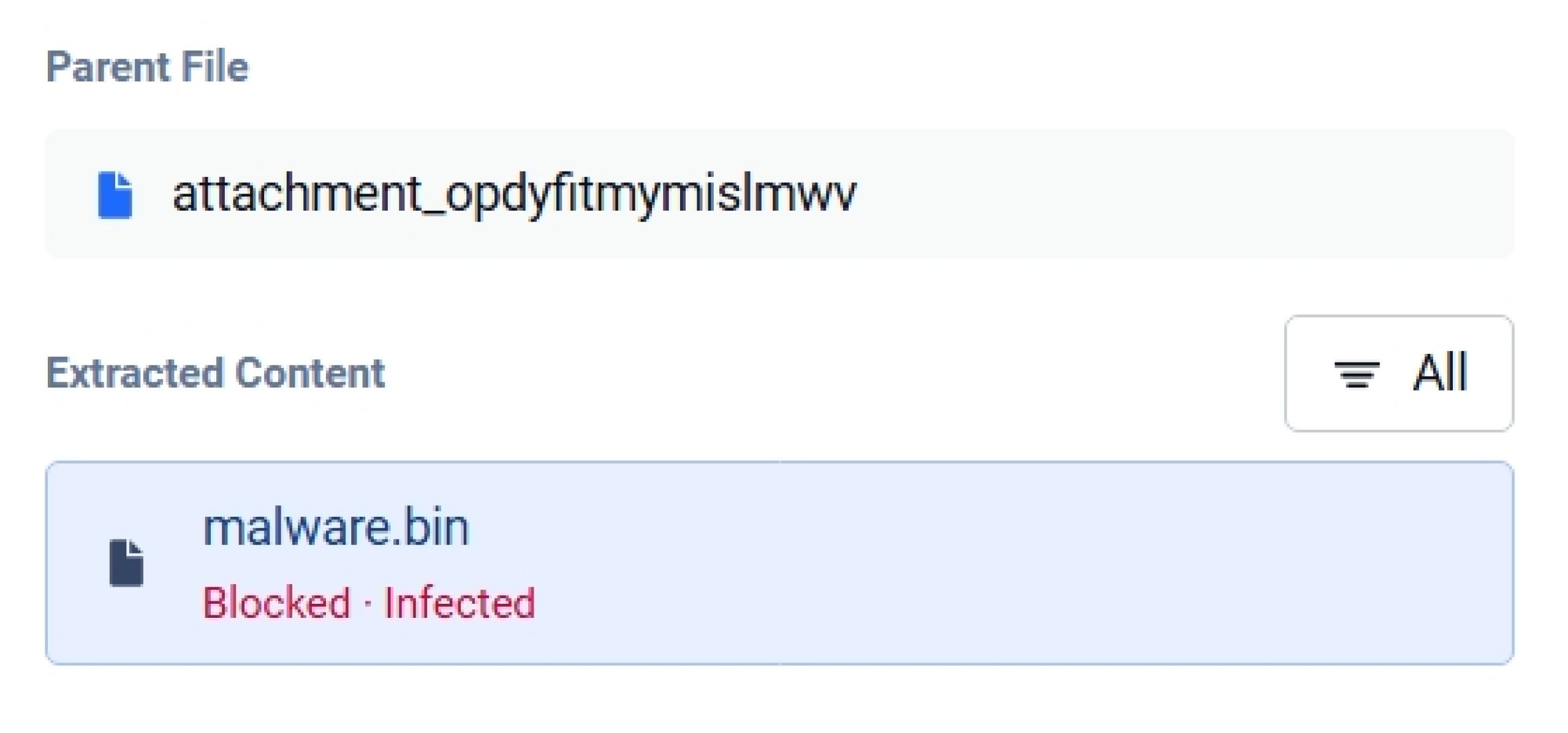
Metascan™ Multiscanning anti-malware engines reported an ‘Infected’ verdict. The same signature databases that reported no threats reported an infection once the payload was presented as a file in its own right.
Where to Start
A clean scan is a statement about what an engine could parse. Whether the file contains something dangerous is a separate question, and answering it is a structural problem that has to be solved before the first detection engine runs.
Whether that means File Structure Validation on its own or alongside sanitization and dynamic analysis depends on your file types, your workflows, and your integrity requirements. Talk to us about which combination fits your environment.