What is Zero-Day Detection?
Zero-day detection is the process of identifying malicious files before a matching signature for them exists in antivirus databases. Traditional antivirus tools are inherently reactive: they can only block threats their vendor has already cataloged. The gap between a threat's first appearance and the moment AV vendors produce a detection pattern is the window attackers operate in.
Key Takeaways
- According to OPSWAT's 2026 zero-day detection analysis of over one million file detections, traditional AV engines trailed zero-day detection by an average of 3.0 days, with worst-case exposure reaching 26.7 days
- Only 3.7% of zero-day threats were detected by traditional AV engines within 24 hours of first appearance
- Script and document file types consistently show the longest exposure windows, with Office documents averaging 6.9 days behind detection
- Approximately 20.8% of zero-days in the dataset were eventually caught by traditional AV engines; a significant portion had response times so long they represent effectively no protection
- MetaDefender Aether™ delivers a single, confidence-scored verdict per file using a five-layer detection pipeline that does not rely on pattern matching
Traditional Antivirus Has a Timing Problem
Traditional antivirus tools detect threats by matching files against a database of known malware signatures. A file that doesn't match any existing pattern may pass through unblocked. That structural dependency on prior knowledge creates a measurable, exploitable delay between when a threat appears and when AV can stop it.
According to our 2026 zero-day detection analysis of over one million file detections, traditional AV engines trailed zero-day detection by an average of 3.0 days, with a median of 2.0 days. Worst-case exposure reached 26.7 days. Only 3.7% of zero-day threats in the dataset were detected by traditional AV engines within 24 hours. Approximately 3% took longer than a week to receive any detection response.
A note on methodology: The 3.0-day average excludes files with very long AV response times and files with no pattern-match history whatsoever. The full dataset reflects a broader range of outcomes. A low but nonzero false positive ratio also exists in the underlying data.
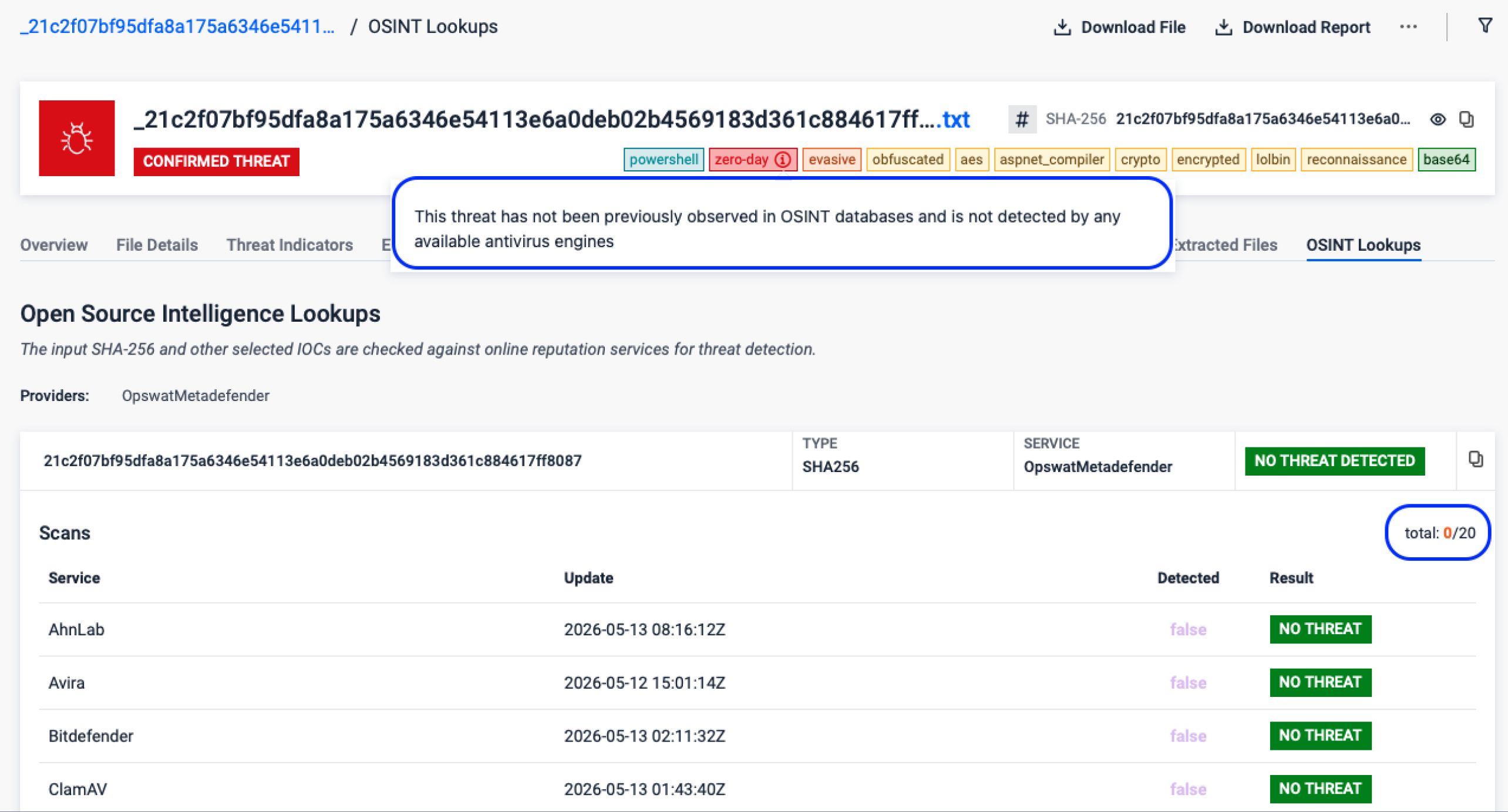
The data starts with moments like this one. At the time of scanning, none of the 20 AV engines we used flagged the file, and no reputation service had recorded it. The threat was already confirmed.
Most Zero-Days Never Match a Known Pattern
The timing problem compounds when AV engines never produce a matching signature for a threat at all. In our analysis, approximately 20.8% of zero-day files were eventually detected by traditional AV engines. Around 17.9% had no pattern-match history whatsoever, placing them fully outside the catalog of any AV engine analyzed. An estimated 54% had AV response times so extended that they represent effectively no protection in practice. It should be noted that this figure, like the others, carries a low but nonzero false positive ratio and should be treated as directional.
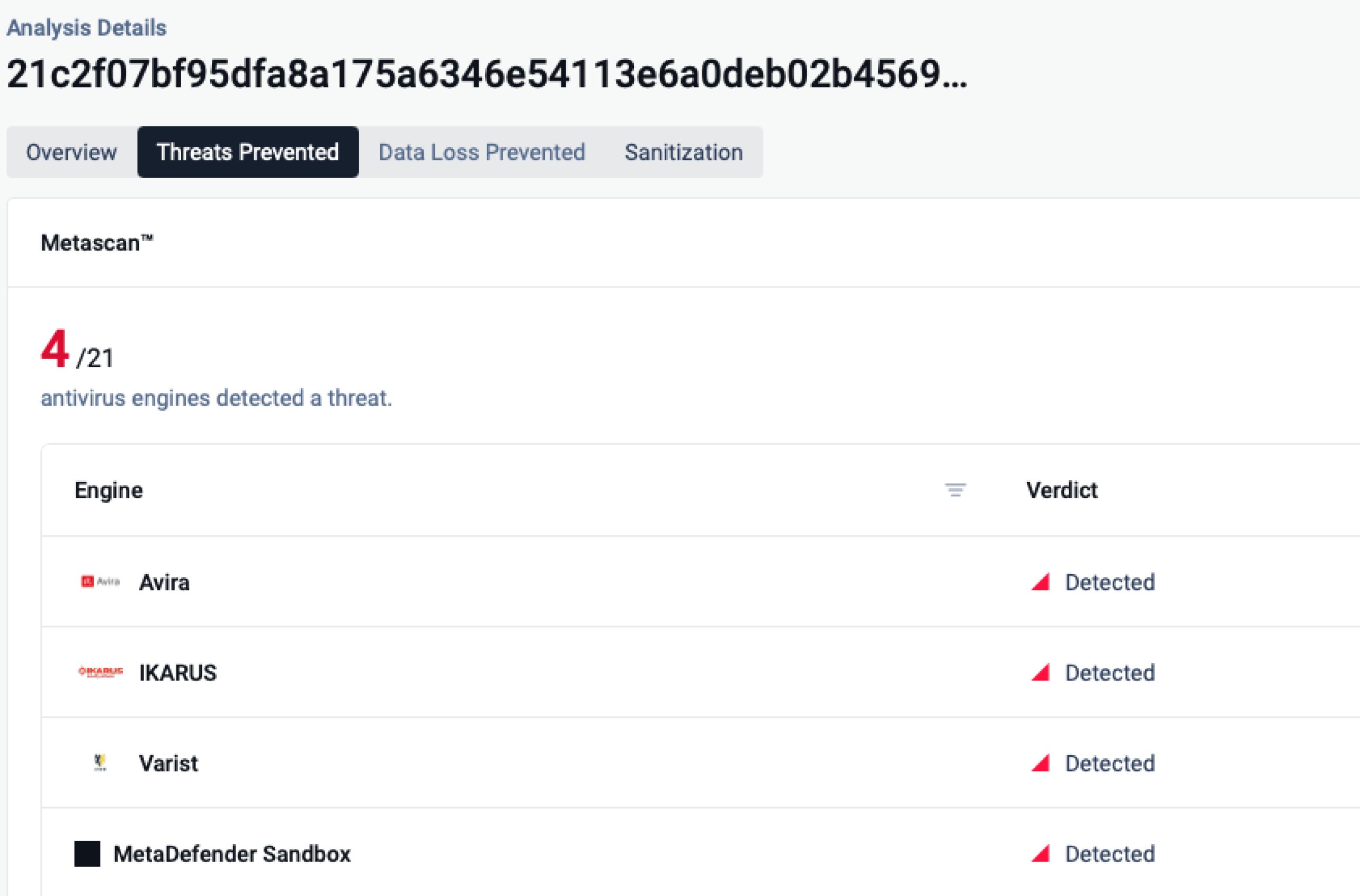
When AV engines do eventually catch up, the coverage remains limited. Rescanned later, only three of those 20 AV engines had produced a match for the same file. The majority still had nothing.
Pattern-based detection requires a vendor to observe, analyze, and catalog a threat before protection is possible. Against novel or deliberately obfuscated malware, that sequence may either never complete, or may complete too late to matter.
Where Traditional AV Detection Falls Furthest Behind
Not all file types carry equal risk when antivirus detection lags. Script-based and document-based files consistently show the longest exposure windows in our analysis, and these are file types that appear in nearly every enterprise workflow.
File Type | Avg. Days Before Threat Detection by Traditional AVs |
Office Documents | ~6.9 days |
PowerShell | ~6.3 days |
VBS Scripts | ~4.9 days |
HTA | ~3.5 days |
PE (Executables) | ~3.1 days |
Office documents and scripting formats top the list precisely because their complexity makes signature generation harder. Macros, embedded objects, and multi-stage execution logic give attackers more surface to work with and give AV vendors more ground to cover before a reliable pattern can be written.
PE (Portable Executable) files rank lowest on the lag table, yet they still averaged more than three days of undetected exposure. For executables entering critical infrastructure environments, patch pipelines, or regulated file flows, three days is not an acceptable window.
Why Traditional Detection Lags
Pattern-based detection works by comparing a file against a library of known malware signatures. When a match is found, the file is blocked. When no match exists, the file passes. The model depends entirely on prior exposure: a threat must be observed, analyzed, and cataloged before any protection is possible. Against a novel file, that sequence hasn't run yet.
The structural limitation has always existed. What has changed is the rate at which attackers can generate novel variants. Adversaries now use AI and machine learning to produce obfuscated, evasive malware at scale, creating files specifically designed to avoid matching any existing signature. Each generated variant is technically new to AV databases, even when the underlying attack logic is not.
Evasion techniques compound the problem further. Malware authors routinely craft files to avoid matching any cataloged threat at the point of entry, using techniques such as:
- Packing and encryption to obscure file contents
- Polymorphism to generate structurally unique variants
- Multi-stage delivery to defer malicious behavior until after entry
- Execution condition checks that suppress activity until a real endpoint is reached
Signature-based tools have no mechanism to anticipate any of these sequences. The result is a detection model that grows less effective as attacker tooling grows more sophisticated. The gap between first appearance and first detection does not close quickly on its own. Instead, it widens.
How We Detect Threats Before a Pattern Match Exists
MetaDefender Aether™ is a unified zero-day detection solution designed to identify malicious files that cannot be caught through signature matching alone. Rather than asking whether a file matches a known pattern, MetaDefender Aether asks five progressively deeper questions about every file that passes through it, combining the answers into a single, confidence-scored verdict.
Layer 1: Threat Reputation
Every file entering the pipeline is evaluated against the OPSWAT global threat intelligence databases. Known malicious files are blocked immediately. Trusted files are fast-tracked. In our analysis, this layer alone resolved 48.7% of threats, preserving pipeline capacity and avoiding unnecessary processing for files that don't require deeper inspection.
Layer 2: Pre-Execution Malicious Intent Prediction (via Predictive Alin AI)
Files that clear the reputation layer are evaluated by Predictive Alin AI, which analyzes structural, semantic, and behavioral indicators before execution, detonation, or runtime monitoring. This layer produces two outcomes: high-confidence clean files are deflected out of the sandbox queue, and high-confidence malicious files are blocked before execution, including threats traditional AV engines miss.
For supported high-risk executables, verdicts land at P90: 50ms and P99: under 100ms. Files that don't meet the confidence threshold continue to layer 3 rather than resolving on a weak verdict. The same engine also inspects supported AI/ML model files for embedded arbitrary code that could execute on load. It operates online or fully offline, including air-gapped environments.
Layer 3: Adaptive Sandboxing via Instruction-Level Emulation
Files that clear the reputation layer and aren't resolved by pre-execution prediction enter MetaDefender Aether's adaptive sandbox. Rather than using virtual machines, the sandbox emulates at the CPU and operating system instruction level across 120+ file types. This approach forces files to execute their full code path regardless of whether they detect a virtualized environment. VM-aware malware that would otherwise stay dormant cannot suppress its behavior under instruction-level emulation. Newly discovered IOCs (indicators of compromise) from this layer feed back into Layer 1, strengthening the reputation database with each analysis cycle.
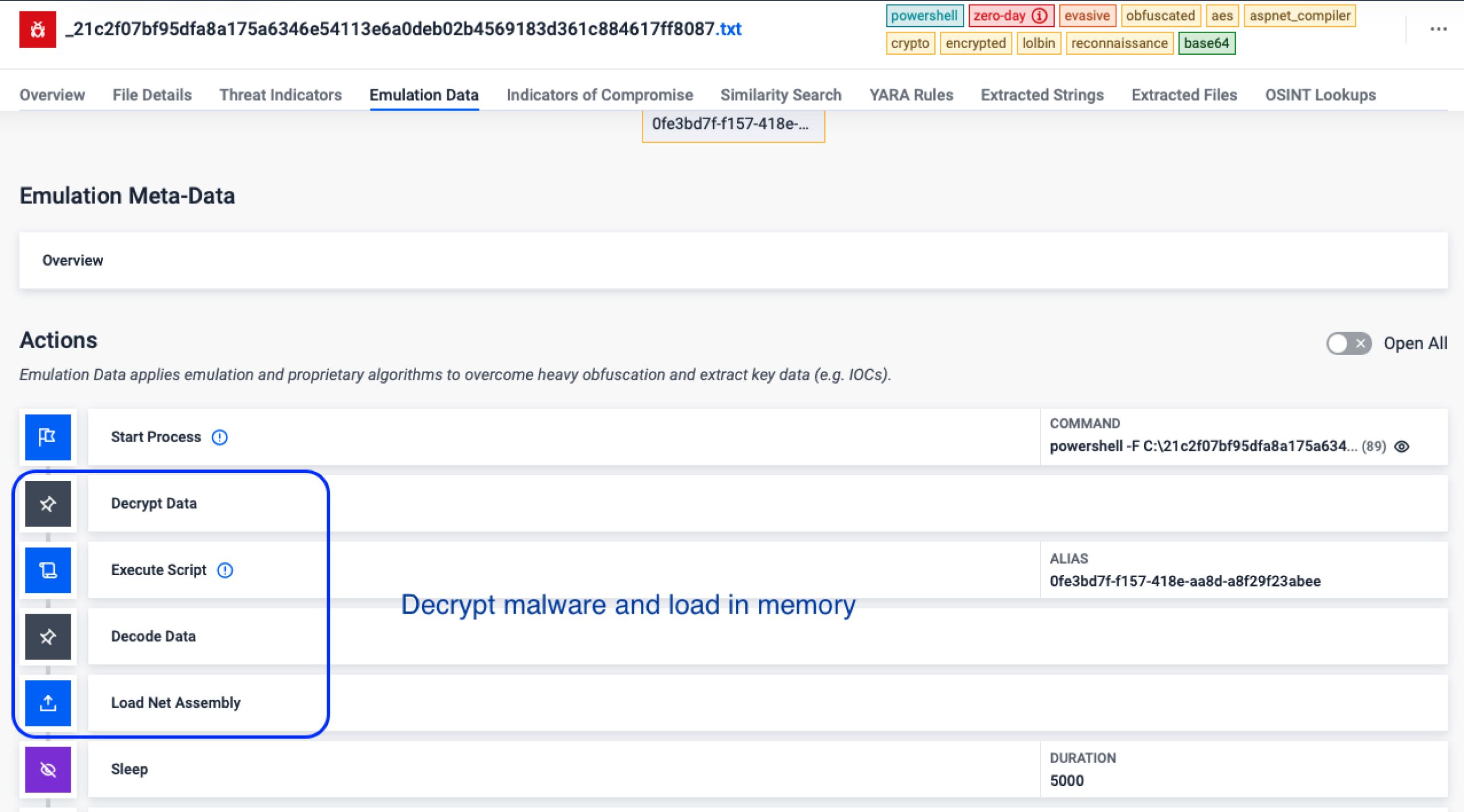
A signature engine sees an obfuscated script and finds nothing to match. Emulation makes the file execute regardless. The moment it decrypts its hidden payload and loads it into memory, the intent is visible.
Layer 4: ML-Driven Threat Scoring
Multiple machine learning engines analyze behavioral signals, anomaly patterns, and IOCs extracted from the sandbox layer. Each file receives a structured, confidence-weighted risk score. Raw telemetry is transformed into a clear decision signal, reducing false positives and minimizing the analyst review burden that fragmented tool outputs typically generate.
Scan your files for free using our detection engines at filescan.io/scan.
Layer 5: AI-Powered Similarity Search
The final layer maps each file's behavioral fingerprint against a database of more than 100 million analyzed malware samples. Files are automatically attributed to known threat families, campaigns, and attack toolkits where matches exist. Files with no prior match are converted into new intelligence, enriching both global and local detection models. This layer brings cumulative detection efficacy to 99.5% per current internal benchmark testing.
MetaDefender Aether vs Traditional Sandbox and AV Approaches
Traditional AV and VM-based sandboxes each address part of the zero-day detection problem, but neither delivers a unified verdict across reputation, pre-execution prediction, behavior, scoring, and similarity search. The table below compares how each approach performs across the capabilities that matter most at the perimeter.
Capability | Traditional AV Engines | VM-Based Sandbox | MetaDefender Aether |
Detection approach | Pattern-based | Behavioral (isolated) | Five-layer unified pipeline |
Evasion resistance | Low | Medium (VM detectable) | High (instruction-level emulation) |
Time to verdict | Zero to 26+ days lag | Variable | Near real-time |
SIEM/SOAR integration | Limited | Manual correlation | Structured, native |
Resource efficiency | Low | High compute | 100x vs VM-based sandbox |
Verdict type | Match/no-match | Per-tool report | Single confidence-scored verdict |
VM-based sandboxes improve on signature detection by observing file behavior at runtime. The limitation is that malware authors know this. Environment checks, timing delays, and VM fingerprinting allow sophisticated threats to detect sandbox conditions and withhold malicious behavior until they reach a real endpoint. Instruction-level emulation removes that evasion surface entirely.
The resource gap is also meaningful at the perimeter scale. VM-based sandboxing requires significant compute per file. MetaDefender Aether delivers 100x greater resource efficiency than VM-based approaches by combining instruction-level emulation with a layered pipeline that escalates only the files that require deeper analysis.
Read more about the key differences between traditional and adaptive sandboxes here.
When to Use Zero-Day Detection Instead of or Alongside Deep CDR™ Technology
Deep CDR™ Technology and MetaDefender Aether solve different problems. Understanding the distinction matters for security architects designing file inspection workflows, particularly in regulated or critical infrastructure environments.
Deep CDR™ Technology proactively disarms file-based threats by stripping potentially malicious content, including macros, scripts, and embedded objects, from more than 200 file types and regenerating a clean, fully usable version. This technology does not rely on detection. A file is sanitized whether or not a threat is ultimately confirmed. For document-based workflows where files can be safely reconstructed, Deep CDR™ Technology removes the threat before it has any opportunity to execute.
Read our previous article about how it works in more detail here.
MetaDefender Aether is the right tool when files cannot be altered. Executables, patch files, firmware, installers, and scripts must remain byte-for-byte intact to function. Sanitizing them is not an option. Regulated documents in healthcare, legal, and financial environments may also carry legal or compliance requirements that prohibit modification. For these file types, dynamic analysis is the only viable inspection path.
The two technologies are not an either/or choice. In practice, most enterprise and critical infrastructure environments handle both alterable and unalterable file types across the same workflows. Deep CDR™ Technology handles documents and office formats that can be safely reconstructed. MetaDefender Aether handles the files that cannot be modified. Together, they provide coverage across the full range of file types entering an environment.
Zero-day threats don't wait for a signature to exist, and neither should your defenses.
Frequently Asked Questions
What is the difference between zero-day detection and traditional antivirus?
Traditional antivirus detects threats by matching files against a library of known malware signatures. Zero-day detection identifies threats that have no existing signature by analyzing file behavior, reputation, and structural characteristics. MetaDefender Aether combines five analysis layers to deliver a verdict on files with a 99.5% efficacy that traditional AV tools would pass without flagging.
How long does it take traditional AV engines to detect a zero-day threat?
According to OPSWAT's 2026 zero-day detection analysis of over one million file detections, traditional AV engines trailed zero-day detection by an average of 3.0 days, with a median of 2.0 days. Worst-case exposure reached 26.7 days. Only 3.7% of zero-day threats received an AV detection response within 24 hours. The 3.0-day average excludes files with very long response times and files with no pattern-match history, so the full range of exposure is wider than this figure alone suggests.
What file types are the hardest for antivirus to detect?
Script-based and document-based file types consistently show the longest AV detection lag. In OPSWAT's 2026 analysis, Office documents averaged 6.9 days behind detection, PowerShell files averaged 6.3 days, and VBS scripts averaged 4.9 days. These file types appear across nearly every enterprise workflow, making the exposure window operationally significant.
How does instruction-level emulation defeat VM-aware malware?
VM-aware malware uses environment checks, timing delays, and virtualization fingerprinting to detect when it is running inside a sandbox and suppress its malicious behavior. Instruction-level emulation bypasses these techniques by emulating at the CPU and operating system level rather than running a full virtual machine. The file has no reliable way to distinguish the emulated environment from a real endpoint, making it significantly harder to suppress execution and exposing behavior that would otherwise remain hidden.
Does MetaDefender Aether replace a sandbox?
MetaDefender Aether includes adaptive sandboxing as one of its five detection layers, but it is not a standalone sandbox product. It combines threat reputation, pre-execution malicious-intent prediction, instruction-level emulation, ML-driven threat scoring, and AI-powered similarity search into a single pipeline that delivers one confidence-scored verdict per file. Organizations replacing a standalone VM-based sandbox with MetaDefender Aether gain evasion resistance, broader detection coverage, and significantly lower resource overhead.