AI-generated invoice fraud is a financial attack in which generative AI produces convincing fake invoices, receipts, and payment requests that contain no malicious code. Because the threat is fabricated business content rather than an executable payload, standard malware scanning, antivirus engines, and PDF security tools report the document as clean and pass it through.
Key Takeaways
- File scanning confirms a document is safe to open, not safe to pay. Malware engines and PDF checks detect executable threats; they cannot assess whether business content is authentic or fabricated.
- AI now generates invoices that are visually and structurally convincing at scale. Metadata anomalies, layout inconsistencies, and content signals are the detection surface, not malware signatures.
- Detecting fabricated invoices requires controls at three layers. File-level authenticity analysis, supplier record validation, and workflow-level exception routing must work together before documents reach AP (accounts payable).
- OPSWAT's AI Content Inspector adds a content authenticity verdict inside the existing MetaDefender™ pipeline. No new vendor or integration is required to add document authenticity checking alongside scanning and sanitization.
What AI-Generated Invoice Fraud Looks Like in Modern Finance Workflows
Attackers using generative AI do not need to embed malicious code in a document. The goal is to produce a document convincing enough to be approved. Generative AI can now replicate supplier branding, produce plausible line-item detail, and match transaction formats at scale, all without any payload that security tools are designed to detect.
How These Documents Enter Finance Workflows
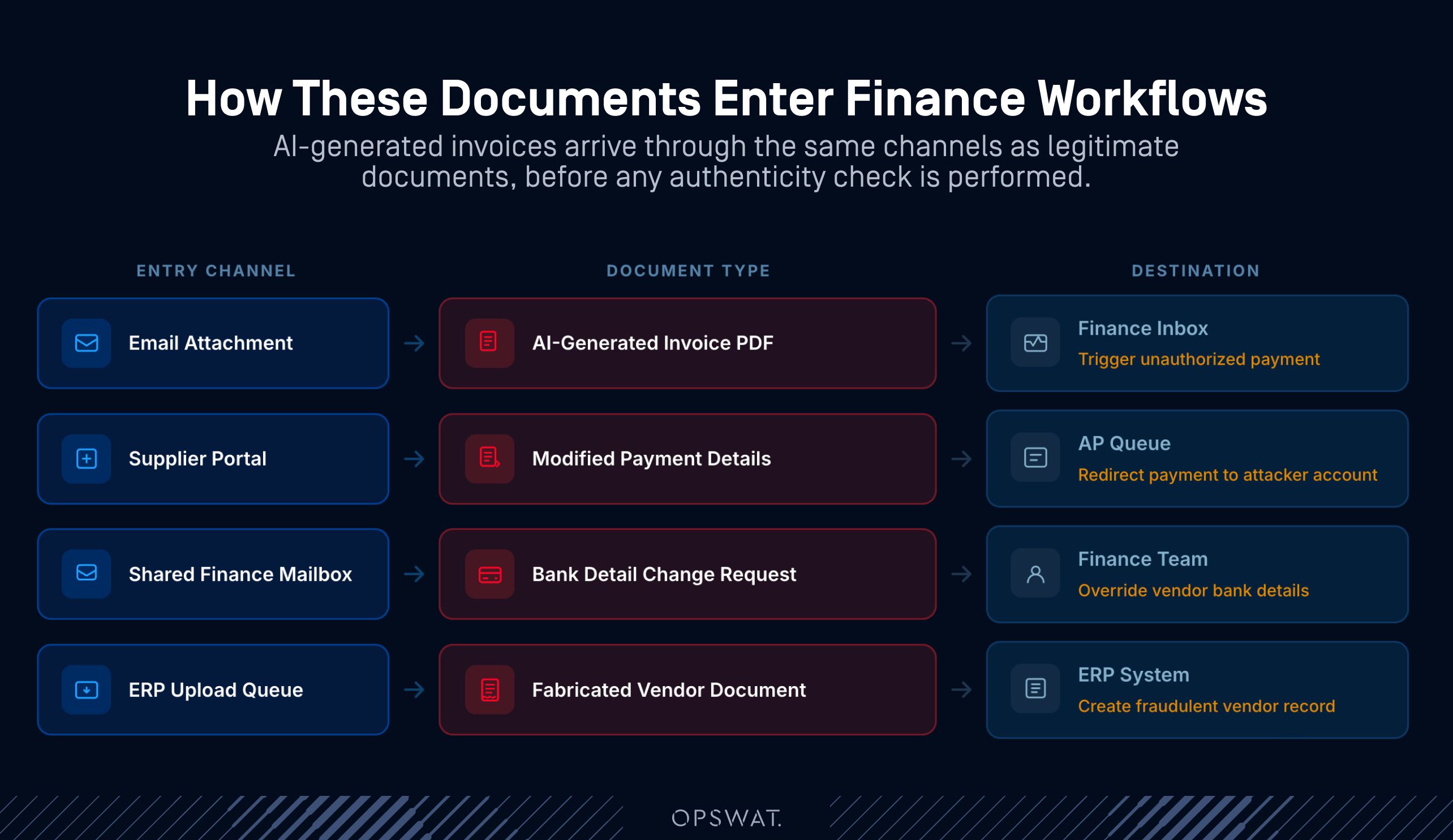
AI-generated invoices typically arrive through the same channels as legitimate ones: emailed PDF attachments, supplier portals, shared finance mailboxes, and manual upload queues connected to enterprise resource planning systems.
The document enters the review pipeline before any approver or automated matching system has evaluated whether the vendor relationship, PO (purchase order), or payment instruction is real.
How AI-Generated Invoice Fraud Differs from Business Email Compromise
Business email compromise typically depends on account takeover or email impersonation to redirect a payment. AI-generated invoice fraud does not require access to any email account. The document itself is the attack vehicle. A convincing fake invoice can succeed even when it arrives from an unfamiliar sender, because the approver evaluates the document content rather than the sender context.
Both threats can be layered. A spoofed or compromised email carrying an AI-generated invoice reinforces the deception at the sender and content layers simultaneously, making detection harder at any single control point.
Why File Scanning Cannot Detect Fabricated Invoice Content
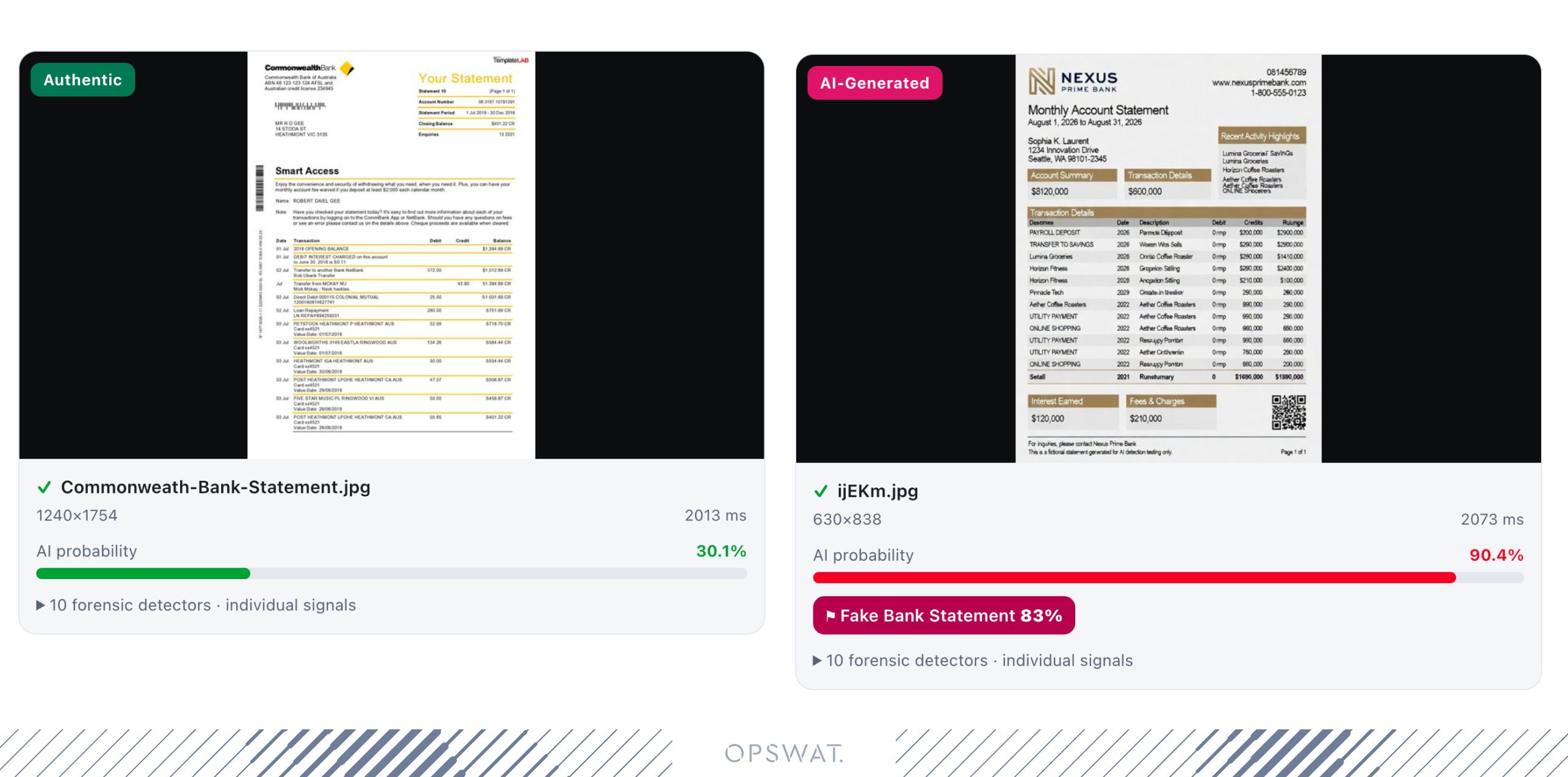
Antivirus engines, PDF malware scanners, and static file analysis tools detect whether a file contains malicious code or exploits. An AI-generated invoice contains neither. The file is a normal PDF or image with normal fonts, normal structure, and normal business text. Every tool that evaluates whether a file is safe to open will return a clean verdict, because on that question, the file is clean.
The Safe-to-Open vs Safe-to-Pay Distinction
Safe-to-open means a file contains no malware, exploits, or unsafe active content. Safe-to-pay means the invoice represents a real obligation from a real supplier for goods or services that were actually ordered and received. These are entirely different questions. File security tools answer the first. Finance controls are supposed to answer the second.
AI-generated invoice fraud exploits the gap between those two questions. A document that passes every file security check can still carry a fraudulent payment instruction that no malware scanner is designed to identify.
Why OCR and Metadata Extraction Do Not Prove Document Authenticity
OCR (optical character recognition) extracts text accurately while providing no information about whether that text represents a real transaction. Metadata extraction surfaces creation tool and timestamp signals, which help but do not produce a trust verdict on document provenance. Both are useful inputs into a detection pipeline, but neither is a substitute for content authenticity analysis.
Which Signals Can Expose AI-Generated Invoices Before Approval
AI-generated documents leave detectable signals across four categories. No single signal is conclusive, but multiple signals in combination support a confidence-scored authenticity verdict that can route suspicious documents for human review before they reach AP (accounts payable).
Signal Category | What to Look For | Why It Matters |
Metadata and file structure | Creation tool inconsistent with supplier's known software, edit history anomalies, inconsistent document producer metadata, unusual rendering paths | Legitimate supplier invoices from an established vendor show predictable structural characteristics; AI-generated documents often show tool or metadata mismatches not visible to the human reviewer |
Layout and visual consistency | Font drift between sections, spacing irregularities, logo artifacts, alignment errors, repeated visual patterns from generative output | AI image and document generators can produce visually convincing output that still contains subtle consistency failures across the document structure |
Content and semantic signals | Line-item totals that do not match subtotals, tax calculations inconsistent with jurisdiction, remittance details that differ from supplier master data, unusual payment terms for the claimed supplier | Generative AI may produce plausible-looking numbers that fail arithmetic validation or comparison against the supplier's historical billing patterns |
How Image Detection Works
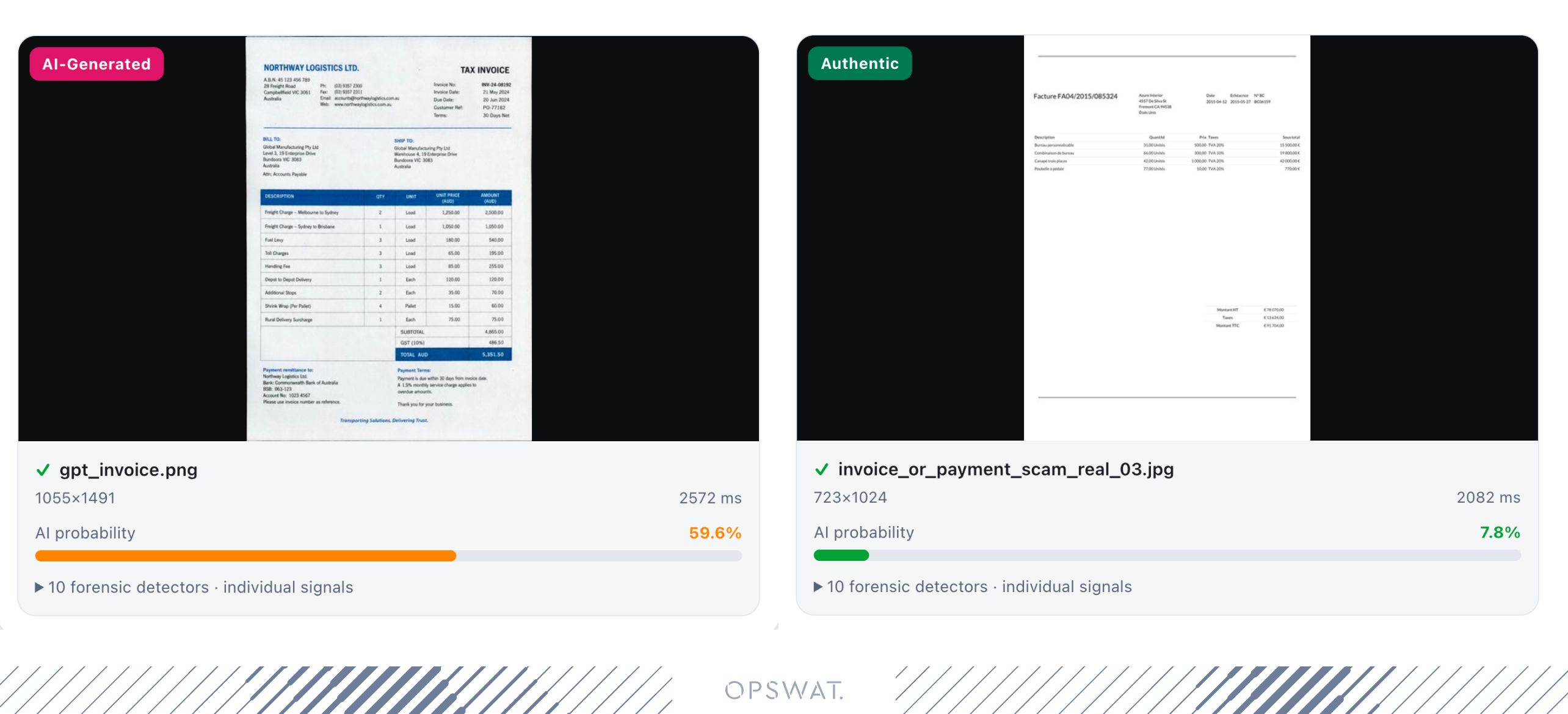
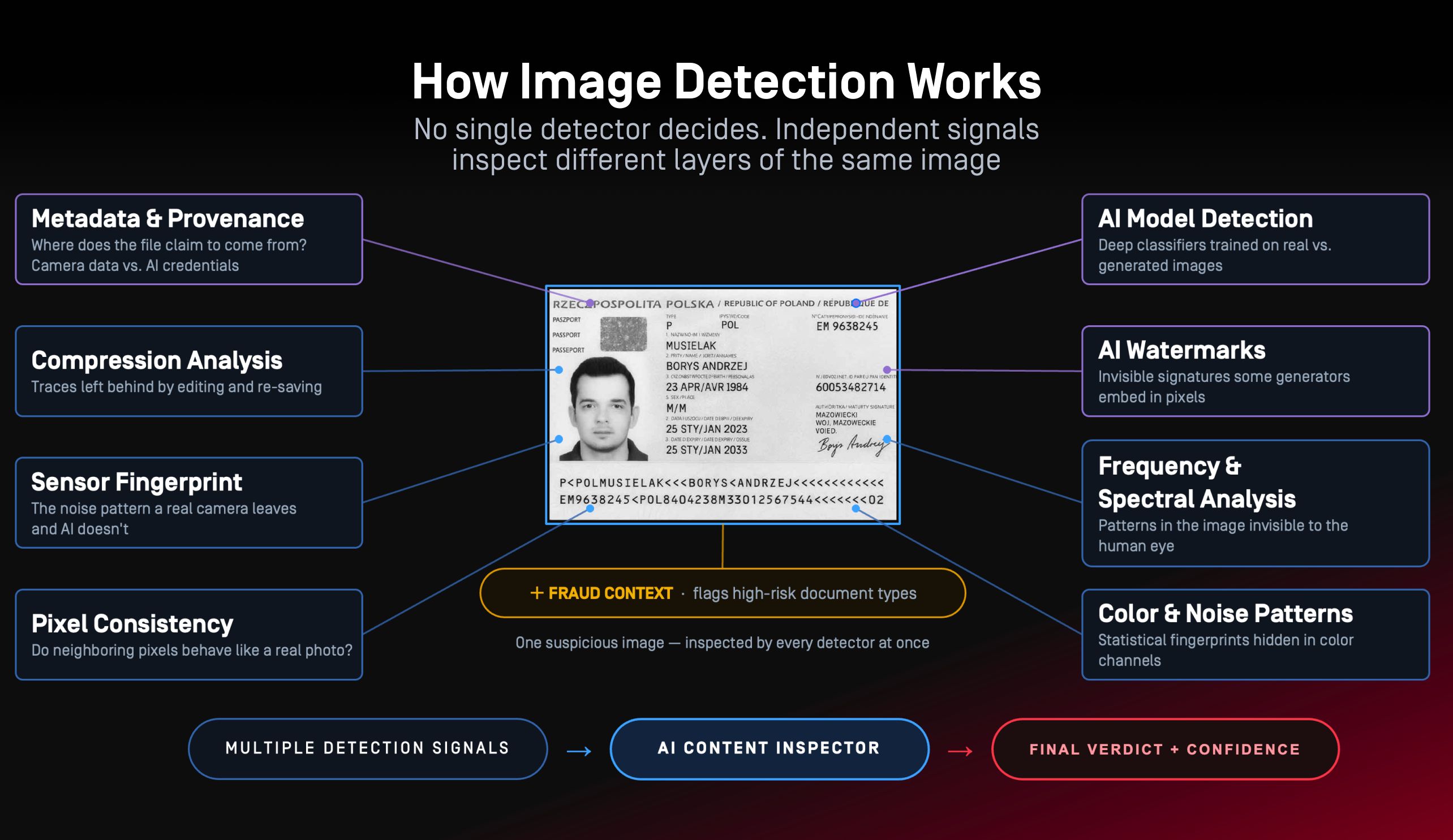
Each submitted image is inspected across eight independent signals simultaneously. No single detector decides the outcome. The engine checks where a file claims to come from — camera data versus AI-generated credentials — and looks for compression traces left behind by editing and re-saving.
It evaluates the sensor fingerprint: the noise pattern a real camera produces that AI-generated images don't. Neighboring pixel behavior, color channel statistics, and frequency patterns invisible to the human eye each run as separate signals. For files from known AI generators, the engine also checks for embedded watermarks such as Google SynthID.
A fraud context layer flags high-risk document types before a verdict is issued. In testing, OPSWAT stripped SynthID markers from over 21,000 AI-generated images. The watermark detector flagged none of them but forensic and deep classification signals still returned above 90% detection accuracy, confirming that the engine doesn't depend on watermarks or metadata alone.
Across more than 1.1 million images tested against output from over 20 AI models, overall accuracy reached approximately 95%. Uncertain results return a confidence score and route to human review rather than an automatic block.
How Text Detection Works
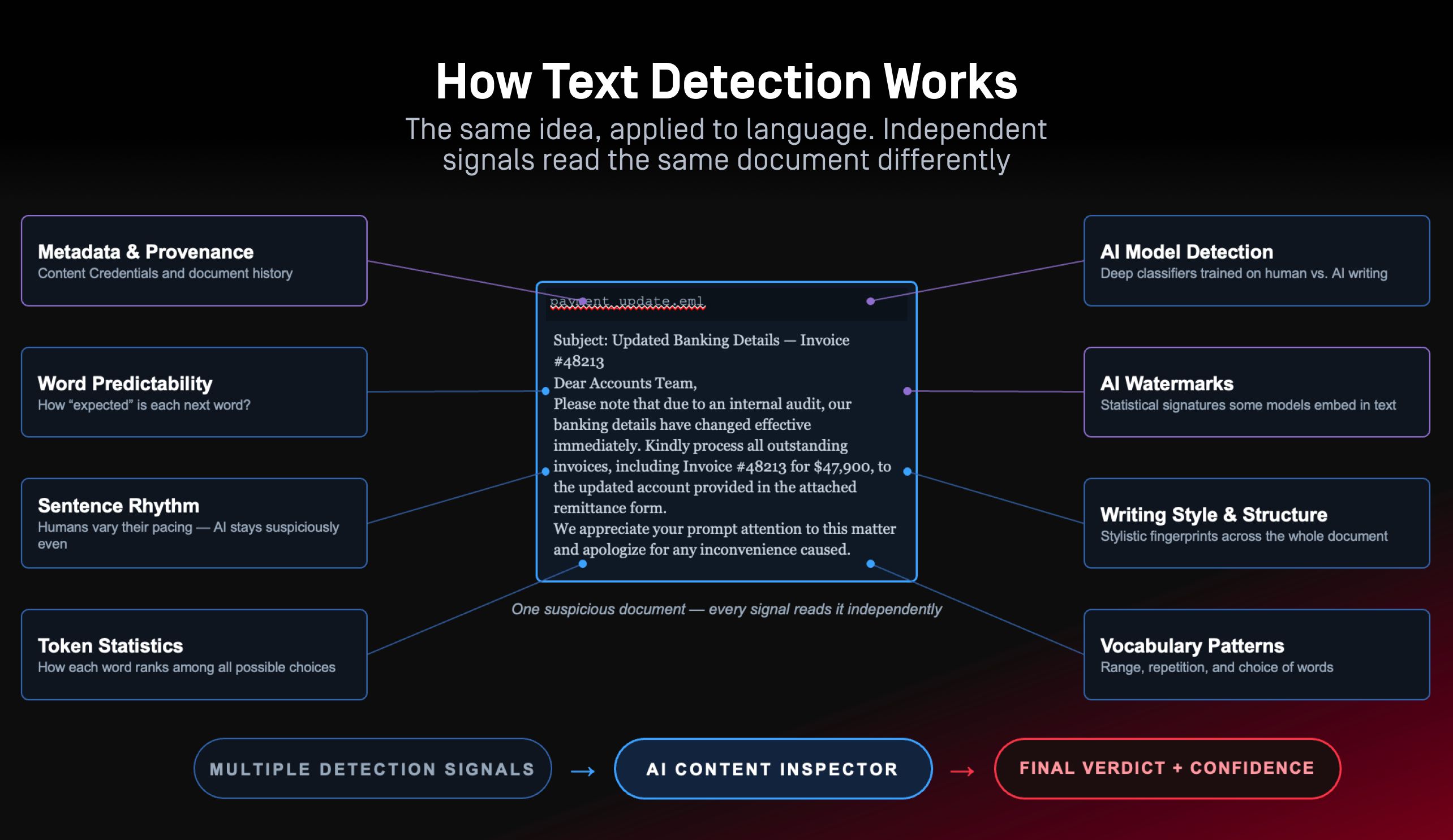
Text inspection works on the same principle as image inspection: eight independent signals read the same document simultaneously, each looking for something different.
Word predictability measures how expected each next word is. Sentence rhythm checks whether pacing varies the way human writing does. AI text stays suspiciously even. Token statistics track how each word ranks among all possible choices at that point in the text. Vocabulary patterns evaluate range, repetition, and word choice across the full document. Writing style and structure look for stylistic fingerprints that hold across the document as a whole.
Metadata and provenance check Content Credentials and document history. AI model detection runs classifiers trained on human versus AI writing. Some models also embed statistical signatures directly in their output. The engine checks for those too. Above 90% detection accuracy was achieved in testing against output from OpenAI, Anthropic, Llama, Mistral, and Meta models.
How Supplier Record Validation Adds a Second Detection Layer
File-level signals assess whether the document looks authentic. Supplier record validation assesses whether the claimed relationship is real.
Matching the vendor name, tax identification, remittance account, and contact details against approved vendor master data catches fraudulent invoices that are structurally clean but reference a supplier that does not exist, has different banking details on file, or is being contacted from an unauthorized address.
How to Verify Invoice Authenticity Before Accounts Payable Approves Payment
Purchase Order and Goods Receipt Matching
Two-way matching confirms that an invoice references a real purchase order. Three-way matching adds confirmation that goods or services were received before approval is granted.
Invoices that arrive without a matching purchase order, with amounts outside the contracted range, or for services not confirmed as delivered should be quarantined for review rather than routed directly to the payment queue.
Exception Handling for Bank Detail Change Requests
Bank detail change requests are the highest-risk document type in any finance workflow. A request to change beneficiary account details, routing numbers, or remittance instructions should never be processed through the standard invoice approval path.
Out-of-band verification, such as a callback to a known contact at the supplier using independently sourced contact information, dual authorization, and a mandatory hold period, are appropriate controls for this scenario regardless of how convincing the supporting documentation appears.
How to Build a Zero-Trust Invoice Workflow Before Files Reach Finance Systems
A prevention-first invoice fraud framework places controls at every document entry point and evaluates authenticity before files reach accounts payable inboxes, ERP (enterprise resource planning) ingestion queues, or automated payment systems.
Control Layer | Placement | What It Evaluates | Fraud Vectors Addressed |
Email and attachment inspection | Email gateway or secure email platform | Sender reputation, domain authenticity, DMARC alignment, attachment type and naming patterns | Spoofed supplier email, lookalike domains, first-time high-value senders |
File-level authenticity analysis | Document ingest point before ERP or AP system | Metadata integrity, structural consistency, content authenticity verdict, manipulation indicators | AI-generated PDFs, manipulated images, altered invoice documents |
Malware scanning and sanitization | Same inspection pipeline as authenticity analysis | Malicious code, exploits, unsafe active content, macro payloads | Traditional document-borne malware delivered alongside fraudulent invoices |
Supplier and PO validation | Before AP approval queue | Vendor master data match, PO existence, goods receipt confirmation, historical billing comparison | Fictitious vendor invoices, unauthorized payment redirects, out-of-contract billing |
Exception routing and dual control | High-risk document queue | Bank detail changes, first-time vendors, amounts above threshold, authenticity flag from earlier layers | Bank detail fraud, new vendor impersonation, urgent payment social engineering |
When Document Authenticity Controls Are Required
Document authenticity controls are appropriate at any point where a fabricated document could trigger a financial transfer. High-priority entry points include supplier invoice intake via email, vendor onboarding portals, bank detail change request forms, and any manual upload queue connected to an ERP or payment system.
Organizations that have migrated invoice processing to structured e-invoicing networks still require authenticity controls during the transition period and for document categories that remain outside the structured network, such as one-time supplier invoices, service agreements, and contractor submissions.
How OPSWAT’s AI Content Inspector Adds Document Authenticity Detection to MetaDefender
OPSWAT’s AI Content Inspector is OPSWAT's AI-driven content authenticity and document fraud detection engine for images, PDFs, and text-bearing files. It adds content verification directly into the MetaDefender™ file inspection pipeline, alongside existing technologies such as Metascan™ Multiscanning, Deep CDR™ Technology and Proactive DLP™. Organizations already using the MetaDefender platform can add document authenticity verdicts without deploying a separate vendor, negotiating a new agreement, or building a new integration.
For finance and procurement workflows, AI Content Inspector provides a clean, suspicious, or AI-generated verdict for every PDF invoice, receipt, or bank detail change request entering through email or an upload portal, before the document reaches an accounts payable approver or ERP ingestion queue. Suspicious documents are routed for human review rather than released into the payment workflow.
According to the Association for Financial Professionals 2026 Payments Fraud and Control Survey, 76% of organizations experienced attempted or actual payments fraud in 2025, with the average loss per incident reaching 133,000 USD. Prevention-first controls that intercept fraudulent documents at the point of ingest reduce exposure without disrupting invoice processing for legitimate suppliers.
Discover how OPSWAT’s AI Content Inspector with document authenticity detection fits into your current file inspection architecture.
FAQs
What makes AI-generated invoices harder to detect than traditional fake invoices?
Traditional fake invoices typically failed on formatting, branding, or transaction detail quality. AI-generated invoices use generative models to replicate supplier branding, produce contextually plausible line items, and scale production without manual effort. The result is a document that is visually and contextually convincing and contains no malware, which means it passes every security control that evaluates only whether a file is safe to open.
Can antivirus or email security tools detect AI-generated invoice fraud?
Standard antivirus and email security tools are designed to detect malicious code, phishing links, and impersonation signals in message headers. An AI-generated invoice PDF contains none of those. Detection requires controls that evaluate content authenticity and business context, not whether the file is technically malicious.
What is the difference between file sanitization and document authenticity verification?
File sanitization using Deep CDR™ Technology removes active content, macros, and embedded objects from a document and reconstructs a structurally clean version. Document authenticity verification evaluates whether the content represents a genuine document from the claimed source, using metadata, structural, and content signals. Both controls address different attack vectors and should run together in the same inspection pipeline.
Which document types carry the highest AI-generated fraud risk?
PDF invoices, remittance advices, receipts, and bank detail change request forms are the primary targets because they directly trigger financial transfers. AI can also generate convincing supplier onboarding documents, contract addenda, and delivery confirmations that establish a fraudulent relationship before a payment request is submitted. Any document that, if accepted, results in a payment or a change to payment instructions should be treated as high-risk.
How do you investigate a suspected AI-generated invoice fraud attempt?
Preserve the original file artifact, email headers, and any metadata extracted during inspection. Capture the content authenticity verdict, structural analysis results, supplier master data comparison output, and the routing decision log. Cross-reference the claimed vendor against approved vendor records and purchase order history. The combination of file-level evidence and workflow audit records supports both internal investigation and any external reporting requirements.
AI-generated invoice fraud is already scaling faster than manual review can handle. Adding document authenticity detection to your existing MetaDefender inspection pipeline closes the safe-to-open vs safe-to-pay gap without requiring new vendors or rebuilding your finance intake architecture.