Zero-day detection is the process of identifying unknown malware with no existing signature and no prior analysis record. At government network perimeters, where executables, patch files, and regulated documents must pass inspection without modification, effective zero-day detection requires instruction-level emulation to expose threats that fingerprint virtual environments and stall analysis before executing.
Key Takeaways
- Traditional VM-based sandboxes are vulnerable to environment fingerprinting, time-based delays, and debugger checks, whereas modern malware uses these techniques to evade analysis before executing malicious behavior
- MetaDefender Aether™ achieves a 99.5% zero-day detection rate through a five-layer pipeline: threat reputation, static analysis, dynamic analysis, threat scoring, and threat hunting
- Instruction-level emulation processes files 40x faster than traditional sandboxes, with a P90 target under 15 seconds and throughput of 50,000 files per day per server
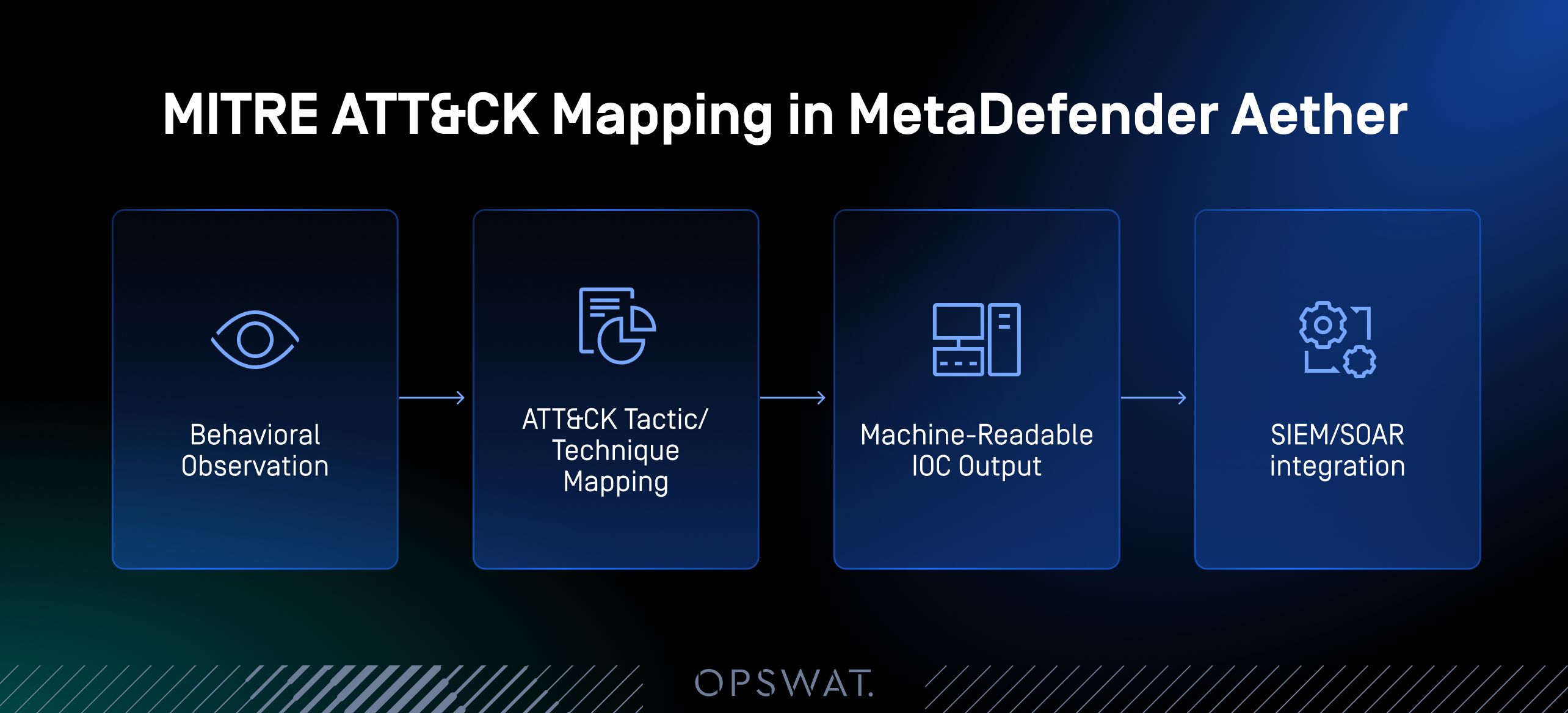
- MetaDefender Aether observes malicious behaviors against MITRE ATT&CK tactics and techniques, providing a standardized framework for triage acceleration, incident reporting, and threat intelligence sharing
- Machine-readable IOC outputs feed directly into SIEM and SOAR workflows, including Splunk, Cortex XSOAR, and CEF Syslog
Why Government Networks Are High-Value Zero-Day Targets
Government networks are among the most targeted environments for zero-day attacks because of what they hold: sensitive systems, classified data, and critical services that adversaries cannot reliably access through known exploits.
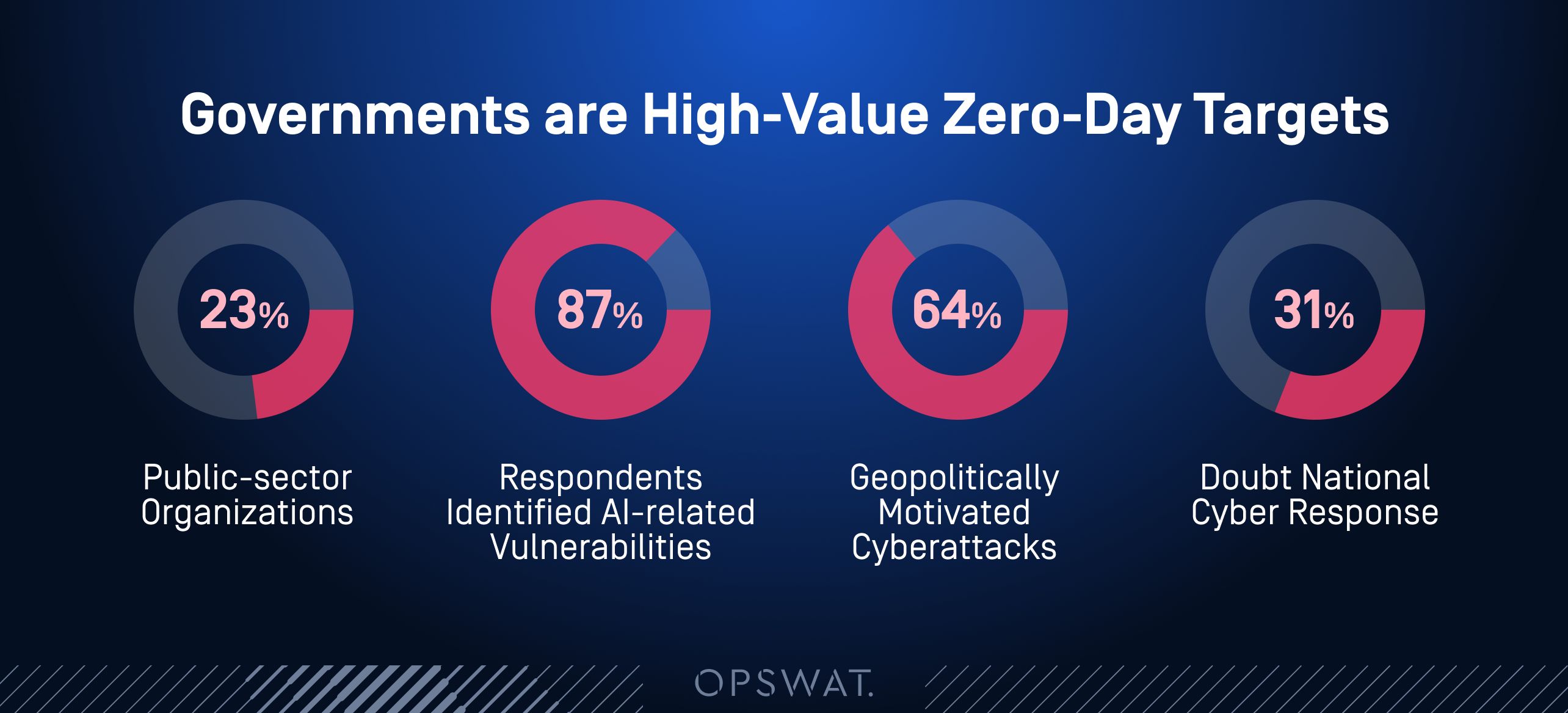
According to the WEF Global Cybersecurity Outlook 2026, 23% of public-sector organizations report insufficient cyber resilience, leaving them disproportionately exposed when sophisticated threats bypass perimeter defenses. Confidence in national preparedness is also eroding: the same report finds that 31% of global respondents report low confidence in their nation's ability to respond to major cyber incidents, up from 26% in 2025.
AI is accelerating the threat surface. According to the same report, 87% of respondents identified AI-related vulnerabilities as the fastest-growing cyber risk. Threat actors are using AI to improve targeting, automate exploit generation, and adapt attacks in near real time, outpacing the static detection tools that many government networks still rely on.
The Compounding Risk for Public Sector Defenders
Government defenders face structural conditions that amplify zero-day risk beyond what most private-sector environments encounter. Legacy infrastructure, constrained budgets, and expanding OT/IT convergence create detection gaps that are difficult to close incrementally. AI-assisted adversaries exploit those gaps with increasing precision and speed.
The geopolitical dimension adds further pressure. According to the WEF report, 64% of organizations globally are now accounting for geopolitically motivated cyberattacks, including critical infrastructure disruption and espionage, with the public sector consistently identified as a primary target. The same report highlights accelerating vendor diversification and supply chain file transfers as a growing and under-scrutinized attack surface at the network perimeter, particularly as governments reconfigure data-hosting arrangements in response to geopolitical pressure.
Traditional VM-Based Sandboxes Fail Against Evolving Evasion
Traditional VM-based sandboxes detonate files inside a virtualized operating environment and record the resulting behavior. Advanced malware is engineered to identify that environment before executing, using a range of detection techniques to recognize analysis conditions and suppress malicious activity. The result is incomplete behavioral data, inconsistent verdicts, and threats that pass through the perimeter undetected.
A national government agency with more than 3,000 employees across civilian and restricted environments encountered exactly this failure with their legacy VM-based sandbox. Evasive malware detected their virtual environment and suppressed its behavior, leaving analysts with incomplete data and reports that required manual interpretation. Over time, this slowed investigations and weakened verdict confidence across both SOC and CERT teams.
Evasion techniques that VM-based sandboxes cannot reliably defeat
- Time-based delays: Malware exploits the fact that VM-based environments have observable timing patterns and waits out the sandbox's analysis window before executing
- Red-pill instructions: Malware queries hardware registers, CPU features, and memory layouts that behave differently in virtualized environments and uses the results to confirm it is under analysis
- Debugger checks: Malware inspects process lists, API call patterns, and system flags for the presence of analysis tools and halts execution when they are detected
- Execution stalls: Malware waits for specific user interactions or system idle states that rarely occur in automated sandbox runs, preventing behavioral triggers from firing
Detection outcomes for government security operations
Capability | VM-Based Sandbox | MetaDefender Aether |
Anti-VM evasion resistance | Vulnerable to environment fingerprinting; malware can detect virtualized hardware and suppress execution before malicious behavior runs | Neutralized; the emulator uses no real hardware or OS timing, removing the signals malware relies on to identify analysis environments |
Anti-debug evasion resistance | Vulnerable to debugger detection; malware that identifies analysis tools halts execution before IOCs are generated | Neutralized at the instruction level; the emulator does not expose the process and API signatures that debugger-aware malware checks for |
Time-based delay bypass | Waits out the delay; analysis windows are finite, and malware that stalls long enough bypasses behavioral observation entirely | Skips the delay by simulating only the components required for execution, without being constrained by real clock timing |
Network traffic capture | Captures network traffic via PCAP, which cannot extract intent from encrypted or obfuscated communications | Captures network intent at the API and memory level, making C2 indicators and exfiltration logic extractable even when traffic is encrypted or obfuscated |
Analysis consistency | Variable across VM states; environmental differences between runs produce inconsistent behavioral outputs and increased analyst noise | Deterministic and repeatable; the same file produces the same result across multiple executions and OS paths, supporting audit trails and chain-of-custody requirements |
Processing speed | Slower and resource-intensive; full OS emulation adds overhead that limits throughput in high-volume environments | 40x faster than traditional sandboxes, with a P90 target under 15 seconds per file |
False positive risk | Higher; VM state variation produces inconsistent verdicts and increased analyst noise, eroding confidence in detection outputs over time | Lower; deterministic analysis delivers consistent verdicts across executions, increasing verdict confidence and reducing the manual review burden on analysts |
How MetaDefender Aether's Instruction-Level Emulation Works
MetaDefender Aether™ is OPSWAT's unified zero-day detection solution designed to identify advanced and unknown threats at the network perimeter through a five-layer threat processing pipeline combining threat reputation, static analysis, dynamic analysis, threat scoring, and threat hunting. MetaDefender Aether's Adaptive Sandbox operates at the instruction level, interpreting file execution component by component instead of emulating a full operating system environment, all without running a real OS or exposing the hardware signals that evasive malware looks for.
Realistic Execution Environment
MetaDefender Aether does not run a full operating system or rely on virtualized hardware. The emulator simulates only the components required for a given file to execute, interpreting behavior at the CPU instruction level. This eliminates the OS fingerprints and hardware signals that evasive malware uses to detect analysis environments, while enabling faster and more resource-efficient detection than full-system virtualization.
Comprehensive Behavioral Monitoring
To achieve their objectives, malware samples must interact with the host environment: manipulating registry entries, creating or injecting processes, invoking APIs, allocating memory, and initiating network operations. MetaDefender Aether monitors all of these interactions throughout execution. Because behavior is intercepted at the instruction level, evasion attempts do not prevent observation. The behaviors must still occur, and the emulator captures them regardless.
Behaviors monitored by MetaDefender Aether include:
- Registry read, write, and delete operations
- Process creation, termination, and injection
- API calls and system service invocations
- Memory allocation, modification, and shellcode execution
- Network connection attempts, DNS resolution, and data transfer operations
Rather than returning static or randomized API responses, MetaDefender Aether dynamically adapts API outputs and environmental characteristics to match what the malware expects, ensuring successful execution and maximizing reliable IOC extraction.
Anti-Evasion and Anti-Detection
Because MetaDefender Aether uses no real hardware, no full OS, and no real clock timing, the evasion techniques that defeat VM-based sandboxes have no effect:
- Time-based delays find no real timing signal to measure against
- Red-pill instructions query hardware registers that return emulator-consistent values
- Debugger checks find no process signatures or API patterns to flag
- Execution stalls receive the idle state or user interaction the malware is waiting for, simulated at the instruction level
The adaptive API response layer reinforces this. Rather than exposing a static environment that malware can profile through repeated probing, MetaDefender Aether dynamically adjusts API responses to reflect a consistent and plausible execution context, closing the gap between what malware expects and what it observes.
Deterministic, Repeatable Analysis
MetaDefender Aether produces the same behavioral output for the same file across multiple executions and OS paths. Analysis is not affected by VM state variation, environmental drift, or sandbox configuration differences between runs.
For government security operations, this consistency matters in two ways. First, it reduces false positives, which the SANS 2025 Detection and Response Survey identifies as the top detection challenge for 73% of security teams, up from 64% in 2024. Second, deterministic outputs support audit trails and chain-of-custody requirements, providing the evidentiary record that government incident response and compliance frameworks demand.
MITRE ATT&CK Mapping
MetaDefender Aether correlates observed malicious behaviors to specific MITRE ATT&CK tactics and techniques, providing a standardized framework that government security teams can use to accelerate triage and align findings with incident reporting requirements. By combining pre-execution static analysis with runtime dynamic analysis, MetaDefender Aether delivers layered visibility across the full attack chain, providing 60% additional MITRE ATT&CK detection coverage compared to single-layer approaches.
Structured ATT&CK outputs also support inter-agency threat intelligence sharing and regulatory compliance contexts where documented threat behavior is required. Machine-readable IOC outputs feed directly into SIEM and SOAR integrations including Splunk, Cortex XSOAR, and CEF Syslog.
Fast Analysis at Scale for High-Throughput Government Environments
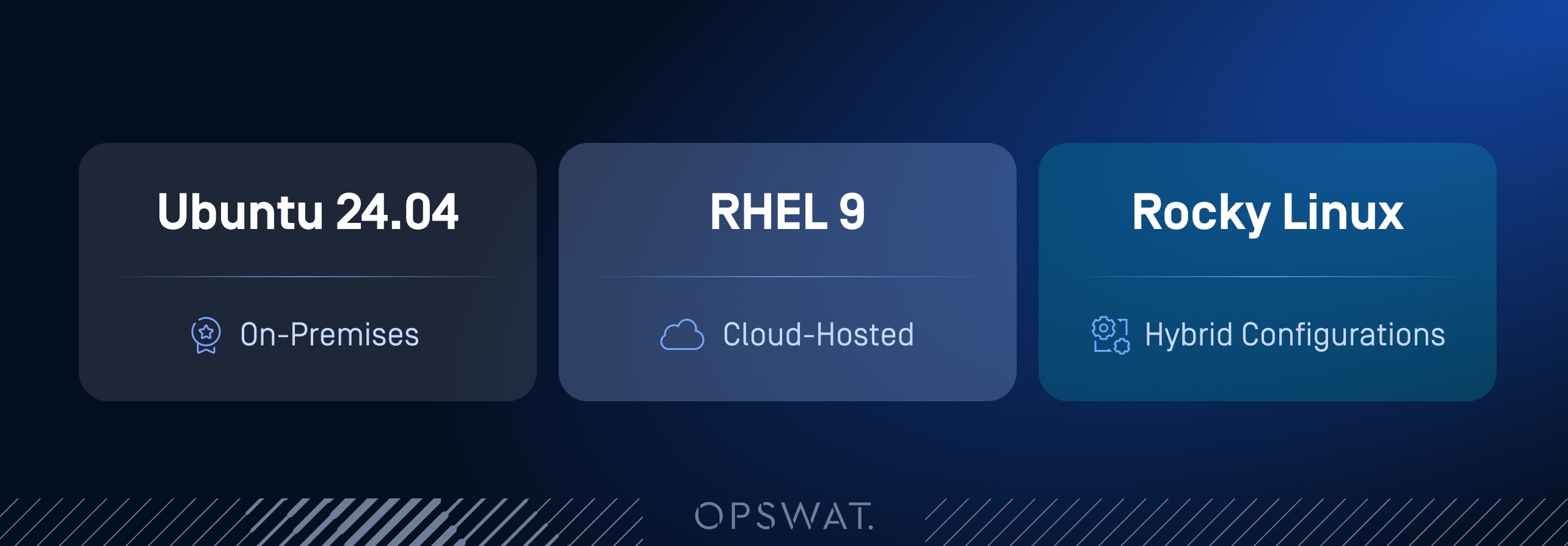
MetaDefender Aether processes up to 25,000 files per day per server, with a P90 target under 15 seconds, supporting continuous inspection across the full range of government file ingestion sources, such as removable media, email attachments, cloud storage, and web transfers. For air-gapped, classified, and hardened government environments, MetaDefender Aether supports flexible deployment:
- On-premises, cloud-hosted, and hybrid configurations
- Ubuntu 24.04, Red Hat Enterprise Linux 9 (offline), and Rocky Linux
- REST API and GUI-based integrations for SIEM and SOAR connectivity
As government agencies accelerate vendor diversification and third-party data transfers in response to geopolitical pressure, supply chain file flows represent a growing inspection requirement at the network perimeter. MetaDefender Aether's throughput capacity is designed to meet that demand without creating operational bottlenecks.
OPSWAT works with government agencies, defense organizations, and critical infrastructure operators to deploy zero-day detection that meets the demands of today's threat environment.
Frequently Asked Questions
What is instruction-level emulation and how does it differ from a traditional sandbox?
Instruction-level emulation interprets file execution at the CPU level without running a full OS or virtualized hardware, eliminating the hardware signals, timing patterns, and process signatures that evasive malware checks to detect analysis environments. Traditional VM-based sandboxes expose those signals, allowing malware to identify analysis conditions and suppress malicious behavior before it can be observed.
How does MetaDefender Aether handle encrypted or obfuscated network traffic?
MetaDefender Aether captures network intent at the API and memory level rather than via PCAP, making C2 indicators, callback logic, and exfiltration patterns extractable even when traffic is encrypted, obfuscated, or never transmitted. This makes it well suited to air-gapped environments and networks with strict traffic monitoring constraints.
Does MetaDefender Aether support MITRE ATT&CK mapping?
MetaDefender Aether observes all detected malicious behaviors against MITRE ATT&CK tactics and techniques, supporting triage acceleration, inter-agency threat intelligence sharing, and incident reporting requirements. Combining pre-execution and runtime detection delivers 60% additional MITRE ATT&CK coverage compared to single-layer approaches. Machine-readable IOC outputs feed directly into Splunk, Cortex XSOAR, and CEF Syslog integrations.
What deployment options are available for air-gapped or classified government environments?
MetaDefender Aether supports on-premises, cloud-hosted, and hybrid deployment, with OS support for Ubuntu 24.04, Red Hat Enterprise Linux 9 (offline), and Rocky Linux for air-gapped and hardened environments. A REST API-first design enables integration with existing government security architectures.
How does MetaDefender Aether reduce false positives compared to traditional detection tools?
MetaDefender Aether's deterministic analysis produces the same behavioral output for the same file across multiple executions and OS paths, eliminating the VM state variation that causes inconsistent verdicts in traditional sandboxes. With 73% of security teams citing false positives as their top detection challenge according to the SANS 2025 Detection and Response Survey, up from 64% in 2024, consistent evidence-backed verdicts directly reduce analyst review burden.