- Key Takeaways
- Agentic AI and the OT Environment Mismatch
- The Compliance Question Your Next Audit Will Ask
- The Security Platform as Attack Surface
- Where AI Belongs in the Security Stack
- What Human-Controlled Security Management Looks Like in Practice
- How OPSWAT Approaches This
- Frequently Asked Questions
- Take Control Without Giving Up Control
Key Takeaways
- Automation is essential for modern patching, vulnerability prioritization, configuration monitoring, and remediation workflows.
- Ungoverned autonomous security execution, including patch deployment, configuration changes, or automated remediation, introduces operational risk in environments where downtime carries safety or financial consequences.
- A change applied during the wrong window in a power grid, manufacturing line, or defense network is not a minor inconvenience. It is an incident.
- Three frameworks govern this space: NERC CIP (energy/utilities), IEC 62443 (industrial control systems), and NIST SP 800-82 (ICS security). All three emphasize documented authorization, validation, testing, and accountability for security changes.
- Autonomous workflows can support governance when approval gates, policies, and audit trails are built into the process. They become a liability when “the system decided” replaces accountable human authorization.
- AI delivers most value at the analysis layer: risk-ranked findings, configuration drift signals, prioritized patch list, not at the execution layer.
- The effective model: AI surfaces information, humans authorize action, every change logs against an accountable identity.
A patch deploys outside a maintenance window at a substation. A firewall rule is modified by an automated remediation system during a production cycle. A configuration change propagates across a distributed OT network before any operator reviews it.
The scenarios differ, but the failure pattern is the same: an automated system acted without human authorization, and by the time someone noticed, the change had already reached production.
Automation is now essential to modern security operations, especially as exploit timelines and patching windows shrink. The risk is not automation itself, but autonomous security execution that applies production-impacting changes without accountable human approval, operational context, and a documented authorization trail.
In critical infrastructure environments, these decisions carry operational risk that structured human oversight is designed to prevent.
Agentic AI and the OT Environment Mismatch
The current wave of agentic AI platforms reflects how autonomous execution is reshaping security operations, particularly in corporate IT environments where speed is the primary design goal.
Critical infrastructure operates under fundamentally different constraints.
A protection relay in a power grid cannot be restarted mid-cycle. A configuration change to a PLC controlling a manufacturing line cannot be rolled back in seconds. An automated remediation step that fires during a production run affects physical processes, not just servers.
Security teams in these environments need to evaluate autonomous capabilities against a different question: not "how fast can it respond?" but "who is accountable when it is wrong?"
The Compliance Question Your Next Audit Will Ask
Before your next NERC CIP or IEC 62443 audit, answer this: does your current security platform produce a documented, timestamped record of who authorized each security change?
NERC CIP-007 requires specific patch management procedures for every change made to cyber assets in the bulk electric system: documented assessment, testing evidence, and deployment timelines. IEC 62443-2-3 defines authorization responsibilities for patch management and configuration changes in industrial automation and control systems, including who holds accountability for each action. NIST SP 800-82 specifies that ICS security changes require risk assessment, validation testing, and coordination with operational stakeholders before deployment, not after.
Autonomous workflows can support this control model when governance is embedded into the process through policy-based approvals, deployment rings, maintenance-window controls, and detailed audit logs.
But autonomous execution does not fit into that model when it obscures the authorization chain. The change occurs, the log shows the system acted, and the auditor asks who approved the action. When no accountable human authorization event exists, the record is incomplete.
Human-controlled platforms with logged authorization steps produce the audit trail. Ungoverned autonomous platforms produce liability.
The Security Platform as Attack Surface
Security management platforms inherently hold privileged access. A platform authorized to push configuration changes, deploy patches, and manage policies across hundreds of deployments is exactly the kind of asset an adversary would prioritize.
When that platform operates autonomously, the attack surface expands significantly. A compromised autonomous system can execute actions at scale across every connected deployment before a human operator recognizes the breach. The attacker inherits the platform's execution authority and uses it across patch management, configuration changes, and policy enforcement simultaneously.
This is not theoretical. In early 2026, three critical zero-days in a widely-deployed patch management platform allowed unauthenticated remote code execution across enterprise environments. CISA has flagged these and similar vulnerabilities as Known Exploited Vulnerabilities requiring immediate remediation. An autonomous platform compromised through such vulnerabilities can push malicious changes to every connected endpoint before a single alert fires.
A platform that requires human approval before executing changes limits this blast radius. When human approval is required before execution, stolen credentials alone are unlikely to trigger automated changes at scale.
Where AI Belongs in the Security Stack
The argument against ungoverned autonomous execution is not an argument against AI or automation in security. AI delivers most value at the right layers: analysis, prioritization, orchestration support, and decision enablement.
CISA guidance consistently highlights visibility gaps as a core challenge for critical infrastructure organizations managing distributed assets. AI addresses this directly: aggregating event data, correlating signals across deployments, flagging configuration drift, and surfacing prioritized findings for human review. The analyst still decides, but AI helps them do it faster, with better information.
Risk-ranked vulnerability and patch management are where this pays off most visibly. Rapidly ranking hundreds of vulnerabilities by exploitability, asset criticality, and exposure gives security teams a prioritized list they can act on within a maintenance window, not a raw feed they have to sort themselves.
The same principle applies to configuration anomalies: AI surfaces drift across hundreds of endpoints; humans decide which changes to roll back and when.
The useful question for any AI capability in a security platform is not "can it act autonomously?" but "does it make the security team more effective?"
These are different design philosophies, and in regulated environments, the distinction matters.
What Human-Controlled Security Management Looks Like in Practice
Human-controlled security management does not mean slow security management. It means structured security management: AI surfaces information, automation accelerates workflows and humans make decisions. Every action is logged against an accountable identity.
In practice: a centralized dashboard aggregates security events, endpoint patch compliance, configuration health, and anomaly findings across all connected deployments. Administrators review risk-ranked findings, evaluate operational context (including whether a maintenance window is currently open at a target site, or if a configuration change has been validated against that specific hardware), and initiate actions through a deliberate authorization step.
For organizations managing distributed environments, this requires a platform that reaches every deployment from a single interface, including air-gapped and offline environments where cloud-based management is not an option. The platform provides the data administrators need to act confidently.
How OPSWAT Approaches This
The My OPSWAT™ Central Management platform is OPSWAT's centralized security management system built for this operating model. It provides security teams with visibility across patch status, configuration compliance, and endpoint health, from a single interface that works across cloud, on-premises, and air-gapped environments.
Security administrators review findings, configure deployment policies, and initiate updates on schedules aligned with maintenance windows. The platform even supports offline patching for air-gapped environments. Every action is initiated by an administrator, which produces the authorization records that NERC CIP, IEC 62443, and NIST SP 800-82 require, and limits the impact of a management plane compromise.
How EPAM Secured 70,000 Devices Across a Global Workforce
EPAM Systems (a global provider of digital platform engineering and software development services with roughly 40,000 employees across 30 countries) faced mounting pressure to secure a distributed, BYOD-heavy workforce without slowing it down. Leveraging My OPSWAT™ Central Management and MetaDefender Endpoint™, the organization gained visibility and compliance control over more than 70,000 devices used by employees, clients, and contractors worldwide.
The platform enabled EPAM's security team to validate device compliance, detect unwanted applications, identify unpatched vulnerabilities, and enforce access policies, all without impacting user productivity. EPAM also integrated MetaDefender Cloud™ to scan files uploaded to their central storage, processing more than 50 million files per day at peak volume. Security teams had the full picture. Every decision stayed with them. Read the full story here.
Frequently Asked Questions
Is autonomous AI appropriate for security operations in critical infrastructure?
Not when it independently executes production-impacting changes without human authorization. In critical infrastructure, including power grids, manufacturing, defense, and financial systems, a security action executed at the wrong time or against the wrong system can affect physical processes, trigger regulatory violations, or create conditions for a safety event.
AI is appropriate and valuable at the analysis, prioritization, coordination, and reporting layers: ranking risk, surfacing findings, flagging anomalies. The authorization decision should remain with a human operator.
What are the risks of autonomous security decisions in OT environments?
Three categories: operational, compliance, and adversarial. Operationally, an autonomous action that fires outside a maintenance window or without hardware-specific validation can affect production processes, not just servers.
From a compliance standpoint, NERC CIP, IEC 62443, and NIST SP 800-82 emphasize documented authorization, testing, validation, and accountability for security changes. Autonomous workflows can support these requirements only if they preserve a clear authorization trail.
Adversarial risk appears when a compromised autonomous platform executes changes across connected deployments before an operator can intervene.
How should critical infrastructure organizations approach AI in security operations?
Apply AI where it produces value without introducing execution risk: risk-ranked vulnerability triage, configuration drift detection, anomaly correlation, and prioritized findings for human review.
Avoid platforms that conflate AI’s analytical value with unchecked execution authority. Evaluate whether a platform produces the authorization records that your compliance framework requires. If the answer is “the system decided,” that is not a sufficient authorization record in regulated critical infrastructure environments.
Take Control Without Giving Up Control
Speed matters in critical infrastructure security, but the speed that matters is mean time to authorized action, not mean time to unchecked automated action.
A security team that receives risk-ranked, contextualized findings and can authorize a response within a defined maintenance window is operating effectively. One that delegates that decision to a system that cannot assess whether the window is open, or whether the production line is mid-cycle, is taking on unnecessary risk.
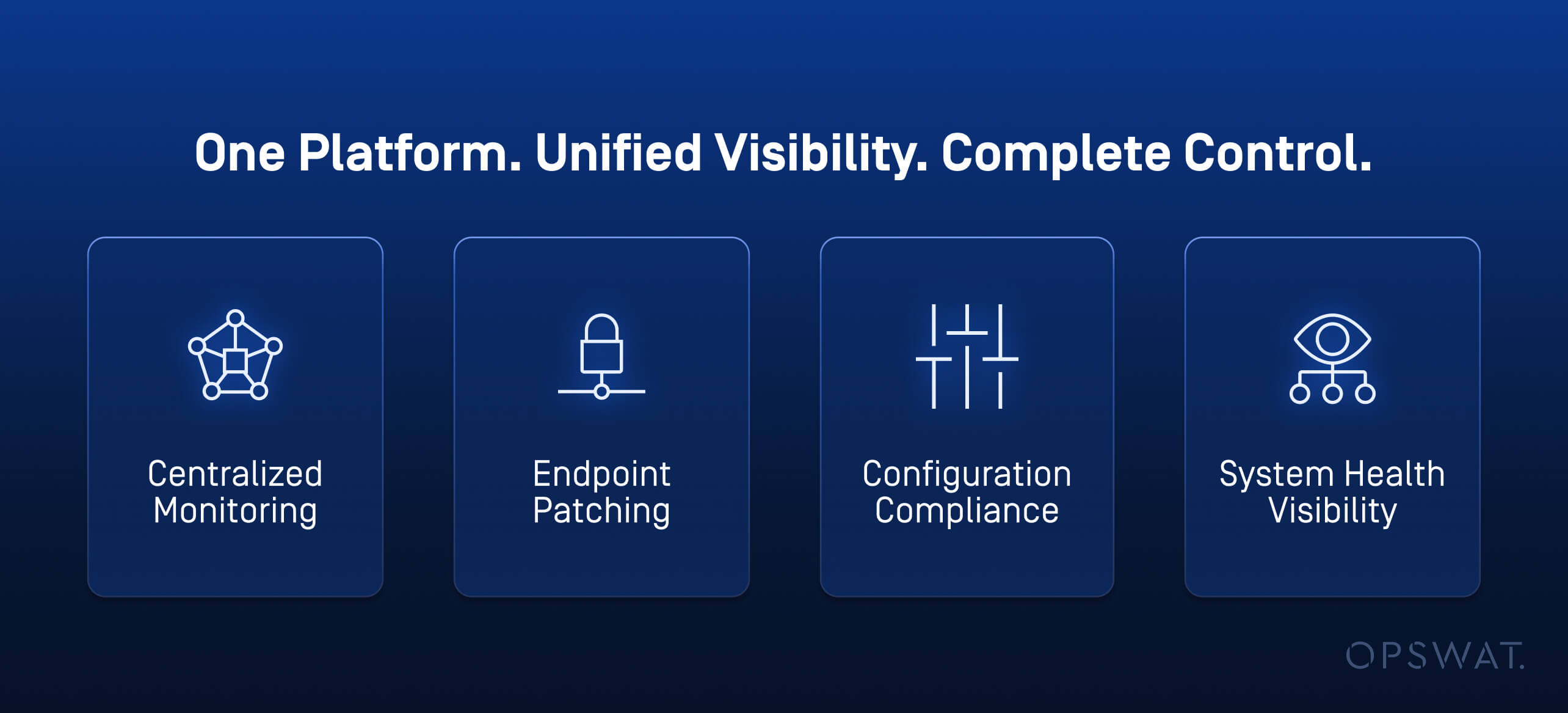
The My OPSWAT Central Management platform delivers centralized monitoring, endpoint patching, configuration compliance, and system health visibility from a single interface that works across cloud, on-premises, and air-gapped environments, with production-impacting actions authorized by a human and logged against an accountable identity.
OPSWAT builds AI-powered cybersecurity for critical infrastructure. My OPSWAT Central Management is where that capability is delivered with the human oversight that regulated industries require.