- What Does it Mean to Maintain a True Air Gap in OT Environments?
- How Do Data Diodes Enforce Air Gap Security for Outbound Data Transfer?
- Best Practices for Implementing Data Diodes to Maintain Air Gap Integrity
- Comparing Data Diodes, Firewalls, and Software-Based Segmentation for Air-Gapped Security
- Meeting Compliance and Audit Requirements for Air-Gapped Data Flows
- Monitoring, Auditing, and Maintaining Air-Gapped Data Diode Deployments
- Addressing Operational Challenges and Secure Inbound Workflows in Air-Gapped Environments
- Key Takeaways: Achieving Air-Gap-Level Assurance with Data Diodes
- Where Can You Learn More About Secure Data Workflows for Critical Infrastructure?
- Frequently Asked Questions (FAQs)
What Does it Mean to Maintain a True Air Gap in OT Environments?
Maintaining a true air gap in OT environments means enforcing complete network non-routability between operational technology and external networks. A true air gap prevents any inbound digital communication paths that could introduce threats into industrial control systems.
Air gaps exist to protect critical assets while still supporting operational reporting, monitoring, and compliance obligations. Regulatory frameworks and business risk models increasingly require proof that data movement out of OT environments does not weaken isolation or create latent backchannels.
Why is Physical Network Isolation Essential for Critical Infrastructure?
Physical network isolation is essential because OT and ICS environments face threat vectors that differ from traditional IT systems. Malware, remote exploitation, and lateral movement can have immediate safety and operational consequences.
Air gap failure in regulated environments can lead to compliance violations, operational outages, and loss of trust. Physical isolation reduces attack surfaces by removing protocol routability and eliminating remote access paths into critical systems.
Common Misconceptions About Air Gaps and Network Segmentation
An air gap is not equivalent to a firewall, VLAN, or software-defined segmentation. Software-based controls still rely on configuration correctness and routable protocols.
A true air gap requires physical enforcement. Any solution that allows bidirectional signaling, even if restricted by policy, does not meet air-gap-level assurance requirements in high-risk OT environments.
How Do Data Diodes Enforce Air Gap Security for Outbound Data Transfer?
Data diodes enforce air gap security by allowing data to move in only one physical direction. Hardware-enforced data diodes enable outbound data transfer from OT to IT while preserving non-routable isolation.
Compared to software controls, data diodes reduce dependency on configuration integrity. This architecture supports operational visibility, regulatory reporting, and monitoring without introducing inbound attack paths.
How Does a Data Diode Work to Maintain Network Isolation?
A data diode uses a unidirectional optical connection to physically prevent reverse communication. The receiving side cannot transmit signals back to the source network.
These workflows maintain isolation while enabling secure outbound visibility. Common OT use cases include:
- Telemetry streaming
- Log export
- Historian replication
- Compliance reporting
What Risks are Mitigated by Using Data Diodes Instead of Firewalls?
Data diodes mitigate risks associated with firewall misconfiguration, protocol abuse, and covert backchannels. Firewalls remain routable devices that can be exploited or bypassed.
By eliminating inbound capability entirely, data diodes prevent command-and-control callbacks, remote exploitation, and lateral movement into protected OT networks.
What are the Limitations and Considerations When Deploying Data Diodes?
Data diodes require protocol adaptation because acknowledgments cannot return to the source network. Not all protocols function natively in one-way mode.
Successful deployments require planning for buffering, data integrity verification, and workflow redesign. Supporting systems must accommodate unidirectional communication models.
Best Practices for Implementing Data Diodes to Maintain Air Gap Integrity
Effective data diode implementations combine hardware enforcement with validated workflows. Architecture decisions should prioritize non-routability, auditability, and operational continuity.
Measured outcomes include reduced attack surface, improved compliance posture, and predictable data flows that withstand configuration drift and operational change.
What are the Key Steps to Deploying a Data Diode in an OT Network?
Deployment begins with defining outbound data requirements and trust boundaries. Integration follows, including protocol adaptation and destination system preparation.
Validation confirms one-way enforcement and data integrity. Reference architectures typically place the diode at the OT perimeter with non-routable transport.


How Can You Automate and Secure File Transfers Across Air-Gapped Networks?
Automated workflows rely on scheduled exports, protocol bridging, and controlled file handling. Data should be formatted, validated, and logged prior to transfer.
Sanitization and policy enforcement ensure files leaving OT environments meet compliance and operational requirements without manual intervention.
How Should Data Diode Configurations Be Reviewed and Audited Over Time?
Configurations should be reviewed on a defined schedule and after environmental changes. Validation includes physical inspection, configuration checks, and flow verification.
Audit documentation should demonstrate continuous enforcement, monitoring coverage, and change control aligned with prevention-first security practices.
Comparing Data Diodes, Firewalls, and Software-Based Segmentation for Air-Gapped Security
Technology selection depends on assurance requirements, not convenience. Software-based controls offer flexibility but increase attack surface and operational risk.
Hardware-enforced data diodes provide deterministic isolation where compliance and safety margins are non-negotiable.
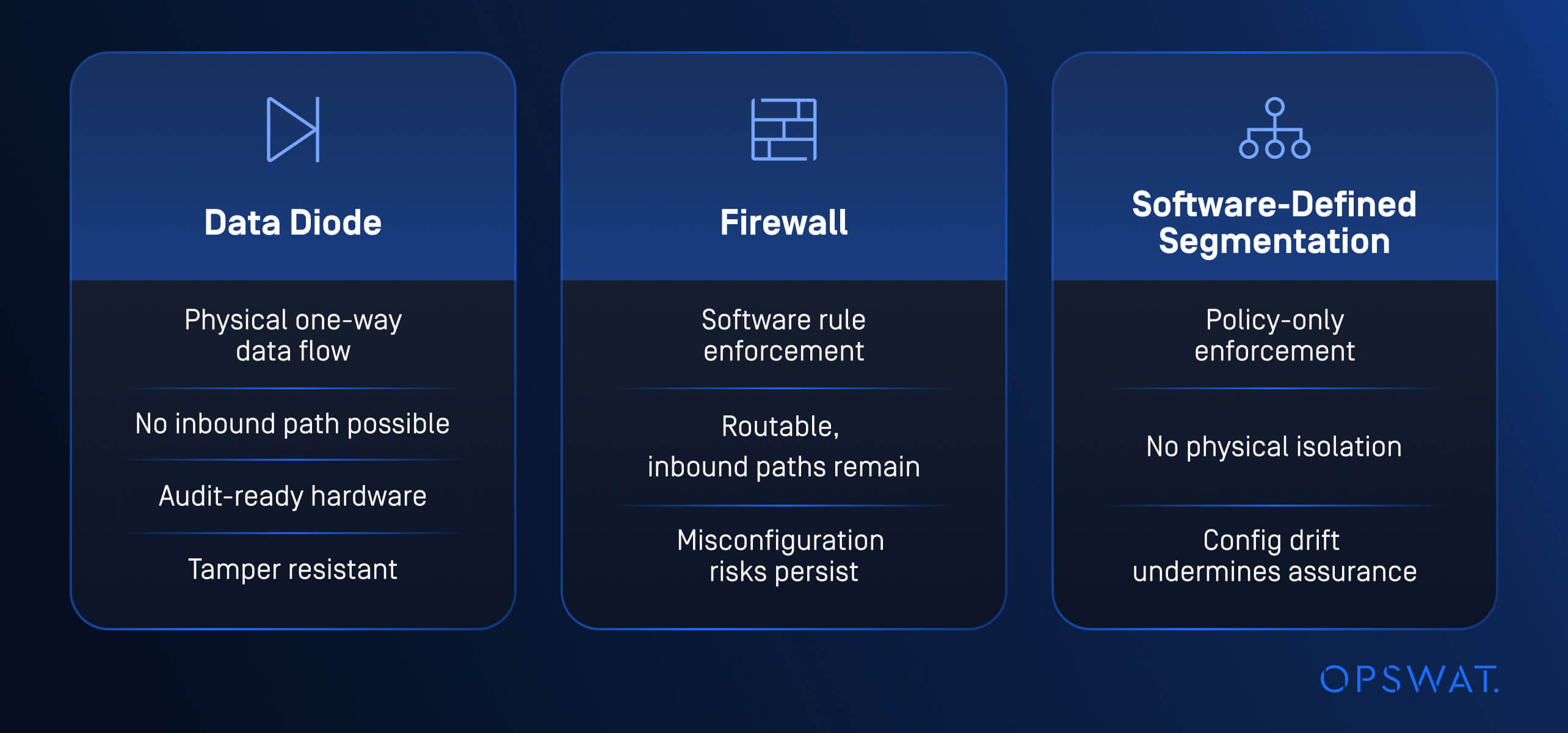
What are the Security Differences Between Data Diodes and Firewalls?
Data diodes enforce security through physical unidirectionality. Firewalls enforce policy through software rules on routable interfaces.
Failure modes differ significantly. Firewall compromise can expose OT networks, while data diodes remove inbound failure scenarios entirely.
When Should You Choose a Data Diode Over Other Segmentation Methods?
Data diodes are appropriate when regulations require non-routable isolation or when risk tolerance is low. Firewalls and VPNs leave residual inbound risk.
Critical infrastructure environments often mandate hardware-enforced controls to meet audit and assurance expectations.
What are the Pros and Cons of Hardware- vs. Software-Based Air Gap Solutions?
Hardware solutions provide high assurance and predictable enforcement. Software solutions offer flexibility but depend on configuration accuracy and ongoing management.
Long-term security assurance favors physical enforcement in environments where failure consequences are severe.
Meeting Compliance and Audit Requirements for Air-Gapped Data Flows
Compliance frameworks require evidence of enforced isolation and controlled data movement. Air-gapped architectures must demonstrate both prevention and traceability.
Data diodes support audit readiness by providing deterministic enforcement and verifiable data paths.
How Do Data Diodes Help Satisfy NERC CIP and Other Regulatory Mandates?
Data diodes align with requirements for electronic security perimeters and controlled outbound communication. Physical enforcement simplifies compliance mapping.
Audit evidence includes:
- Architecture diagrams
- Validation records
- Monitored data flows
What Security Assurance and Validation Should Be Required for Data Diodes?
Assurance should include proof of hardware enforcement, tamper resistance, and third-party validation. Software-only claims are insufficient for high-assurance environments.
Ongoing testing and documented verification reinforce trust over the solution lifecycle.
Monitoring, Auditing, and Maintaining Air-Gapped Data Diode Deployments
Operational success requires continuous visibility into data flows and device health. Monitoring confirms expected behavior and detects anomalies.
Maintenance practices should preserve enforcement integrity while supporting availability and performance requirements.
What are the Best Practices for Monitoring Data Flows Through a Data Diode?
Monitoring should track throughput, integrity, and delivery success on the receiving side. Logs must be centralized and retained for audit purposes.
Integration with SOC workflows improves incident readiness without introducing inbound connectivity.
How Should Maintenance, Redundancy, and Performance Be Managed for Data Diodes?
Deployments should include redundancy planning and capacity sizing. Performance limits must align with data volume requirements.
Maintenance activities should avoid changes that could compromise physical enforcement or isolation.
What are Common Pitfalls and How Can They Be Avoided in Critical Infrastructure Deployments?
Common pitfalls include assuming protocol compatibility, neglecting audit documentation, and underestimating operational change management.
Avoidance requires upfront design, validation testing, and continuous governance.
|
| |||||||||
Addressing Operational Challenges and Secure Inbound Workflows in Air-Gapped Environments
Some operations require inbound data despite air gap constraints. These workflows must remain isolated from outbound paths.
A prevention-first strategy separates inbound handling from diode-enforced outbound monitoring.
How Can You Securely Move Files or Patches Into an Air-Gapped OT Environment?
Segregated processes preserve air gap integrity while meeting operational needs. Inbound workflows rely on:
- Removable media controls
- Malware scanning and sanitization
- Approval gates
- File validation prior to introduction into the OT environment
How Do You Handle Operational Needs for Return Traffic When Using a Data Diode?
Return traffic is handled through architectural alternatives such as out-of-band systems or protocol adaptation.
These approaches maintain one-way enforcement while supporting operational requirements.
Key Takeaways: Achieving Air-Gap-Level Assurance with Data Diodes
Maintaining air-gap-level assurance requires physical enforcement, validated workflows, and continuous oversight. Data diodes enable secure outbound visibility without compromising isolation.
Hardware-enforced architectures support resilience, compliance, and long-term risk reduction.
What are the Measurable Benefits of Data Diode-Based Air Gap Solutions?
Benefits include reduced attack surface, audit-ready compliance, and predictable data flows. Operational continuity improves without increasing exposure.
Hardware enforcement delivers assurance that software controls cannot replicate.
Where Can You Learn More About Secure Data Workflows for Critical Infrastructure?
MetaDefender Optical Diode is OPSWAT’s data diode solution designed to enable secure, hardware-enforced one-way data transfer between IT and OT networks.
Learn how it supports secure OT-to-IT reporting without introducing inbound attack paths.
Frequently Asked Questions (FAQs)
When should we choose a data diode to maintain an air gap instead of using a firewall, VPN, or segmented network?
A data diode should be chosen when regulations or risk models require non-routable isolation. Firewalls and VPNs retain inbound risk due to software enforcement.
What does a reference architecture look like for using a data diode to send OT telemetry or logs to IT or a SOC?
A reference architecture places the data diode at the OT perimeter with unidirectional flow toward IT systems. The OT side remains non-routable.
How do you handle return traffic when a data diode only allows one-way flow?
Return traffic is addressed through protocol adaptation, out-of-band workflows, or compensating systems that do not break isolation.
Which protocols and data types can reliably pass over a data diode?
Protocols designed for unidirectional transfer, file exports, telemetry streams, and log replication are most reliable. Interactive protocols typically require adaptation.
How can files or patches be securely moved into an air-gapped OT environment?
Inbound workflows rely on removable media, scanning, sanitization, and approval processes separate from outbound diode paths.
What security assurance should be required to prove one-way enforcement?
Assurance should include hardware enforcement evidence, validation testing, and tamper resistance. Software-only enforcement is insufficient.
What are common implementation pitfalls for data diodes?
Pitfalls include poor protocol planning, lack of audit documentation, and insufficient monitoring. These can be avoided through structured governance.