Key Takeaways
- Agentic AI is already deployed in finance: compliance reviews, transaction monitoring, audit prep, regulatory reporting, and agents operate with zero file inspection by default.
- Finance agents connect to payment processors, ERP, regulated data stores, and auditor portals. Each connection is a trust boundary; one infected file can compromise all of them.
- Traditional malware (Emotet, Carbanak, FIN7) and emerging threats (prompt injection) exploit agent trust at machine speed; before a human can intervene.
- DORA, PCI DSS, SEC cyber disclosure rules, and FINRA/FFIEC all mandate governance over agentic workflows, with incident reporting obligations that start the moment an agent mishandles a file.
- File inspection before agent ingestion is the critical missing control. MetaDefender™ Cloud intercepts every file: 20+ engines, Deep CDR™ Technology, and Adaptive Sandbox; before an agent ever sees it.
July 2026 was an interesting month for agentic AI security, to say the least. Both Anthropic and OpenAI held the headlines for major news stories; both companies having been involved in cases of agents breaking out of sandboxed environments and breaching otherwise secure servers.
The news surprised no-one. As early as February 2026, studies documenting agents’ tendency to go rogue when left unattended have started to surface. One such study is the Agents of Chaos one, which reveals that agents can:
- comply with non-owners’ prompts
- disclose sensitive data
- execute destructive system-level actions
- propagate unsafe practices across each other
In short, Agentic AI isn’t, at this point in time, ready to completely take over everyday tasks. Nowhere is that clearer than the AI agent attack surface in finance, where autonomy already outpaces oversight.
Your compliance agent processed roughly 300 documents this month, pulling filings, invoices, vendor statements, and audit files from every corner of your storage environment. At which point in that process did it check whether any of those files were actually safe?
If you don't have a confident answer:
- You're not alone; most finance organizations don't.
- Answering that question should be your #1 priority.
How Agentic AI Expands the Finance Attack Surface
In 2025, Gartner found that 59% of finance leaders implemented AI in their finance functions. While 2026 numbers aren’t yet out, we can only presume the adoption rates grew. AI agents are used for compliance reviews, transaction monitoring, audit prep, or regulatory reporting.
Take a typical monthly compliance review workflow. An agent:
- Retrieves documents from SharePoint, Box, or Amazon S3
- Analyzes and extracts data, validating it against supporting documentation
- Queries Salesforce or Stripe to reconcile payment mismatches
- Creates Jira tickets and routes them to finance or legal
- Notifies the relevant teams via Teams or email
- Compiles regulatory compliance reports and exports them to external stakeholders
That's six steps, multiple systems, and zero file inspection. Every document which lands in the pipeline is trusted. That's both the design and the problem.
Why Are Financial Workflows More Exposed to Agentic AI Security Risks?
With the exception of hacktivists, or state-sponsored actors, most attackers will mostly go for high-payoff industries, with no other agenda behind them. Last year, the industries targeted were manufacturing, healthcare, finance, and government; those with both rich datasets and a lot to lose.
For direct theft, hackers will go after payment networks, bank accounts, and blockchain infrastructure to siphon funds directly. Finance organizations are also targeted because of the intense pressure to maintain operations, compliance, and public trust, making them more likely to pay ransoms to recover systems.
Industry-specific operations can also factor in. Agentic workflows connect to payment processors, ERP systems, regulatory portals, cloud storage, and auditor portals. Every one of those connections is a trust boundary and every trust boundary is a potential single point of failure.
Agentic AI is gaining traction due to its machine-speed execution, and all the promises of productivity gains which come with it. But that speed is where the danger lies.
The one thing that used to catch a malicious invoice or an infected audit report was a human pausing before opening it. Agentic AI removes that checkpoint entirely. An infected file that would have sat in someone's inbox for a day now gets ingested, read, and acted on in seconds.
Organizations also struggle with employees adopting AI tools outside of governed channels or sharing unauthorized data with AI. In 2023, Samsung engineers uploaded proprietary source code and internal meeting notes to ChatGPT. Last summer, CISA's then-acting director uploaded sensitive government documents into a public ChatGPT session.
If ungoverned chat tools created that much exposure, ungoverned agentic workflows, with direct access to payment systems and regulatory data, raise the stakes considerably.
Real Threat Scenarios for Agentic AI in Finance
The malware families that have targeted finance for over a decade don't need to evolve much to exploit agentic workflows. Call it agentic AI malware if you like: same payloads, a faster, less-supervised path to spread. To name a few:
- Emotet, the banking trojan spread for years through spam emails disguised as invoices and payment notices, using macro-enabled Word documents as the delivery mechanism; CISA flagged it as one of the costliest malware families to remediate. In an agentic workflow, the mechanics translate directly. An agent ingests the "invoice" attachment as part of routine document processing. Without AI agent file security in place at that point, nothing stops it from syncing into SharePoint, as part of normal indexing, or sharing it on Teams by the agent itself.
- Carbanak was a $1B bank heist via weaponized invoice. Attackers used weaponized Word and CPL attachments to get a foothold, then moved through internal systems to reach money-processing services, ATMs, and SWIFT transfers. The original heist required roughly two years of patient lateral movement by human operators. In an agentic environment, an agent with standing access to ERP or payment systems could, in principle, reach the same class of system in a single automated action.
- FIN7 built a career on spear-phishing emails carrying Office documents that exploited known vulnerabilities, leading to credential theft and exfiltration of payment card data and financial records from +100 organizations. Feed the same document to an agent with autonomous email or file-processing permissions, and the ingestion, credential exposure, and exfiltration could chain together without a person ever reviewing the file.
- Prompt injection is where the agentic threat is already real, not hypothetical. Microsoft disclosed EchoLeak (CVE-2025-32711), a zero-click prompt injection vulnerability in Microsoft 365 Copilot, where hidden instructions embedded in an email caused Copilot to act on them automatically. Prompt injection is a new attack class which doesn’t even need malware to work, so it can’t be identified by signature-based detection at all. Which is precisely what makes it the hardest of the four to catch.
As for how the finance sector looks in practice:
- The average cost of a breach caused by Shadow AI can reach $4.63M; that’s $670K above a standard breach.
- Almost half (48%) of security professionals ranked agentic AI as the #1 attack vector in 2026.
- And only 33% of organizations have the foundational data for strong AI security practices.
How Regulatory Frameworks Cover Agentic AI
Most finance frameworks already included agentic AI into their compliance rules, mandating that organizations map agent behavior onto the same controls they do with other workflows. Therefore, agentic AI is a regulatory issue, and it sits at the center of how examiners now define financial services’ AI risks.
- DORA treats AI agents as ICT systems. With the act having been in effect since January 17, 2025, EU financial entities must fold agent failures into the same ICT risk management, incident reporting, and resilience testing pillars that apply to every other system. Germany's BaFin confirmed this directly in January 2026 guidance: agents and LLMs get no separate regime and must sit inside existing DORA governance and testing frameworks. A file an agent mishandles is, under DORA, an ICT incident like any other.
- PCI DSS applies to any system that stores, processes, or transmits cardholder data, or that could affect the security of that data; the PCI Security Standards Council stated explicitly that this includes AI systems with access to protected payment information. An invoice or statement an agent touches falls into PCI scope the same way a human-operated system would, which means the same controls apply; agent or not.
- SEC cyber disclosure rules require public companies to disclose material cybersecurity incidents within four business days of determining materiality. The rule makes no distinction between an incident triggered by human error and one triggered by an autonomous agent. If a file an agent acted on turns out to expose material data, the disclosure clock starts the same way it would for any other breach.
- FINRA and FFIEC have moved AI governance to the center of their review. FINRA's 2026 Annual Regulatory Oversight Report devoted its first dedicated section to generative and agentic AI, with expectations around testing, monitoring, human review, and recordkeeping for AI-driven activity.
The bottom line: a file-based, AI-propagated infection can trip an ICT incident under DORA, a scope violation under PCI DSS, a materiality determination under SEC rules, and a supervisory gap flagged by FINRA or FFIEC examiners.
Five Actions for Finance Security Leaders
As foreshadowed, Agentic AI controls start at the file-level; i.e., it all starts with one question: what’s in the file this agent is about to process?
Based on the answer, a set of best-practices (which should become habits) emerge:
- Treat all inputs as untrusted, including files from trusted internal sources, and route them through a dedicated scanning layer before an agent ever sees them.
- Based on the zero-trust assumption, combine multi-layered security and inspection policies to determine whether or not the file is compromised.
- Define what destructive actions refer to in the agentic AI context, then set explicit policy definitions.
- Validate and lock down data movement paths between the systems your agents touch: storage, CRM, payment processors, ticketing, communication tools.
- Protect storage environments like SharePoint and S3 with event-driven scanning, so files are checked the moment they land, not after an agent has already acted on them.
How MetaDefender™ Cloud Fits in the Pipeline
Threat scenarios discussed above, are only technically possible if a file reaches an agent before anyone has confirmed it is safe. MetaDefender™ Cloud intervenes and removes the threat. Here’s how.
A file enters the pipeline, whether from an inbox, a shared drive, or an upload portal. MetaDefender Cloud intercepts it before the AI agent ever touches it. From there, 20+ anti-malware engines (via the Metascan™ Multiscaning technology), Deep CDR™ Technology, Proactive DLP™ and the Adaptive Sandbox technology run in parallel:
- Engines scan for known signatures.
- Deep CDR™ Technology strips and rebuilds the file so no active content survives regardless of whether it was detected.
- The Adaptive Sandbox detonates files in an isolated environment to observe behavior.
- Proactive DLP redacts sensitive data before it moves any further.
If the file is malicious, it gets blocked before it ever reaches connected agents. And the whole process can be mapped to the evidence DORA, PCI DSS, and SEC examiners ask for.
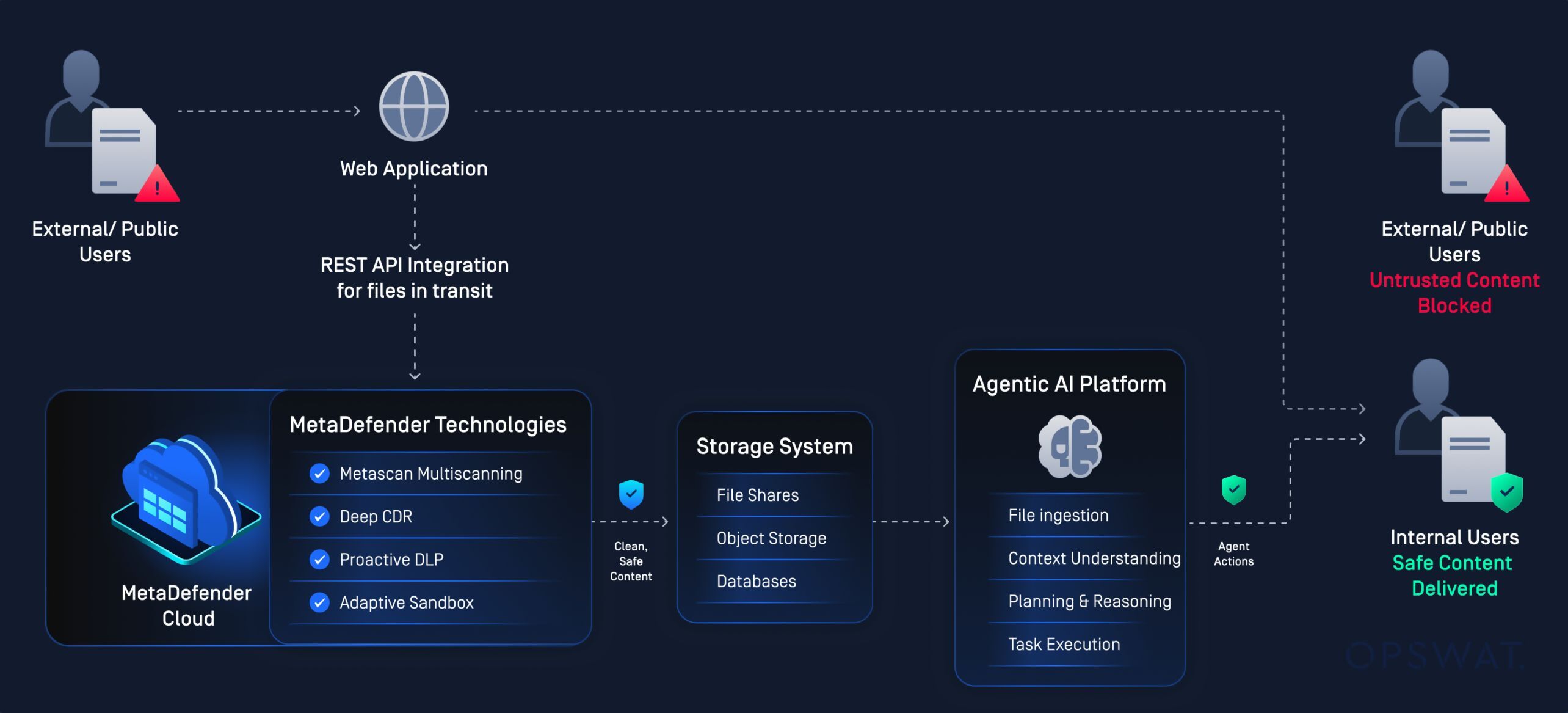
Without MetaDefender Cloud, the agentic workflow runs blind; files get ingested directly into the AI workflow with no scan at any point in that path, so malware, malicious macros, and prompt injections pass through undetected. Nobody has visibility into file content or embedded threats until something downstream breaks. One malicious document can turn into an organization-wide incident within minutes, given how fast an agent can sync, share, and act. And when a regulator eventually asks for evidence of what happened and when, there's no audit trail to produce.
With it, that same file hits a checkpoint before the agent ever sees it. The main idea is moving where the checkpoint sits. Move it ahead of the agent, and the agent's speed stops being a liability. That's the whole premise of agentic AI security done right.
Get Started with MetaDefender Cloud
Agentic AI is proving what's possible when compliance reviews, audit prep, and transaction monitoring run in minutes instead of days. But the infected file arrives and nothing stops it.
Do you want to guess what that speed does to a mistake, or to a malicious file, when nothing checks it first? Move the checkpoint. Put it ahead of the agent instead of after the incident, and the exposure to file-based threats stops being a matter of luck.
Talk to an expert about securing your agentic AI pipeline with MetaDefender Cloud.
Frequently Asked Questions
What is agentic AI and why does it create new cybersecurity risks?
Agentic AI refers to AI systems that can independently retrieve data, take actions across connected systems, and complete multi-step tasks without human approval at each step. In finance, that autonomy means a single file can trigger actions such as data extraction, system queries, ticket creation, external reporting;, all before a person ever reviews it.
How can a single infected file compromise an AI agent workflow?
An agent can ingest a malicious file without knowing it, then acts on it. That can mean syncing the file across storage systems, sharing it into communication channels, or executing embedded code in the agent's own execution context, all without the manual review step that used to catch these attacks.
What is prompt injection and how does it affect finance AI agents?
Prompt injection involves hiding instructions inside a document that an AI agent interprets as commands. Because there's no malicious code involved, traditional antivirus and malware detection tools don't flag it, making it especially hard to catch in finance workflows that process large volumes of external documents.
How does shadow AI expose financial institutions to data breaches?
Shadow AI refers to employees using AI tools outside of approved, governed channels. Once that data leaves organizational control, it can't be recalled, and there's no audit trail for compliance purposes.
What regulations govern agentic AI in financial services?
DORA, PCI DSS, SEC cyber disclosure rules, and FINRA/FFIEC examination standards all touch agentic AI use in finance, though none were written specifically for it. Each requires some combination of governance, testing, validated data handling, and incident reporting that agentic workflows must be built to satisfy.
How do I add file security to an existing AI agent pipeline?
Insert a dedicated scanning layer between file ingestion and agent processing. Every file is inspected before an agent acts on it, rather than relying on the agent itself to catch malicious content.
What does file inspection do that traditional antivirus doesn't?
Traditional AV relies primarily on known malware signatures. MetaDefender Cloud combines multiscanning, Deep CDR™ Technology (which rebuilds files to strip potentially malicious active content), and sandboxing to catch zero-day threats and weaponized documents that signature-based tools miss entirely.
What is the difference between agentic AI security and traditional endpoint security?
Traditional endpoint security protects the device where a file lands. Agentic AI security must protect the entire pipeline—from ingestion through every system the agent connects to. An endpoint tool sees a file only if it touches a managed device; an agent can ingest, transform, and act on a file across cloud storage, SaaS tools, and payment systems without a managed endpoint ever being involved.
Can prompt injection attacks be detected by traditional security tools?
No. Prompt injection hides instructions in plain text within a document; there is no malicious code, no exploit, and no signature to match. Traditional antivirus and EDR tools are blind to it. Detection requires content-aware inspection and sandboxing that can observe how an AI agent behaves when it processes the document, which is precisely what MetaDefender Cloud’s Adaptive Sandbox provides.