We utilize artificial intelligence for site translations, and while we strive for accuracy, they may not always be 100% precise. Your understanding is appreciated.
Home/
Blog
/
Manufacturing Cybersecurity in the Age of AI: Why…
For most of the last decade, the worst-case OT cybersecurity scenario was familiar. A ransomware attack locked the control system, production stopped, and downtime costs climbed by the hour. This is still the narrative that dominates most board discussions today.
Manufacturing is now the most targeted sector for ransomware, with attacks rising 56% year over year as threat actors increasingly focus on operational disruption. At the same time, legacy OT systems and expanding supply chains are creating a broader attack surface that is harder to secure. In 2026, the most valuable asset may no longer be the machinery itself, but the operational data generated every second of production.
The Threat Surface Shift from Disruption to Extraction
Verizon’s 2025 Data Breach Investigations Report recorded 1,607 confirmed breaches in manufacturing, an 89% increase. As IT and OT environments increasingly converge, files such as CAD designs, predictive maintenance logs, supplier updates, and process IP constantly move across connected systems. Every transfer now creates a potential entry point.
What has changed is what attackers do after gaining access. Modern campaigns increasingly prioritize data theft and extortion over pure encryption. A halted production line creates temporary leverage, but stolen designs, formulations, and operational telemetry can be resold, reused, and even leveraged to train future attack models.
Recent industry reports estimates that up to 80% of new ransomware is AI-generated. Agentic AI can autonomously develop and deploy attacks, reducing the manual effort required for intrusion. For defenders, this shortens response windows as attacks become faster, more adaptive, and more varied. The same AI-driven productivity gains in transforming manufacturing are also strengthening attackers' capabilities.
Challenges in the Era of Smart Factory
Modern manufacturing depends on continuous data movement. Technologies such as UNS (Unified Namespace), MQTT, Industrial DataOps, and agentic AI are becoming core parts of the 2026 smart factory model highlighted by IIoT World. These systems rely on OT data flowing freely into analytics platforms and operational applications to support predictive maintenance, autonomous workflows, and real-time optimization.
But the same data movement that enables operational intelligence also creates new exposure points. Every file shared with a supplier, every firmware update delivered by USB, and every contractor laptop connected to a control network introduces potential risk. The traditional IT/OT boundary is that a managed flow of data exists between environments.
With these changes to the security model for manufacturing, managed flows can be monitored, redirected, or compromised, making connectivity itself part of the attack surface. Consequently, the same infrastructure powering AI-driven manufacturing is also making factories more attractive targets for cyberattacks.
The Blind Spot is Still Physical
It is tempting to view AI-era OT defense as primarily a software problem. But reality is broader than that. Roughly a quarter of OT incidents still involve removable media & transient devices such as USB drives, vendor laptops, and contractor devices.
These risks appear in day-to-day operations. For instance, a plant operator plugging a personal phone into an HMI to charge it can unintentionally cause the phone's default tethering setting to create a network bridge. In seconds, the air gap is effectively bypassed without anyone realizing it. These incidents become more likely when human behavior, operational pressure, and unenforced policies intersect with exposed USB ports and connected devices.
Industry threat research shows the same trend in malware itself. A large share of malicious files found on industrial removable media today can directly disrupt OT systems. In the AI era, organizations deploy advanced analytics to detect anomalies in process data, while removable media still enters facilities with limited inspection or control.
Legacy manufacturing systems and security procedures were not designed or implemented with ever evolving AI threats in mind. It is critical to frequently re-evaluate your process and security controls against the latest AI threats
Matt Wiseman
Senior Director of Product Marketing
The Investment Gap is the Other Half of the Problem
Even as threats continue to evolve, the numbers show that fewer manufacturers plan to invest in OT cybersecurity during automation initiatives. This gap needs to be addressed, as automation initiatives are where new connections are created, new file flows are introduced, and new transient devices are trusted into the environment.
If security is treated as a phase-two add-on or something to be addressed once the AI use case is in production, the threats coming online today will outrun the defenses being budgeted for tomorrow. The reality is: AI adoption is accelerating, while AI-driven attack capabilities are accelerating alongside it.
What Readiness Looks Like in 2026
Manufacturers who are ready for the AI era share a few characteristics:
Treat Security as a Precondition for AI Security must be treated as a precondition for AI, not a follow-on. These reframing matters because it changes capital planning, vendor selection, and project sequencing. Cloud-connected AI initiatives that go live without a hardened data ingress and egress posture are taking on more risk than the business case typically accounts for.
Harden the Physical Perimeter Removable media and transient devices must be validated using a standardized, repeatable workflow. Ideally, this should be integrated with visitor management so that every external device entering a plant undergoes the same scan, regardless of who's carrying it.
Favor Outbound-Only Data Architectures Where the operating model allows and when agentic AI can autonomously write and deploy attacks, removing inbound pathways becomes increasingly important. It is one of the most reliable ways to shrink the attack surface that AI-driven adversaries can reach.
Align with Regulatory Compliance Frameworks Guidelines like IEC 62443, NIST SP 800-82, and NIS2 are not just compliance scaffolding. They are the auditable baselines that make security decisions defensible to boards, regulators, and insurers when something goes wrong.
AI-Ready Integrated Solutions
OPSWAT continues to provide innovative end-to-end solutions to secure manufacturing OT environments in the AI era. Discover why worldwide organizations, institutions, and entities trust OPSWAT’s MetaDefender™ platform to protect critical infrastructure.
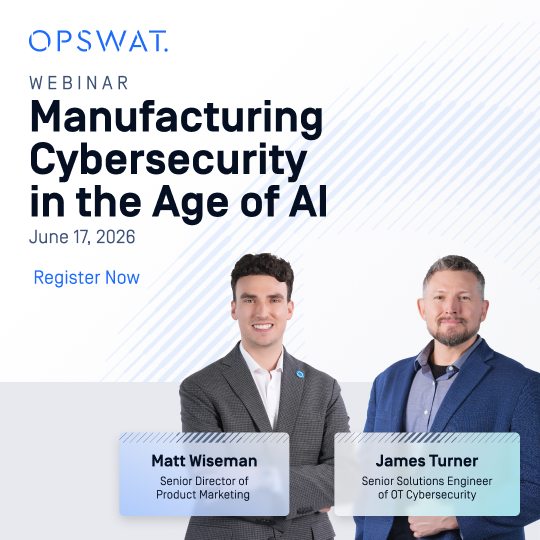
AI is moving from pilots into manufacturing operations, helping teams improve productivity, quality, and scale. But as more files, devices, suppliers, and OT data flows become connected, cyber risk expands in an industry already targeted more than any other. Join OPSWAT to learn how to protect critical operations in the age of AI.