Modern infrastructure runs on autoscaling, self-healing, and automated provisioning, whether that infrastructure lives in Kubernetes or is stood up through Infrastructure as Code. File security, in most environments, still runs on a single static instance that cannot keep up with that same elasticity, and becomes a single point of failure the moment volume spikes.
Extending Resilience to the File Security Layer
Cloud infrastructure has become highly automated because orchestration and provisioning tooling have matured to solve exactly that problem. What that tooling does not do on its own is guarantee that file security keeps pace. A single scanning instance can still become the bottleneck, or the single point of failure, even while everything around it scales and self-heals as designed.
That is the gap MetaDefender Cluster closes, across two deployment paths built for how cloud infrastructure actually runs today.
Kubernetes Deployment
MetaDefender Cluster extends MetaDefender Core with a distributed, disruption-resistant architecture. Instead of scaling a single node vertically, it distributes scan requests horizontally across multiple MetaDefender Core instances, coordinated through a Cluster Control Center that handles load balancing and worker health monitoring automatically. That architecture now runs natively on Kubernetes.
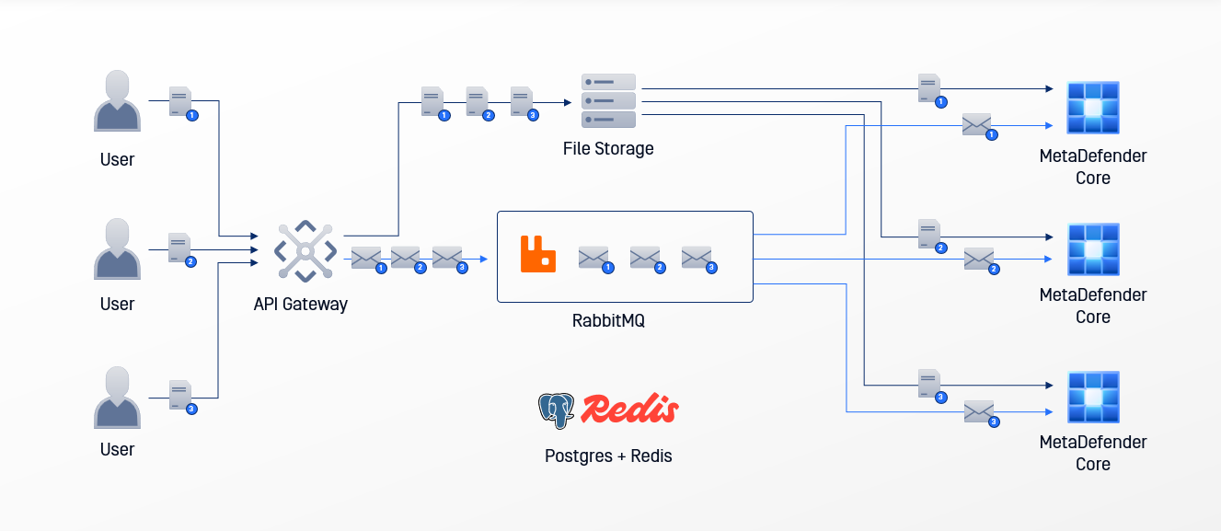
For platform and security teams, that means:
- Cloud-native deployment via Kubernetes. MetaDefender Cluster can be deployed and operated on Kubernetes, enabling scalable, cloud-native deployments across modern infrastructure.
- High availability. MetaDefender Cluster supports high-availability deployments on Kubernetes, with high-availability deployment options for PostgreSQL, RabbitMQ, Redis, and MetaDefender Cluster File Storage.
- Staged upgrades. Separate Helm charts for platform services and worker instances enable staged upgrades, reducing service disruption during updates.
- Official Docker images. Official Docker images are available for all MetaDefender Cluster services, simplifying containerized deployments.
- Graceful worker shutdown. Worker instances running on Kubernetes complete in-progress processing before shutting down, helping prevent interrupted scans during scaling and upgrades.
Organizations processing millions of files a day have deployed MetaDefender Cluster without throughput degradation, because the architecture was built for exactly that pressure. Running natively on Kubernetes means teams get that same resilience using the orchestration tooling they already operate.
Terraform Deployment
Not every team's path to production runs through Kubernetes alone, and infrastructure provisioning itself is often where consistency breaks down first. MetaDefender Cluster now supports Infrastructure as Code through Terraform, allowing consistent, repeatable deployment across AWS, Microsoft Azure, and Google Cloud Platform.
For platform and security teams, that means:
- Consistent provisioning across clouds. The same deployment approach applies whether the environment sits in AWS, Azure, or Google Cloud Platform, reducing drift between environments.
- Production-ready templates. Included Terraform templates simplify provisioning from the start, instead of building infrastructure definitions from scratch.
- Infrastructure managed as code. Environments become versioned, reviewable, and repeatable, in line with how the rest of the infrastructure is already managed.
Where These Deployment Models Fit
Teams standardizing on either Kubernetes or infrastructure provisioning through Terraform across one or more clouds, are both exactly who these deployment paths were built for. Either way, scanning capacity scales the same way the rest of the environment does, staying resilient through the same upgrade, failover, and provisioning patterns already in place for everything else running in that environment.
File-borne threats do not slow down to match an organization's infrastructure maturity, and neither should the tooling that inspects them. With native Kubernetes support and Terraform deployment, MetaDefender Cluster lets file security scale the same way the rest of the cloud-native stack already does, wherever that infrastructure runs.
Talk to our experts to map MetaDefender Cluster to your environment.
Release Details
- Product: MetaDefender Cluster
- Version: 2.8.0
- Release Date: July 31, 2026
- Support Resources: Release Notes