Key takeaways
- Steganography-based threats conceal malicious payloads inside ordinary-looking files: images, documents, audio, and more.
- A peer-reviewed ARES 2024 study documented 106 stegomalware cases and found that known stegomalware relies on a relatively small set of recurring patterns and hiding methods.
- Positive Technologies reported that the SteganoAmor campaign used steganography in more than 320 attacks targeting companies across 31 countries and multiple sectors.
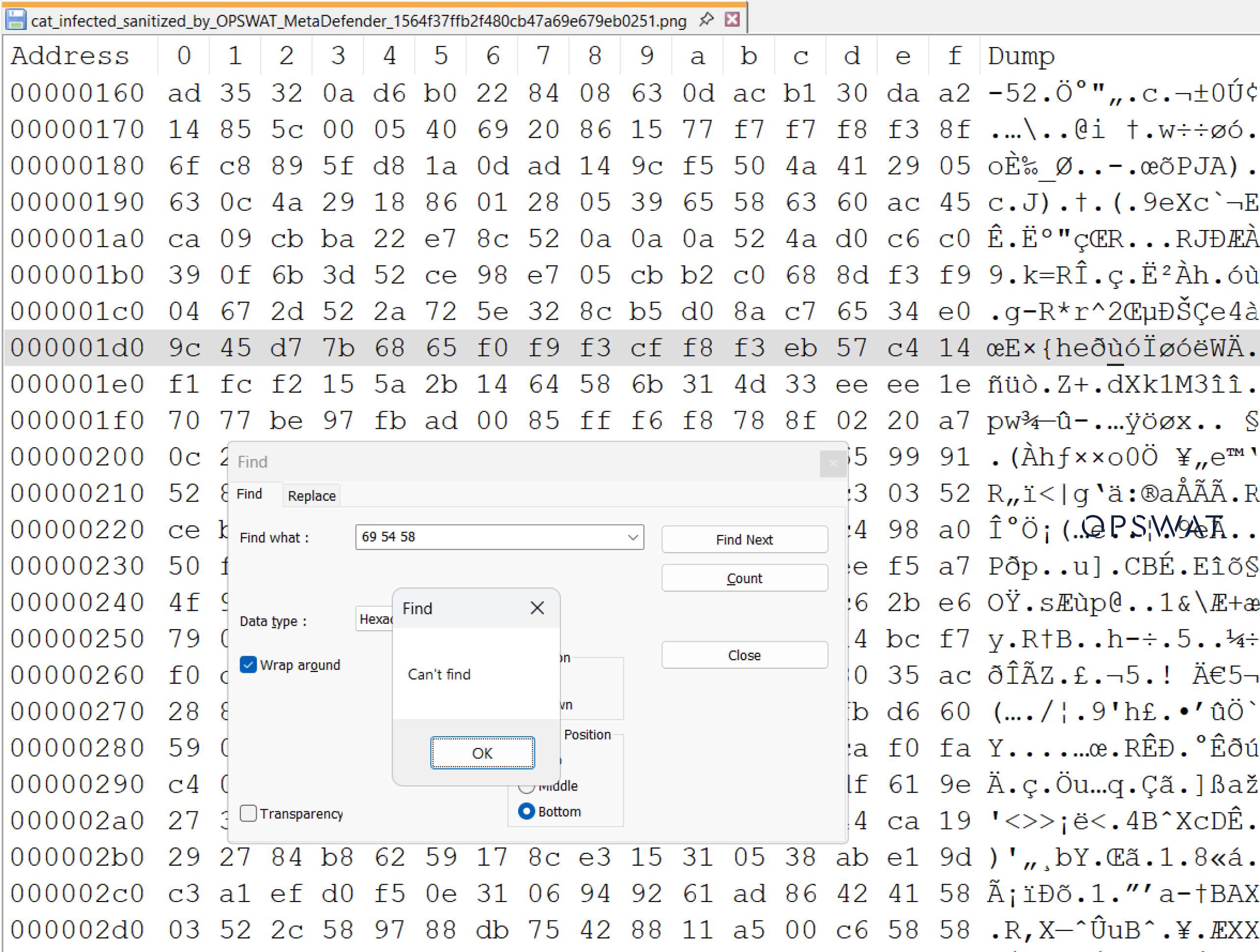
- A prevention-first approach removes the hiding spot before the file ever reaches a user. Deep CDR™ Technology strips metadata chunks such as iTXt and regenerates pixel data during reconstruction, eliminating hidden payloads while the image continues to render normally.
Steganography Is a Real-World Threat Vector
Steganography is the practice of concealing information inside another, unsuspicious carrier. In a modern attack context, steganography means hiding a malicious payload inside an ordinary file (an image, an audio clip, a document) in a way that leaves the carrier looking and functioning completely normally. The file renders as expected, passes format validation, and raises no behavioral flags. The payload is simply there, waiting, invisible to anything that isn't specifically looking for it.
There is clear evidence that this technique is in active use. A peer-reviewed ARES 2024 study analyzed 106 documented cases across 133 threat intelligence reports and found that known stegomalware relies on a relatively small set of recurring patterns and hiding methods. Positive Technologies also reported that the SteganoAmor campaign used steganography in more than 320 attacks targeting companies across 31 countries and multiple sectors.
For IT and security leaders, the message is straightforward: steganography is not a theoretical threat. It is a practical, documented technique being used to conceal malicious payloads inside ordinary-looking files delivered through email.
How Image-Based Steganography Actually Works
Images are one of the most widely abused carrier formats and looking closely at how attackers use them reveals two distinct hiding techniques that often travel under the same name.
The first is steganography in the strict sense: embedding data inside the pixel values that make up the picture itself. The most common method is LSB (least significant bit) embedding. Every pixel is stored as a set of numeric color values, and the lowest-order bit of each value contributes almost nothing to how that color appears on screen. Attackers overwrite those bits with fragments of an encoded payload, scattering it across thousands or millions of pixels. The visual difference stays imperceptible to the human eye, the file remains fully valid, and the payload lives inside the image data itself instead of in any separate field a scanner might single out for inspection. Threat research confirms this is the approach documented most often in the wild, with the ARES 2024 study finding PNG (Portable Network Graphics) and JPG files to be the most frequently abused media carriers and LSB embedding among the recurring hiding methods.
The second technique hides data in the structure of the file surrounding the picture. Image formats combine required data, which carries everything the image needs to render, with optional metadata chunks holding supplementary information such as author names, descriptions, or copyright notices. Renderers skip those optional chunks entirely, so anything stored there leaves the displayed image untouched. PNG files include one such optional chunk called iTXt, originally designed for text metadata, and attackers store encoded payloads there knowing that nothing in the normal file handling pipeline will ever read that data. Security researchers classify this as structural data hiding, a close cousin of pixel-level steganography, and threat reporting typically groups both under the stegomalware label.
The same principle extends beyond images. Audio files have metadata structures that can carry hidden data without affecting playback. Video files have similar gaps. Document formats can hide data in metadata fields, whitespace, or formatting structures. The carrier format changes, but the logic does not.
What all of these have in common: the carrier file remains valid, functional, and visually or audibly unchanged. There is nothing for a detection tool looking for suspicious behavior to find, because there is no suspicious behavior.
In a typical steganography-based email attack, the image doesn't arrive alone. It arrives alongside a malicious document (most commonly an Office file) that contains a macro: a small program embedded in the document that runs automatically when the file is opened. That macro is the executor. It fetches the carrier image, reads its raw bytes, extracts the encoded payload from the metadata, decodes it, and runs it. The image itself is a storage mechanism that never executes anything.
Why Detection-Based Controls Miss Steganography
Detection-based security is built around a simple question: does this look malicious? It works by scanning files for known threat signatures, behavioral indicators, and structural anomalies. When something matches a pattern associated with malicious activity, it gets flagged.
Steganography is specifically designed to defeat that question. The carrier file is structurally valid. It renders correctly. It contains no executable code, no suspicious scripts, no recognizable malware signatures.
This is not a gap that better detection closes. It is a structural mismatch between what detection tools are designed to find and what steganography is designed to be. The threat passes every check not by defeating the scanner, but by giving it nothing to find.
How Deep CDR™ Technology Prevents Steganographic Payloads
OPSWAT's Deep CDR™ Technology does not attempt to determine whether a file is malicious. Instead, it applies a prevention-first approach: deconstruct the file, remove potentially malicious content, and rebuild a clean, usable version.
For a PNG carrying hidden data in its iTXt chunk, Deep CDR™ Technology reconstructs the file without any iTXt content. For payloads embedded at the pixel level, Deep CDR™ Technology regenerates the image data during reconstruction, disrupting any payload distributed across pixel values while preserving visual quality. The sanitized PNG remains specification-compliant and renders normally, with the hidden payload eliminated either way. That is the core difference between detection and prevention: detection tries to recognize the threat, while Deep CDR™ Technology removes the hidden attack surface before the file reaches the user.
This prevention-first approach is validated by SE Labs, which recognized Deep CDR™ Technology as the first-ever CDR solution to achieve a 100% Protection and Accuracy score.
Adding Zero-Day Attachment Analysis with MetaDefender™ Aether
Deep CDR™ Technology neutralizes active and embedded content. Some suspicious attachments, however, still warrant deeper behavioral inspection. MetaDefender™ Aether extends OPSWAT Email Security with zero-day attachment analysis, using adaptive sandboxing and built-in threat intelligence to expose malicious behavior in evasive or unknown files and return a single trusted verdict for faster blocking, triage, and response. With a 99.9% zero-day detection rate, Aether helps close the residual gap left by sanitization and multiscanning alone.
How OPSWAT Applies a Multi-Layered Approach to Email Security
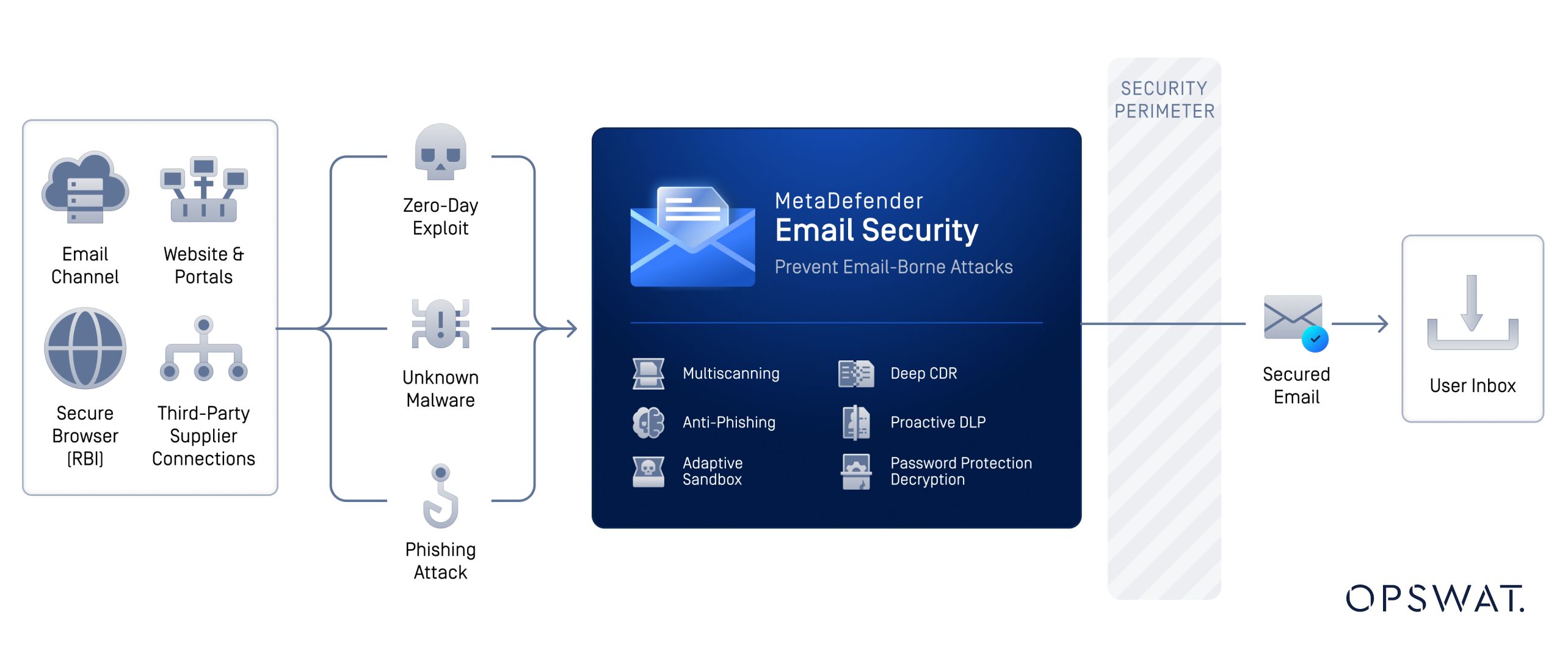
MetaDefender™ Email Security delivers combined detection and prevention through two deployment models designed for different environments.
MetaDefender™ Email Gateway Security deploys as software in front of existing mail servers at the SMTP /MX level. It applies Deep CDR™ Technology across 200+ file types, MetaDefender Aether for adaptive sandboxing and deeper behavioral inspection of suspicious attachments, Metascan™ Multiscanning across 30+ AV engines for broad known-threat coverage, Proactive DLP™ technology, and Predictive Alin AI, an AI-powered engine that predicts whether a file contains malware in milliseconds with a 0.1% false positive rate.
MetaDefender™ for Microsoft 365 (formerly known as MetaDefender™ Cloud Email Security) augments Microsoft 365 environments and deploys in minutes, with no changes to existing MX records required. Against image-based steganography and other file-borne threats, our platform applies Deep CDR™ Technology, MetaDefender Aether for zero-day attachment analysis and deeper behavioral inspection of suspicious files, Metascan Multiscanning across up to 17 AV engines, and Predictive Alin AI.
The Bottom Line
Steganography-based threats are a practical concern for organizations that rely on email as a primary communication channel. When attackers can hide payloads inside ordinary-looking files, organizations need more than detection alone. A prevention-first approach mitigates that risk by removing the hidden attack surface before the file ever reaches the user.