Managing security controls across distributed environments requires more than deploying protection tools. Critical infrastructure operators need a reliable way to oversee configurations, monitor operations, and maintain consistent administration across multiple sites and systems.
Security solutions management provides a centralized operating model for managing these controls at scale. My OPSWAT™ Central Management brings this approach to OPSWAT environments by giving supported MetaDefender™ deployments a unified management layer across IT, OT, on-premises, and air-gapped environments.
- Key Takeaways
- Why Managing Security Solutions Across Distributed Sites Is Challenging
- How OPSWAT Applies Security Solutions Management
- What My OPSWAT Central Management Does at Each Site
- When to Use My OPSWAT Central Management
- How Centralized Security Solutions Management Supports Compliance and Resilience
- Related Topics
- Frequently Asked Questions
Key Takeaways
- Remote and distributed sites make security controls harder to manage. Visibility gaps, fragmented tools, and manual workflows can leave deployed instances with inconsistent configurations or outdated software.
- Centralized security solutions management moves routine administration into a shared management layer. Teams can maintain control, monitoring, and policy enforcement across supported deployments without administering every site separately.
- Centralized oversight must preserve OT safeguards. Secure air-gapped and segmented environments still depend on controlled synchronization, approved update procedures, and local operating constraints rather than broad, always-on connectivity between sites.
- My OPSWAT Central Management applies this management model to supported OPSWAT products, giving administrators one place to see, operate, and govern distributed MetaDefender deployments across diverse deployment models and operating conditions.
Why Managing Security Solutions Across Distributed Sites Is Challenging
Distributed security deployments are hard to keep consistent.
They often span manufacturing facilities, substations, treatment plants, remote offices, and operational environments where routine physical access is limited.
When each site or product instance is managed through a separate console, your team loses a complete view of what is deployed, what is current, and what needs attention.
Visibility Gaps and Fragmented Oversight
Visibility gaps make distributed security instances difficult to monitor consistently. According to the SANS State of ICS/OT Security 2025 Report, only about 13% of organizations report full visibility across the ICS/OT system.
At remote or unmanned sites, limited visibility can allow instances to become stale, drift from approved baselines, and stop reporting without immediate detection.
Tool fragmentation adds another layer of complexity. A 2025 global survey from the IBM Institute for Business Value of 1,000 executives found that organizations use an average of 83 security solutions from 29 vendors. More than half of executives (52%) identified complexity as the biggest impediment to security operations.
Each additional console is a place where a deployed solution can quietly go unmanaged.
Manual, Site-by-Site Management Workflows
Manual management turns routine administration into repeated operational work. Critical infrastructure operators can have tools spread across many facilities, while the teams responsible for them may not have regular physical access to every location.
The workload grows with every deployment:
- Local admins apply one-off exceptions that drift from the approved baseline
- Incident responders must reconstruct which console, owner, and policy apply to an affected instance
- Reporting often requires manually combining data from separate systems
Instead of managing the environment as a whole, your team keeps it current through repeated logins, report consolidation, local coordination, and sometimes travel.
The larger the site footprint grows, the harder that operating model is to sustain.
How OPSWAT Applies Security Solutions Management
OPSWAT applies security solutions management through My OPSWAT™ Central Management, the control layer for OPSWAT solutions. It provides administrators with a single place to monitor, operate, and govern supported MetaDefender™ deployments across distributed environments.
The platform addresses several practical requirements for distributed MetaDefender deployments:
Requirements | How My OPSWAT Central Management helps? |
Centralized inventory | Maintain a record of deployed instances, including version, configuration, license status, and health. |
Air-gapped support | Manage disconnected environments without removing the safeguards that separate them from other networks. |
Remote orchestration | Coordinate supported product updates and management actions without visiting each site. |
Configuration management | Apply and maintain configuration policies consistently across supported deployments. |
Instead of piecing the environment together from separate consoles, your team works from one view of what is deployed, what is current, and what needs attention.
What My OPSWAT Central Management Does at Each Site
My OPSWAT Central Management is OPSWAT's centralized security management platform that provides unified visibility, policy enforcement, and compliance reporting across MetaDefender deployments in IT, OT, on-premises, and air-gapped environments.
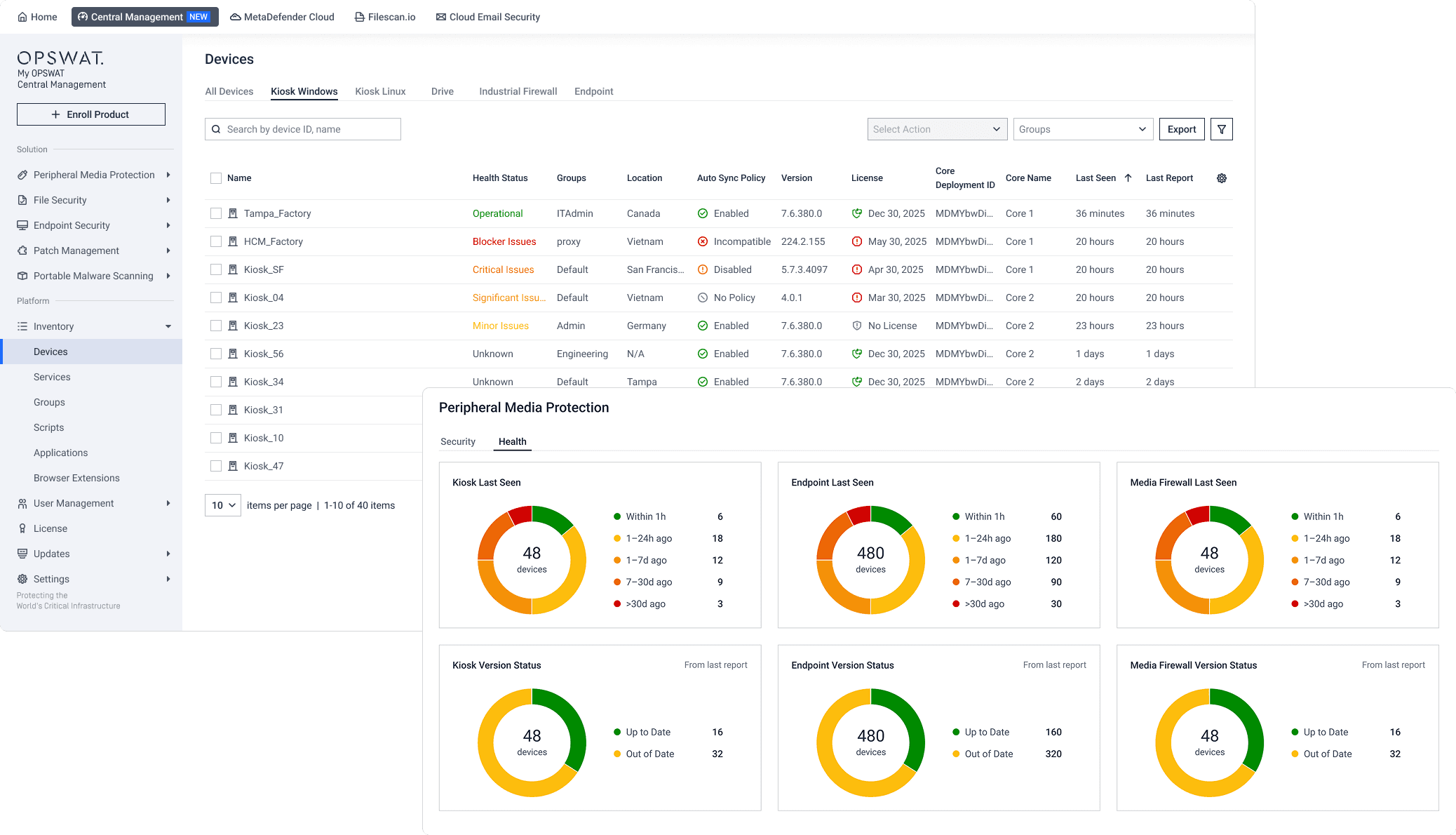
Centralized Inventory and Health Monitoring
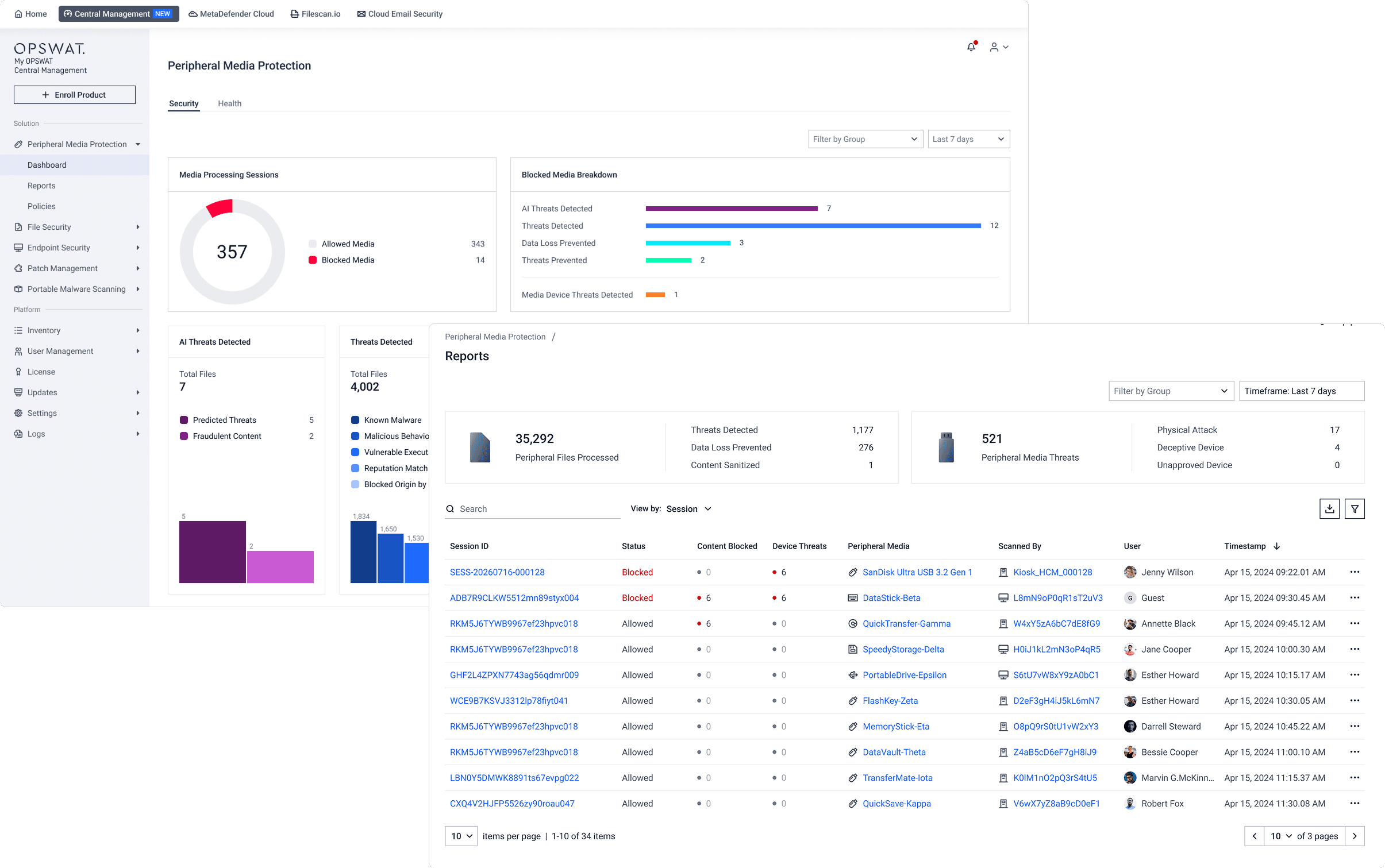
Centralized inventory and health monitoring maintain an authoritative record of every deployed MetaDefender instance, including version, configuration, license state, and last-seen status. Health telemetry from every site can surface drift, errors, and outages before they escalate into incidents.
For example, a Southeast Asian smart manufacturing plant used My OPSWAT Central Management to unify device monitoring across a 450,000-square-foot campus, giving security teams a consolidated view of production endpoints and systems instead of relying on disconnected monitoring tools.
Remote Product Management
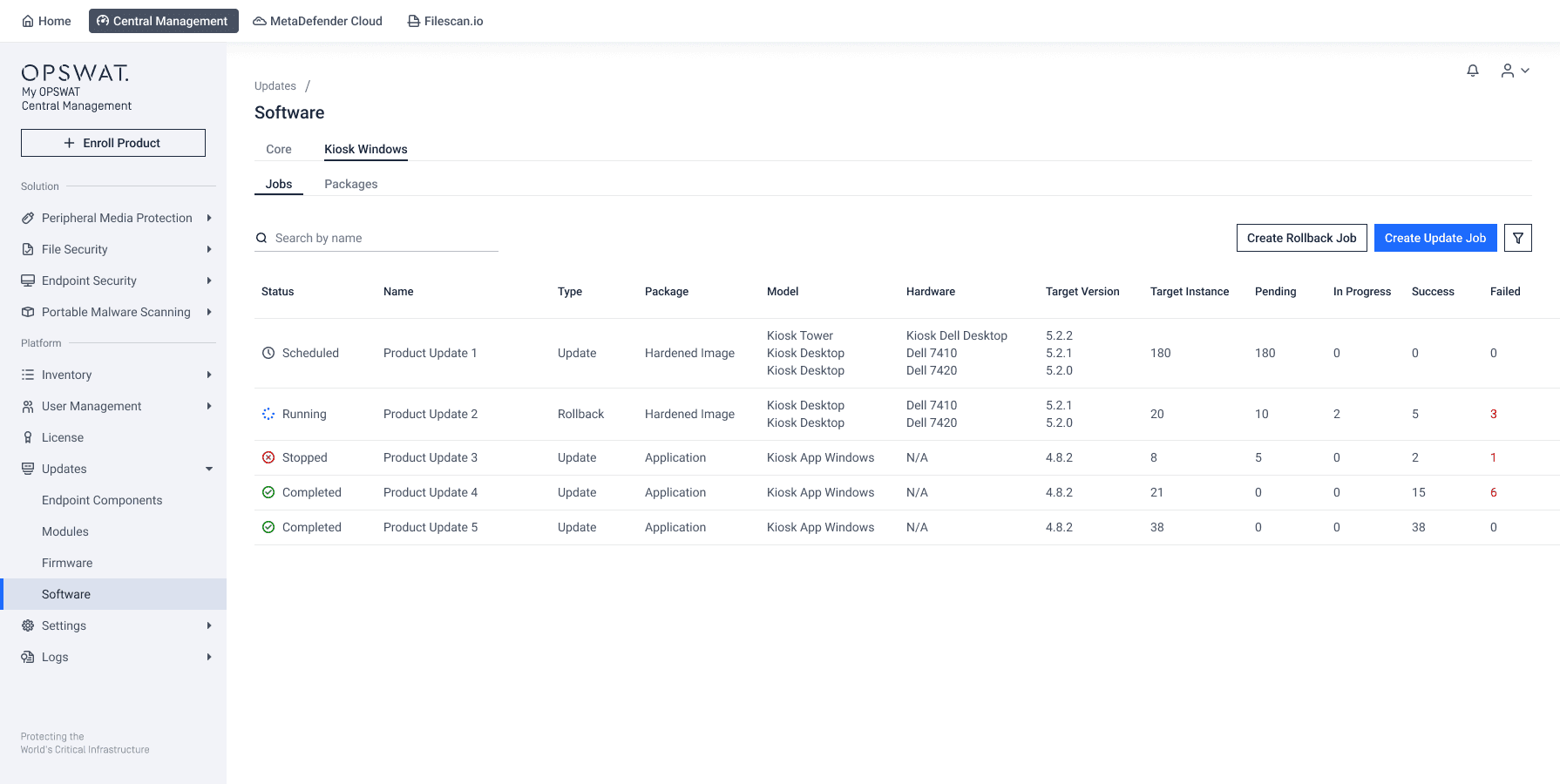
Remote product management gives security teams a way to operate supported deployments without depending on routine local access. Administrators can use a central console to coordinate application updates, collect logs and support packages, monitor instance health, and manage rollout activity across hard-to-reach environments.
Consolidating those workflows reduces the need to repeat the same administrative process at each location. Teams can coordinate maintenance and troubleshooting across a distributed deployment while still accounting for the operating requirements of individual sites.
Configuration Management at Scale
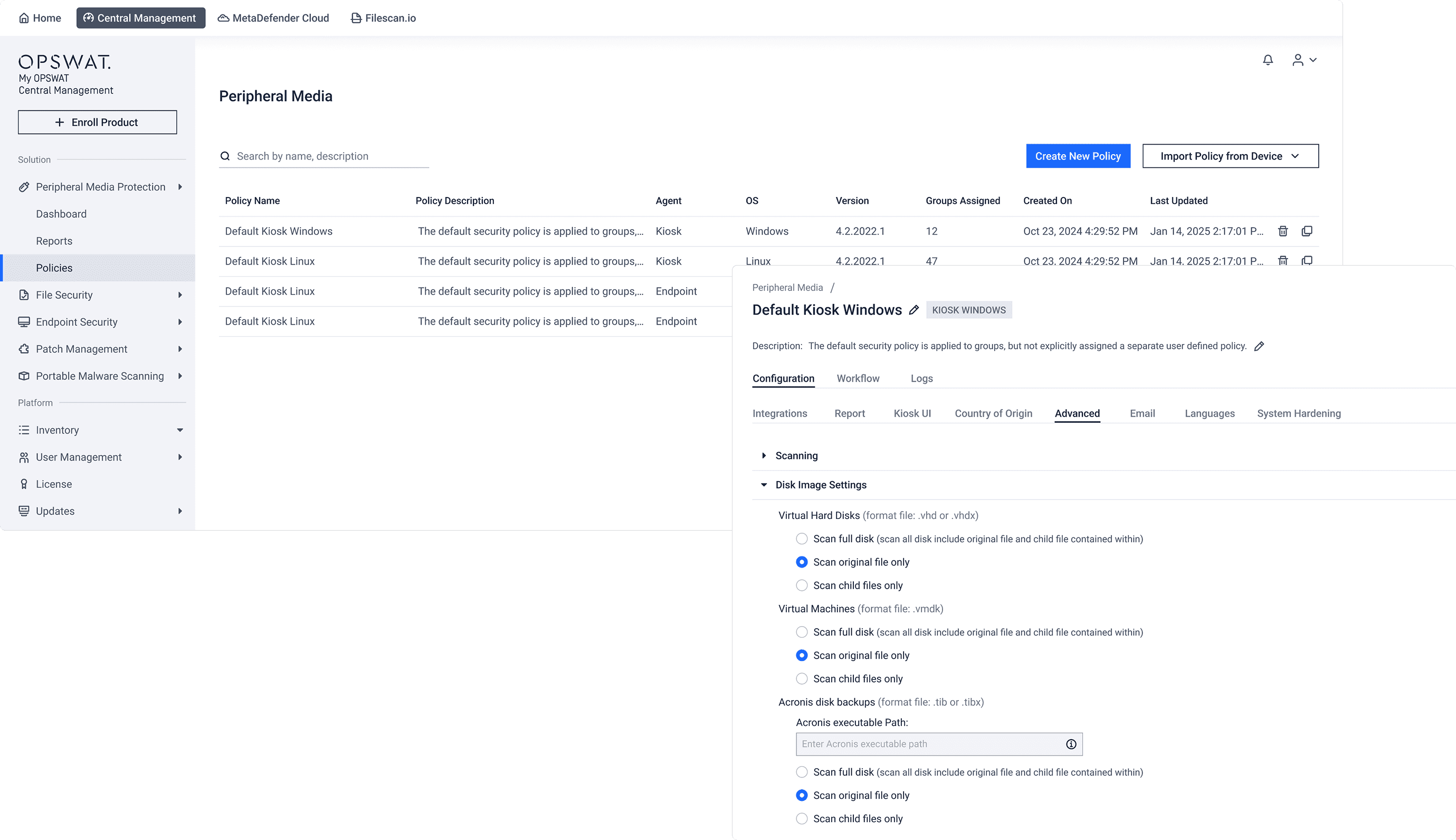
Configuration management at scale allows administrators to define, deploy, and maintain security settings across connected MetaDefender instances from one centralized console. Instead of manually configuring each deployment site by site, security teams can standardize policies, update configurations, maintain consistent protection, and coordinate configuration changes across cloud, on-premises, and air-gapped environments.
Aggregating Scan Reports and Risk Data
Aggregating scan reports and risk data brings information from connected MetaDefender products into a shared operational view. Security teams can compare detection activity, policy status, and other reported data across locations rather than reviewing each site in isolation.
Cross-site context can help teams identify unusual changes in detection volume, recurring policy violations, or locations requiring additional attention. A consistent reporting layer also gives auditors and security teams comparable evidence across facilities instead of separate reports built from different local processes.
When to Use My OPSWAT Central Management
My OPSWAT Central Management is designed for organizations managing supported MetaDefender deployments across sites that are difficult to reach, inconsistently connected, or operationally sensitive. It is especially useful when teams are:
- Operating dozens or hundreds of MetaDefender instances across sites that cannot be visited on a routine basis, such as offshore rigs, substations, or remote treatment plants.
- Losing time to console-switching during incident response because no single view shows which instance is healthy, current, and in policy right now.
- Rolling out updates or configuration changes across many sites at once and needing staged rollout and rollback instead of a manual, site-by-site push.
- Managing a mix of connected, intermittently connected, and air-gapped sites that each need a different data path into the same central inventory.
- Investigating a file journey across an OPSWAT deployment, including where the file entered, which OPSWAT products handled it, what happened at each stage, and whether the file changed along the way. See the File Audit Trail blog for more details.
How Centralized Security Solutions Management Supports Compliance and Resilience
Centralized security solutions management produces the attributable, time-stamped records that compliance reviews and incident investigations depend on. A platform may support these reviews, yet that does not guarantee compliance automatically.
Standardized reports replace repeated requests to local administrators for screenshots, spreadsheets, and exported logs, and consistent data definitions make audit evidence comparable across facilities and regions. For critical infrastructure operators working with frameworks such as NIST guidance or NERC CIP, an authoritative inventory of deployed security solutions becomes the foundation the rest of the compliance program builds on.
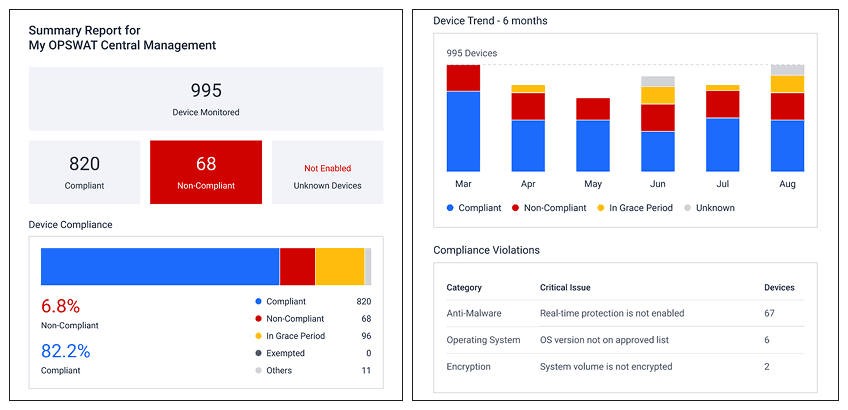
My OPSWAT Central Management provides that foundation for distributed MetaDefender deployments, giving IT, OT, and air-gapped sites a single point of inventory, health monitoring, and policy control. Talk to an OPSWAT expert or visit the My OPSWAT Central Management solution page to see how centralized management can elevate your security operations.
Related Topics
Centralized security solutions management gives teams the context needed to govern security deployments across remote sites. The next step is understanding how that visibility supports continuous monitoring: detecting changes, identifying risky behavior, and reducing the time attackers or unmanaged activity can remain unnoticed.
For a deeper look at that side of the same security operations challenge, read the related article: What Is Continuous Monitoring in Cybersecurity and How to Implement It.
Frequently Asked Questions
What capabilities should a centralized security solutions management platform include?
At minimum: an authoritative inventory across every asset class you deploy, health and configuration monitoring, remote update orchestration with staged rollout and rollback, centralized policy enforcement, and aggregated scan and risk reporting. The platform should also scale to thousands of sites without a proportional increase in administrative headcount.
How does centralized security solutions management detect instances that go offline, fail an update, or drift from configuration?
Centralized platforms combine registration at deployment, ongoing check-ins, and health telemetry to flag instances that go offline, fail an update, or drift from the approved configuration baseline. This works for solutions the platform already knows about, not instances that were never registered in the first place. , so an instance that was never registered needs asset discovery to surface it. The value lies in catching these conditions on the known fleet as they happen.
Does centralized management work in air-gapped or intermittently connected sites?
Yes, but the connection model differs from that of a continuously connected site. Air-gapped and intermittently connected sites use controlled synchronization, signed update packages, and local administration, with evidence and status reconciling back to the central console once an approved transfer window completes.
How should a centralized security solutions management platform integrate with existing security tools?
A centralized security solutions management platform should export stable asset identifiers, health status, and policy state to the SIEM or SOAR platforms a security team already uses, so analysts get site and ownership context during alert triage without switching consoles.
How does centralized security solutions management support compliance reporting?
Centralized security solutions management produces attributable, time-stamped records of configuration, ownership, and policy status that replace manual evidence collection from each site. These records support control verification for frameworks like NIST guidance and NERC CIP, , though compliance still rests on the organization's own controls and processes.
What's the first step to centralizing security solutions management across distributed sites?
Start by defining which system will be authoritative for identity, ownership, configuration, and health status, then register known instances before layering in discovery for anything unmanaged. Establishing that authoritative source first prevents conflicting records once multiple sites are connected.