Continuous monitoring in cybersecurity is an ongoing operating model that combines real-time asset visibility, telemetry collection, configuration tracking, and automated evidence generation. It gives security leaders continuous awareness of their security posture and threat conditions rather than relying on periodic scans or point-in-time assessments that leave exploitable gaps between check-ins.
- What Continuous Monitoring in Cybersecurity Actually Means
- Why Continuous Monitoring Matters More Than Periodic Assessments
- What a Continuous Monitoring Program Should Cover
- How Continuous Monitoring Differs From SIEM, EDR, XDR, and Continuous Controls Monitoring
- How OPSWAT’s Centralized Security Management Supports Continuous Monitoring Across Distributed Environments
- Frequently Asked Questions
Key Takeaways
- Continuous monitoring is an operating model, not a product. Multiple tools feed the program; baselines, ownership, dashboards, and corrective workflows define whether it functions.
- Periodic scans leave exposure windows that attackers exploit. According to IBM's 2025 Cost of Data Breach Report, the average time to identify a breach is 207 days. That gap is precisely what continuous telemetry is designed to close.
- Coverage must extend beyond cloud and enterprise networks. OT, ICS, and air-gapped environments have monitoring constraints that cloud-native tools cannot address without purpose-built support.
- SIEM, EDR, and XDR are layers within a continuous monitoring program, not replacements for it. The operating model governs how those tools are configured, integrated, and acted on across the full environment.
- My OPSWAT™ Central Management supports continuous monitoring across MetaDefender deployments, including disconnected and air-gapped sites. Visibility, policy enforcement , and compliance reporting work the same way whether a site is connected or isolated.
What Continuous Monitoring in Cybersecurity Actually Means
Continuous monitoring in cybersecurity is not a single product category or a vendor feature list. It is a security operating model that combines asset inventory, threat detection, policy enforcement, and automated remediation into an ongoing program rather than a series of scheduled events.
The formal term for this model in the United States federal context is Information Security Continuous Monitoring (ISCM). NIST SP 800-137 defines ISCM as maintaining ongoing awareness of information security, vulnerabilities, and threats to support organizational risk management decisions. The framework applies beyond federal agencies, giving any security leader a structured way to think about what a monitoring program should produce and how to govern it.
What NIST SP 800-137 Says About Information Security Continuous Monitoring
NIST SP 800-137 structures ISCM into six components: strategy definition, controls selection, implementation, collection, analysis and reporting, and response to findings. Each component builds on the previous one, creating a closed loop between policy decisions and operational evidence.
For CISOs, the practical value of SP 800-137 is governance clarity. It separates program structure (who defines the strategy, who acts on findings, how frequently different assets are assessed) from the tools used to collect data. This separation prevents the common failure mode where monitoring is treated as a tool deployment rather than an operating model with ownership and accountability.
Why Continuous Monitoring Is an Operating Model Rather Than a Point Tool
Multiple tools feed a continuous monitoring program: SIEM for log correlation, EDR for endpoint telemetry, vulnerability scanners, configuration assessment tools, and OT-specific data collectors. No single tool constitutes the program. The operating model is defined by what governs those tools: baselines, policies, dashboards, escalation paths, and corrective action workflows.
Organizations that buy a tool expecting it to deliver continuous monitoring typically find they have telemetry but no program. The program requires defined ownership, approved security state baselines, response workflows, and leadership reporting before any tool delivers its full value.
What a Board-Ready Definition Looks Like
For executive and board audiences, continuous monitoring reduces to three outcomes: knowing when something changes in the security environment, shortening the time between that change and organizational awareness, and maintaining defensible evidence of ongoing security oversight.
This framing matters because board-level conversations about continuous monitoring often conflate the operating model with a product purchase. Security leaders who can explain monitoring as an operational capability rather than a budget line item are better positioned to defend program investment and explain gaps in terms of organizational risk.
Why Continuous Monitoring Matters More Than Periodic Assessments
Periodic security assessments take three common forms: quarterly vulnerability scans, annual penetration tests, and monthly configuration reviews. Each provides a snapshot. The time between those snapshots is when attacks happen, misconfigurations go undetected, and patch exposure compounds.
How Periodic Scans Leave Exploitable Gaps Between Assessments
A quarterly vulnerability scan tells you what your exposure looked like on the day the scanner ran. A newly deployed server, a changed firewall rule, or a cloud workload spun up three days after the scan is invisible until the next check-in. Fast-changing environments like cloud infrastructure, remote endpoints, and distributed OT sites make periodic assessment architecturally insufficient.
Configuration drift compounds the problem. A server correctly configured at last scan can drift from its approved baseline within hours of a patch, a software update, or an administrator change. Continuous configuration monitoring catches that drift in near-real time rather than at the next scheduled review.
How Continuous Telemetry Reduces Attacker Dwell Time
According to IBM's 2025 Cost of Data Breach Report, the average time to identify a security breach is 207 days. Most of that dwell time occurs not because detection tools lack capability but because telemetry is fragmented, ownership is unclear, and alerts do not route to the right response teams.
Continuous monitoring shortens dwell time by combining data collection with workflow ownership. When telemetry flows into a centralized view, is correlated against baselines, and routes to defined response owners, the path from detection to containment shortens. The bottleneck in most organizations is not detection technology. It is the absence of a program that connects detection to action.
Why CISOs Use Continuous Monitoring for Risk-Based Decision-Making
Centralized, continuous visibility changes how security leadership makes prioritization decisions. With a live view of asset health, vulnerability age, patch status, and policy compliance across the full environment, CISOs can shift from responding to the most recent alert to acting on the highest-risk exposure.
Risk-based prioritization requires current data. An organization relying on monthly reports and quarterly dashboards cannot distinguish between a high-severity finding remediated last week and one open for six months. Continuous monitoring makes that distinction visible and actionable before it becomes a breach or an audit finding.
What a Continuous Monitoring Program Should Cover
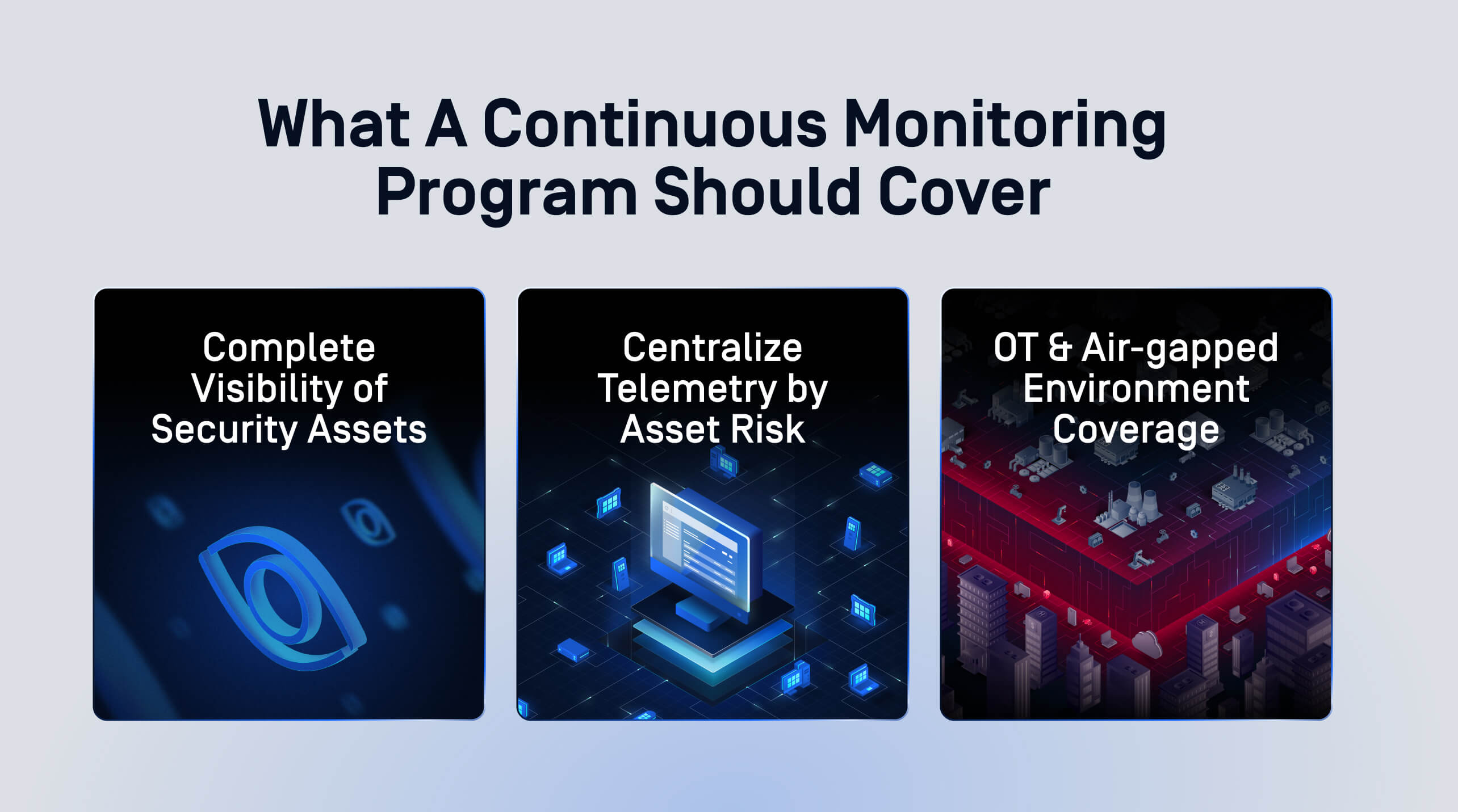
A complete continuous monitoring program covers more than network traffic or endpoint alerts. It spans every asset type, security domain, and environment where a security event can occur, and addresses the distinct constraints of each.
Which Assets and Security Domains Need Continuous Monitoring
The full scope of continuous monitoring includes endpoints, servers, virtual machines, cloud workloads, network infrastructure, identities, applications, data transfer points, removable media, and deployed security controls. Each asset class produces telemetry that belongs in the monitoring program.
Blind spots in continuous monitoring programs most often come from unmanaged assets and incomplete inventories. An asset not in the inventory is not being monitored, which means it is not contributing to the organization's security posture picture. Accurate, maintained asset inventory is the foundation on which telemetry selection, baselines, and coverage measurement are built.
What Telemetry to Centralize and at What Frequency
The telemetry categories a continuous monitoring program should centralize include vulnerability data, configuration state, authentication events, malware scan results, network flow data, security control health status, and policy compliance status. Not all telemetry requires the same collection cadence.
Collection depth should align with asset criticality. Crown-jewel assets (production control systems, identity infrastructure, and data transfer gateways) warrant higher-frequency collection and tighter baselines. Less critical assets can be monitored at lower cadence without creating meaningful exposure gaps. Treating all telemetry at equal frequency increases processing noise without improving detection outcomes.
What Changes When You Monitor OT and Air-Gapped Environments
OT and air-gapped environments introduce monitoring constraints that cloud-native and enterprise-focused tools are not designed to address. Connectivity is limited or absent. Change-control processes are slow by design. Safety requirements restrict what can be deployed on operational systems. Data paths between OT and IT networks are deliberately controlled.
These constraints do not eliminate the need for centralized oversight; they change how data is collected and how remediation is delivered. Monitoring in OT environments typically relies on passive data collection, polling agents, or scheduled data transfer rather than continuous streaming. Air-gapped sites require offline remediation paths, such as patch deployment through disconnected management tools rather than cloud-based update pipelines.
How Continuous Monitoring Differs From SIEM, EDR, XDR, and Continuous Controls Monitoring
Security Information and Event Management (SIEM), Endpoint Detection and Response (EDR), Extended Detection and Response (XDR), and Continuous Controls Monitoring (CCM) are commonly conflated with continuous monitoring or proposed as alternatives to it. Each is a distinct capability that fits inside a monitoring program rather than replacing it.
Tool / Category | Primary Function | Key Capability | Role in a Continuous Monitoring Program |
Continuous Monitoring Program | Operating model for ongoing security awareness | Governs asset inventory, baselines, telemetry, and response ownership across all domains | The program itself. All other tools feed into it |
SIEM | Log aggregation, correlation, and alerting | Normalizes events from multiple sources, applies detection rules, surfaces alerts | Log and event layer; handles alert routing and investigation workflow |
EDR | Endpoint detection and response | Deep endpoint telemetry, behavioral detection, isolation and remediation | Endpoint telemetry source; covers managed endpoints only |
XDR | Cross-domain detection and response | Correlates endpoint, network, and cloud telemetry for unified detection | Broader detection layer; does not cover OT or air-gapped environments |
Continuous Controls Monitoring (CCM) | Ongoing validation that security controls are functioning | Automated evidence generation for compliance; policy conformance tracking | Compliance and governance evidence layer; overlaps with CM on audit documentation |
Where These Tools Fit Inside a Continuous Monitoring Program
SIEM serves as the log aggregation, correlation, and alerting layer within the program. It handles event normalization, detection rules, and analyst investigation workflows. SIEM does not govern asset inventory, configuration baselines, or remediation action.
EDR and XDR address endpoint and network detection and response. They provide deep telemetry and response capabilities for the assets they cover but do not extend to OT systems, air-gapped environments, removable media, or the full range of assets a monitoring program must cover.
CCM validates that security controls are functioning and that policies are being followed. It addresses governance and compliance evidence, overlapping with continuous monitoring in audit reporting but not addressing threat detection, dwell time reduction, or corrective action outside the controls it tracks.
How OPSWAT’s Centralized Security Management Supports Continuous Monitoring Across Distributed Environments
Continuous monitoring only works if a security team can see every deployment at once, including the ones that never touch the internet. Distributed IT, OT, and air-gapped environments each generate their own scan results, health signals, and policy states, and without a single console to aggregate them, a security leader is left checking multiple systems to answer one question: is anything at risk right now?
My OPSWAT™ Central Management is OPSWAT's centralized security management platform designed to provide unified visibility, centralized oversight, and streamlined remediation across MetaDefender deployments in IT, OT, on-premises, and air-gapped environments.
Real-Time Asset Visibility across Devices and Environments
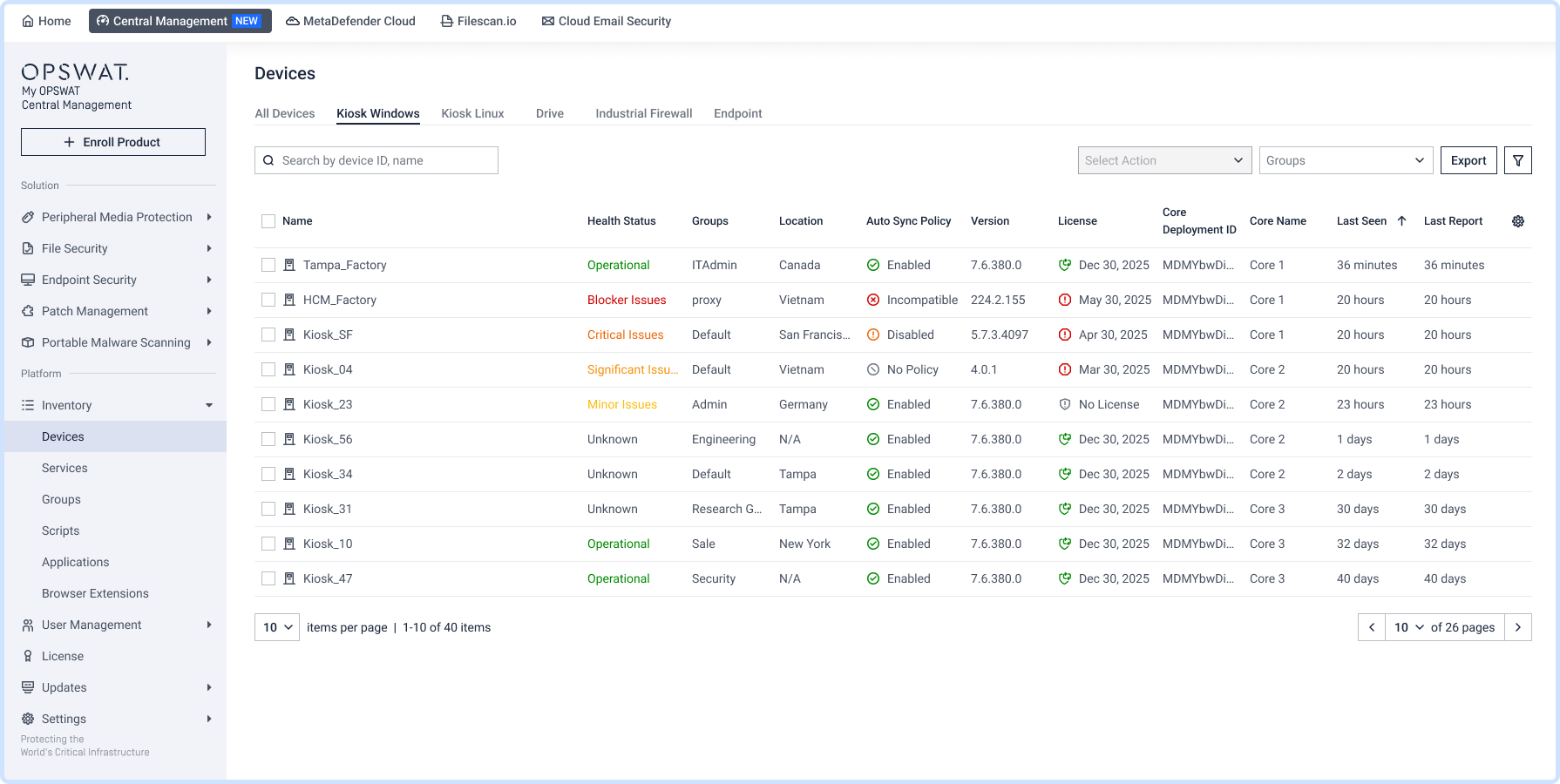
Continuous monitoring starts with knowing exactly what exists in your environment. My OPSWAT Central Management provides a centralized inventory of every enrolled MetaDefender instance across cloud, on-premises, and air-gapped deployments.
With a single source of truth, teams can quickly identify protected and unmanaged assets, detect devices that have stopped reporting, and accurately measure coverage across distributed or segmented networks where manual tracking is often impractical.
Unified Endpoint Security Posture
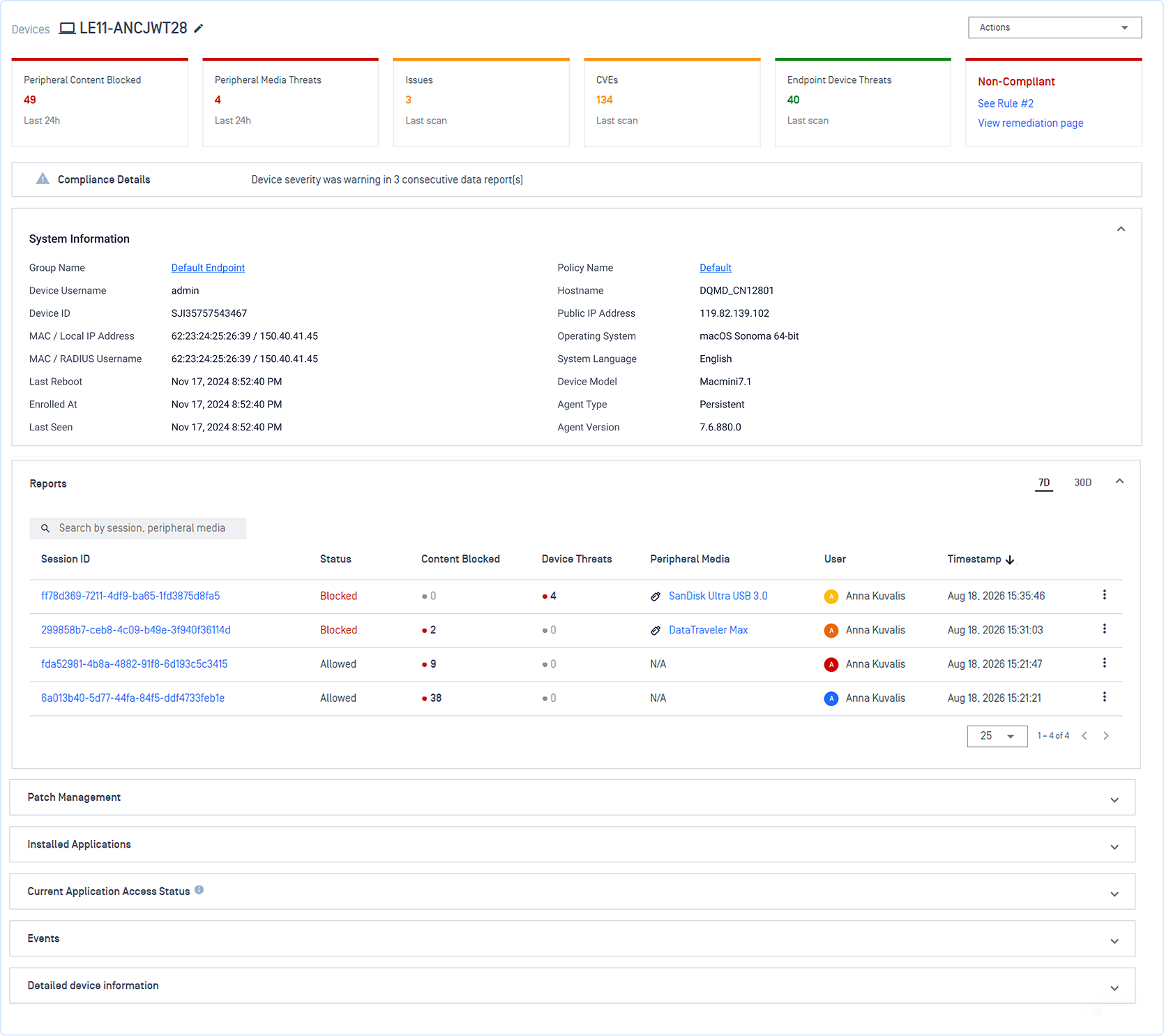
My OPSWAT Central Management gives administrators a consolidated view of endpoint security across the organization. From a single dashboard, teams can review endpoint health, access scan results, and track compliance status without switching between consoles.
Built-in monitoring highlights security gaps and configuration drift, making it easier to identify devices that fall outside established security baselines and take corrective action before issues escalate.
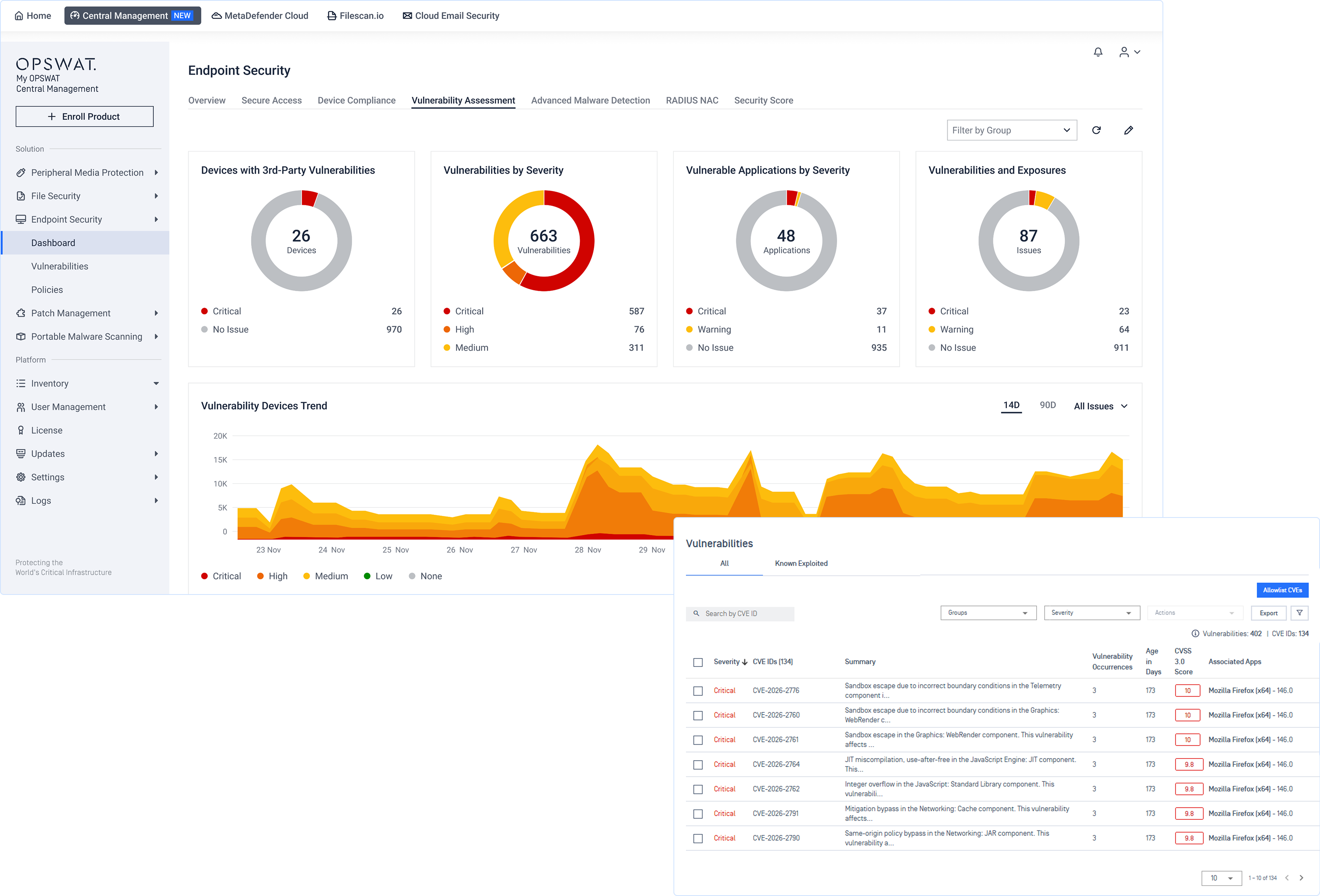
Vulnerability Monitoring and Risk Prioritization
Gain a continuously updated view of vulnerabilities across managed devices and applications. Security teams can quickly identify affected endpoints, understand which applications are exposed, and monitor risk trends over time. Findings are categorized by severity, helping teams prioritize remediation efforts where they will have the greatest impact and track progress as their attack surface evolves.
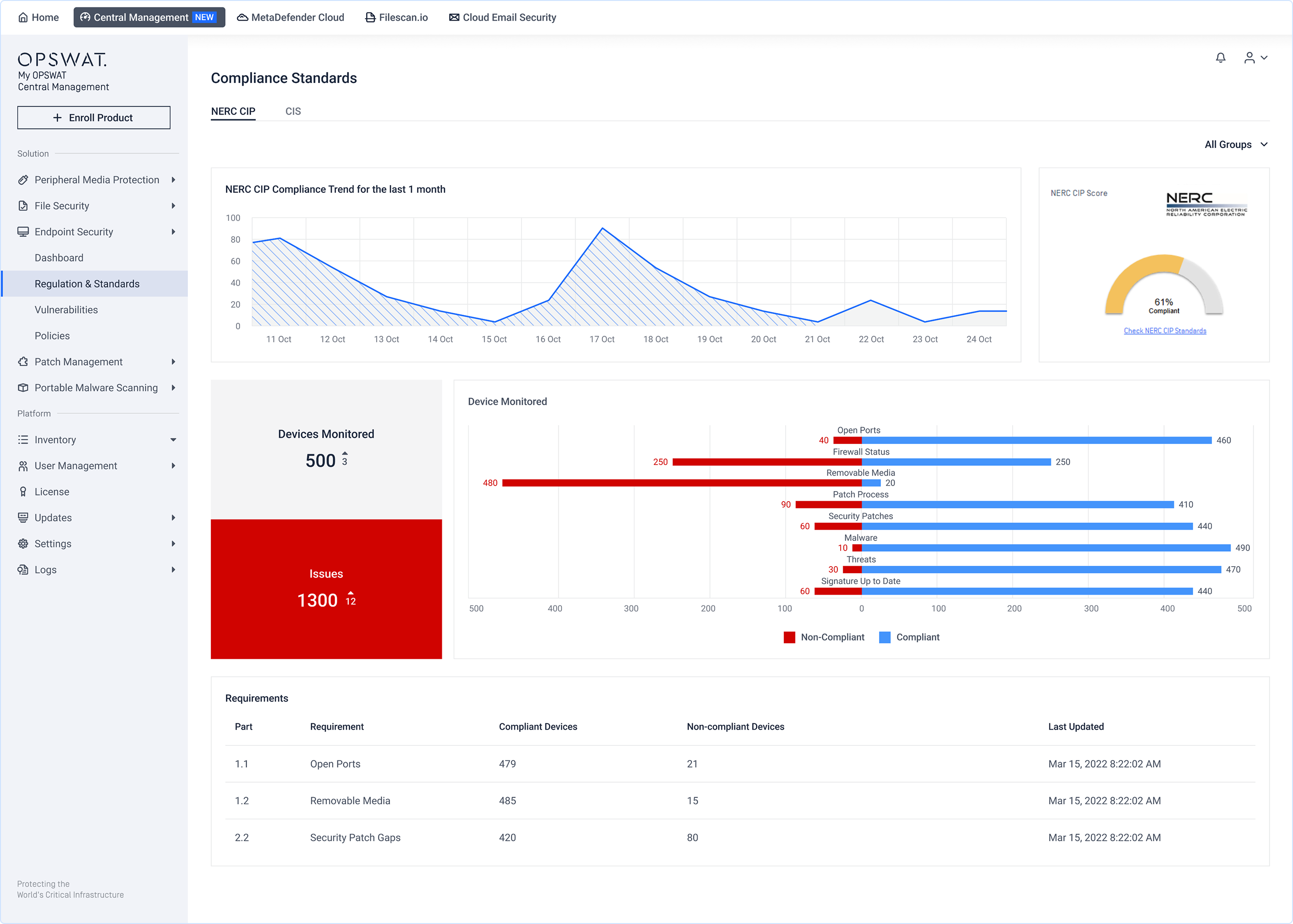
Maintain Audit-Ready Compliance in Regulated Environments
For organizations operating under regulatory requirements, demonstrating compliance can be just as important as maintaining it. My OPSWAT Central Management continuously evaluates devices against organizational policies, records results in centralized logs, and generates reports aligned with frameworks such as NIST, CISA, and GDPR. Because security data is collected in a single location, evidence is readily available for audits, while non-compliant devices can be identified and addressed as soon as they drift from policy.
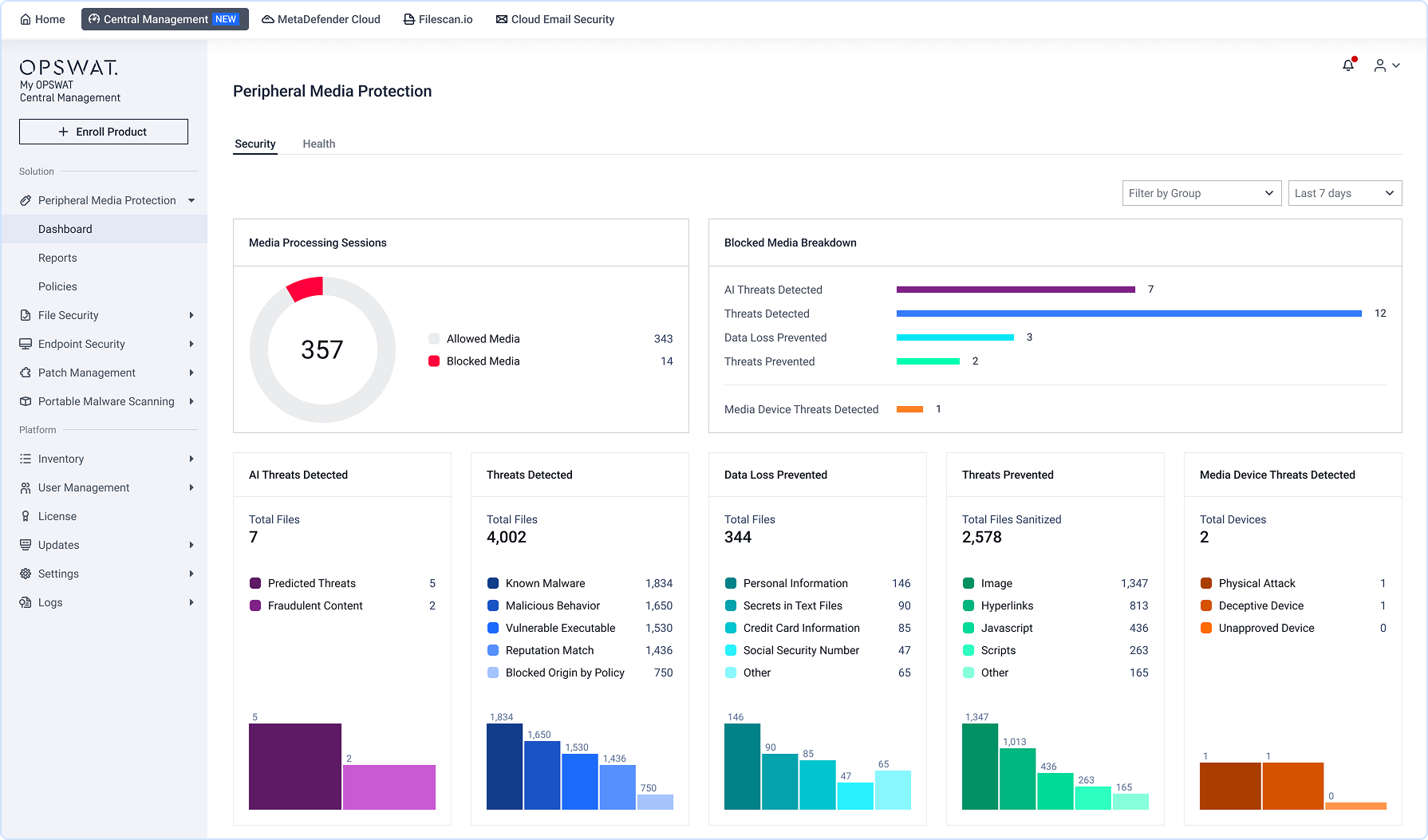
Consolidating Threat Findings into Actionable Insights
For continuous monitoring to work across distributed environments, security teams need centralized security management that aggregate all security events in one place.
My OPSWAT Central Management consolidates malware detections, blocked files, quarantine events, and other findings from across the organization into a unified view.
By analyzing activity across locations and deployment types, teams can uncover recurring patterns, identify emerging threats, and determine whether an issue is isolated or indicative of a broader risk.
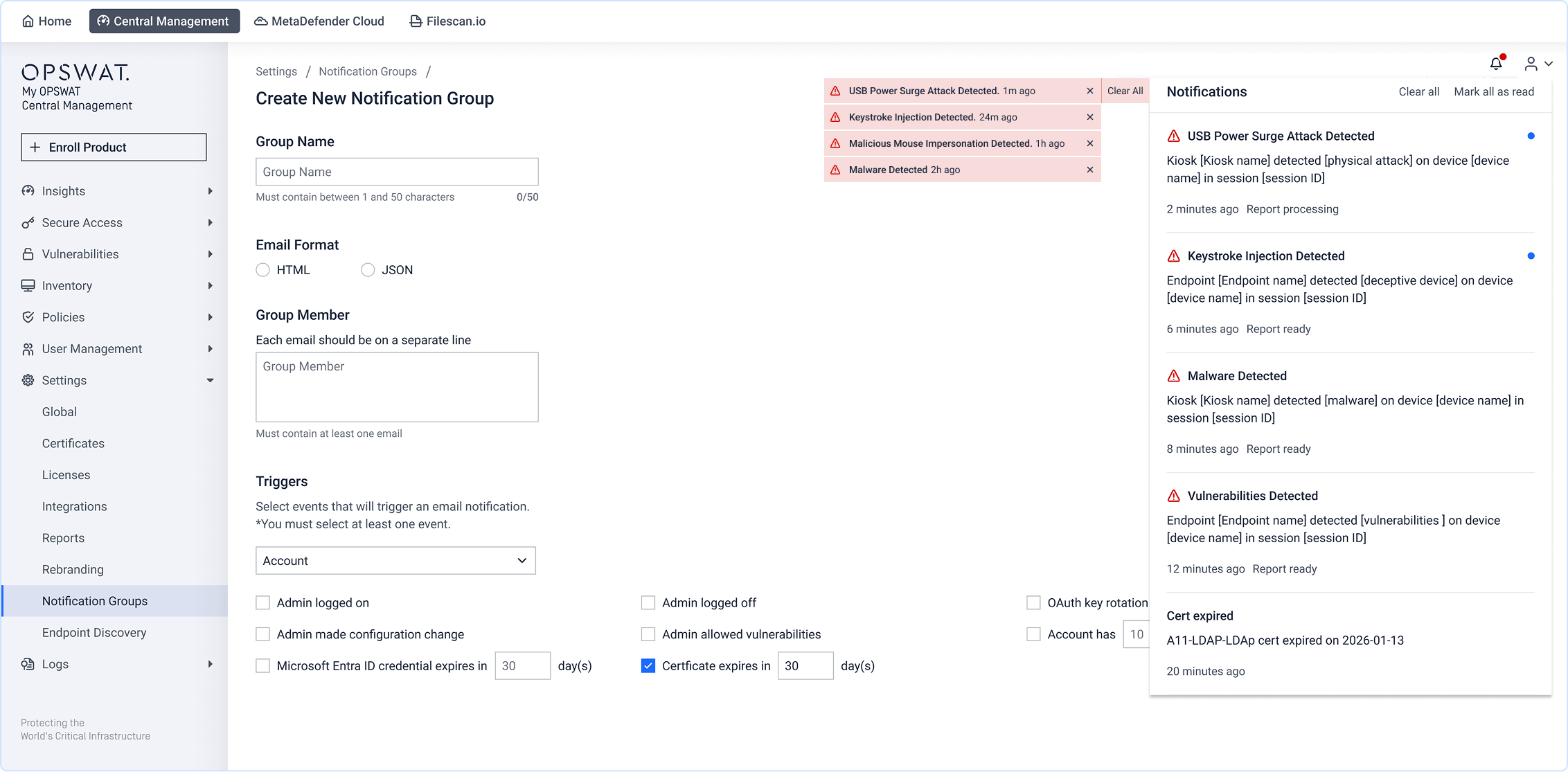
Proactive Alerts for Critical Events
Security teams should not have to constantly monitor dashboards to stay informed. My OPSWAT Central Management provides timely alerts for critical security events, malware detections, system health issues, and other conditions requiring attention.
By notifying the right personnel when meaningful changes occur, the platform helps accelerate response, reduce operational disruption, and prevent minor issues from developing into larger security or compliance incidents.
Talk to an OPSWAT expert or visit the My OPSWAT Central Management solution page to see how centralized management can elevate your security operations.
Frequently Asked Questions
What is the difference between continuous monitoring and periodic scanning?
Periodic scanning produces point-in-time assessments: a snapshot of exposure on the day the scanner ran. Continuous monitoring maintains ongoing awareness of asset state, configuration drift, vulnerability status, and threat activity between those snapshots. The critical difference is time. A misconfiguration introduced three days after the last scan is invisible in a periodic model and visible within hours in a continuous one.
What telemetry should be centralized for effective continuous monitoring?
The core telemetry categories are vulnerability data, configuration state, authentication events, malware scan results, network flow data, security control health, and policy compliance status. For OT environments, add asset inventory, protocol activity, and patch status for operational systems. Collection cadence should align with asset criticality rather than treating all telemetry at the same frequency.
How do you integrate continuous monitoring with existing SIEM, SOAR, and XDR without creating alert fatigue?
Define the role of each platform before integration: SIEM handles log correlation and alerting, SOAR handles response orchestration, XDR handles endpoint and network detection. Continuous monitoring is the governance layer above them. It governs what data flows into each platform, sets the baselines those platforms alert against, and routes findings to the appropriate response owners. Deduplication at the integration layer, risk-based alerting thresholds, and clear severity models prevent alert sprawl.
Can continuous monitoring work in air-gapped or OT environments?
Yes, but collection and remediation methods differ from connected enterprise networks. Air-gapped sites require passive data collection, polling agents, or scheduled data transfer rather than continuous streaming. Remediation (patches, policy updates, and configuration changes) must be delivered through offline-capable management tools rather than cloud-based pipelines. Security management platforms that explicitly support air-gapped enrollment and offline patching are a prerequisite for extending continuous monitoring to these environments.
How can continuous monitoring generate audit-ready evidence for NIST 800-53, NIST 800-137, and FedRAMP?
Continuous monitoring produces audit-ready evidence when it captures configuration changes, scan results, control status, and policy actions with timestamps, role attribution, and retention in a tamper-resistant log. NIST 800-53 requires ongoing assessment of control effectiveness. Continuous monitoring provides automated evidence that replaces manual attestations and point-in-time screenshots. FedRAMP continuous monitoring requirements specify minimum assessment frequencies and evidence retention periods; a program designed around those requirements generates compliant documentation as a byproduct of normal operations.
Which common gaps cause continuous monitoring programs to fail?
The most common failure modes are incomplete asset inventory (assets not monitored because they are not tracked), unclear response ownership (alerts generated but not acted on), and absence of baselines (telemetry collected without a reference point for normal). The fastest fixes follow in this order: audit the asset inventory and close unmanaged asset gaps, assign named response owners with defined escalation timelines, and document approved security state baselines for the highest-risk asset classes. These three steps deliver measurable improvement before any new tooling is added.