What Is Pre-Execution Zero-Day Detection?
Pre-execution zero-day detection is the practice of identifying malicious files before they run, using machine-learning analysis of structural and behavioral file characteristics rather than signature matching or sandbox detonation. It requires no prior knowledge of a specific threat and no sandbox detonation to reach a verdict.
Key Takeaways
- OPSWAT’s Predictive Alin AI analyzes file structure and behavioral indicators to predict malicious intent before execution, catching zero-days that signatures miss
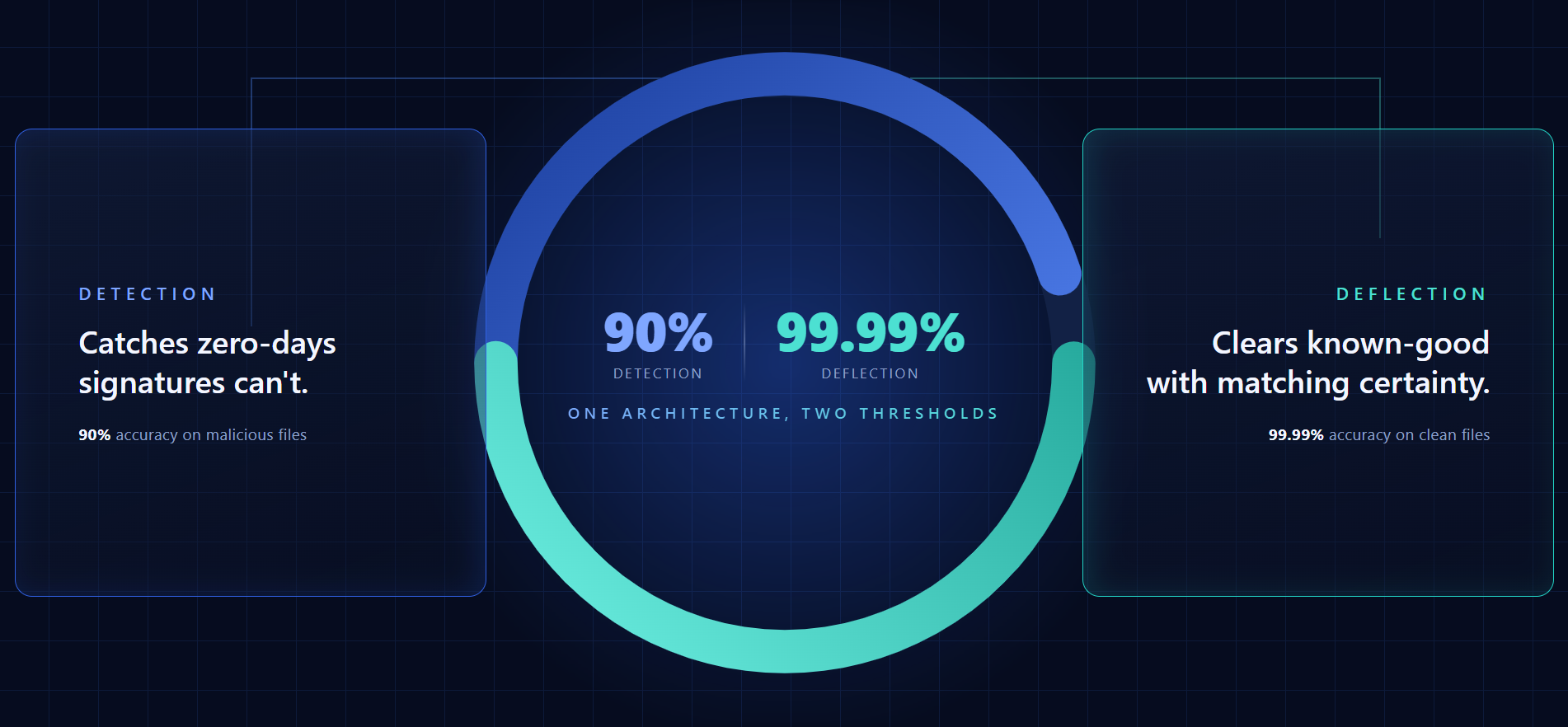
- The engine is tuned for precision first: 90% detection accuracy on malicious files and 99.99% accuracy on clean-file deflection, so every verdict is actionable and analyst trust stays intact
- Verdicts arrive in under 15 milliseconds at P50 for PE (Portable Executable) files, with P90 performance at 50 milliseconds for supported high-risk executable files
- The deflection use case applies the same precision in the opposite direction: high-confidence clean files skip Metascan™ Multiscanning and route directly to Deep CDR™ Technology, reducing pipeline latency without reducing security coverage
- Predictive Alin AI runs identically in cloud, on-premises, and air-gapped environments with zero external connectivity requirements
- According to the SANS 2025 Detection and Response Survey, false positives are the leading detection challenge cited by 73% of security teams, up from 64% the year prior
Why 99.9% of Your File Traffic Is Already Clean and Why That Is the Problem
Every enterprise file pipeline carries a hidden inefficiency. MFT (Managed File Transfer) jobs, ICAP (Internet Content Adaptation Protocol) proxies, email attachments, customer upload portals, and cross-domain data transfers share one statistical reality: roughly 99.9% of the files moving through them are clean business data. The 0.1% that are malicious are the entire reason the pipeline exists. Every file pays the same security tax regardless of risk, and that uniformity is the inefficiency.
The Security Tax Has Two Bills
The first bill is latency. A file queued behind dozens of others during morning rush hour waits its turn through full multiscanning regardless of whether it is a routine spreadsheet or an unknown executable. In banking and financial services, that delay translates directly to held transactions, slower processing, and wire transfers waiting on a scanner. According to the SANS 2025 Detection and Response Survey, response time has become a top challenge for 53% of security teams, up from 45% the prior year.
The second bill is false positives. Most machine-learning security engines are tuned for recall: catch everything, accept the noise. That trade-off works on an endpoint. In a file pipeline, a false positive blocks a legitimate business file, triggers an unnecessary SOC (Security Operations Center) alert, and erodes the analyst trust that makes automation possible. The same SANS survey found that false positives are now the leading detection challenge for 73% of respondents.
Two Mandates, One Pipeline
Security and speed are not inherently in conflict. Defense, government, and critical infrastructure environments operate under compliance mandates requiring every byte to be examined before it moves, while finance, enterprise portals, and high-volume transfer workflows operate under experience mandates where scanning friction causes users to abandon uploads and route around controls. Both mandates are legitimate and can be met by intelligent triage: a system that routes files based on confidence, concentrating deep analysis where it pays off and clearing known-good traffic at speed.
Predictive Alin AI Reads File DNA Before Execution
Predictive Alin AI is OPSWAT's AI-powered malware detection engine for pre-execution zero-day detection, designed to identify malicious files before they execute using machine-learning analysis of structural and behavioral file characteristics. The engine does not rely on signatures, prior knowledge of a specific threat, or sandbox detonation to reach a verdict. Predictive Alin AI reads the structural indicators that reveal malicious intent before a single instruction runs.
Layer 2 of MetaDefender Aether's Five-Layer Pipeline
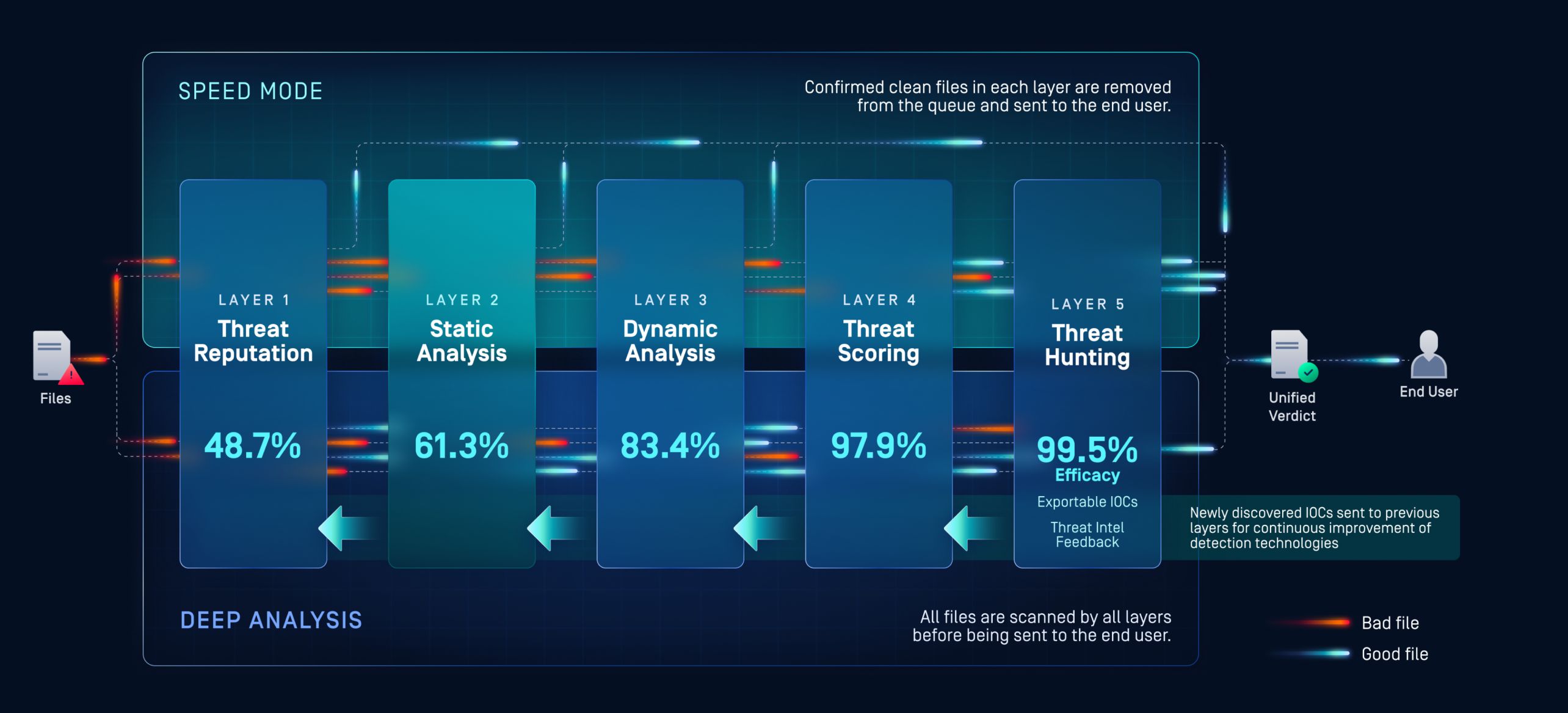
Within MetaDefender Aether™, OPSWAT's unified zero-day detection platform, Predictive Alin AI operates as Layer 2 of a five-layer pipeline: Threat Reputation, Static Analysis, Dynamic Analysis, Threat Scoring, and Threat Hunting. Positioned between Threat Reputation and Dynamic Analysis, Predictive Alin AI reaches its verdict before a file ever reaches the adaptive sandbox.
Files that meet the confidence threshold are deflected or blocked pre-execution; files that don't meet the threshold continue to Dynamic Analysis for deeper emulation rather than relying on a weak static verdict. Confirmed zero-day findings from Dynamic Analysis feed back into Threat Reputation and Predictive Alin AI, strengthening future verdicts across the pipeline.
What the Engine Actually Analyzes
Traditional antivirus engines operate from a list. A signature matches a known threat, and the file is flagged. With 450,000 new malware samples appearing every day, according to AV-TEST.org, that list is always a step behind. Predictive Alin AI takes a different approach, extracting and analyzing the structural features that malicious files leave behind regardless of whether they have been seen before.
The engine evaluates features including:
- File headers, sections, and overall layout
- Entropy patterns and packed code indicators
- Entry points and control flow characteristics
- Metadata and import tables
These are the indicators a threat embeds in its file structure, present regardless of whether the specific threat has been seen before. A file built to evade detection still has to be built, and that construction carries patterns a trained model can read.
Precision First, by Design
Most machine-learning security engines optimize for recall: flag as much as possible and accept the false positives as a cost of coverage. OPSWAT made the opposite engineering decision with Predictive Alin AI. The engine is tuned for precision first. When Predictive Alin AI issues a verdict, that verdict is designed to be trusted and acted on without human review.
That precision runs in both directions, though at different strengths. Detecting malicious files is the harder problem, reaching 90% accuracy, while clearing clean files reaches 99.99% accuracy. This asymmetric confidence is what makes the Deflection use case possible, covered in detail in the next section.
Speed as a Security Feature
Predictive Alin AI delivers verdicts in under 15 milliseconds at P50 for PE files, with P90 performance at 50 milliseconds and P99 under 100 milliseconds for supported high-risk executable files. Four formats are in production today: PE, PDF, Mach-O, and ELF, with expanded format support on the roadmap. The verdict arrives before a user could register the file was uploaded, making inline protection practical without becoming a pipeline bottleneck.
Close the Latency Gap with Deflection
Detection proves the engine works. Every correctly flagged zero-day is a data point that builds the track record required to act in the other direction. Once that trust is established, the same precision threshold that flags malicious files can be applied to clear clean ones with equal confidence.
The Two-Path Pipeline
When Predictive Alin AI issues a high-confidence clean verdict, the file takes a verified shortcut. It bypasses Metascan™ Multiscanning and routes directly to Deep CDR™ Technology for sanitization before delivery. When Predictive Alin AI is not certain, the file takes the full route: multiscanning across up to 30 engines, Deep CDR™ Technology, and a complete verdict before delivery. Every file ends with a verdict. Deflection only changes the path, not the outcome.
This matters most during peak load. Morning email surges, end-of-day batch transfers, and upload bursts after announcements are exactly when queues stretch and response times climb. Deflection clears known-good traffic at ingress so the rest of the pipeline never absorbs the wave.
Zero Trust Stays Intact
Deflection does not reduce scrutiny. The "Trust no file. Trust no device.™" philosophy on which MetaDefender™ was built remains unchanged. No file is assumed clean. Deflection is a conservative act: when the engine is certain, it acts; when there is any doubt, the file takes the longer route. Ambiguity is never resolved at the deflection layer.
How Predictive Alin AI Reduces SOC Alert Fatigue
According to the SANS 2025 Detection and Response Survey, false positives are the leading detection challenge for 73% of security teams, with those encountering them at very high rates climbing to 20% from 13% the prior year. Every false positive is an analyst pulled away from a real threat, a clean file blocked from a legitimate workflow, and an incremental erosion of trust in the detection system itself.
Why Alert Volume Becomes a Security Risk
SOC (Security Operations Center) teams managing high-volume file pipelines face a compounding problem: the more files that pass through the pipeline, the more alerts the detection stack generates, and the harder it becomes to distinguish signal from noise. When analysts spend their shift clearing false positives, genuine threats have more time to move. The SOC bottleneck is the detection bottleneck.
For a deeper look at how smarter analysis breaks this cycle, see: SOC Bottleneck: Breaking the Alert Fatigue Cycle with Smarter Sandboxing.
Precision as the Foundation for Automation
Predictive Alin AI addresses alert fatigue at the source by tuning for precision rather than recall. Only verdicts the SOC can trust are the verdicts that can be automated. Workflows that previously required human review to confirm a clean file can run end-to-end without intervention, freeing analysts to focus on the ambiguous and suspicious files that genuinely need their attention. High-confidence verdicts in milliseconds mean the pipeline moves, and the queue stays clear.
Predictive Alin AI Across Critical Infrastructure
The detection gap and the latency gap are not exclusive to any single sector. Across manufacturing, energy, and government environments, the detection and latency gaps appear in different operational contexts. The table below maps each sector's specific exposure to the capabilities Predictive Alin AI addresses.
The Use of Predictive Alin AI by Industry
Industry | Core Risk | How Predictive Alin AI Helps |
Financial Services | Zero-day executables and evasive malware in high-volume file pipelines and customer upload portals | Precision-first verdicts reduce false positives and SOC alert volume while catching threats signatures miss |
Manufacturing | Malicious firmware, build artifacts, and supplier-delivered executables entering production | Pre-execution verdict before files reach OT systems; integrates into existing workflows |
Energy & Utilities | Malicious field updates and vendor-supplied software targeting grid and plant operations | Air-gapped deployment with zero connectivity required; no degraded mode in isolated OT environments |
Government & Defense | Zero-day executables in classified and mission-critical environments; strict compliance mandates | Offline-capable detection at 99.99% precision; supports regulated and cross-domain environments without cloud dependency |
Financial Services: Precision That Clears the Queue
Financial services organizations run some of the highest-volume file pipelines in any sector. Customer upload portals, document intake workflows, and cross-domain transfers all generate continuous file traffic, and every unnecessary alert is an analyst diverted from a genuine threat. According to the SANS survey, false positives are the leading detection challenge for 73% of security teams, with those encountering them at very high rates climbing to 20% from 13% the prior year.
Predictive Alin AI reduces alert volume at the source by tuning for precision rather than recall. A verdict the SOC can trust is a verdict the SOC can automate, freeing analysts to focus on the files that genuinely require investigation.
Manufacturing and Supply Chain: Stop Threats Before They Enter Production
Manufacturing environments face a specific ingress problem. Firmware updates, build artifacts, and software packages delivered by third-party suppliers arrive as files before they arrive as threats. By the time a malicious package reaches an OT system, the damage is already inside the perimeter. Predictive Alin AI intercepts these files at the perimeter, issuing a pre-execution verdict before they are introduced into production environments. Running through MetaDefender Core™, OPSWAT’s advanced threat detection and prevention platform, the engine adds a predictive intelligence layer to existing intake workflows without requiring architectural changes.
Energy and Utilities: Air-Gapped Protection at Full Precision
Energy and utility operators manage some of the most connectivity-restricted environments in critical infrastructure. Many detection approaches degrade in air-gapped deployments, relying on cloud lookups or external telemetry that simply are not available. Predictive Alin AI runs fully offline with the same 99.99% precision as cloud deployments, requiring no external connectivity and no cloud lookups to maintain that performance. Field update packages and vendor-supplied software can be inspected at the perimeter before they reach grid or plant operations, with verdicts arriving in milliseconds regardless of network isolation.
Government and Defense: Compliance Without Connectivity
Government and defense environments operate under two simultaneous constraints: strict compliance mandates requiring that nothing moves unexamined, and network architectures that prohibit external connectivity. These constraints historically forced a choice between thorough scanning and operational speed. Predictive Alin AI resolves both by delivering pre-execution zero-day detection that:
- Operates fully offline in air-gapped and cross-domain environments
- Meets high-confidence detection requirements without sandbox detonation
- Integrates into existing MetaDefender Core™, MetaDefender Managed File Transfer™, and MetaDefender Kiosk™ deployments
- Continuously improves through a zero-day retraining loop as layer 2 of MetaDefender Aether's five-layer pipeline, without requiring live connectivity to do so
See Predictive Alin AI in Action
The "Scan What Matters" webinar walks through how Predictive Alin AI closes both the zero-day detection gap and the pipeline latency gap, with a live demonstration of the deflection use case and precision metrics in production. Watch the on-demand recording at your own pace.
Benchmark Your Detection Program
The SANS 2025 Detection and Response Survey, sponsored by OPSWAT, captures how 300+ security practitioners across banking, government, healthcare, and manufacturing are rethinking detection in the face of false positive surge, alert fatigue, and zero-day exposure. Download the full report to see where your program stands.
Frequently Asked Questions
What is pre-execution zero-day detection and how is it different from traditional antivirus?
Pre-execution zero-day detection identifies malicious files by analyzing structural and behavioral file characteristics before the file runs, without requiring a matching signature or sandbox detonation. Traditional antivirus engines operate from a list of known threats and can only flag what they have already seen. Predictive Alin AI reads the structural indicators a malicious file leaves in its construction, catching threats that have never appeared in any signature database.
What is the false positive rate for OPSWAT Predictive Alin AI?
Predictive Alin AI is tuned for precision first. Malicious file detection reaches 90% accuracy, while clean-file deflection reaches 99.99% accuracy; a false positive rate of 0.01%. In production environments, observed false positive rates have come in below even that target figure.
Does Predictive Alin AI work in air-gapped or offline environments?
Yes. Predictive Alin AI operates fully offline with no external connectivity required and no degraded performance in air-gapped deployments. The full engine and its models are self-contained, making it suitable for government, defense, critical infrastructure, and regulated environments where cloud dependency is not an option.
How does Deflection work without reducing security coverage?
Deflection uses its own 99.99% accuracy threshold to identify high-confidence clean files. Files that meet this threshold bypass Metascan™ Multiscanning and route directly to Deep CDR™ Technology for sanitization. Files that do not meet the threshold take the full analysis stack. Every file receives a verdict. Deflection changes the route, not the standard.
How does Predictive Alin AI fit into MetaDefender Aether™'s five-layer pipeline?
It's Layer 2, sitting between Threat Reputation and Dynamic Analysis. High-confidence clean files are deflected, high-confidence malicious files are blocked pre-execution, and uncertain files continue to Dynamic Analysis for deeper inspection.
Which OPSWAT products does Predictive Alin AI integrate with?
Predictive Alin AI integrates across MetaDefender Aether™ — where it serves as Layer 2 of the five-layer zero-day detection pipeline — as well as MetaDefender Core™, MetaDefender Cloud™, MetaDefender Managed File Transfer™, MetaDefender Kiosk™, and ICAP workflows. It enhances Metascan™ Multiscanning by adding predictive detection where traditional antivirus engines lack visibility, and it operates through an API-driven architecture for integration into existing workflows.