Post-quantum cryptography (PQC) and quantum key distribution (QKD) are often mentioned together, but they solve different problems. Somewhere right now, encrypted traffic is being copied and stored, not to be read today, but to be unlocked later. This is the "harvest now, decrypt later" strategy, and it’s the reason quantum security can’t wait for quantum computers to actually arrive.
The Threat is Already in Motion
Most of today’s internet security, from browsing to banking to government communications, relies on public-key cryptography like RSA (Rivest-Shamir-Adleman) and ECC (Elliptic Curve Cryptography). Their strength depends on math problems (factoring large numbers, solving discrete logarithms) that are effectively impossible for classical computers to solve in a useful timeframe.
Quantum computers change that equation. Using Shor’s algorithm, a sufficiently powerful quantum computer could derive a private key from its public counterpart, unraveling the encryption that protects everything from financial transactions to classified communications. Symmetric encryption like AES (Advanced Encryption Standard) is more resilient, since it isn’t vulnerable to Shor’s algorithm, but Grover’s algorithm still cuts its effective strength in half, which is why the industry is already moving toward AES-256 as a baseline.
Cryptographically relevant quantum computers capable of this don’t exist yet, and most estimates place them sometime in the 2030s. Encrypted data being harvested today, however, doesn’t need tomorrow’s technology to become a future liability; it just needs someone patient enough to wait for it. For data that must stay confidential for years or decades, government records, financial history, health data, intellectual property, that’s exactly why the strongest security roadmaps start now rather than later.
Physics, Not Math, as the Foundation of Trust
QKD (Quantum Key Distribution) offers a fundamentally different kind of security. Instead of relying on a math problem that might one day be solved, QKD encodes secret keys into the quantum states of individual photons. Any attempt to intercept or measure those photons disturbs their state, a direct consequence of quantum mechanics, not an assumption about attacker capability. That disturbance is detectable, which means eavesdropping doesn’t just fail quietly, it gets caught.
This gives QKD what’s called information-theoretic security: its guarantees don’t depend on how much computing power an adversary has, now or in the future. The resulting key is then paired with fast, proven symmetric encryption like AES to protect the actual data, combining quantum-grade key generation with the encryption performance the real world runs on.
From Physics Experiment to Deployable Infrastructure
For years, QKD’s biggest limitation wasn’t the physics, it was interoperability. Different vendors’ quantum hardware couldn’t easily talk to the classical networks and applications that needed the keys they generated.
That’s changing. Standards like ETSI (European Telecommunications Standards Institute) GS QKD-014 define a common, secure API for requesting and delivering quantum-generated keys, letting firewalls, VPNs (Virtual Private Networks), and other network infrastructure pull keys from QKD systems regardless of which vendor built them.
Complementary standards like ETSI GS QKD-020 extend this further, allowing key management systems from different vendors to exchange keys across domains, the kind of multi-vendor interoperability large-scale networks require. Together, these standards are what move QKD out of the lab and into telecom-grade, real-world deployments.
The Mandate is No Longer Hypothetical
On June 22, 2026, this risk moved from research paper to federal law. Executive Order 14412, Securing the Nation Against Advanced Cryptographic Attacks, directs United States federal agencies to migrate their highest-value systems to NIST (National Institute of Standards and Technology)-approved PQC (Post-Quantum Cryptography) for key establishment by December 31, 2030, and for digital signatures by December 31, 2031. Agencies have 30 days to name a dedicated PQC migration lead, and CISA (Cybersecurity and Infrastructure Security Agency) is directing agencies to favor PQC-capable vendors in upcoming procurement cycles.
The order does not stop at agency walls. It directs the Federal Acquisition Regulatory Council to write the same 2030 deadline into federal contract requirements, which means any contractor or vendor whose systems touch federal data now needs to demonstrate PQC readiness simply to keep doing business with the government. For organizations in defense, finance, healthcare, and other regulated industries, that pressure will move through supply chains quickly.
Visibility before migration: why the CBOM matters
Executive orders aside, most organizations do not actually know where classical cryptography lives across their environment. Keys, certificates, and algorithms sit buried in vendor libraries, embedded firmware, build pipelines, and third-party components accumulated over years, usually without a central inventory. You cannot migrate what you cannot see, and a multi-year PQC transition has to start with that inventory, not with swapping algorithms.
Executive Order 14412 addresses this specifically: it directs CISA and NIST to define the minimum elements of a CBOM (Cryptographic Bill of Materials), a machine-readable inventory of the algorithms, keys, certificates, and protocols embedded in a piece of hardware or software. Think of it as the cryptographic counterpart to an SBOM (Software Bill of Materials): instead of only knowing what components are in your software, you also know what encryption it runs, and whether that encryption can withstand a quantum-capable adversary.
This is the gap MetaDefender Software Supply Chain™ is evolving to close. It already gives organizations automated visibility into their software supply chain, generating SBOMs in SPDX and CycloneDX formats, screening components for known vulnerabilities, and validating vendor-supplied builds before they reach production. As CBOM requirements take shape, extending that same visibility model to cryptographic assets is on the roadmap, so organizations will be able to inventory cryptographic risk alongside the software risk they already track, all from one place.
Crypto-agility has a physical dimension, too
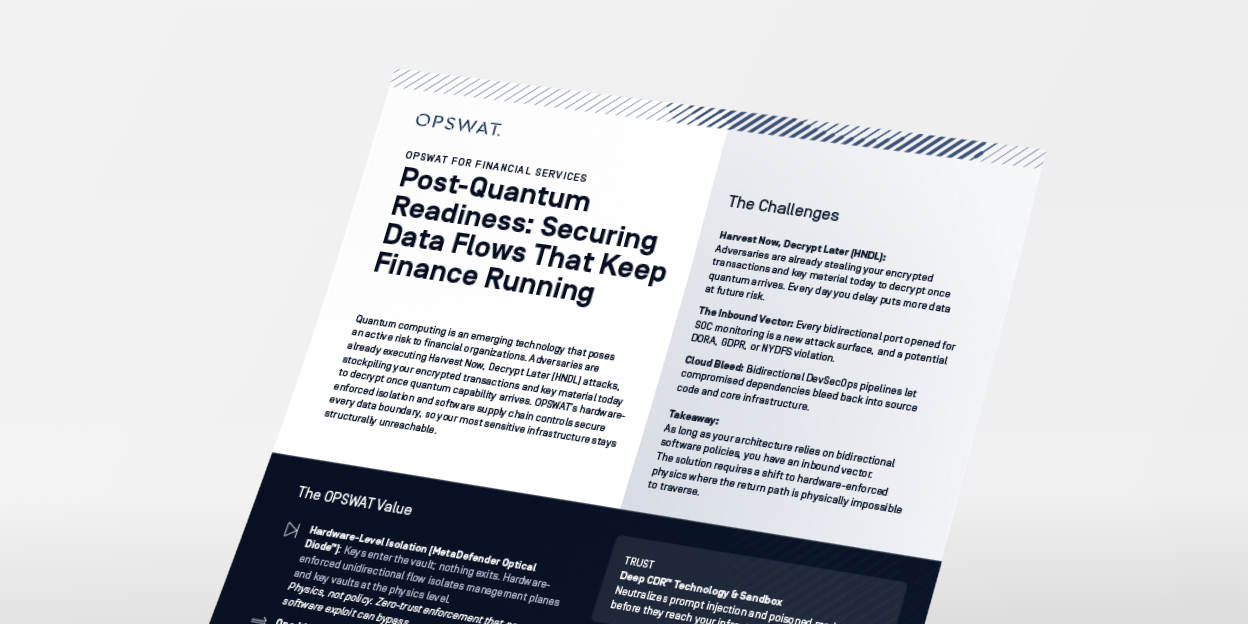
In OT (Operational Technology), industrial, and other high-security environments, keys and certificates often need to move between network segments with different trust levels, without opening a two-way path an attacker could exploit. MetaDefender Optical Diode™ enforces that boundary in hardware: data flows only one way between segmented networks, letting organizations rotate keys and harden cryptography in critical infrastructure without expanding their attack surface in the process.
Why this matters now, not later
The organizations that benefit most from acting early are the ones with the longest confidentiality requirements, and increasingly, the ones with federal contracts on the line: governments, financial institutions, critical infrastructure operators, and any business handling long-lived sensitive data. With Executive Order 14412 attaching real deadlines and procurement consequences to PQC migration, quantum-readiness is no longer a future initiative. It is a compliance one.
That doesn’t mean ripping out existing infrastructure. It means understanding where cryptographic risk concentrates in your environment, building the visibility a CBOM requires, and combining approaches, QKD, PQC, and hardware-enforced controls, rather than betting on a single silver bullet.
The shift to quantum-safe security is a matter of when, not if, and now it’s also a matter of by when. Organizations that start building that roadmap today will be the ones best positioned to keep earning trust with sensitive data well into the quantum era.
OPSWAT has spent more than 20 years helping governments, industrial operators, and enterprises protect their most critical infrastructure and data. As Executive Order 14412 turns crypto-agility into a deadline, that experience is built directly into the platform: MetaDefender Software Supply Chain gives organizations visibility into the software, and soon the cryptographic assets, they run, while MetaDefender Optical Diode enforces the hardware boundaries that keep critical infrastructure segmented during the transition.