Data Prevention in an Environment Built for Continuity
The manufacturer operated production environments where uptime and stability were top priorities. Many of their OT systems could not be patched or modified without risking disruption, which limited the use of traditional security controls and made change inherently risky.
At the same time, business-critical files moved continuously between suppliers, engineering teams, and factory systems, often crossing IT and OT boundaries. These files could not be altered or sanitized, leaving security teams with few options to inspect them safely before execution. Each supplier-to-factory file exchange expanded the attack surface for malware to enter production environments through trusted operational workflows.
With dozens of plants operating globally, the company lacked a consistent way to detect unknown threats before execution, and existing tools relied on post-execution alerts that were difficult to operationalize in manufacturing environments. Without consistent visibility into what was happening across plants and OT-adjacent systems, security teams lacked the observability needed to make fast, confident decisions when suspicious files appeared.
A Growing, Heterogeneous Attack Surface
How to secure an environment with limited visibility and a constantly changing asset landscape?

In this manufacturing environment, legacy and modern systems required file-centric, pre-execution security controls that were independent of complete asset visibility or system patching. Engineering tools, automation platforms, and supplier-driven file exchanges were deeply embedded into daily operations, but many of these systems could not be easily patched, altered, or taken offline.
3 Key Challenges
- Legacy OT systems operating alongside modern digital technologies
- Limited visibility and patchability across production environments
- Expanding attack surface across global manufacturing plants
File-Based Workflows Without Pre-Execution Assurance
How to stop malicious files before they execute when production and engineering workflows depend on files that can't be altered or sanitized?
The only reliable approach to stop malicious files is to dynamically analyze them before execution in order to identify zero-day and evasive malware hidden in business-critical engineering and production files. At this organization, files moved continuously between suppliers, R&D, and factory systems and could not be altered without disrupting workflows, leaving endpoint- and reputation-based detection to identify threats only after execution.
3 Key Challenges
- High-volume file exchanges across suppliers, R&D, and factories
- Engineering and production files that could not be altered or sanitized
- Detection occurring after execution rather than before
Scale, Simplicity, and the Limits of Traditional Detection
How to detect unknown and zero-day threats across global plants without adding complexity for operational teams?
With dozens of plants operating around the clock, the manufacturer needed security controls that could scale globally while remaining usable by entire operational teams. Tools designed primarily for IT environments often added complexity without delivering actionable clarity for plant operators. The lack of a consistent, pre-execution view into unknown and zero-day threats left the company exposed to risks.
3 Key Challenges
- Need for consistent security controls across dozens of plants
- Tools designed for IT environments, not operational teams
- Lack of reliable visibility into unknown and zero-day threats
Zero-Day Detection Without Disrupting Production
The manufacturer deployed OPSWAT’s MetaDefender Aether to establish a consistent, file-centric zero-day detection layer across engineering, supplier, and manufacturing workflows. At the core of this approach was a multi-layer detection pipeline where files were assessed pre-execution by Predictive Alin AI, with uncertain or high-risk samples, then emulated in an isolated, sandbox environment to observe real behavior before ever being allowed into production systems.
Key implementation objectives
- Detect unknown and evasive threats before execution
- Preserve file integrity for engineering and production use
- Operate without introducing latency or operational downtime
MetaDefender Aether was positioned at critical control points where files entered the environment, including supplier exchanges, engineering file ingestion, and manufacturing perimeter workflows. Predictive Alin AI performed pre-execution static analysis to clear high-confidence clean files and flag high-confidence malicious files in milliseconds, while files with uncertain or conflicting signals were emulated using instruction-level emulation to expose hidden behaviors that traditional signature-based or VM sandbox tools would miss.
Built-in threat intelligence and ML-powered threat similarity search then enriched each analysis with context and lookalike pattern detection to help teams identify related threats and unknown malware variants across plants and regions.
Deployment touchpoints
- Supplier and third-party file exchanges
- Engineering and R&D file workflows
- OT-adjacent and manufacturing perimeter environments
MetaDefender Aether integrated smoothly into existing operations, returning a single, trusted verdict powered by multi-source threat scoring for each file in under 60 seconds. This allowed security teams to prevent execution of malicious files while enabling plant and engineering teams to continue working without added complexity or manual intervention.
Operational improvements
- Pre-execution blocking of zero-day and evasive malware
- Clear, actionable verdicts for SOC and operational teams
- Consistent security enforcement across global plants
With MetaDefender Aether in place, zero-day detection shifted from a reactive investigation activity to a preventative control embedded directly into manufacturing workflows. Seeing that unknown threats were identified before they could disrupt production confirmed the manufacturer had achieved the level of pre-execution protection it had been aiming for.
From Reactive Response to Preventative Control
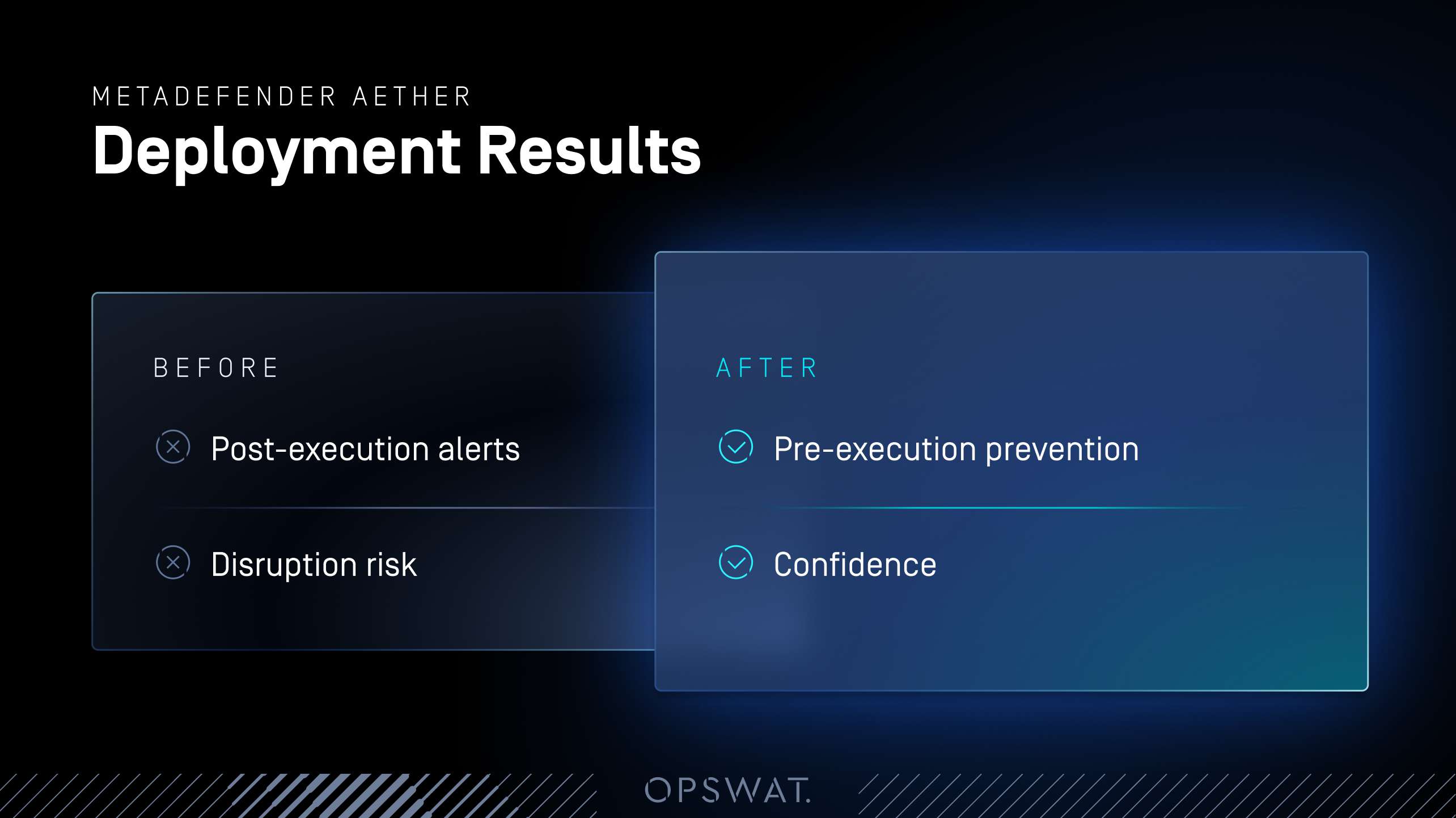
The manufacturer shifted zero-day detection from a reactive, incident-driven process to a preventative control embedded directly into manufacturing workflows. Security teams gained confidence that unknown and evasive threats would be identified before execution, reducing the risk of unplanned production disruption.
Security outcomes
- Prevention of zero-day malware before execution in factory and supply chain environments
- Improved visibility into unknown and evasive file-based threats
- Reduced reliance on post-incident containment and investigation
Operationally, the solution delivered value without adding friction. File inspections completed in just under one minute, preserving production velocity and engineering workflows while providing clear, trusted verdicts that could be acted on immediately.
Operational and business impact
- No disruption to production or engineering workflows
- Faster, clearer security decisions through a single trusted verdict per file
- Reduced risk of downtime caused by file-based malware incidents
The deployment also strengthened collaboration between IT, OT, and SOC teams. By standardizing how files were analyzed and how risk was assessed, the manufacturer reduced ambiguity and improved coordination across security and operations.
Organizational benefits
- Improved alignment between IT, OT, and security teams
- Greater executive confidence in cyber resilience
- A scalable foundation for zero-day detection across global plants
Strengthening Cyber Resilience Across the Factory Floor
By deploying OPSWAT MetaDefender Aether, the manufacturer established a reliable way to detect and stop zero-day threats before they could disrupt production. This deployment demonstrates how manufacturers can use file-based zero-day detection to prevent production disruption without modifying OT systems.
As manufacturing systems continue to evolve and file-based workflows expand across suppliers, engineering, and factory operations, the ability to inspect unknown file-based threats before execution becomes a foundational control. OPSWAT enables organizations to protect critical infrastructure without compromising uptime or operational efficiency.
Ready to protect your manufacturing operations against zero-day threats? Talk to an OPSWAT expert today to learn how MetaDefender Aether can strengthen cyber resilience across your production environment.