Why Secure Remote Access is Difficult in OT Environments
The biggest risk was not remote access itself, but the lack of control and visibility once users were inside the OT network

Supporting remote access in an OT environment is inherently complex. The utility needed to balance uptime, safety, and speed while protecting legacy control systems that were never designed for modern connectivity. Internal engineers and third-party vendors required frequent access for configuration, maintenance, and incident response, but every connection into the OT environment expanded the attack surface.
5 Reasons Why VPNs and Generic Remote Access Tools Fail in OT Networks
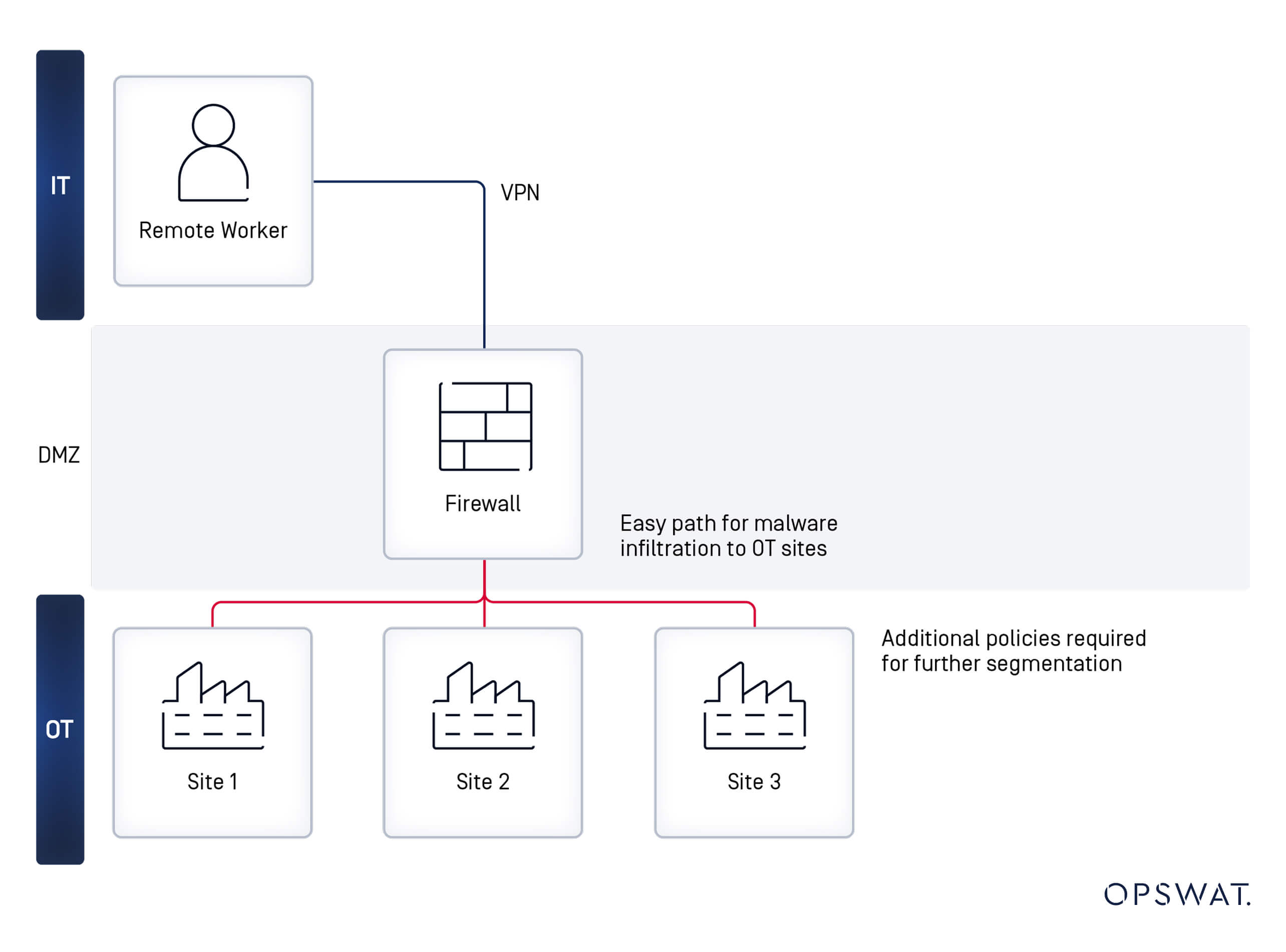
The utility relied on legacy VPNs and generic remote access tools that extended network-level trust into sensitive OT zones. Once connected, users often had broader visibility and access than required, creating risk that the security team could not easily contain or monitor.
5 Key Challenges
- Overprivileged access: VPN-based connectivity granted broad network access instead of limiting users to specific OT assets or screens
- Limited session visibility: Security teams could not see what users were doing during active RDP sessions or intervene in real time
- Lateral movement risk: Once inside, users could potentially move across OT segments, increasing blast radius
- Open firewall ports: Inbound access requirements introduced persistent exposure points into critical infrastructure
- Audit and compliance strain: Proving who accessed which systems, for how long, and with what actions required manual effort and fragmented logs
Business and Operational Impact
- Increased cyber risk to SCADA, DCS, HMI, and PLC environments
- Slower response during maintenance windows and incidents due to access workarounds
- Growing pressure on the CISO to demonstrate stronger controls and audit readiness
- Reduced confidence that remote access aligned with least-privilege principles
What Does a Secure OT Remote Access Solution Need to Deliver?
We needed RDP access without inheriting the risk that comes with exposing the OT network.
The utility needed a purpose-built OT remote access solution that enforced least privilege, eliminated inbound exposure, and delivered full auditability without slowing operations. The security and OT teams aligned early on a clear principle: remote access must support day-to-day engineering work without extending trust to the OT network itself. Any solution had to reduce cyber risk by default while remaining practical for engineers, operators, and third-party vendors working across multiple sites.
Core requirements
To replace VPN-based access safely, the utility defined the following criteria:
- Granular RDP control: Allow engineers to access Windows-based HMIs and diagnostic tools without granting network-wide visibility or unrestricted privileges
- Least-privilege enforcement: Users should only see and interact with explicitly approved assets, with no ability to move laterally
- Strong auditability: Every session must be logged, recorded if required, and tied to a specific user, asset, and time window
- No inbound firewall exposure: Remote access must work without opening ports into OT networks
- Operational fit for OT: The solution must support legacy systems, minimize architectural change, and avoid downtime during deployment
What they wanted to avoid
Past experience shaped what the utility did not want to repeat:
- Generic IT remote access tools repurposed for OT
- Network-level access that expanded blast radius
- Manual audit preparation using fragmented logs
- Security controls that slowed maintenance or incident response
For the leadership, the turning point was recognizing that remote access itself was not the problem. The problem was how access was granted, enforced, and monitored.
Ways to Secure RDP Access to OT Systems Without Exposing the Network
The turning point was moving from network access to controlled sessions without disrupting operations.
The utility reduced OT remote access risk and improved operational control by shifting from network-level access to session-based, policy-enforced RDP connectivity. Remote access into OT environments became controlled, auditable, and isolated by design. Engineers and vendors could connect to the exact systems they needed, when they needed them, without exposing the broader OT network or opening inbound firewall ports.
How they achieved it
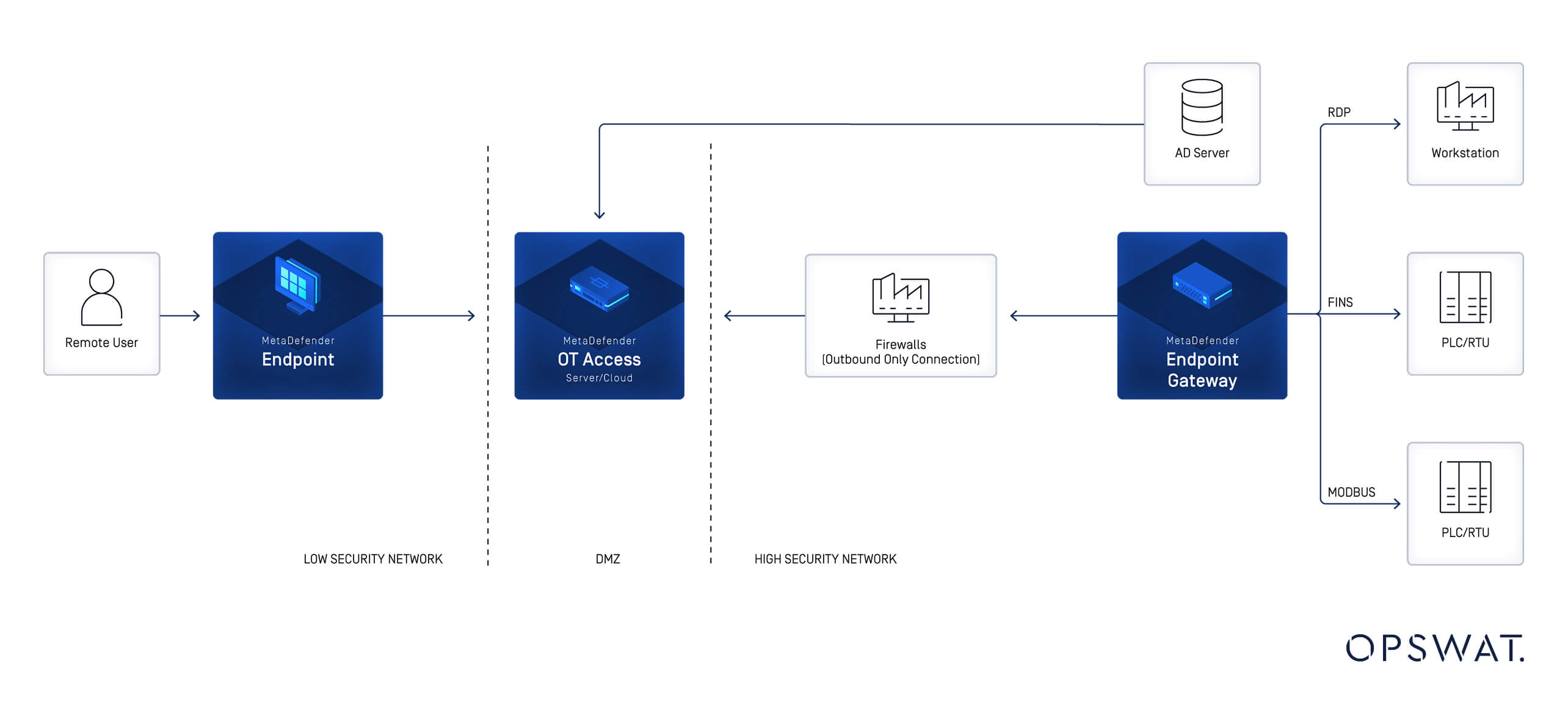
The utility implemented MetaDefender OT Access™ as a secure remote access gateway purpose-built for OT environments. Rather than extending VPN access into control networks, the platform enforced session-level access with strict visibility and policy controls tailored to operational roles.
5 Key Elements of the Solution
- Granular RDP access to OT systems
Engineers were granted RDP access only to approved Windows-based HMIs, engineering workstations, or diagnostic systems. Policies defined what actions were permitted during each session, reducing the risk of misuse or accidental changes. - Line-of-sight and least-privilege enforcement
Users could only see and interact with assets explicitly assigned to them. There was no ability to browse the OT network or move laterally between systems. - Outbound-only secure connectivity
The OT access gateway initiated outbound-only TLS connections, eliminating the need to open inbound firewall ports and reducing the attack surface of critical infrastructure. - Session monitoring, logging, and recording
All remote sessions were logged and, where required, recorded. OT and security teams could supervise live sessions or review activity later to support audits and investigations. - Secure file transfer into OT environments
When configuration files, scripts, or patches were required, file transfers were integrated with managed file transfer and multi-engine malware scanning to prevent malicious content from entering OT systems.
Why this approach worked
Instead of asking OT teams to change how they worked, the solution adapted to operational reality while enforcing security controls transparently in the background. Access was no longer based on trust in the network, but on authorized users based on defined roles and policies.
From Risky Access to Measurable Control
Remote access went from a necessary risk to a controlled operational capability
The utility gained real, operational control over OT remote access, reducing risk while making audits, maintenance, and incident response faster and more predictable. The operational improvements were immediate and visible across security, OT, and compliance teams. Remote access stopped being a blind spot and became a governed, repeatable process.
Operational Improvements
- Reduced OT exposure: Eliminated inbound firewall ports through outbound-only TLS tunnels, shrinking the external attack surface
- Stronger access governance: Engineers and vendors accessed only approved systems, with no lateral movement
- Faster audits: Session logs and recordings replaced manual evidence collection
- Improved incident response: Teams could grant time-bound access quickly without relaxing security controls
Impact on Teams
- Security teams gained confidence that remote access aligned with least-privilege and zero-trust access enforcement
- OT teams spent less time managing access exceptions and more time maintaining systems
- Leadership had clearer assurance that remote access risk was controlled without impacting uptime
Before vs. After Remote OT Access
Before | After |
VPN-based network access | Session-based RDP access |
Broad visibility once connected | Line-of-sight to approved assets only |
Limited activity visibility | Full session logging and recording |
Open inbound firewall ports | Outbound-only secure connections |
Manual audit preparation | Audit-ready access records by default |
Extending Secure Access Across a Growing OT Landscape
How can utilities scale secure OT remote access as operations grow?
With controlled OT remote access in place, the utility is positioned to expand secure RDP access and integrate RDP session logs and recordings into broader security operations. As the utility continues to modernize and digitize operations, remote access requirements are expected to grow, both in volume and in scope. Rather than introducing new point solutions, the organization plans to build on the same access control foundation to maintain consistency and reduce operational complexity.
Expansion Opportunities Under Consideration
- Broader RDP coverage across OT assets
Extend secure RDP access to additional Windows-based systems such as historian servers, engineering workstations, and edge controllers, while maintaining the same least-privilege and line-of-sight enforcement.
- Deeper security operations integration
Correlate RDP session logs and recordings with SIEM and SOAR platforms to provide richer context during investigations and faster incident response.
- Support for future digital initiatives
Use the same access framework to secure connectivity to cloud-hosted analytics platforms or OT digitization gateways, ensuring policy consistency as architectures evolve.
Closing the Gap Between Access and Assurance
Controlled access, not connectivity, is what protects critical operations.
By rethinking OT remote access, the utility reduced cyber risk, improved audit readiness, and enabled engineers to work efficiently without compromising critical infrastructure. By implementing MetaDefender OT Access, the organization shifted from network-level trust to controlled, policy-driven RDP sessions.
Remote access became isolated, auditable, and aligned with least-privilege principles, without operational friction. The result was a safer, more predictable remote access model that supported uptime, compliance, and long-term operational resilience.
Final Takeaways
- OT remote access does not need to expand risk to support operations
- Session-based control delivers stronger security than network-level trust
- Audit readiness improves when access is logged and governed by default
- Purpose-built OT access solutions scale better than repurposed IT tools
If you are securing remote access to SCADA, DCS, HMI, or other OT systems and facing similar challenges around risk, visibility, and compliance, talk to an OPSWAT expert to learn how MetaDefender OT Access can help modernize your OT connectivity.