- Why is Managed File Transfer a Primary Attack Surface?
- Four Reasons Why Traditional MFT Platforms Give Organizations a False Sense of Security
- What Does "Shifting Left" Mean for File Security in MFT?
- When a File Transfer Environment Needs Shift-Left Security
- What is the Security Paradox in File Transfer, and How Do You Resolve It?
- MetaDefender Aether's Four-Layer Detection Pipeline
- How Predictive Alin AI Reduces Alert Overload Without Missing Threats
- How MetaDefender Managed File Transfer and MetaDefender Aether Work Together as a Unified Secure File Transfer Architecture
- Frequently Asked Questions
Zero-day detection in managed file transfer (MFT) is the practice of identifying unknown, evasive, and never-before-seen malware within file transfer workflows at the point of entry, before files reach internal systems. Unlike transport-layer security, which authenticates the channel, zero-day detection operates at the file level, inspecting content structure, behavioral indicators, and threat patterns on both inbound and outbound transfers in near real time.
TL;DR / Key Takeaways
- File transfer workflows sit at the heart of supply chain risk. According to the WEF Global Cybersecurity Outlook 2025, 72% of organizations reported an increase in cyber risks over the past year, and 54% of large organizations cite supply chain challenges as the biggest barrier to cyber resilience.
- Traditional MFT platforms secure the transport layer while leaving the file itself uninspected. Compliance readiness and a real security posture are two different things.
- Shifting left in file security means inspecting files at the perimeter before internal exposure, reducing blast radius and dwell time.
- MetaDefender Aether uses a four-layer detection pipeline combining threat reputation, adaptive emulation-based sandboxing, threat scoring, and ML-powered threat hunting to achieve up to 99.9% zero-day detection efficacy.
- Predictive Alin AI detects malicious intent before execution using ML pattern recognition, producing verdicts in under 100ms (P99) with a false positive rate below 0.1%.
- MetaDefender Managed File Transfer™ and MetaDefender Aether together deliver deep file inspection on inbound transfers, while MetaDefender Aether extends detection across both ingress and egress without interrupting compliant file flows.
Why is Managed File Transfer a Primary Attack Surface?
Every day, organizations move enormous volumes of files across network boundaries: inbound patches, firmware updates, configuration files, and vendor-supplied documents; outbound compliance reports, log files, and application data. Each transfer represents a potential ingress or egress point for a threat actor.
The problem is not the volume alone. It is the diversity of file types, origins, and transfer mechanisms. Employees share files through personal cloud drives and direct links to contractor laptops, a pattern commonly called “shadow IT.” CRM (customer relationship management) and ERP (enterprise resource planning) synchronization jobs push and pull structured data across network boundaries on automated schedules, often with minimal inspection. Third-party vendor laptops connect directly to enterprise environments, bypassing standard endpoint controls entirely.
According to the WEF Global Cybersecurity Outlook 2025, 72% of organizations reported an increase in cyber risks over the past year, and 54% of large organizations identify supply chain vulnerabilities as the single biggest barrier to cyber resilience. File transfer workflows sit at the center of that supply chain risk. As OPSWAT’s CEO Benny Czarny has stated: "Devices are not designed to scan files." That gap is precisely what adversaries exploit.
Four Reasons Why Traditional MFT Platforms Give Organizations a False Sense of Security
Traditional MFT platforms were built to move files reliably and protect the transport layer. They encrypt the channel, authenticate the endpoint, and confirm delivery. What they do not do is inspect the file itself. That distinction separates compliance readiness from a genuine security posture.
Four failure modes appear consistently across legacy MFT deployments:
Illusion of "secure enough." Most traditional MFT platforms secure the transfer, not the file. Third-party file scanning integrations lack cohesion and real-time visibility. Treating compliance readiness as equivalent to security is precisely how organizations get breached.
Incomplete audit trails. Legacy platforms prioritize delivery confirmation over forensic traceability. When incident response teams need to answer what moved, where it went, and what it did, most platforms cannot provide that answer at file-level granularity.
Workflow fragmentation. Disparate tools, custom scripts, and manual handoffs introduce both operational and dependency risk. A single misconfigured script in a data pipeline can become an organization's largest attack surface.
Limited visibility and complex implementation. Legacy MFT platforms are notoriously difficult to stand up. Policy configuration is time-intensive, and without centralized oversight, blind spots accumulate across the transfer environment.
The consequences are quantifiable. According to IBM's Cost of a Data Breach Report 2025, the global average cost of a data breach now sits at $4.44 million, and the average time to detect and contain a breach exceeds 240 days. That is eight months of dwell time for a threat actor to operate inside an environment before detection.
Real-world examples confirm the pattern: in March 2023, a MOVEit Transfer zero-day SQL injection vulnerability resulted in breaches across more than 2,600 organizations, exposing data belonging to over 90 million individuals. In December 2024, an exploited flaw in Cleo put 4,200 customers at risk. In July 2025, a SharePoint vulnerability led to 400 breached organizations and more than 10,700 exposed servers.
What Does "Shifting Left" Mean for File Security in MFT?
Shift-left security in MFT means moving file inspection earlier in the transfer workflow: inspecting files at the point of entry, before they reach internal systems, rather than reacting after a breach has already occurred. The traditional model waits for an endpoint or SIEM (security information and event management) to surface a threat after delivery. Shift-left security intercepts the file at the perimeter and applies multi-layer analysis before it crosses any network boundary.
MetaDefender Managed File Transfer™ is OPSWAT's managed file transfer solution designed to automate and secure file transfers across enterprise IT and OT and business-critical environments with AI-powered malware analysis built in natively rather than added through a third-party integration. The platform applies pre-execution threat prediction, adaptive sandbox inspection, Deep CDR™ Technology, and multiscanning at the point of transfer, making MFT an active security control rather than a delivery mechanism.
Why Detecting Threats at the Perimeter Reduces Breach Dwell Time
The average time to detect and contain a breach exceeds 240 days. The later a threat is detected in the file workflow, the greater the blast radius. A file that clears the transport layer but carries embedded malware has unrestricted access to internal systems from the moment it lands.
Perimeter-level inspection breaks that chain. When files are inspected before internal exposure occurs, malware is blocked before it can establish persistence, exfiltrate data, or move laterally. MetaDefender Managed File Transfer quarantines detected threats mid-transfer, triggers alerts, and escalates without interrupting compliant file flows. The rest of the transfer pipeline keeps running.
When a File Transfer Environment Needs Shift-Left Security
Shift-left file security is not only for high-security environments. Organizations across a broad range of scenarios need file-level inspection at the perimeter.
Any organization moving files across IT/OT boundaries requires inspection at every crossing point. Firmware updates, patches, and configuration files delivered to operational technology environments can directly impact safety-critical systems. The 2025 OPSWAT Threat Landscape Report found a 127% increase in multi-stage malware complexity and confirmed that 1 in 14 files initially deemed safe by public feeds are later confirmed malicious.
Organizations with third-party vendor or contractor access face the same exposure. Vendor laptops and contractor endpoints connect directly to enterprise environments, bypassing standard endpoint controls. Every file they transfer is a potential ingress vector.
Regulated industries carry an additional requirement: verifiable, audit-ready evidence of file-level inspection. MetaDefender Managed File Transfer supports compliance with NERC CIP, NIS2, IEC 62443, SWIFT CSP, CMMC, HIPAA, and GDPR through immutable audit logging, granular access controls, and policy-enforced transfer workflows. Compliance readiness becomes a product of the security architecture rather than a separate documentation exercise. Any workflow where file-based threats have historically reached internal systems before detection is a candidate for shift-left redesign.
What is the Security Paradox in File Transfer, and How Do You Resolve It?
Earlier, organizations had to choose between applying deep threat inspection and slowing down data flow or maintaining throughput and accepting security gaps. The result was a trade-off between security and operations that left both teams short of what they needed.
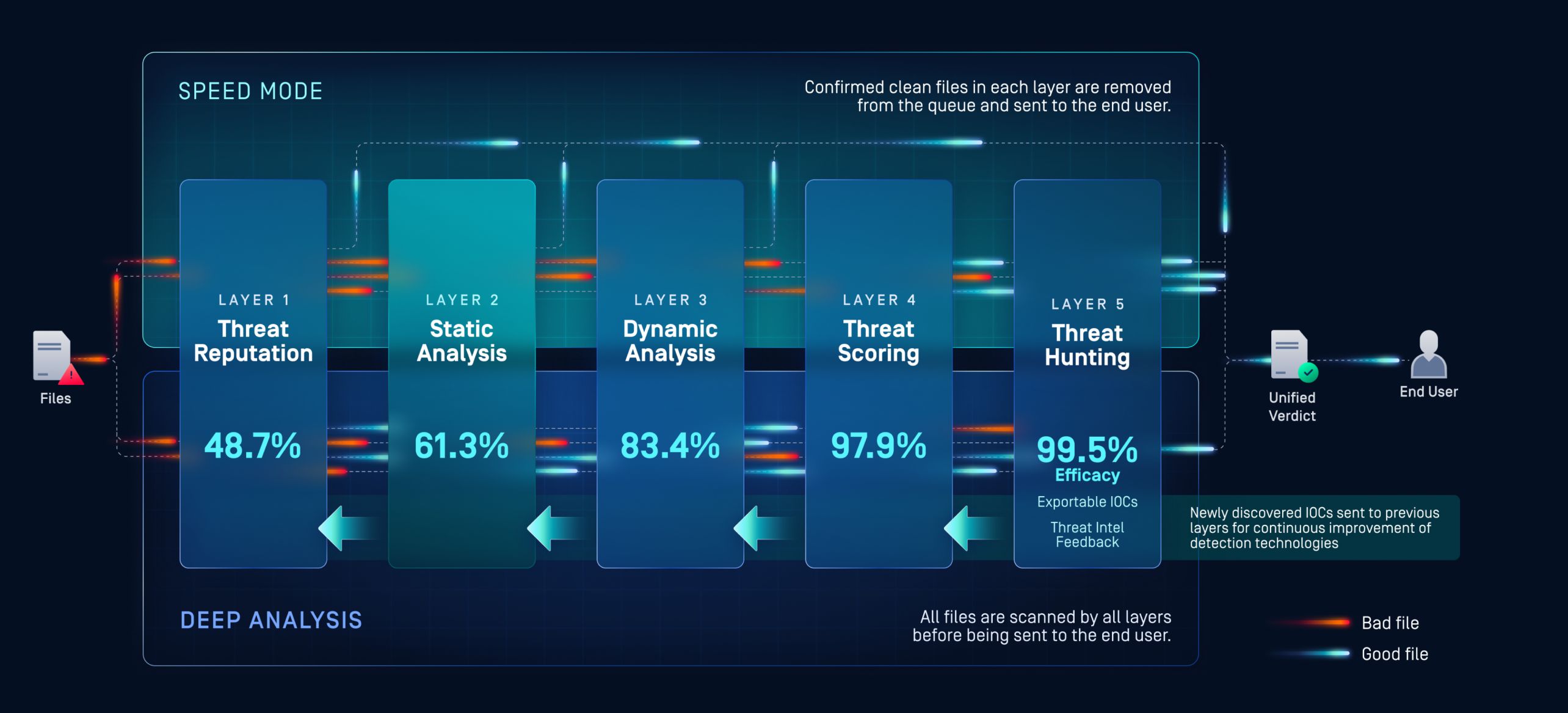
Resolving this paradox requires smarter analysis. An intelligent detection pipeline uses fast, low-cost methods to filter the majority of threats instantly, reserving deep sandbox analysis only for files that genuinely require it. MetaDefender Aether is OPSWAT's unified zero-day detection solution built on exactly this principle. Each layer of the pipeline handles a distinct category of threat, and together they achieve up to 99.9% detection efficacy without disrupting throughput.
MetaDefender Aether's Four-Layer Detection Pipeline
How Does Threat Reputation Filtering Work in MetaDefender Aether?
Layer 1, Threat Reputation, performs a near-instantaneous check against global threat intelligence feeds. MetaDefender Aether queries multiple intelligence sources to determine whether an indicator of compromise associated with the file has already been identified as malicious. This process eliminates up to 99.99% of common threats with zero performance impact. The speed of Layer 1 is what makes deep sandboxing practical: by filtering the known, the pipeline reserves computational resources for the truly unknown.
How Does MetaDefender Aether's Adaptive Sandboxing Detect Evasive Malware That Bypasses Traditional Sandboxes?
Layer 2, Dynamic Analysis, is where MetaDefender Aether's emulation-based sandbox operates. Unlike virtual machine-based sandboxes, MetaDefender Aether simulates the CPU and OS from the ground up. Malware cannot detect that it is being analyzed, so it behaves as it would on a real endpoint and reveals its true intent. This approach provides granular visibility into every instruction, every API call, and every memory request, defeating the environment checks, timing delays, and VM-detection tricks that cause evasive malware to remain dormant in traditional sandbox environments.
How Does Threat Scoring Turn Sandbox Results Into Actionable Intelligence?
Layer 3, Threat Scoring, generates a detailed report with full context: mappings to the MITRE ATT&CK framework, a library of threat indicators, and a structured output designed for direct use by SOC (security operations center) teams and threat intelligence functions. The output goes beyond a binary malicious/clean verdict. It is an intelligence asset: actionable data that tells incident responders what the file attempted to do, what infrastructure it contacted, and how it relates to known threat families.
How Does Automated Threat Hunting Work in MetaDefender Aether?
Layer 4, Threat Hunting, uses ML similarity search to correlate IOCs (indicators of compromise), file construction patterns, and behavioral signatures across a threat database. A single detection in Layer 2 becomes the seed for a broader hunt. Related malware families, shared infrastructure, and campaign-level patterns surface automatically, turning one blocked file into an intelligence event that protects the entire environment.

How Predictive Alin AI Reduces Alert Overload Without Missing Threats
How Does Predictive Alin AI Compare to Signature-Based AV and Sandbox Detonation?
Predictive Alin AI vs. Signature-Based AV vs. Sandbox Detonation
Attributes | Signature-Based AV | Predictive Alin AI | Sandbox Detonation |
Threat type covered | Known threats | Predicted unknown threats | Confirmed unknown threats |
Analysis speed | Near instant | Under 100ms (P99) | Minutes |
False positive rate | Variable | Under 0.1% | Low |
Execution required | No | No | Yes |
Retraining mechanism | Manual signature updates | Continuous, sandbox-confirmed zero-days | N/A |
Signature-based AV engines detect known threats using predefined signatures. Sandbox detonation confirms unknown threats by executing the file in a controlled environment. Predictive Alin AI occupies the detection layer between them: it predicts malicious intent before execution, filling the blind spot where AV engines are silent and before the sandbox is needed. The result is faster triage, fewer false positives, and a more confident security posture for SOC teams.
How MetaDefender Managed File Transfer and MetaDefender Aether Work Together as a Unified Secure File Transfer Architecture
How Does File-Level Inspection Work at Ingress?
MetaDefender Managed File Transfer integrates with MetaDefender Aether to apply multi-layer file inspection on inbound transfers. The inspection stack includes multiscanning across 30+ antivirus engines, Predictive Alin AI for pre-execution verdict generation, Deep CDR™ Technology to remove potentially malicious content from supported file types, and adaptive sandbox detonation for behavioral analysis. Security is built in natively rather than delegated to a third-party integration.
What Happens When a Threat is Detected During Scanning?
When a threat is detected during scanning, MetaDefender Managed File Transfer quarantines the file, triggers an alert, and escalates through approval workflows without interrupting compliant file flows. MFA-enforced approval workflows and malware outbreak prevention keep the rest of the transfer pipeline running. The business day continues, and only the threat is stopped.
How Does Centralized Visibility Reduce Alert Fatigue Across File Workflows?
MetaDefender Managed File Transfer provides a single pane of glass across all inbound transfers, outbound data flows, and file activity. Immutable audit logs capture every transaction, scan result, and policy decision across user and system activity. Centralized dashboards reduce alert fatigue and accelerate threat triage. MetaDefender
Managed File Transfer supports syslog integration with RFC 5424 and CEF output formats, enabling security events to flow directly into major SIEM platforms, such as Splunk, Microsoft Sentinel, and IBM QRadar, without requiring custom parsing. With SOC teams receiving the full event stream in a format their tools already understand, the 1,600 analyst hours per month currently spent triaging noise can be redirected toward confirmed threats and proactive defense.
Ready to eliminate the security paradox in your file transfer environment? OPSWAT provides AI-powered cybersecurity for critical infrastructure. MetaDefender Managed File Transfer, MetaDefender Aether, and Predictive Alin AI work together as a unified secure file transfer architecture that delivers both deep threat inspection and uninterrupted file flows.
Chat with an expert to see how MetaDefender Managed File Transfer and MetaDefender Aether work in your environment. Request a demo at opswat.com.
Frequently Asked Questions
What is the difference between MetaDefender Managed File Transfer and MetaDefender Aether?
MetaDefender Managed File Transfer is OPSWAT's managed file transfer solution that automates and secures file transfers across enterprise IT/OT and business-critical environments. MetaDefender Aether is OPSWAT's unified zero-day detection solution that provides a four-layer threat detection pipeline: threat reputation, adaptive sandboxing, threat scoring, and ML-powered threat hunting. In a unified secure file transfer architecture, MetaDefender Aether provides the detection intelligence, and MetaDefender Managed File Transfer enforces policy and controls the transfer workflow based on MetaDefender Aether's verdicts.
How does "shifting left" apply to managed file transfer security?
Shifting left in MFT means applying file-level inspection at the point of entry, before files reach internal systems. MetaDefender Managed File Transfer enforces inspection at ingress, so threats are blocked at the perimeter rather than discovered after internal exposure has already occurred.
How Does MetaDefender Managed File Transfer handle threats without disrupting file transfer workflows?
When a threat is detected, MetaDefender Managed File Transfer quarantines the file and escalates it through approval workflows while compliant transfers continue uninterrupted. The detection pipeline is designed to analyze files at high throughput. Predictive Alin AI produces verdicts in under 100ms (P99). Threat reputation checks are near-instantaneous. Files that clear all inspection layers continue without interruption. Files that fail are quarantined and escalated without stopping compliant transfers already in progress.
How does Predictive Alin AI reduce false positives for SOC teams?
Predictive Alin AI is trained on curated, enterprise-grade datasets that reflect real-world file movement patterns. Its false positive rate is below 0.1%. The model is continuously retrained on sandbox-confirmed zero-days from MetaDefender Aether, which improves detection accuracy over time without increasing noise.
How does emulation-based sandboxing differ from VM-based sandboxing?
VM-based sandboxes run malware inside a virtual machine. Sophisticated malware can detect virtual environments through timing checks, registry queries, and hardware fingerprinting, and will remain dormant to avoid detection. MetaDefender Aether's emulation-based sandbox simulates the CPU and OS from the ground up. Malware cannot detect the emulated environment, so it behaves as it would on a real endpoint and reveals its true intent.
What compliance frameworks does this unified file security architecture support?
MetaDefender Managed File Transfer supports compliance with NERC CIP, NIS2, IEC 62443, SWIFT CSP, CMMC, HIPAA, and GDPR through immutable audit logging, policy-enforced transfer workflows, file-level encryption, and granular access controls. The File Security Report provides scan and file status visibility, the General Audit Log tracks user and system activity, and the File Audit Log records file operations and access attempts. Together they support data integrity, system monitoring, and compliance with security policies. MetaDefender Aether provides verifiable behavioral inspection to support dynamic malware analysis requirements under these frameworks.