Financial institutions are increasingly exposed to large-scale cyberattacks originating outside their own environments, where a single breach can cascade across hundreds of organizations. In one recent ransomware event, attackers accessed and exfiltrated sensitive files linked to more than 70 banks and credit unions, with up to 1.3 million individuals impacted, highlighting how delayed detection and limited visibility can rapidly amplify risk across the financial sector.
Why Traditional Sandbox-Driven SOCs Could Not Keep Up
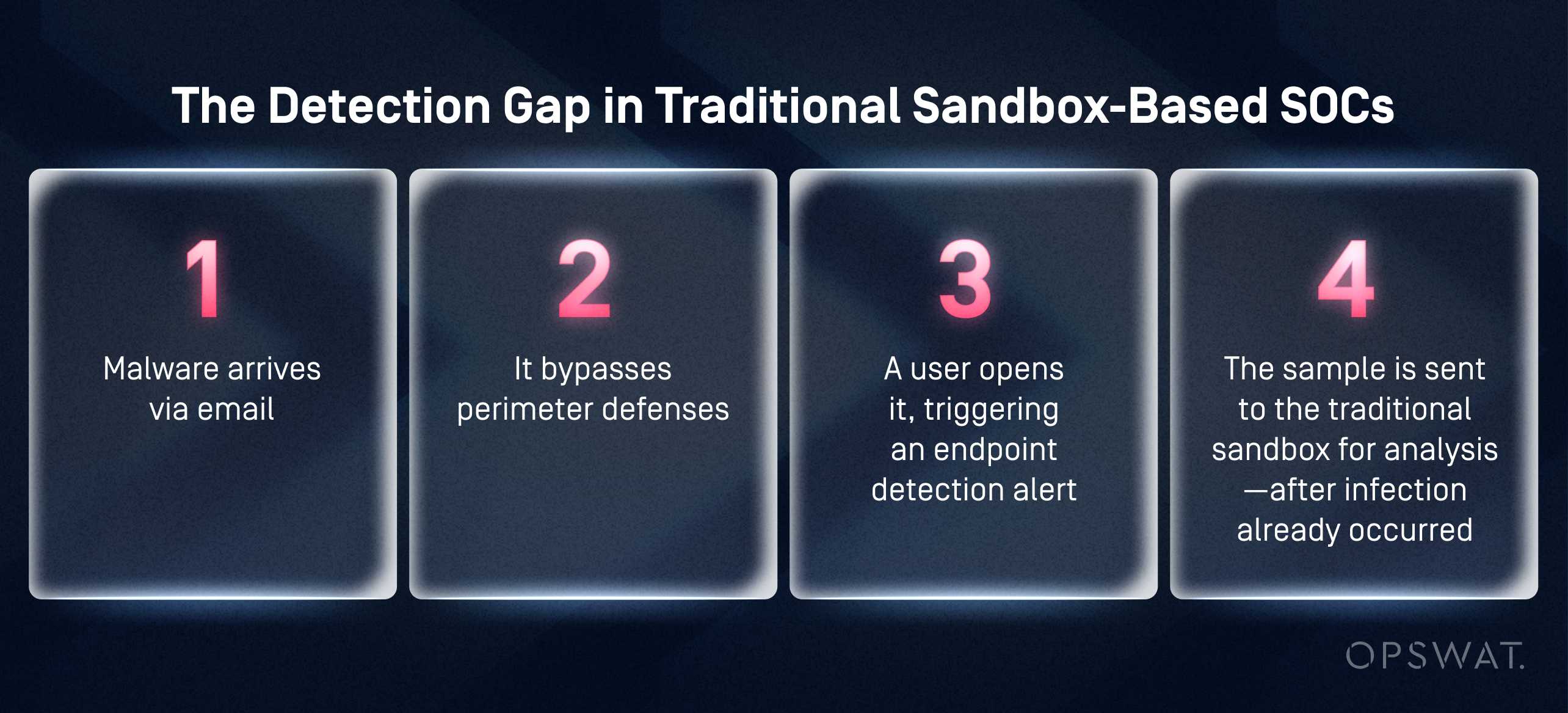
At this financial institution, traditional SOC sandboxing failed because detection occurred too late. Endpoint alerts triggered analysis only after execution, increasing risk, response costs, and regulatory exposure. For the CISO, this meant unknown threats were reaching users before confirmation, creating a persistent gap between detection and prevention.
For the SOC, the challenge was scale. Nearly 1,000 suspicious emails per day were sent through a VM-based sandbox via SOAR automation. Each detonation required significant time and compute resources, creating persistent queues that slowed investigations and extended time-to-response.
When high-priority incidents emerged, analysts were forced to pause or cancel automated jobs to free sandbox capacity. Automation became a constraint rather than an accelerator, leaving the SOC reactive, overextended, and unable to stop threats before they reached endpoints.
How OPSWAT MetaDefender Aether™ Shifted Zero-Day Detection Left
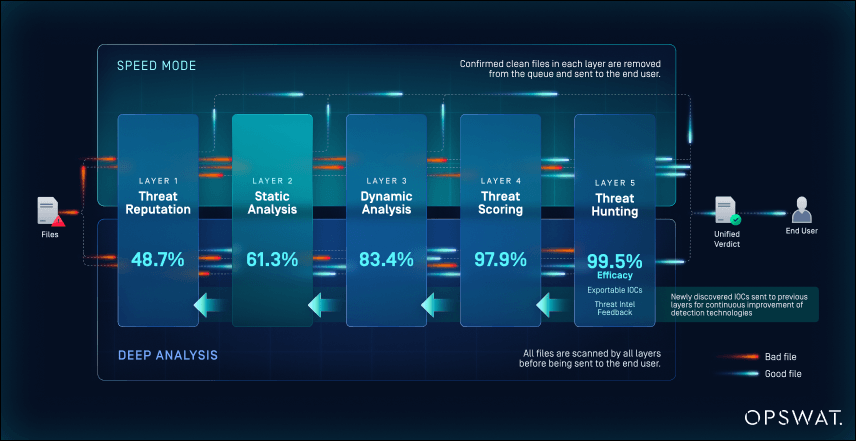
The organization addressed its SOC and risk challenges by replacing its VM-based sandbox with OPSWAT’s MetaDefender Aether, a unified zero-day detection solution built on a five-layer pipeline spanning threat reputation, pre-execution static analysis, instruction-level emulation, threat scoring, and threat hunting. This architectural shift allowed the security team to move dynamic analysis out of the SOC and into the perimeter where threats could be stopped before reaching users or endpoints.
Unlike traditional VM detonation, MetaDefender Aether executes files at the instruction level, eliminating delays caused by virtual machine spin-up and reducing susceptibility to anti-VM evasion. This enabled the institution to analyze suspicious files in seconds rather than minutes, even under heavy email volumes.
Implementation focused on three core objectives:
1. Perimeter-first sandboxing
MetaDefender Aether was deployed at email security gateways and file ingestion points, ensuring suspicious files were dynamically analyzed before delivery, not after endpoint execution.
2. Restoring SOC automation and scale
By integrating dynamic analysis directly into existing SOAR workflows, sandbox-related queue backlogs were eliminated, allowing automation to run continuously without analyst intervention.
3. Unified zero-day intelligence
Each analysis contributed to MetaDefender Aether’s built-in threat intelligence pipeline, combining threat reputation, pre-execution static analysis, emulation results, threat scoring, and ML-powered similarity search to deliver a single trusted verdict per file.
This implementation transformed sandboxing from a reactive incident response tool into a proactive perimeter defense, aligning detection speed, scale, and risk reduction with the organization’s operational and regulatory requirements.
Measurable Impact on SOC Performance and Risk Reduction
By replacing VM-based sandboxing with MetaDefender Aether and shifting zero-day detection to the perimeter, the organization achieved immediate and sustained operational improvements. Detection became faster, automation stabilized, and threats were stopped earlier in the attack lifecycle.
Measurable outcomes delivered by MetaDefender Aether
| Area of Impact | Measurable Outcome |
|---|---|
| SOC automation performance | Eliminated SOAR queue bottlenecks caused by slow VM-based sandbox detonation, allowing automation to run continuously at scale |
| Investigation speed | Reduced file analysis time from minutes to seconds using emulation-based dynamic analysis |
| Endpoint security | Prevented zero-day threats at email and file entry points, significantly reducing endpoint infections and costly remediation |
| Incident response workload | Lowered the number of incidents requiring remediation by stopping threats before execution |
| Analyst efficiency | Reduced time spent managing sandbox capacity and automation constraints, allowing analysts to focus on higher-value security analysis and threat response |
| Zero-day readiness and compliance | Strengthened proactive control over unknown threats, supporting audit and regulatory expectations |
Building a Sustainable Zero-Day Detection Model
A sustainable zero-day detection model stops threats, scales with file volume, and reduces SOC operational strain. By deploying OPSWAT MetaDefender Aether at the perimeter, the organization achieved proactive prevention, restored automation, and created an audit-ready approach to managing unknown threats in regulated environments.
For financial institutions, this approach delivers more than faster detection. It provides a scalable, audit-ready model for managing zero-day risk, reducing operational strain on SOC teams, and strengthening confidence in security controls across critical file flows.MetaDefender Aether demonstrates how modern, instruction-level sandboxing and unified threat intelligence can transform zero-day detection into a measurable business advantage.
Ready to protect your critical file workflows and stop zero-day threats earlier?