- Why the Cybersecurity Industry Is Stuck in a Reaction Cycle
- Invariant 1: Adversaries Will Always Adapt Faster Than Static Defenses
- Invariant 2: Signal Fusion Outperforms Any Single Engine
- Invariant 3: Detection Systems Must Generate Intelligence, Not Just Consume It
- Build Detection on What Attackers Cannot Change
Why the Cybersecurity Industry Is Stuck in a Reaction Cycle
The cybersecurity industry is in a perpetual state of reaction. Each quarter brings a new class of threat, a new evasion technique, and a new acronym promising to redefine defense. This creates a paradox for CISOs and CTOs responsible for long-horizon infrastructure decisions: detection strategies must remain relevant for five to ten years, even as the threat landscape shifts every few months. Layered defenses are essential. The open question is what to anchor those layers to so they hold up as threats evolve.
Building that durable strategy means looking past what is changing in the threat landscape and identifying what does not change: the underlying constraints that continue to shape how threats behave regardless of how tools evolve. These invariants give layered defenses something durable to anchor to, so detection architecture stays relevant as specific threats and techniques shift. In this post, we focus on three of those invariants because they have the most direct impact on how modern detection pipelines need to be built.
Critical Infrastructure Cannot Afford the Reaction Cycle
In OT and critical infrastructure environments, systems are not patched quickly; updates are often vendor-controlled, and downtime carries operational consequences. When a malicious file enters this environment, it rarely stays isolated. Many detection approaches still rely on assumptions that do not hold under these conditions:
- Threats will resemble what has already been seen
- Static inspection can fully determine intent
- Delayed analysis is an acceptable trade-off
The invariants point to a different reality:
- Unknown threats will continue to appear
- Behavioral analysis is required to expose intent
- Detection speed affects containment outcomes
- Multiple signals outperform single-engine detection
- Detection systems must generate their own intelligence
That gap between assumption and reality is where attackers operate most effectively. The next section starts with the first invariant that consistently exposes it.
Invariant 1: Adversaries Will Always Adapt Faster Than Static Defenses
Static defense is a temporary illusion. Attackers reverse-engineer detection logic, share evasion techniques, and iterate continuously. Once deployed and left unchanged, no defensive technology remains effective against a motivated adversary for long. This has held since the first sandbox was deployed, and AI-generated malware only accelerates the cycle.
The practical consequence is that evasive malware does not need to defeat every detection layer. It only needs to defeat the one you rely on. Variants can now be produced faster, tested against defensive controls, and refined in tight loops. What used to take weeks of development can now happen in cycles measured in hours.
Why OT Environments Absorb the Damage First
In OT environments, the adaptation problem compounds. Patch cycles are long, systems are often vendor-controlled, and software arrives through firmware updates, vendor packages, and field tools that cannot be easily replaced. Those same files become ideal delivery mechanisms because they are expected, trusted, and difficult to inspect without disrupting operations.
Some of these files can be sanitized, while others cannot. Executables, firmware images, and patch files need to run as intended, which limits where content disarm and reconstruction can be applied. That leaves a narrower set of viable inspection methods, and static inspection often becomes the default control in many of these environments, even though it is the surface attackers have learned to bypass.
How Instruction-Level Emulation Removes the Evasion Advantage
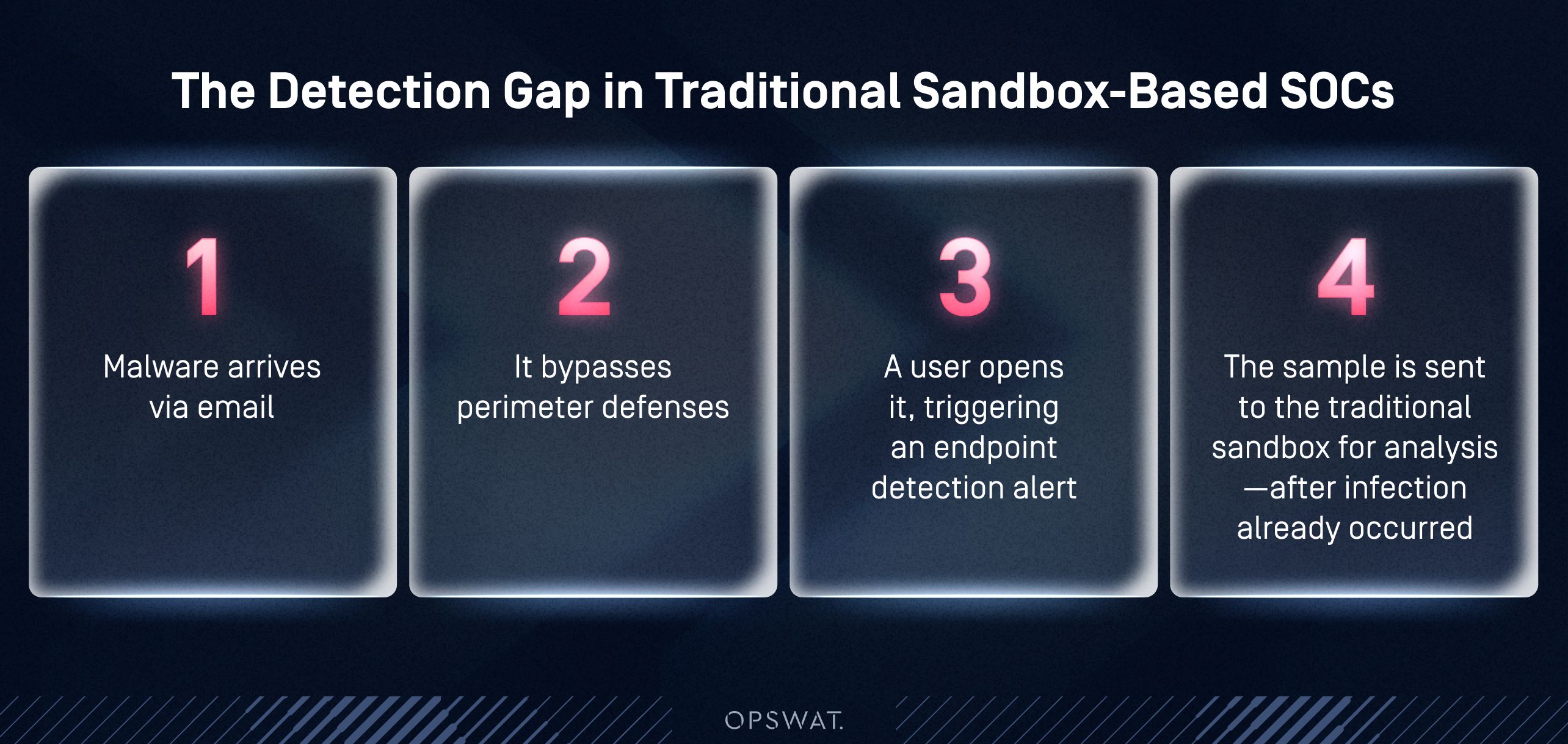
Traditional VM-based sandboxing still plays a role, but it introduces conditions attackers have learned to exploit. Evasion techniques can detect virtualized environments, delay execution, or alter behavior based on analysis signals. In many cases, analysis also happens after the file has already reached the endpoint, turning detection into confirmation rather than prevention.
MetaDefender Aether addresses this by shifting away from VM-dependent detonation toward emulation-based dynamic analysis. Using instruction-level emulation, the detection pipeline executes files in a controlled environment that does not expose the artifacts malware typically relies on for evasion. Anti-VM checks find nothing to fingerprint, delayed execution paths are observed, and multi-stage payloads are allowed to unfold.
Traditional Sandbox vs. MetaDefender Aether Dynamic Analysis
Traditional VM-Based Sandbox | MetaDefender Aether | |
Evasion resistance | Vulnerable to anti-VM, timing, and environment checks | Instruction-level emulation defeats anti-VM and delay-based evasion |
File types supported | Limited | 120+ file types, including executables, scripts, patch files, and installers |
Verdict output | Single sandbox result | Unified verdict combining reputation, static analysis, dynamic analysis, threat scoring, and threat hunting |
Speed | 10-15 minutes per file | Near real-time; 50,000+ analyses per day |
Deployment | Cloud-dependent in most cases | On-premises, cloud, or hybrid |
Intelligence generation | Limited IOC extraction | Behavioral IOCs feed back into the detection pipeline and retrain Predictive Alin AI |
In practice, this exposes how a file behaves rather than how it appears. The full execution path becomes visible regardless of the evasion logic embedded in the sample. For file types that cannot be sanitized, such as executables, patch files, scripts, and installers, this kind of dynamic analysis becomes the most reliable way to determine intent before the file moves deeper into the environment.
A government forensic agency demonstrated this in production. It was tasked with analyzing files seized from suspect devices, many of which carried deeply embedded malware in formats that cannot be altered without destroying evidentiary value. The agency replaced legacy antivirus and manual review with multiscanning paired with emulation-based sandboxing. Files that previously took hours to clear were verified in minutes, and threats that hid from signature-based tools surfaced in behavioral analysis without compromising the integrity of the evidence.
There is still a constraint worth calling out. Deep analysis improves visibility, but it slows down the decision process. If every unknown file requires full inspection before a verdict is reached, latency becomes part of the architecture, and attackers will look for ways around it. That tension leads directly to the next invariant: no single method, no matter how effective, is enough on its own.
Invariant 2: Signal Fusion Outperforms Any Single Engine
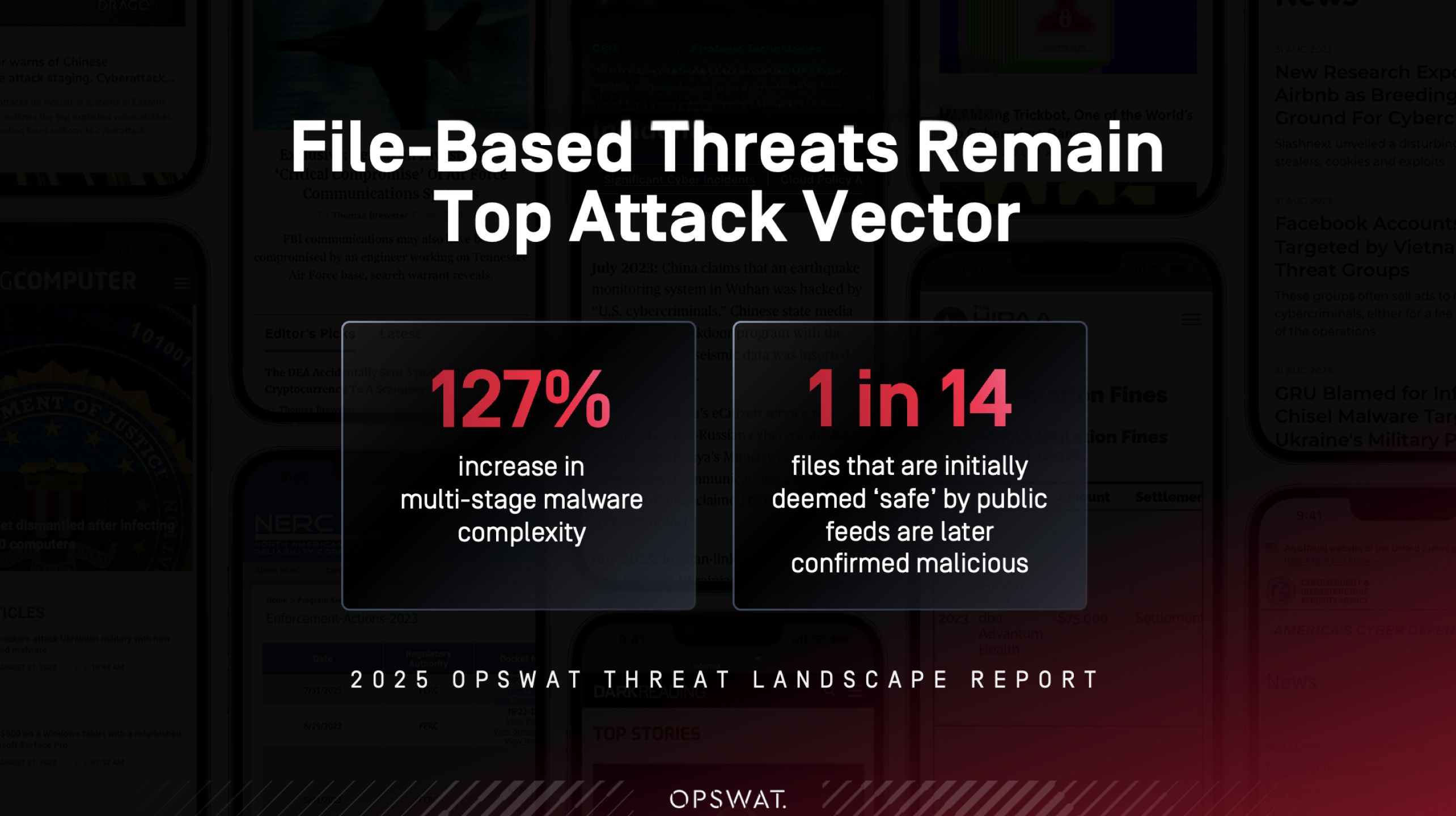
No single detection engine achieves optimal results on its own. This is not a limitation of any one technology. It is a statistical property of combining independent classifiers. When multiple engines evaluate the same file using different methods, their error rates do not stack in a linear way. They offset, producing a combined detection capability that consistently outperforms any individual engine, regardless of how advanced it is.
The implication is straightforward, even if it is inconvenient. Evasive malware does not need to defeat every possible control. It only needs to defeat the one you rely on most. A file that bypasses reputation checks but triggers behavioral indicators or avoids signature detection but shows anomalous similarity to a known malware family, is caught in a layered pipeline. In a single-engine model, it moves forward.
Why Single-Engine Detection Breaks Down in Practice
Most environments already deploy multiple tools, but the signals they generate are often disconnected. One system flags a file as suspicious, another passes it as clean, and a third produces indicators that require manual interpretation. The burden of correlation shifts to the analyst.
This creates two consistent failure modes:
- Evasion succeeds quietly when a threat bypasses the primary control and never triggers deeper inspection
- Alert volume increases when overlapping or conflicting signals generate noise without clarity
At scale, neither outcome is sustainable. In high-throughput environments, detection either misses what matters or overwhelms the team responsible for responding.
MetaDefender Aether Turns Five Signals Into One Trusted Verdict
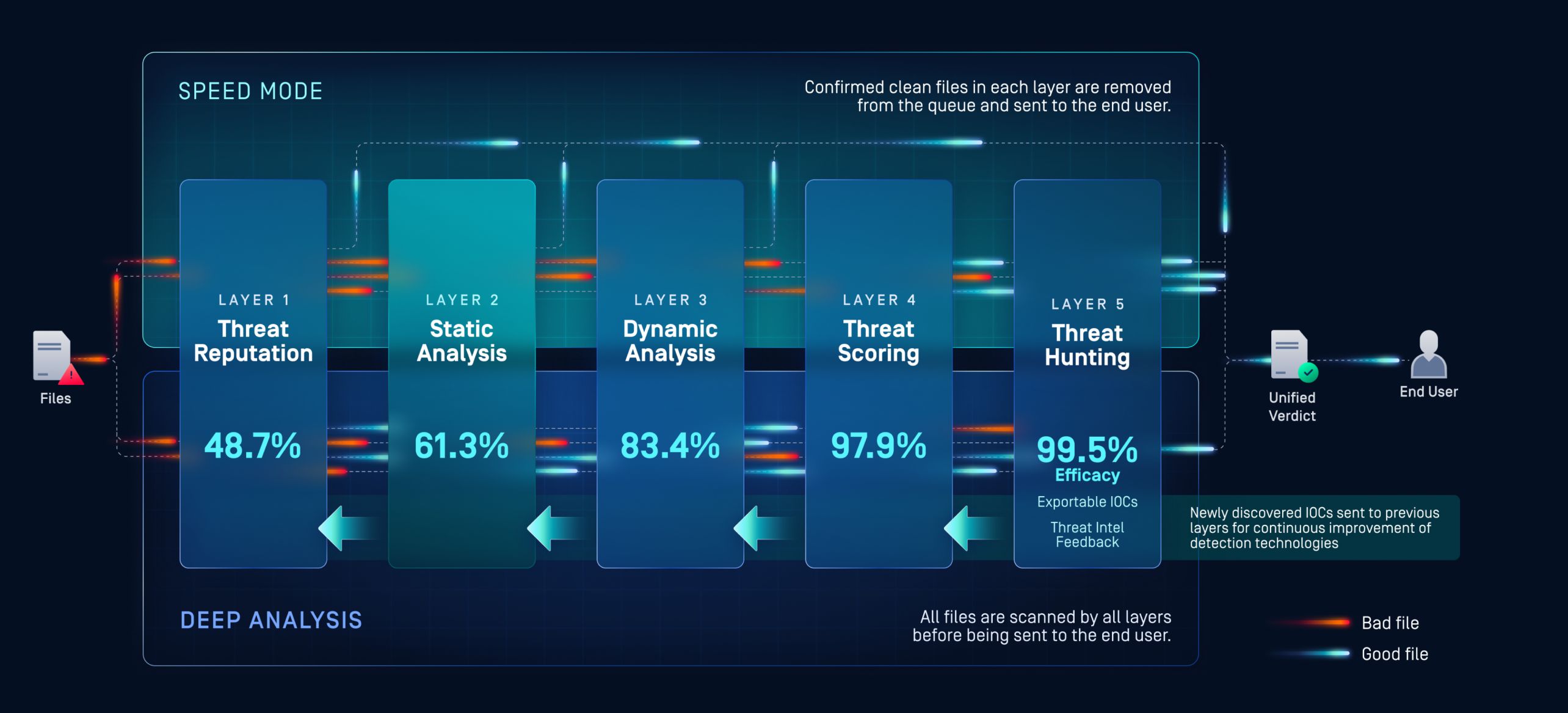
MetaDefender Aether addresses this by structuring detection as a unified pipeline rather than a collection of independent checks. Each layer evaluates the same file from a different perspective, and the results are combined into a single, correlated verdict.
MetaDefender Aether Detection Pipeline and Signal Contribution
Layer | What it contributes |
Threat reputation | Blocks known indicators such as malicious hashes, domains, and IPs early |
Static analysis | Predicts malicious intent pre-execution using Predictive Alin AI, deflecting clean files and blocking high-confidence malware before it runs |
Dynamic analysis | Executes unknown samples to expose hidden behavior and extract IOCs |
Threat scoring | Correlates signals into a confidence-based risk score |
Threat hunting | Identifies relationships across samples, linking activity to campaigns and families |
Each layer answers a different question. Threat reputation addresses what is already known. static analysis predicts what is likely before execution, dynamic analysis exposes what static signals can't resolve. Threat scoring provides context, and threat hunting connects isolated events into something actionable. The output is one decision based on all available evidence, not four separate results. Across all five layers, the pipeline achieves 99.5% zero-day detection efficacy.
A Global Financial Institution Eliminated SOC Bottlenecks
A global financial institution processing nearly 1,000 suspicious emails per day ran dynamic analysis inside the SOC through a VM-based sandbox integrated with SOAR automation. The system worked until volume increased. Sandbox queues grew, high-priority incidents forced manual intervention, and automation became a bottleneck rather than a force multiplier.
By deploying MetaDefender Aether at the perimeter, the organization moved signal fusion upstream. Files were analyzed before delivery rather than after endpoint execution. Queue bottlenecks were eliminated, analysis time dropped from minutes to seconds, and the SOC regained the capacity to focus on investigation instead of managing backlog.
Predictive Alin AI Resolves the Speed-Depth Trade-Off
A multi-layer pipeline improves accuracy. But it does not, on its own, eliminate the time required to reach a verdict. At high volumes, sending every file through deep analysis introduces latency, and that delay can be exploited elsewhere in the attack chain.
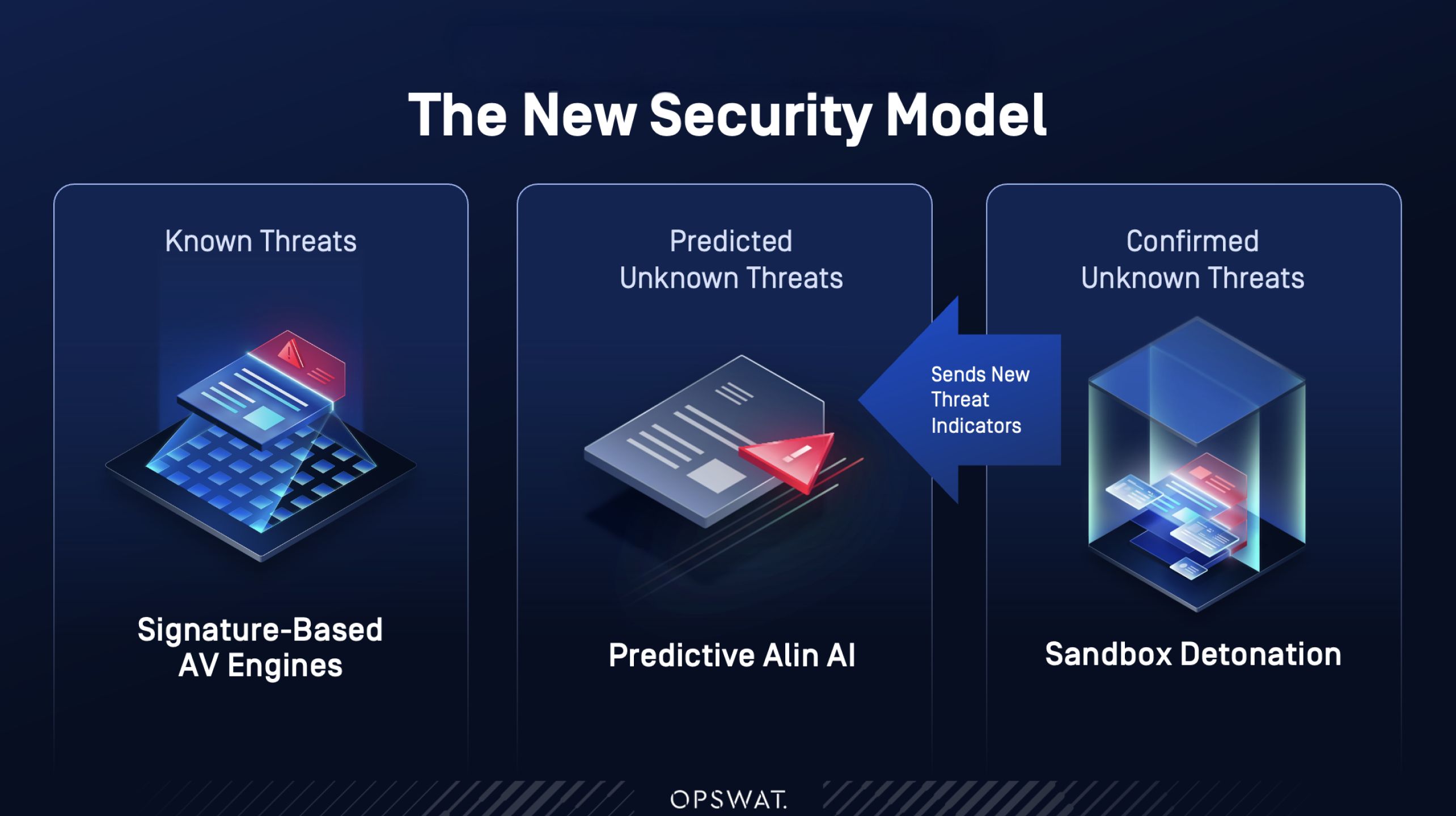
Predictive Alin AI operates as layer 2 of the pipeline — a static analysis stage positioned between reputation and dynamic analysis — delivering verdicts before a file executes, without sandbox detonation. Trained on enterprise-grade, privacy-safe datasets and continuously retrained on sandbox-confirmed zero-days,
Predictive Alin AI delivers machine-learning verdicts in milliseconds without requiring detonation. Files predicted as malicious are stopped immediately, while others proceed to deeper inspection. Verdicts are delivered with P99 under 100ms and a false positive rate as low as 0.1%, meaning high-volume environments get fast, accurate decisions without flooding analysts with noise.
The effect is not replacement but coordination. Static analysis handles volume early in the pipeline, and dynamic analysis provides depth where it's needed. Over time, the feedback loop between the two strengthens both, improving early detection without increasing noise.
The takeaway is that coordinated signals, rather than more engines, solve the problem. Detection improves when those signals are combined, correlated, and acted on as a system. That leads to the final invariant: detection systems that only consume intelligence eventually fall behind those that generate it.
Invariant 3: Detection Systems Must Generate Intelligence, Not Just Consume It
There is a meaningful difference between a detection system that ingests external threat feeds and one that produces its own intelligence. Feed-based detection has a structural ceiling: it can only identify what someone else has already found, documented, and shared. Novel threats, modified variants, and targeted attacks designed to avoid public detection infrastructure fall outside that boundary.
Dynamic analysis changes that. When a file is executed through emulation-based inspection, the outcome is not just a verdict. It produces behavioral indicators, network activity, configuration data, and execution traces. These become first-party intelligence that enables retrospective hunting, variant clustering, and proactive blocking grounded in observed behavior rather than reported indicators.
Why Regulated Industries Need Evidence, Not Just Verdicts
In critical infrastructure, financial services, and defense environments, verifiable evidence is not just an architectural preference. It is an operational requirement tied to compliance and auditability.
Regulatory frameworks increasingly expect verifiable analysis of unknown threats, not just feed-based validation. A binary verdict without supporting evidence does not hold up under audit or investigation. Detection systems must be able to demonstrate how a file behaved, what indicators were extracted, and how the decision was reached.
This also changes how organizations understand their own risks. An environment that generates its own intelligence builds a localized view of threat activity over time. Patterns emerge across campaigns, infrastructure reuse, and recurring behavioral patterns targeting specific workflows. External feeds, as well as internally generated intelligence, provide depth.
How MetaDefender Aether and Predictive Alin AI Close the Loop
MetaDefender Aether generates intelligence as part of its detection pipeline. Each file analyzed through emulation-based dynamic analysis produces behavioral indicators, extracted artifacts, and correlated signals that feed back into the system. Detection becomes a continuous learning process rather than a one-time decision.
That intelligence does not remain isolated. It feeds into Predictive Alin AI, where sandbox-confirmed zero-days are used to retrain the pre-execution detection models. Each confirmed threat strengthens the system’s ability to recognize similar patterns earlier, before execution occurs. This creates a feedback loop between deep analysis and fast prediction.
A national government agency responsible for protecting sensitive systems and citizen data illustrates the operational difference. Its previous sandbox produced detailed reports but left analysts manually interpreting fragmented behavioral signals, and confidence in zero-day detection eroded as evasive samples slipped through.
After deploying MetaDefender Aether, sandboxing shifted from a standalone reporting tool into a unified detection pipeline that returned a single verdict per file backed by structured behavioral evidence and threat scoring. This was the type of intelligence the agency could finally act on directly.
What the Intelligence Loop Delivers for SOC Teams
For SOC teams, this shift is measurable. Analysts receive pre-correlated verdicts backed by behavioral evidence instead of isolated signals requiring manual interpretation. False positives decrease, and investigation time is reduced because context is already attached to each detection.
At scale, that distinction matters. Detection systems that only consume intelligence tend to generate more work as volume increases. Systems that generate intelligence reduce that burden by improving both accuracy and context over time.
The goal is to build detection on the things attackers cannot change. Intelligence generation is one of those constraints, and systems that treat it as a core function gain an advantage that compounds with every new threat.
Build Detection on What Attackers Cannot Change
The three invariants act as constraints, both on attackers and on the systems designed to stop them. Adversaries will keep adapting, single-engine detection will keep missing what layered signals can catch, and systems that generate intelligence will continue to outpace those that only consume it.
These invariants are useful because they describe what attackers cannot change. This has direct implications for how detection is built. Static defenses erode over time. Signal fusion consistently outperforms isolated methods. Every confirmed zero-day either improves your next detection or becomes a missed opportunity that someone else eventually captures.
MetaDefender Aether and Predictive Alin AI are built around these constraints. Emulation-based dynamic analysis exposes real behavior, the multi-layer pipeline correlates signals into a single verdict, and the intelligence loop ensures the system improves with every analyzed file.
For organizations operating in high-consequence environments, the outcome is practical. Detection becomes faster, more accurate, and easier to trust. Analysts spend less time reconciling signals and more time acting on them.
If you want to explore the full set of detection invariants and the architecture behind them, read our “The Invariants of Cybersecurity” whitepaper: https://static.opswat.com/uploads/files/opswat-the-invariants-of-cybersecurity-whitepaper.pdf