For years, organizations have built file security programs around one core assumption: every file entering the environment must be inspected before it can be trusted.
That assumption still holds. But it is no longer enough.
Today, the risk is not only what may be hidden inside a file, such as malware, macros, exploit payloads, or embedded threats. The risk is increasingly what the file itself claims to be.
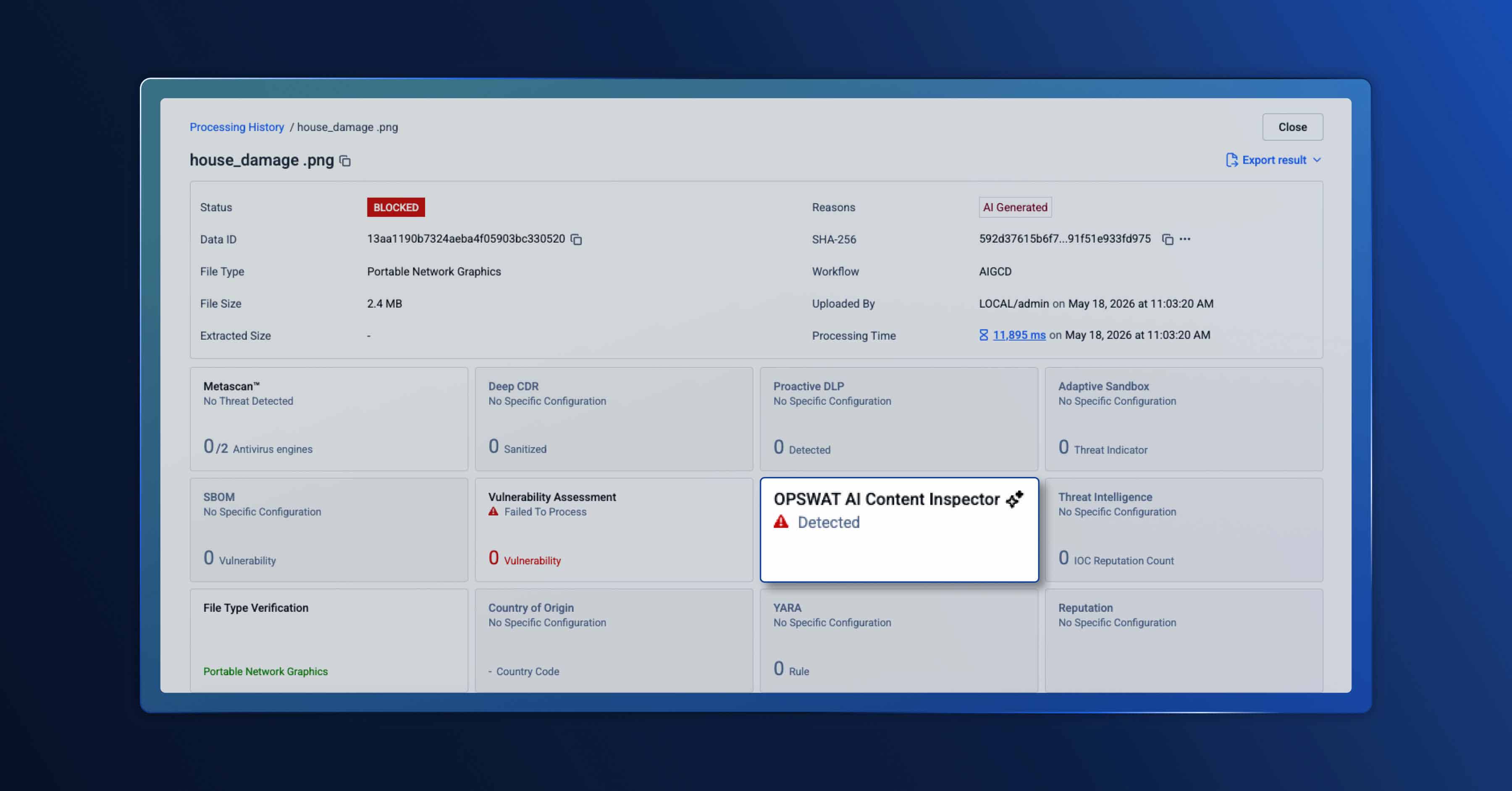
A PDF invoice can be free of malware and still be fraudulent. A photo of property damage can contain no malicious code and still show an incident that never happened. An accident report can arrive as a clean image file and still be generated, altered, or staged to trigger an unauthorized payout.
This is the new content trust gap: files may be technically safe, yet factually deceptive.
That is why OPSWAT is introducing OPSWAT AI Content Inspector 2.0, the General Access release of OPSWAT’s proprietary AI-driven content authenticity and document fraud detection engine. Purpose-built for identifying AI-generated content and detecting fraudulent documents in modern, high-throughput environments, AI Content Inspector extends the MetaDefender platform from file security to content authenticity.
Why Content Authenticity Now?
Digital workflows have become faster, more remote, and more automated. Insurers accept claim photos through online portals. Finance teams process invoices through email, AP automation platforms, and supplier portals. Expense teams review receipts and supporting documentation at scale.
These workflows depend on images and documents as evidence.
Generative AI has changed the economics of that evidence.
Fraudsters no longer need advanced editing skills or insider access to create convincing visual and document-based deception. They can generate realistic property damage, alter vehicle accident photos, fabricate invoices, or create synthetic receipts quickly and cheaply. In many cases, these files still pass traditional malware scanning because the problem is not malicious code. The problem is false content.
For insurers, this creates exposure at the point of claim intake. Market research cited for AI Content Inspector found that Admiral Insurance reported a 71% rise in fraudulent claims in 2025, with AI image manipulation identified as a meaningful driver. The same research noted that 36% of consumers were open to altering claim evidence, indicating how quickly the fraud surface expands when image manipulation becomes easy.
For auto insurers, accident claims are especially exposed because they rely heavily on photos of vehicle damage, accident scenes, license plates, and supporting documentation. Research cited for AI Content Inspector found that U.S. insurance fraud costs more than $40 billion annually, while Shift Technology estimated that 20–30% of insurance claims now contain some form of AI-altered media.
For finance and AP teams, invoice fraud remains one of the most measurable business risks. AI Content Inspector market research identified an average U.S. invoice fraud loss of $133,000 per incident and noted that 76% of organizations experienced attempted or actual payments fraud in 2025. Generative AI now enables fabricated invoices, receipts, pay stubs, bank statements, and supplier documentation that can pass manual review when teams rely only on visual inspection.
The result is a new operational requirement: organizations need to inspect not only whether a file is safe to open, but whether the content can be trusted.
Introducing OPSWAT AI Content Inspector 2.0
OPSWAT AI Content Inspector 2.0 is a new AI-driven content authenticity and document fraud detection engine for the MetaDefender platform.
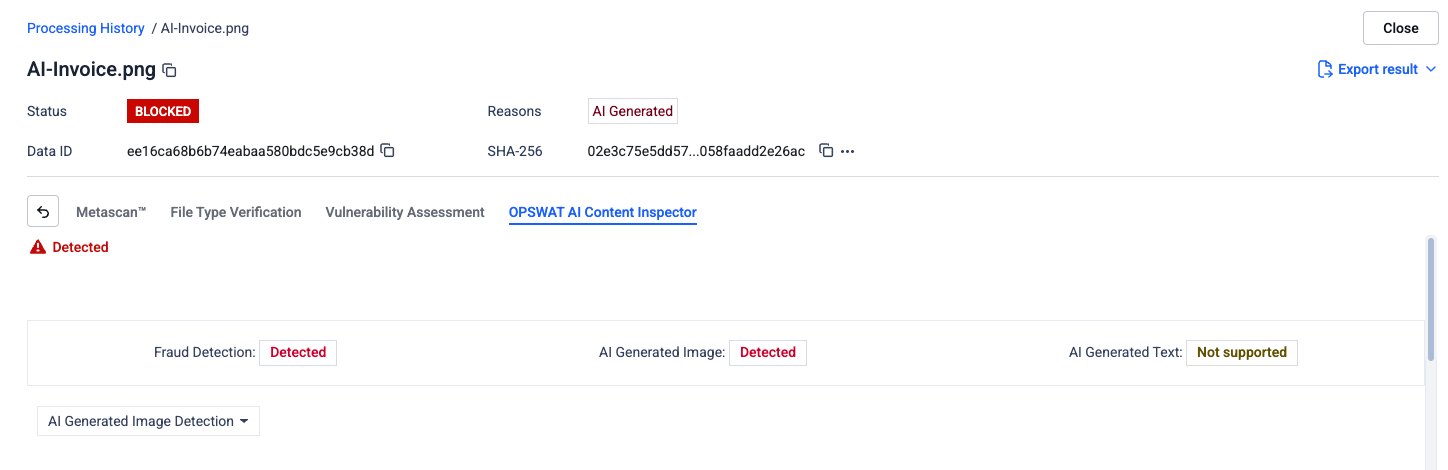
The engine is designed to analyze textual and visual artifacts across common fraud-bearing file types and provide indicators of AI generation, manipulation, and document fraud. It helps organizations make faster pre-decision determinations, such as whether to allow, flag, block, or route content for review before it reaches downstream business workflows.
With AI Content Inspector 2.0, MetaDefender customers can add content authenticity screening directly into existing file inspection workflows. That means claim images, accident photos, invoices, receipts, and supporting documents can be inspected at ingest, before adjusters, finance teams, AP approvers, or automated systems act on them.
This is a major release for MetaDefender customers. AI Content Inspector integrates into the MetaDefender platform and is available across cloud and on-premises deployments, with support for Windows and Linux environments. It can run alongside OPSWAT technologies such as Proactive DLP and Deep CDR™ Technology to strengthen content inspection coverage without forcing customers to redesign existing file security architecture.
How AI Content Inspector Works in 3 Steps
A multi-signal inspection engine analyzes submitted files for AI-generation, manipulation, and document fraud indicators.
File Ingestion & Normalization
Submitted files are normalized, validated, deduplicated, and prepared for inspection, including EXIF and metadata canonicalization for images.
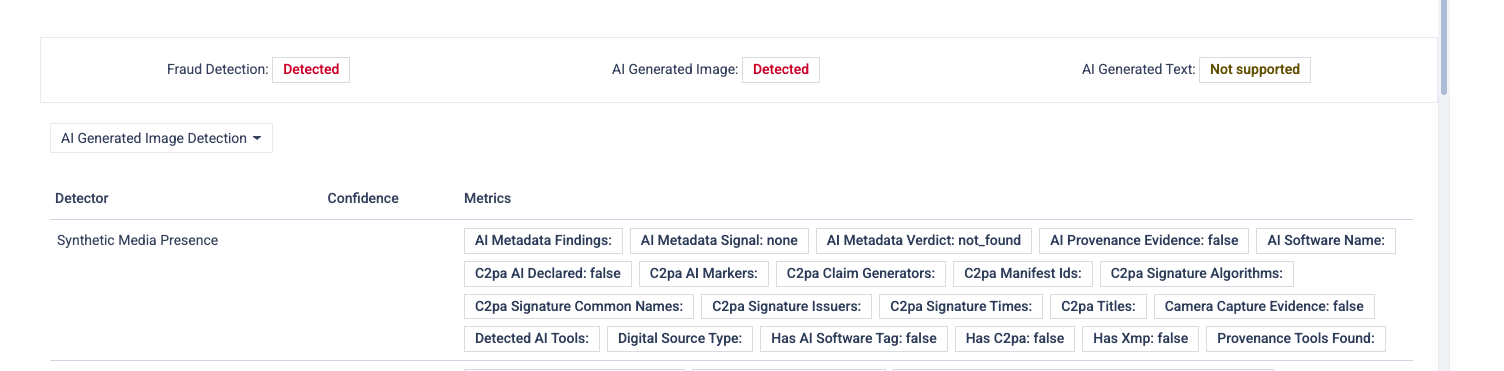
Multi-Signal Content Analysis
The engine evaluates visual forensic signals, textual patterns, and document structure to identify AI-generated or manipulated content.
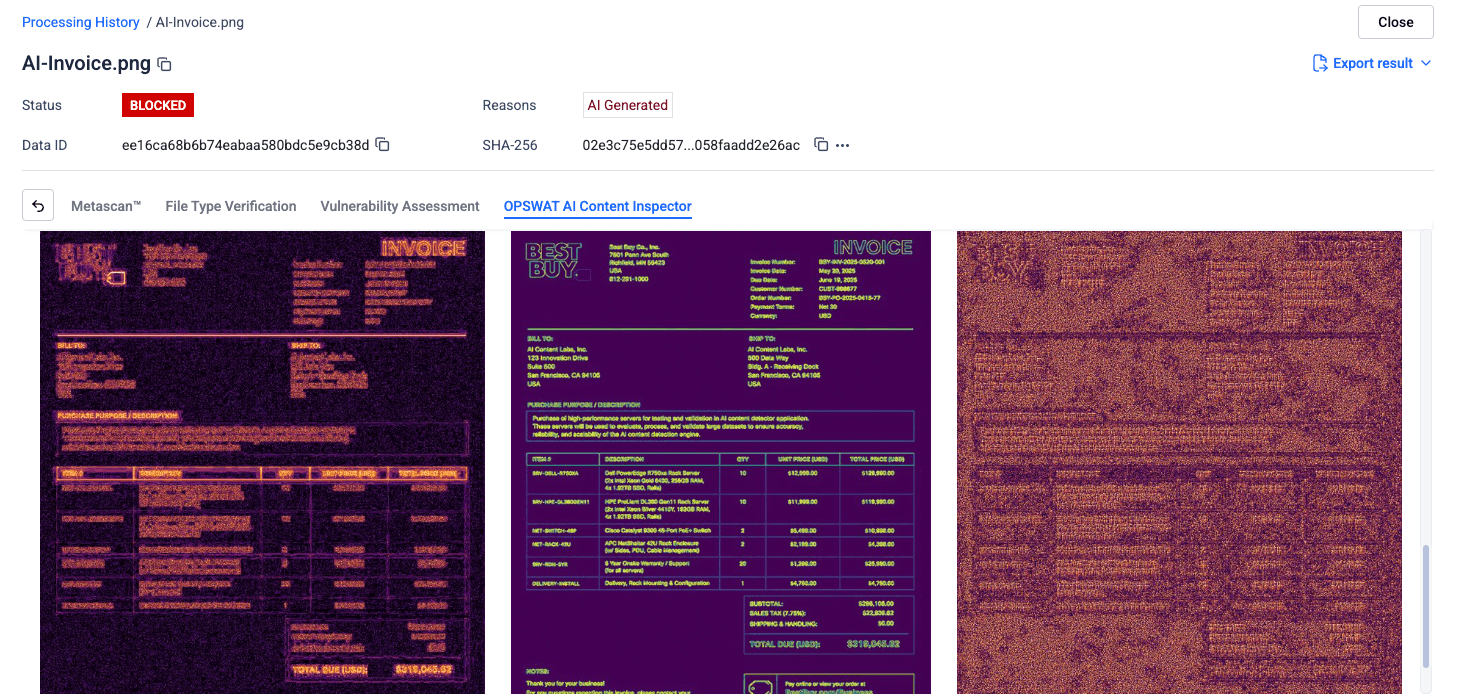
Fraud Indicator Verdicts
AI-generation and document-fraud indicators support policy-driven decisions such as allow, flag, block, or route for manual review.
From Malware Detection to Content Trust
Traditional file security answers critical questions:
- Is this file malicious?
- Does it contain known malware?
- Does it include hidden active content?
- Can it be sanitized before delivery?
AI Content Inspector adds another layer of inspection:
- Was this image likely AI-generated or manipulated?
- Does this document show indicators of fraud?
- Does the content contain signals that should trigger review before a business decision is made?
This matters because modern fraud often arrives in files that look ordinary.
A home insurance claim photo may show convincing water damage, but the scene may have been generated or altered. A vehicle accident image may show damage that was digitally exaggerated. An invoice may look like it came from a known supplier, but payment details may have been modified, or the invoice may have been fabricated entirely.
AI Content Inspector is designed for these content-borne risks.
Key Use Cases for OPSWAT AI Content Inspector 2.0
1. Detecting Fake Home Insurance Claims
Property and casualty insurers increasingly rely on digital First Notice of Loss workflows. Claimants upload photos of damaged ceilings, flooded rooms, fire-affected interiors, stolen property, or other evidence. Adjusters then review the submitted media remotely.
The image becomes the evidence.
But generative AI can now fabricate highly realistic damage scenes or extend real images with synthetic damage. That creates a problem for claims teams: the file may be clean, the metadata may be incomplete, and the image may still be deceptive.
AI Content Inspector helps insurers inspect claim images at ingest, before they reach adjuster review or payment authorization workflows. By adding AI-generation and manipulation indicators into the existing file pipeline, insurers can flag suspicious content earlier and route higher-risk claims for additional review.
2. Detecting Fraudulent Accident Reports and Vehicle Damage Images
Auto insurance claims are high-volume, image-heavy, and time-sensitive. A typical accident claim may include photos of vehicle damage, license plates, accident scenes, police reports, repair documentation, and supporting evidence.
Generative AI introduces multiple fraud paths:
- A fully fabricated accident scene.
- A real vehicle image with digitally exaggerated damage.
- A reused or manipulated salvage-yard photo submitted as new evidence.
- A supporting repair document generated or altered to inflate payout.
AI Content Inspector provides content authenticity inspection for accident photos and related documentation at the file level. This helps insurers identify suspicious media earlier in the claims process, before fraudulent content becomes the basis for claim approval.
3. Detecting Invoice, AP, and Expense Fraud
Invoice fraud is one of the clearest business cases for AI Content Inspector because the risk is measurable and the workflow is already file-driven.
Invoices arrive as PDFs, images, scans, and attachments. Receipts flow through expense platforms. Supplier documents move through onboarding portals. Many of these files are already inspected for malware, but not necessarily for content authenticity.
Generative AI now makes it easier to create:
- Fully fabricated invoices that mimic real supplier formats.
- Altered invoices with modified payment details.
- Synthetic receipts for expense reimbursement.
- Fake supporting documents used in vendor onboarding or payment authorization.
AI Content Inspector enables organizations to screen invoices, receipts, and supporting documents for AI-generated and fraud-related indicators before they reach AP approval, expense reimbursement, or payment execution. For MetaDefender customers, this extends existing file inspection into a high-value fraud prevention control without requiring a separate content authenticity pipeline.
How AI Content Inspector Continuously Improves
Generative AI models evolve quickly. Detection engines must evolve with them.
AI Content Inspector 2.0 is built with a documented machine learning and AI pipeline lifecycle that includes data ingestion and normalization controls, labeling and enrichment using multiple evidence sources, training and quality gating, and continuous refresh and monitoring to adapt to emerging fraud patterns.
The engine analyzes multiple signal types, including visual forensic indicators, text-stylometry features, document structure cues, EXIF and metadata normalization, and separate evaluation gates for AI-generated text, AI-generated images, and document fraud classifiers.
This lifecycle is important for customers because content fraud is not static. Fraudsters will continue to test new image generators, document templates, editing workflows, and synthetic media techniques. AI Content Inspector is designed to improve as these patterns change.
Built for MetaDefender Customers
AI Content Inspector is not a standalone point solution that asks organizations to create a new inspection path.
It is designed as a MetaDefender engine.
That matters because many of the files involved in fraud-prone workflows are already moving through MetaDefender today. Email attachments, uploads, managed file transfers, claim documents, scanned invoices, PDFs, and images are already part of enterprise file security operations.
With AI Content Inspector, customers can add content authenticity verdicts into the same broader inspection strategy they use for multiscanning, CDR, DLP, and file-based threat prevention. The release notes state that AI Content Inspector is available as a separate engine in MetaDefender Core and MetaDefender Cloud and supports image formats, text-bearing documents, and PDFs commonly used in fraud workflows.
Supported platforms include Windows and Linux. Supported file types include common image and document formats such as JPG, PNG, WEBP, AVIF, BMP, PDF, TXT, MD, and additional image formats used across enterprise workflows.
Key Benefits at a Glance
Inspect content before business decisions are made
Flag suspicious images, invoices, receipts, and documents before they reach claims review, AP approval, or payment authorization.
Extend MetaDefender from file security to content authenticity
Add AI-generated content and document fraud detection alongside existing MetaDefender inspection technologies.
Support high-volume workflows
Apply pre-decision content inspection to use cases such as insurance claims intake, accident report review, invoice processing, and expense documentation.
Reduce reliance on manual visual review
Give reviewers additional authenticity indicators when files look convincing but may be synthetic, altered, or fraudulent.
Deploy across flexible environments
Use AI Content Inspector across cloud and on-premises MetaDefender deployments, including Windows and Linux environments.
Stronger Together with MetaDefender
AI Content Inspector reflects an important evolution in file security.
Organizations still need to detect malware. They still need to sanitize risky files. They still need to prevent sensitive data exposure. But they also need to know whether the content inside the file can be trusted.
That is the gap AI Content Inspector is built to close.
By bringing AI-driven content authenticity and document fraud detection into MetaDefender, OPSWAT helps customers inspect files more completely: not only for hidden threats, but for deceptive content that can trigger financial loss, operational disruption, and compliance exposure.
The future of file security is not only Trust No File.
It is Trust No Content.
Get Started with OPSWAT AI Content Inspector 2.0
Customers currently using MetaDefender products can add OPSWAT AI Content Inspector to unlock AI-generation detection and document fraud screening while retaining familiar multiscanning, Proactive DLP, and Deep CDR™ Technology capabilities.
To discuss upgrade options, deployment planning, or fraud-focused content inspection use cases, contact your OPSWAT representative.