The Cost of Late Detection in Healthcare
Healthcare has been the most expensive industry to breach for thirteen consecutive years. According to the IBM 2026 Cost of a Data Breach Report, the average healthcare breach now costs $6.64 million, still the highest of any industry and well above the global average of $4.99 million. That detection gap defines the interval between a breach and when a SOC team becomes aware that anything has gone wrong.
A Detection Model Built for Response, Not Prevention
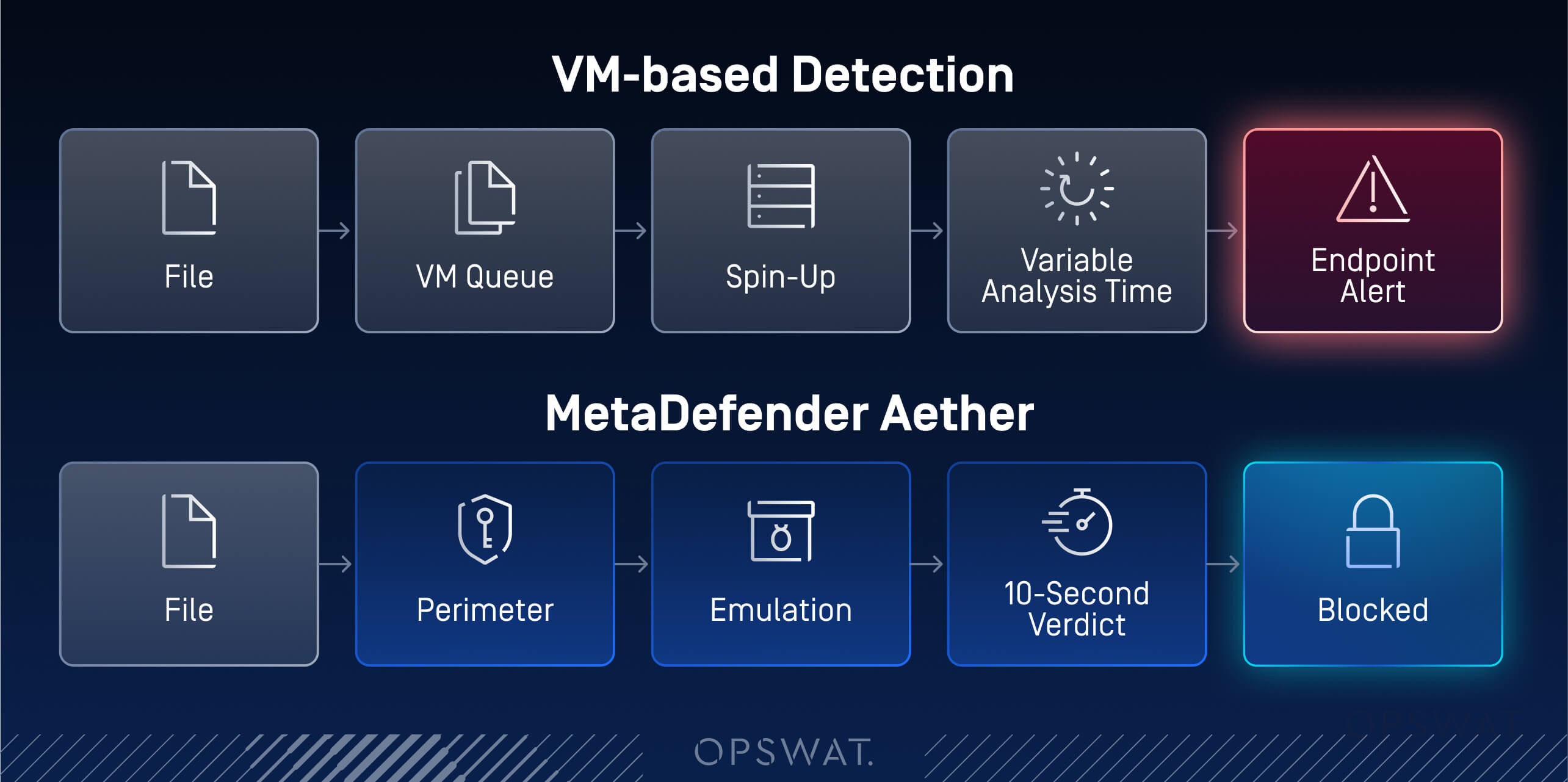
The organization's primary security tool was designed around endpoint visibility. Suspicious files were flagged only after they executed on a user device or clinical system, which meant that every detection marked the start of an incident response, not the prevention of one. In a network where compromised EHR (electronic health record) access or disrupted medical device communication has immediate consequences for patient care, that sequence was operationally untenable. The SOC was perpetually managing damage rather than stopping threats upstream.
File Volume Exposed the Limits of VM-Based Analysis
As file-based threats grew through email attachments, shared documents, and external file exchanges, the team leaned harder on the tool's detonation capabilities. Virtual machine-based workflows required spinning up multiple virtual environments per analysis, and processing time became unpredictable as volume increased.
IBM's research identified phishing as the top attack vector in healthcare specifically, meaning malicious files delivered through email represented the primary risk, not just a growing one. The SOC had no reliable way to predict how long a file would take to clear, and in clinical environments where file access underlies patient workflows, that unpredictability was a liability the team could not manage around.
Scaling Through VMs Was a Problem That Compounded Itself
Higher file volumes required more VM resources. Each increase in throughput demand translated directly into infrastructure overhead, and during peak periods, backlogs formed and investigation queues backed up. A SOC already operating with lean staffing now faced analysis bottlenecks on top of it. For a network with thousands of users and continuous file movement across hospitals, outpatient facilities, and research environments, the organization had reached the practical ceiling of what VM-based scaling could deliver.
The Criteria That Could Not Be Compromised
The SOC entered its evaluation with four requirements shaped directly by what had failed operationally. Each one addressed a gap the existing tool could not close.
- Stop threats before execution
- Maintain accuracy across unknown and evasive threats
- Deliver consistent analysis speed regardless of volume
- Scale without VM infrastructure growth
Detection Moved Upstream
The organization chose OPSWAT’s MetaDefender Aether. Within the first weeks of deployment, something the team hadn't experienced in years happened: files were being stopped before the endpoint ever saw them. Threats that previously generated endpoint alerts were stopped before they got that far. The shift was architectural as much as operational. Endpoint tools remained in place for visibility and response, but they were no longer the first line of detection. That role moved to the perimeter.
Emulation Replaced the VM Bottleneck
Where VM-based analysis required spinning up virtual environments for each detonation, MetaDefender Aether now screens files through Predictive Alin AI before they reach a sandbox at all. This pre-execution static analysis layer clears high-confidence clean files in milliseconds and blocks high-confidence malicious files outright, so only uncertain samples move to the emulation-based adaptive sandbox, which executes files at the instruction level. Analysis completes in an average of ten seconds, 40x faster than traditional sandboxes, and the platform supports more than 50,000 file analyses per day.
Because emulation operates at the instruction level, it is significantly harder to detect by malware designed to identify sandbox environments. Threats that would stall or behave differently under VM analysis execute as expected, exposing behaviors that evasion-aware samples would otherwise conceal. The SOC gained consistent, predictable analysis speed at the volumes a multi-hospital network generates, with a 99.5% detection rate and without adding VM infrastructure to achieve it.
Detections That Arrived Ready to Act On
What changed the team's investigative workload was the detection speed and what came with each detection. Rather than a flag that required follow-up research, each result arrived with reputation data, behavioral analysis, a confidence-based risk score, and threat hunting context already attached.
Built-in threat intelligence continuously checks URLs, IPs, and domains against real-time indicators, flagging suspicious files for deeper analysis. ML-powered threat similarity search enabled the SOC to identify related malware variants, detect modified or previously unseen threats, and correlate suspicious files with known malicious patterns, reducing manual triage burden on analysts already operating lean.
The Path from Reaction to Prevention
Ask any SOC analyst what changed first and the answer is the same: the queue. Files cleared, backlogs didn't form, and the investigations that did land arrived with context already attached, such as reputation data, behavioral analysis, and risk score, rather than a flag that needed to be chased down.
Security Operations Before and After MetaDefender Aether
Capability | Before | After |
Detection timing | Post-execution, endpoint-dependent | Pre-execution, at the perimeter |
Analysis speed | Variable, unpredictable under load | Consistent, ~10 seconds average |
Scalability | VM-dependent, bottlenecked at high volume | 50,000+ files/day, no VM overhead |
SOC workload | Repeated IR cycles, manual triage | Reduced endpoint incidents, contextual verdicts |
Threat coverage | Reactive to known threats | Evasive malware, zero-day, and modified variants |
Security Built for the Speed of Patient Care
This healthcare provider shifted the point in the workflow where security acts. Perimeter prevention replaced reactive endpoint response; analysis backlogs gave way to consistent throughput, and investigations that once required manual triage now arrived with context already attached.
For healthcare security teams, the path forward is the same one this organization took: move detection upstream, remove the infrastructure that slows analysis down, and build a security posture that operates at the speed clinical environments require.