Key Takeaways
- KYC checks confirm a document was submitted in an expected format, not that the identity behind it is real
- Synthetic identity fraud combines real stolen data, most often SSNs taken from children or people who rarely check their credit, with fabricated details built to pass onboarding over time
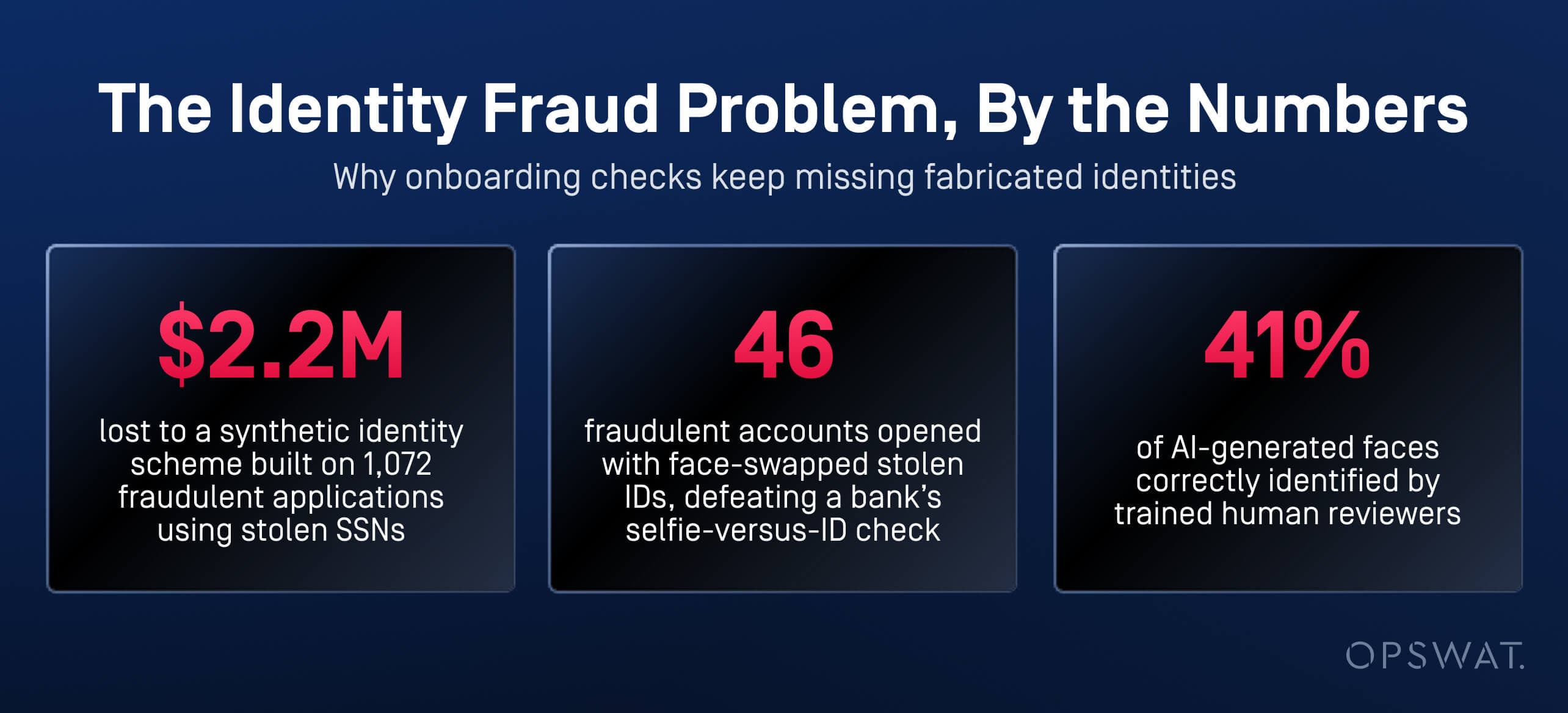
- A federal indictment unsealed in August 2026 charged two individuals in a $2.2 million synthetic identity scheme built on more than 1,072 fraudulent credit card applications
- A man convicted in June 2026 defeated a Dutch bank's selfie-versus-ID check by face-swapping stolen identity documents onto his own photo, opening 46 fraudulent accounts
- AI Content Inspector applies the same image, text, and metadata detection signals used for invoice and claims fraud to ID images, selfies, and supporting onboarding documents
What AI-Generated Identity Fraud Looks Like in Financial Onboarding
AI-generated identity fraud takes two forms in onboarding: synthetic identities built from real stolen data, and deepfake images layered onto stolen documents. Both are designed to satisfy a checkpoint, not withstand investigation.
Synthetic Identities Built From Real Stolen SSNs
A federal grand jury unsealed a 19-count indictment in August 2026 against two individuals accused of running a synthetic identity scheme from around 2012 through 2024. Prosecutors say the pair used valid Social Security numbers, many belonging to children, to submit approximately 1,072 online credit and debit card applications, causing an estimated $2.2 million in losses.
Deepfake Selfies Submitted During Digital Onboarding
A separate case shows the image side of the problem. A man convicted in June 2026 used face-swap software to blend his own features onto stolen identity documents, defeating a Dutch bank's mobile selfie-versus-ID check and opening 46 fraudulent accounts.
The Scale of the Problem
According to Biometric Update, one financial institution logged 8,065 deepfake verification attempts in eight months, tied to $347 million in losses. Check Point's AI Security Report 2026 found trained reviewers correctly identified only about 41% of AI-generated faces, confirming human review alone can no longer catch what generative models produce.
How These Identities Enter Onboarding and Account-Opening Workflows
Fabricated identities enter through the same channels as legitimate applicants: digital onboarding portals, mobile app account creation, and document upload queues connected to KYC systems. The identity enters the review pipeline before any check evaluates whether the underlying data is real.
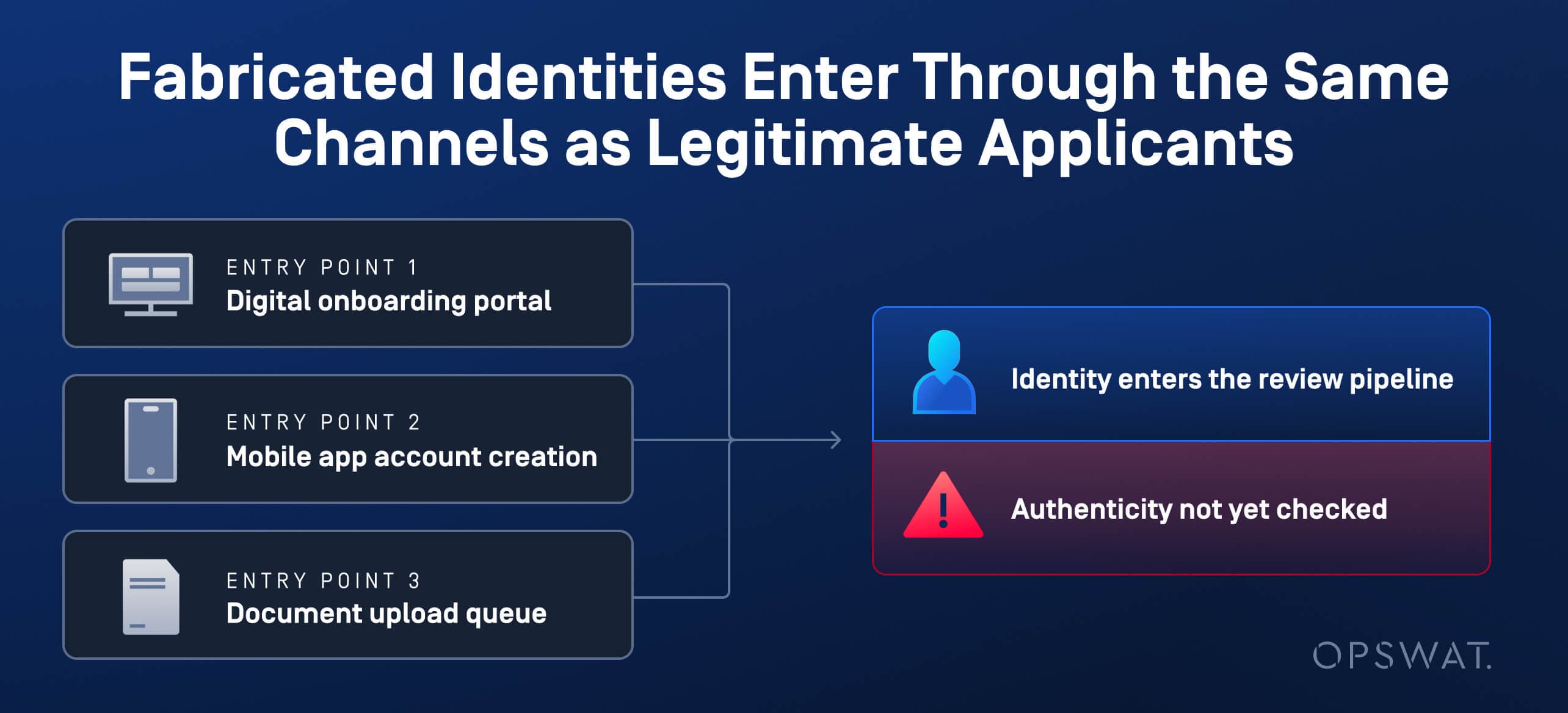
The Dutch bank case shows the mechanism end to end. Identity documents were harvested through a fake rental listing and social media, then submitted through the bank's standard mobile photo-and-selfie process, the same one legitimate applicants use.
Three Reasons Standard KYC Checks Cannot Detect Fabricated or Synthetic Identities
Document upload checks confirm a file is complete and correctly formatted, not that the identity in it is authentic. That gap lets synthetic and AI-generated identities through.
Selfie-versus-ID matching assumes the submitted photo is an unaltered capture of a real face. It wasn't designed to catch a face-swapped or AI-generated image layered onto a stolen document, which is exactly what defeated the Dutch bank's mobile check.
Synthetic identities also behave like real, slow-building applicants. Nothing about a single application looks urgent, because the fraud is assembled gradually across months of ordinary-looking activity rather than one suspicious event. Check Point's AI Security Report 2026 frames this as part of a broader shift, with AI moving from assisting fraud attempts to running them directly.
Signals That Expose AI-Generated Identity Documents and Selfies
AI Content Inspector is OPSWAT's AI-driven content authenticity and document fraud detection engine for the MetaDefender™ platform. It applies the same inspection architecture used for invoice and claims fraud to ID photos, selfies, and onboarding documents, running multiple independent signals against each file at once rather than relying on a single check.
AI-Generated Image Detection inspects submitted ID photos and selfies the way it inspects claim images: for sensor-fingerprint inconsistencies, compression artifacts, and the pixel-level and frequency-domain signals that separate a camera capture from a generated or manipulated one.
Document Fraud Screening applies to proof-of-address files and supporting onboarding documents, checking metadata and structural consistency against what a legitimate document from that source should look like.
Google SynthID Watermark Detection checks for the embedded watermark some AI image generators produce. In testing, OPSWAT stripped SynthID markers from over 21,000 AI-generated images; the watermark detector missed those, but forensic and deep classification signals still returned above 90% detection accuracy, confirming the engine doesn't depend on watermarks alone.
Every result returns as a confidence-scored verdict rather than a binary pass or fail, so onboarding teams can set how much certainty is required before a file is auto-cleared, flagged, or routed for human review.
How to Verify Identity Authenticity Before Account Opening
Verifying identity authenticity before account opening requires two checks running together, neither of which alone would have caught the Dutch case or the synthetic identity indictment.
Document authenticity analysis evaluates whether the ID, selfie, and proof-of-address file are genuine and internally consistent.
Applicant record validation checks the claimed identity against what's already known: whether the SSN, address, and contact details match an established history rather than a recently assembled one.
Uncertain verdicts should route to human review rather than auto-approving or auto-rejecting. Onboarding teams should also treat compounding risk signals, such as a new account, changed contact details, and unusually high application velocity, as one combined decision rather than isolated checks that each look acceptable on their own.
How to Build a Prevention-First Onboarding Workflow
A prevention-first onboarding workflow places authenticity controls at every document and image entry point before an account is created, not after a suspicious transaction triggers a review.
Onboarding Control Layers for Identity Fraud Prevention
Control Layer | Placement | What It Evaluates | Fraud Vectors Addressed |
Document and image intake | Onboarding portal or mobile upload | Format, completeness, malware | Malicious files disguised as ID uploads |
Content authenticity analysis | Ingest point, before KYC decisioning | AI-generation signals, metadata, manipulation | AI-generated selfies, face-swapped IDs |
Selfie-versus-ID matching | KYC verification step | Facial similarity | Stolen or mismatched identity documents |
Applicant record validation | Before account approval | SSN and address history | Synthetic identities on stolen SSNs |
Exception routing and human review | High-risk decision queue | Uncertain verdicts, compounding risk | Cases no single check resolves alone |
AI Content Inspector Adds ID Authenticity Detection
AI Content Inspector adds identity document authenticity detection directly to the MetaDefender pipeline, rather than requiring a separate tool for ID and selfie review. For regulated onboarding teams that means inspecting synthetic identities and AI-generated faces at the same point where a selfie-versus-ID check would otherwise pass them through.
AI Content Inspector runs as a separate engine within MetaDefender™ Core and MetaDefender™ Cloud, alongside Metascan™ Multiscanning, Deep CDR™ Technology, and Proactive DLP™ technologies. Organizations already running MetaDefender can add identity document authenticity verdicts without a new vendor or a separate integration project.
Add AI Content Inspector to your MetaDefender deployment to bring the same content-authenticity detection used for invoice and claims fraud to ID images, selfies, and onboarding documents.
Frequently Asked Questions
What is synthetic identity fraud?
Synthetic identity fraud combines real stolen data, most often a Social Security number, with fabricated personal details to build an identity that doesn't correspond to a real applicant, built to pass onboarding checks over time rather than trigger a single suspicious application.
How does AI-generated identity fraud work during onboarding?
Fraudsters submit AI-generated or manipulated ID photos, selfies, and supporting documents through the same portals legitimate applicants use. Because the files contain no malware, standard file security tools clear them, and the fraud only surfaces if the content itself is authenticated.
Can KYC checks detect deepfake or AI-generated ID documents?
Standard KYC checks confirm format and completeness and match a selfie against an ID photo. Neither step was built to detect whether the submitted image is AI-generated or manipulated, which is why a face-swapped selfie can pass a selfie-versus-ID match.
What signals expose an AI-generated ID document or selfie?
Sensor-fingerprint inconsistencies, compression artifacts, metadata mismatches, and structural anomalies each provide a partial signal. AI Content Inspector combines these with watermark detection, such as Google SynthID, into a single confidence-scored verdict.
How is identity fraud different from the invoice fraud covered in our previous blog on AI-generated invoice fraud?
Invoice fraud targets a payment decision using a fabricated document like an invoice or receipt. Identity fraud targets a verification decision using a fabricated or manipulated identity document, selfie, or proof-of-address file. Both exploit the same gap: a file can be free of malware and still be fraudulent in what it claims to represent.