Every security decision about a file starts from one answer: what the file actually is. OPSWAT File Type Detection treats that answer as a verdict to be earned, one analyzer at a time, with a confidence score attached.
Why File Identity Comes First
Every file that enters an organization raises the same first question: what is it?
The answer decides what happens next. A document might be sanitized. An archive might be opened and checked piece by piece. An executable might be blocked outright. If a file is labeled wrong, it goes down the wrong security path, and the protections built for its real format never touch it.
The extension is a name anyone can type. Text-based formats, such as scripts, configs, and source code, often have no signature at all, just patterns. And files deliberately dressed as another format are a standard evasion tactic against every filter that trusts a single clue.
How File Type Detection Reaches a Decision
OPSWAT File Type Detection treats a verdict on file type as something to prove. Each file passes through a series of specialized checks, called analyzers, one after another. Each analyzer is an expert in certain formats, and the process stops as soon as one reaches a firm answer.
The order of those checks is deliberately engineered:
- Fast checks go first. Every file passes through the start of the line, so those checks must be quick
- Similar formats are checked early. Some formats closely resemble more common ones, so the analyzer that can tell them apart gets the first look
- Strong evidence outranks weak evidence. Analyzers that read a file's real internal structure run before those that rely on short signatures or loose patterns. A lucky two-byte match can never outrank a parsed read
- Heavy analysis runs only when needed. Deeper parsing, machine-learning classification, and third-party engines step in only when faster checks return a vague answer
- Finally, a refinement step takes any answer that is still generic. A file’s identity is whatever survives such scrutiny.
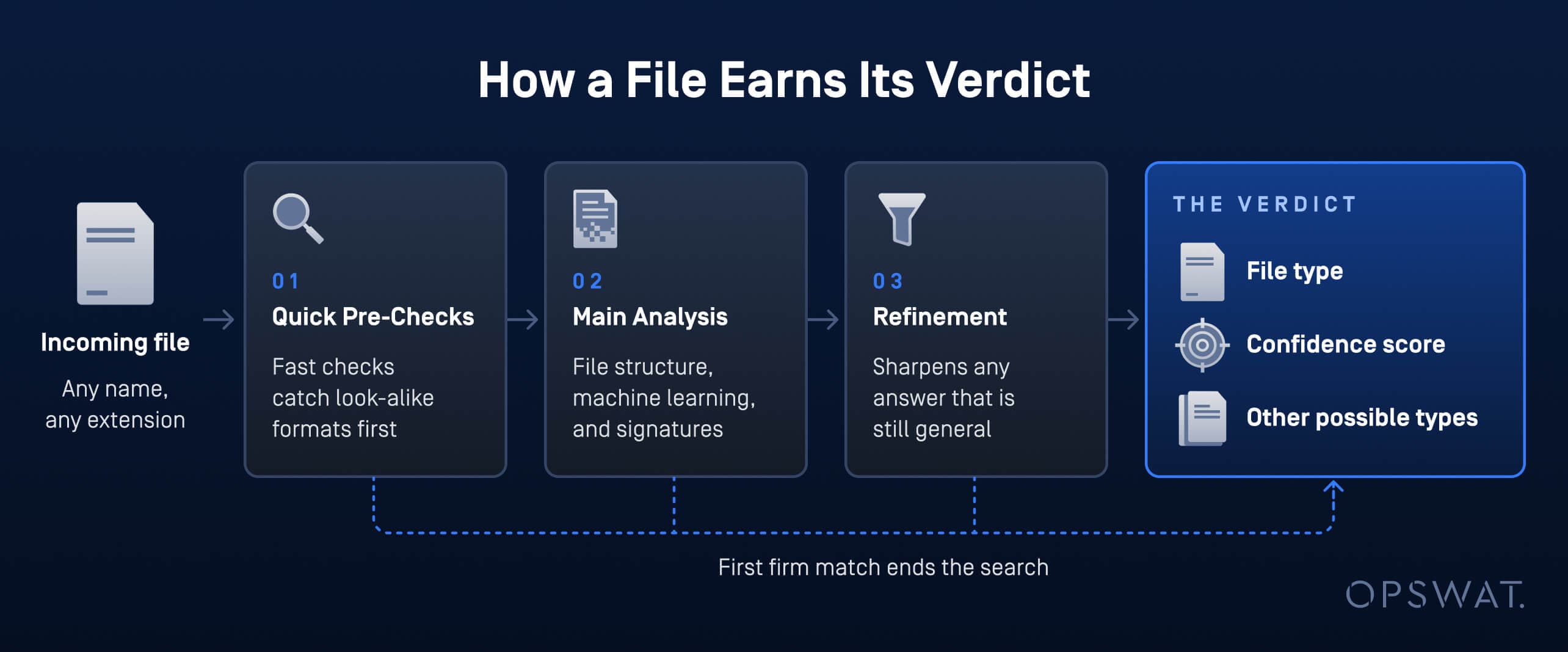
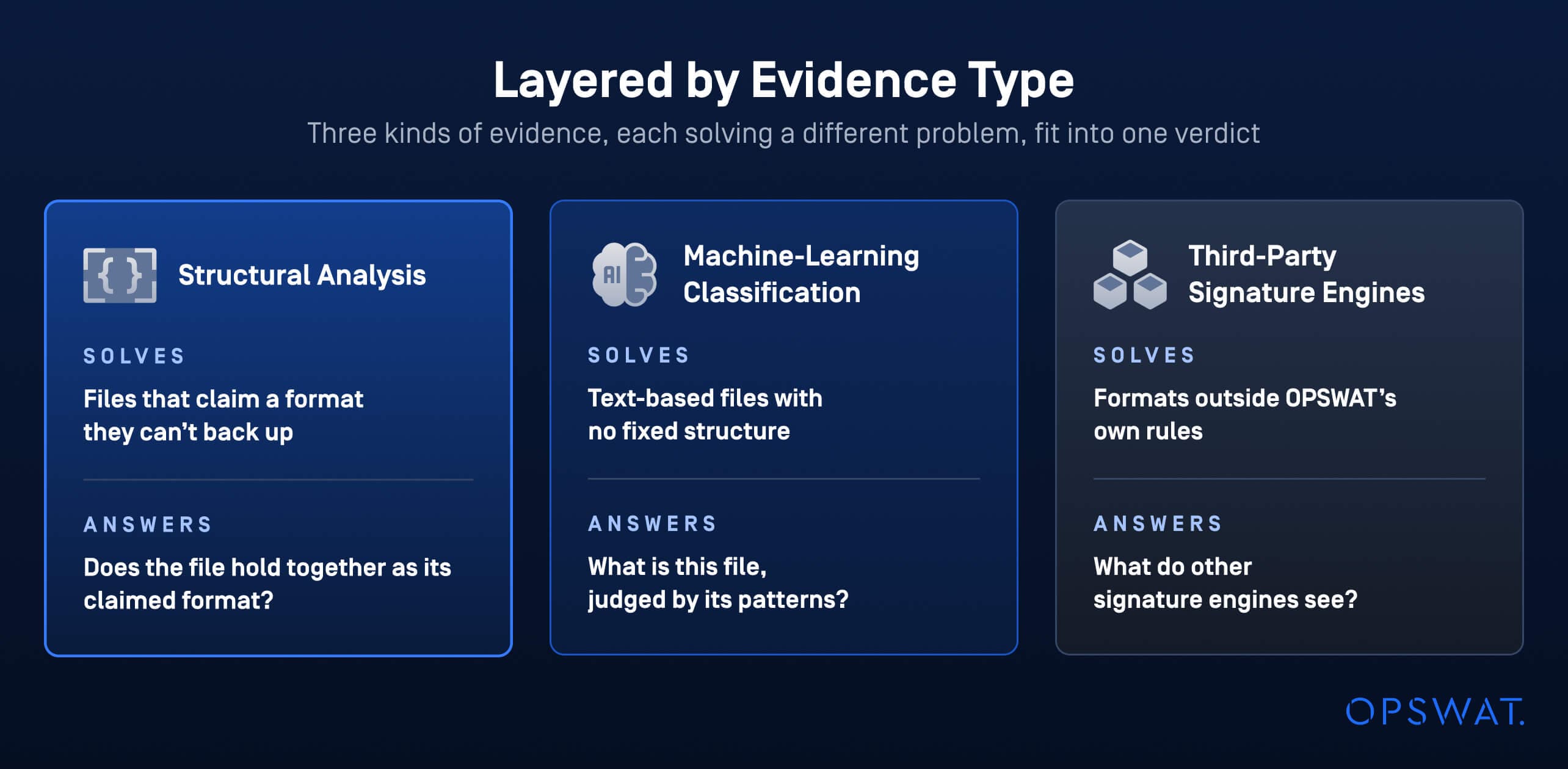
The pipeline is layered by evidence type, from strongest to broadest.
- Structural analysis. The engine reads the file the way its claimed format requires. If a file claims to be a spreadsheet, it has to hold together as a spreadsheet. This is the strongest evidence available
- Machine-learning classification. Models handle files that structure alone can't settle, especially text-based types
- Third-party signature engines. These add coverage for formats and details outside OPSWAT's own rules, and their results are cross-checked into the final answer
Then the results are aggregated by confidence, and a refinement stage re-examines anything that came through ambiguous or generic.
The verdict is more than a label. Alongside the file type, the engine reports a confidence score (how firmly the evidence supports the answer), plus which component detected it, the other types the file could plausibly be, and the detected type's place in its family hierarchy. Downstream policy gets a measured answer, and a file that only barely looks like its claim is visible as exactly that.
Built for the Hard Cases: Beyond Fixed Signature
Three capabilities extend the File Type Detection pipeline beyond what a fixed list of signatures can do.
- Machine learning, where patterns beat signatures. Text-based types are where byte signatures give up: a script or a config file has a recognizable style but no fixed structure. The engine treats those files as a classification problem. The model itself is selectable, including a mode backed by modern deep-learning classifiers, so detection quality for signature-less formats keeps improving without new hand-written rules
- Detect specific file types only, when speed is the mission. When a workflow only cares about certain types, such as extractable archives, the engine can narrow its scope. It selects just the analyzers relevant to the chosen groups and skips the rest of the chain. The pipeline stays the same with a shorter gauntlet, giving faster answers to high-volume flows that know what they're looking for
- Custom detection, without waiting for an engine release. Organizations meet file types the catalog doesn't cover: proprietary formats, industry-specific containers, and in-house tooling output. User-defined rules teach the engine new types at runtime by matching raw byte patterns, ZIP-based container contents, or XML structure. Rules can be added and cleared without an engine update, so "unsupported format" becomes a configuration entry instead of a support ticket
The Bottom Line
File identity is critical to the file security pipeline, and it deserves more than a glance at a name or a magic number. File Type Detection earns it: an ordered chain of specialist analyzers, a wider net of third-party signatures, and a confidence-scored verdict. It is extendable by machine learning for the signature-less, scope-able for speed, and teachable by rule when your files are ahead of the catalog.
File Type Detection delivers 99%+ accuracy on files with disguised extensions and detects spoofed file types in milliseconds. Learn More about File Type Detection, or chat with an expert to see how it fits your file security workflows.

Nhut Ngo is Director of Software Engineering at OPSWAT, where he leads the engineering teams behind Deep CDR™ Technology and other file-processing technologies in MetaDefender Core™. With more than a decade of experience in software engineering and cybersecurity, he focuses on making file sanitization fast, accurate, and ready for critical infrastructure. Nhut earned his PhD in Information Science in 2015.