AI-generated content fraud is the use of generative AI to fabricate or manipulate images, documents, or text submitted as evidence in a business decision. AI Content Inspector is OPSWAT's AI-driven content authenticity and document fraud detection engine, built to flag this content before it drives a payment or care decision.
Key Takeaways
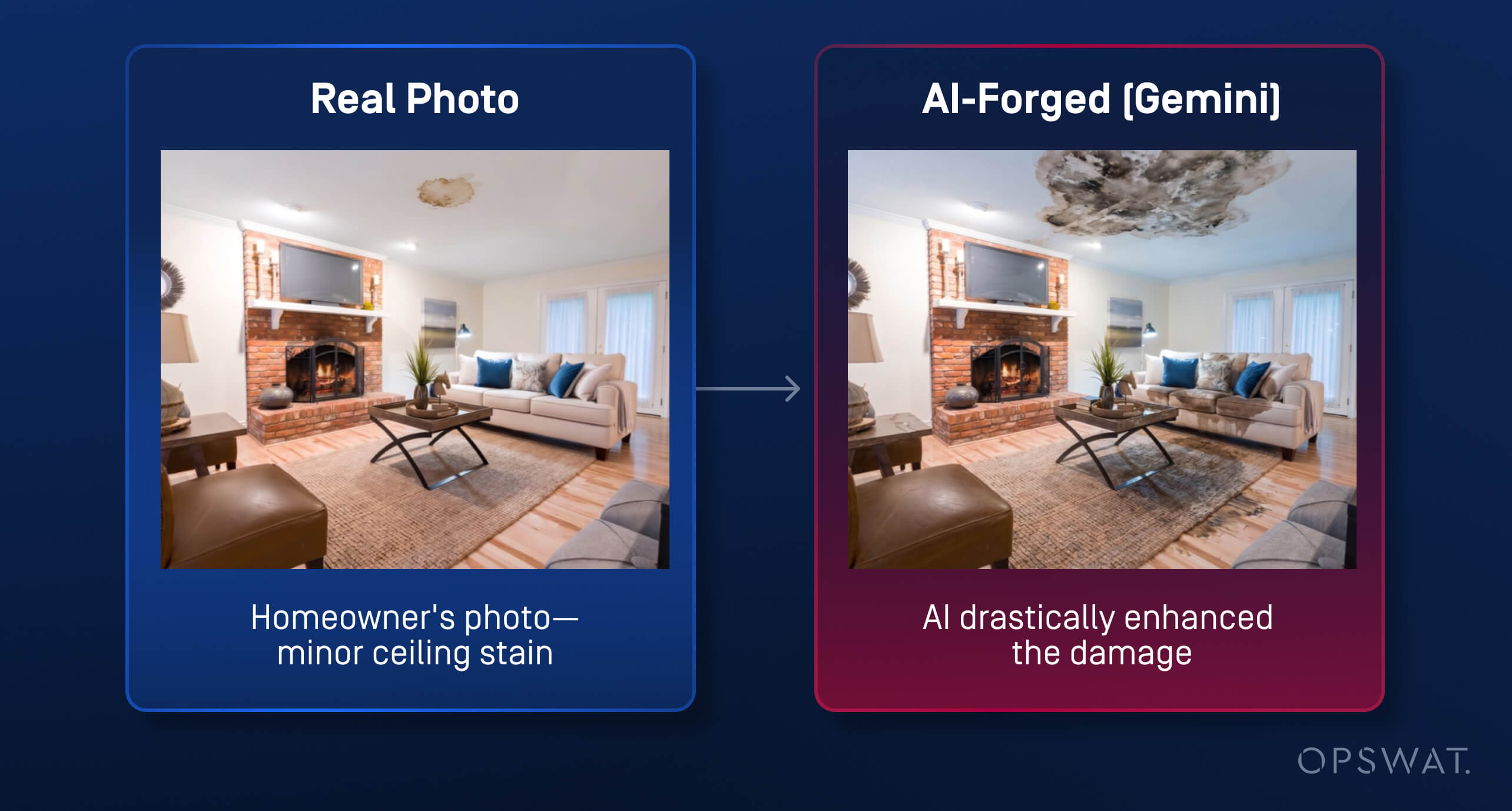
- A $600 ceiling stain became an $18,400 home insurance payout after generative AI enhanced the damage in a submitted photo, with zero inspector visit
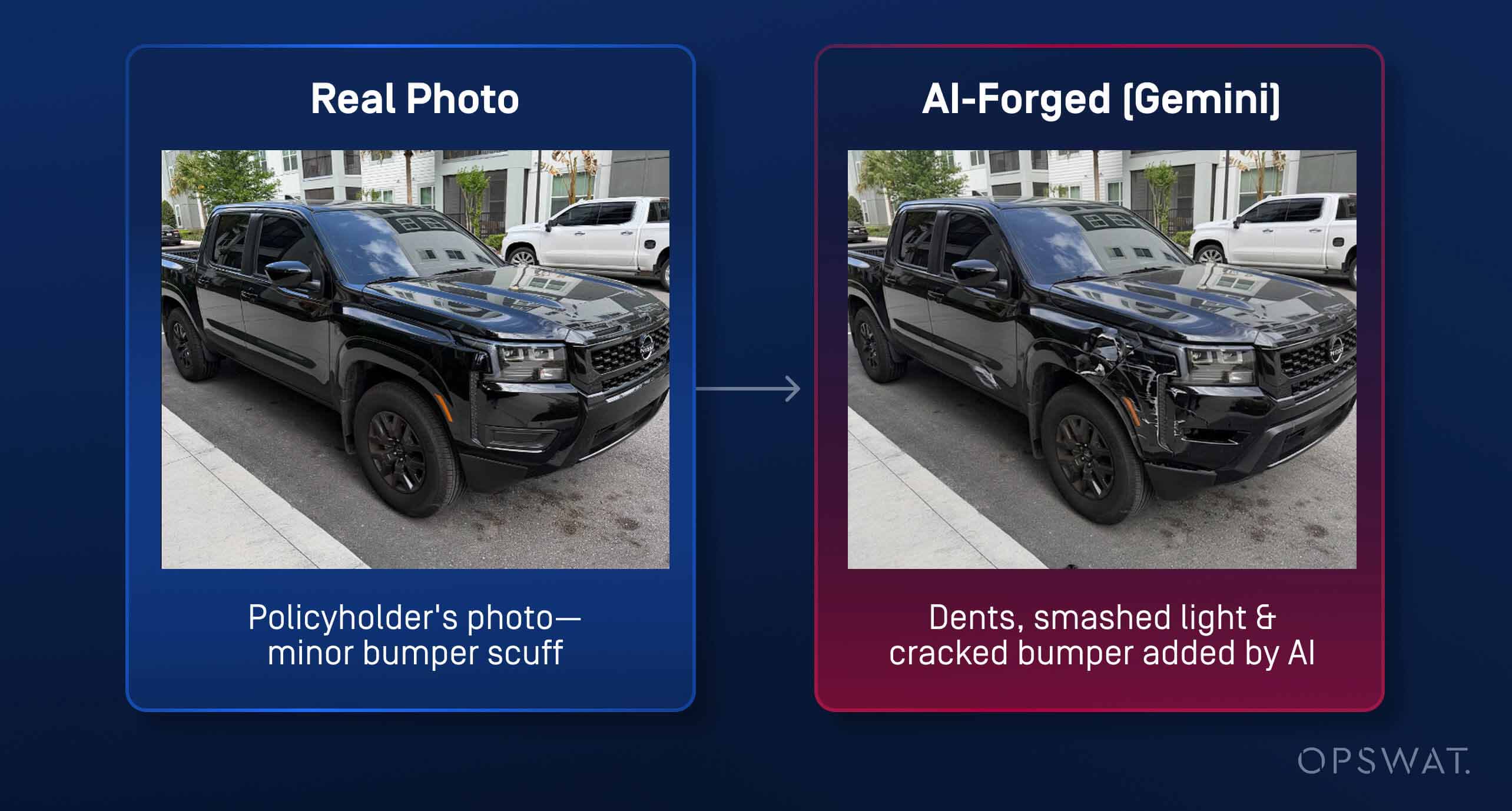
- A $150 bumper scuff turned into a $3,850 auto claim once AI added dents and a cracked bumper to the same photo
- Healthcare payers face a related exposure: synthetic medical imagery and fabricated clinical documentation can drive either wrong reimbursement decisions or wrong care decisions
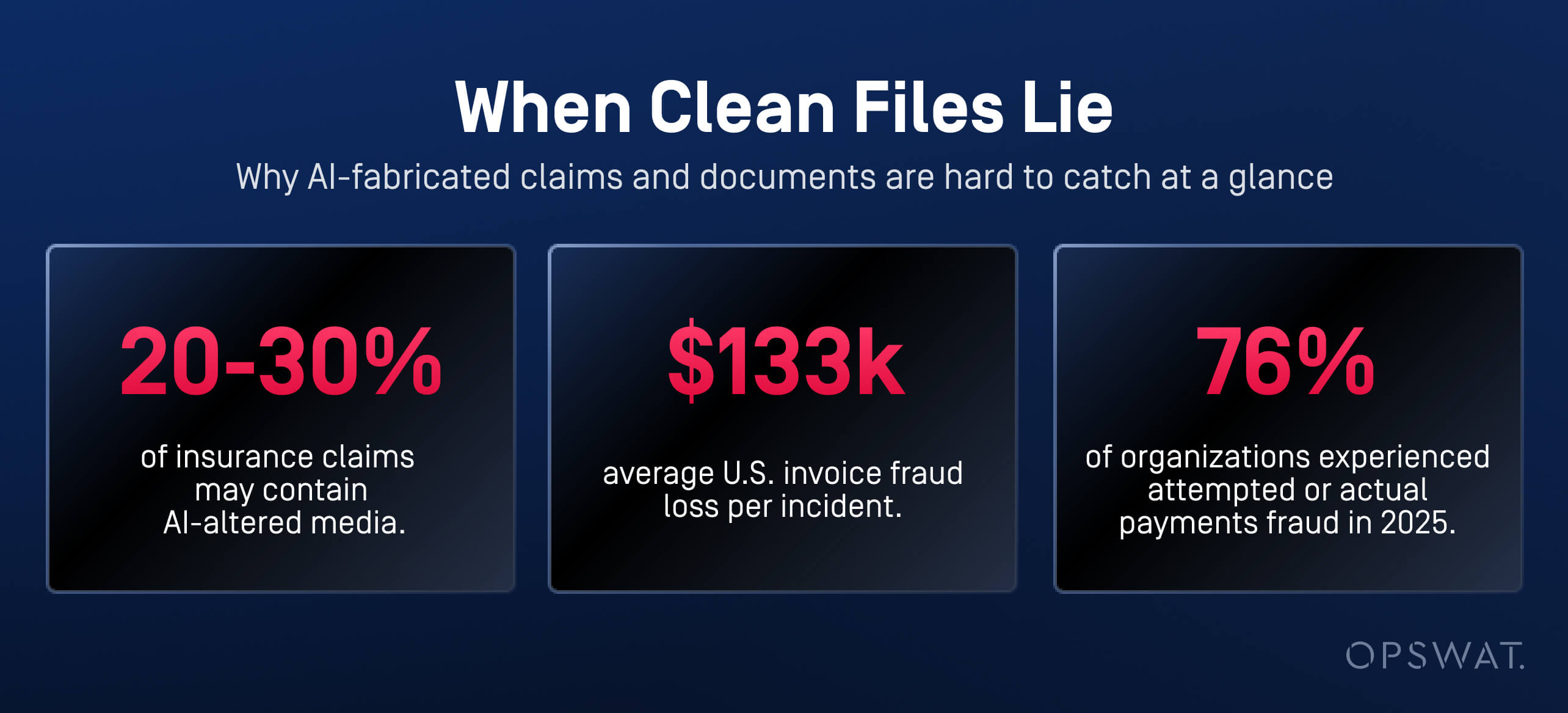
- 20% to 30% of insurance claims may already contain AI-altered media
- AI Content Inspector combines metadata and provenance checks, forensic and compression analysis AI model classifiers, and watermark detection into a single verdict with a confidence score, not a pass or fail flag
Our earlier post on AI-generated invoice fraud showed that a fabricated invoice can pass every malware scan while carrying a fraudulent payment instruction. The same gap shows up anywhere a photo, document, or scanned form is accepted as proof. A property photo, an accident image, or a medical record can be free of malicious code and still misrepresent what actually happened.
In this blog, we will present three claim types – home insurance, auto insurance, and healthcare reimbursement – to show how far that exposure already reaches. Fraud analysts, special investigation units, claims operations leaders, and healthcare payment integrity teams are the ones who absorb that risk, since they are the last checkpoint before a payout or a care decision goes through.
Where AI-Generated Fraud Is Already Hitting Claims
Generative AI has made fabricated claims evidence fast, cheap, and difficult to catch by sight. According to Shift Technology, 20% to 30% of insurance claims may contain AI-altered media. According to the Association for Financial Professionals, 76% of organizations experienced attempted or actual payments fraud in 2025, and as a recent report by Medius Financial Census reveals, average invoice fraud losses reach $133,000 per incident.
Claims, payment, and reimbursement workflows all depend on submitted content that generative AI can now convincingly fake. Each workflow makes an allow, flag, block, or route-for-review decision based on that content, and a forged image or document can push that decision through before anyone questions whether the underlying evidence is real.
How AI-Generated Property Damage Photos Inflate Home Insurance Claims
The scenario
A homeowner photographs a minor ceiling stain, roughly a $600 repair. Generative AI edits the image to show storm damage spreading across the ceiling and roof. Submitted through a remote property claims triage tool, the AI-enhanced photo drives an automated $18,400 payout, with no inspector ever visiting the house.
How AI Content Inspector catches AI forgery at intake
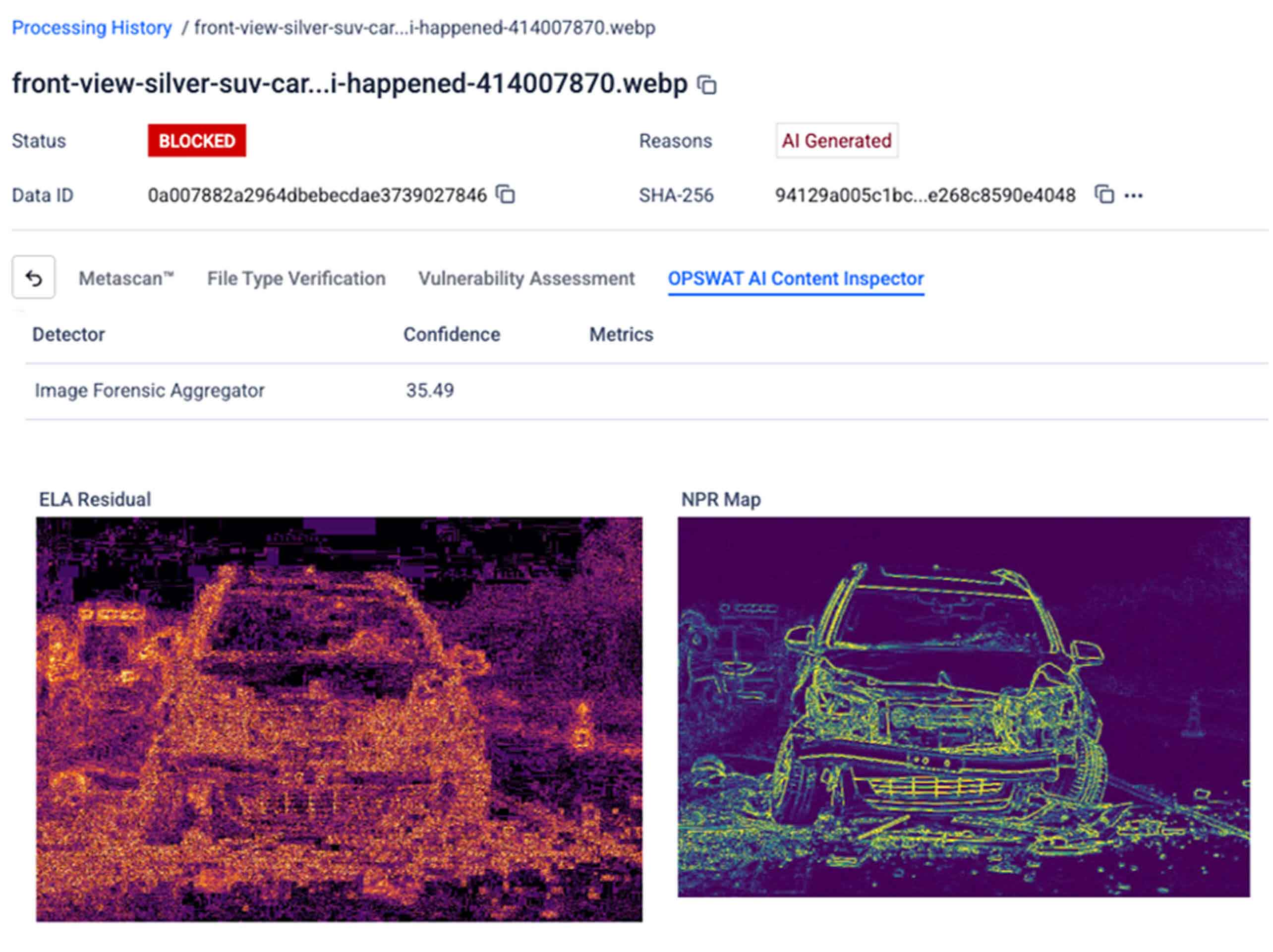
AI Content Inspector inspects the submitted image using multiple signals at once, including sensor fingerprint analysis, pixel-consistency checks, and compression traces left behind by editing. No single detector decides the outcome. That combination lets the engine flag an AI-forged image even when it looks convincing to a human reviewer. The resulting verdict and confidence score travel back to the claims platform that submitted the file, so a suspicious photo can be routed for manual review before the payout is authorized rather than after the funds go out.
Can AI-Doctored Photos Get a Car Insurance Claim Approved?
The scenario
A policyholder photographs a minor bumper scuff, a $150 repair. Generative AI adds dents, a smashed light, and a cracked bumper to the same photo. Submitted to a photo-based claims platform, the doctored image drives an automated $3,850 payout, and no adjuster ever sees the car.
Why photo-based claims platforms are exposed
Photo-based claims platforms are built to speed up approval, not to question whether a submitted image is real. AI Content Inspector adds a content-authenticity verdict at the same intake point where the image already enters the workflow. That verdict does not require a new procurement cycle or a separate detection tool bolted onto the claims platform, and it gives special investigation units an earlier signal to work from when a suspicious claim needs a closer look.
Healthcare's Exposure to Synthetic Medical Documentation
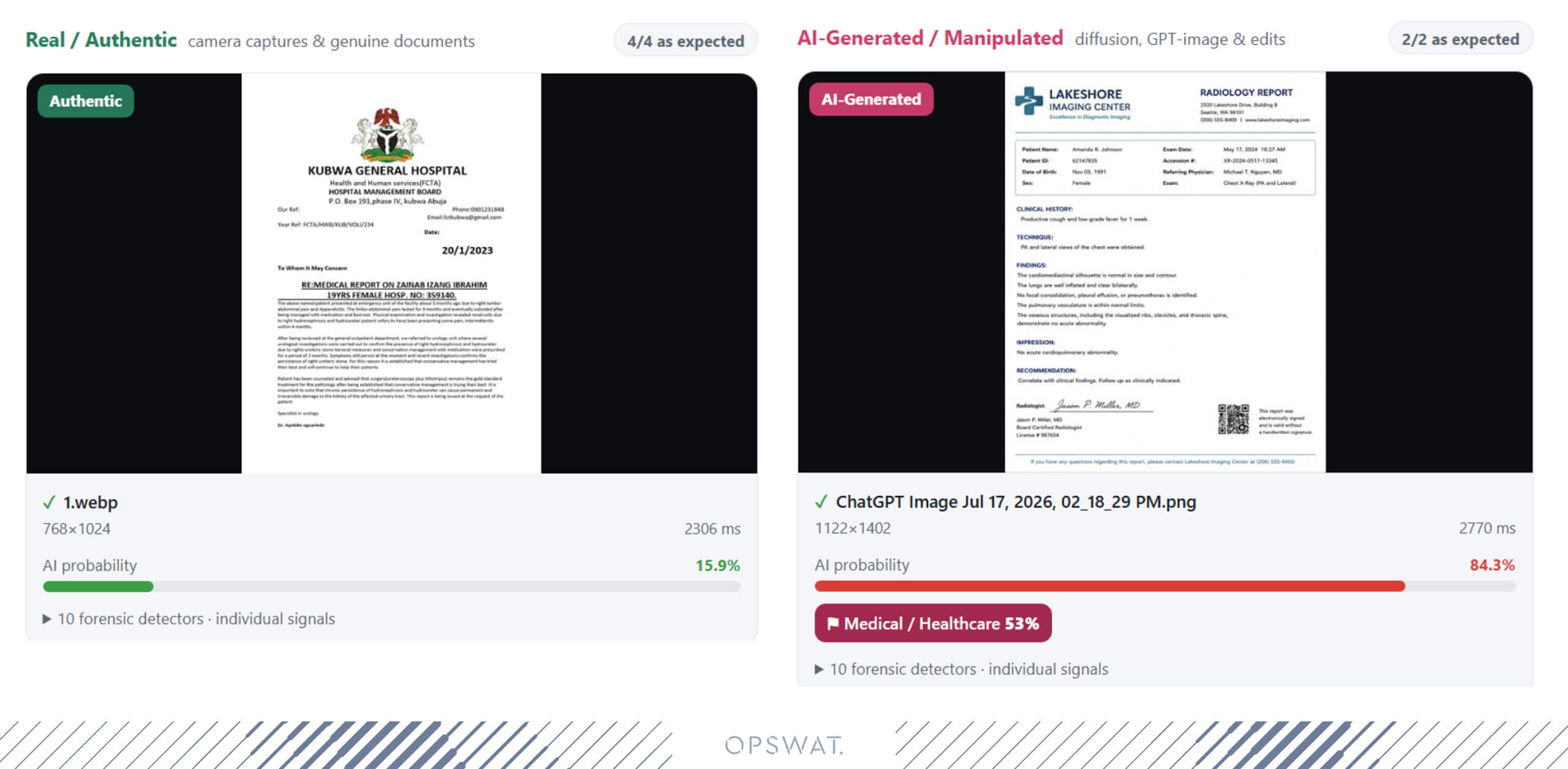
Healthcare payers face two related risks from the same underlying problem. Fabricated clinical imagery or synthetic documentation submitted with a claim can drive the wrong reimbursement decisions. The same fabricated content, if it reaches a provider's record instead of a payer's queue, can drive the wrong clinical decisions instead.
Why manual document review is not enough to catch either risk
Healthcare payers and payment integrity teams need to identify fabricated medical imagery and synthetic documentation while preserving the integrity of a regulated workflow, and they process claim volumes that make line-by-line manual review of every image and document impractical. AI Content Inspector analyzes submitted medical imagery and documentation for AI-generation and fraud indicators before that content reaches a reimbursement workflow or a care pathway, without adding a separate review step for every file.
How AI Content Inspector Detects Fabricated Content
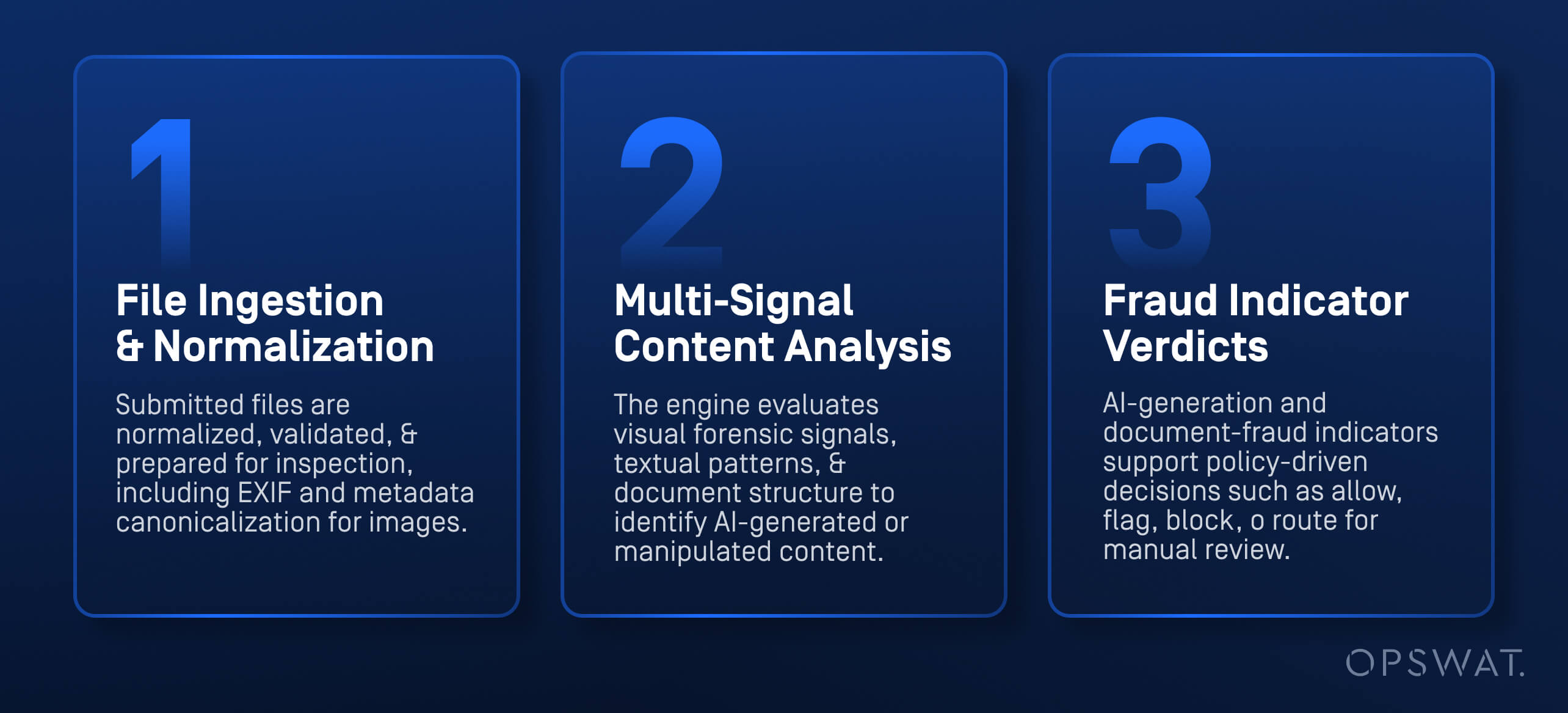
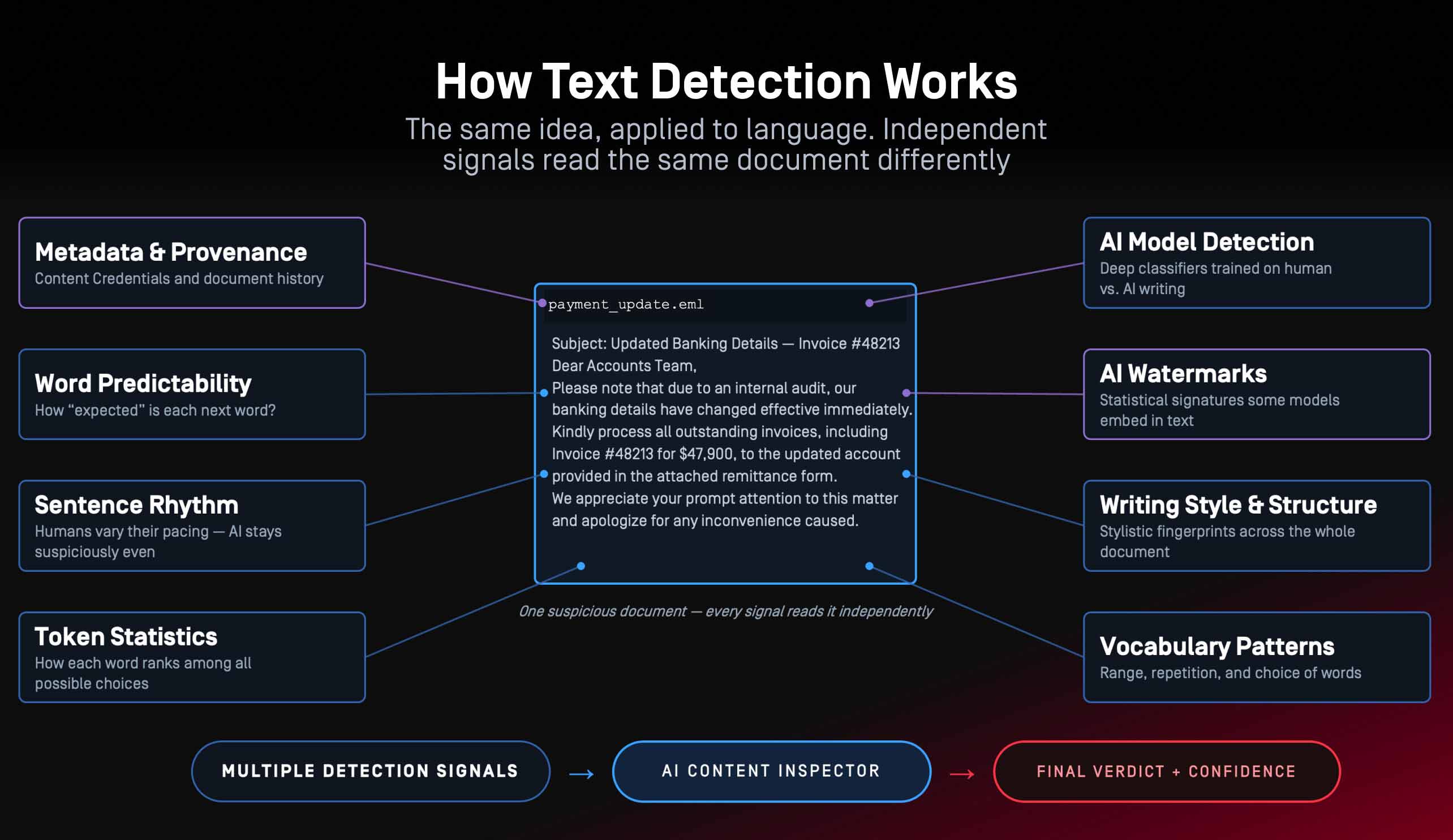
Before any detection signal runs, AI Content Inspector validates and normalizes each submitted file, including metadata and EXIF handling for supported image formats. No single signal then decides whether the file is fabricated. AI Content Inspector combines four categories of detection across images, text, and PDFs:
- Metadata and provenance analysis. Checks where a file claims to come from, comparing camera data against AI-generation credentials.
- Forensic and compression analysis. Looks for editing artifacts, sensor fingerprint gaps, and compression traces left behind by re-saving or manipulation.
- AI model classifiers. Runs deep learning models trained to distinguish real content from AI-generated images and text.
- Watermark detection. Checks for embedded signatures such as Google SynthID in supported image content.
Each signal returns its own result. AI Content Inspector combines them into a single verdict with a confidence score, rather than a pass or fail flag, so uncertain results can route to human review instead of an automatic block or approval.
Where AI Content Inspector Fits in the MetaDefender™ Platform
AI Content Inspector runs as a separate engine inside MetaDefender™ Core and MetaDefender™ Cloud. It sits alongside the Metascan™ Multiscanning, Deep CDR™ Technology, and Proactive DLP™ technologies. Adding content-authenticity verdicts to that existing pipeline means that claims, payment, and healthcare intake systems don't need a separate deepfake-detection tool or a new integration to start checking whether submitted content can be trusted.
Unlike standalone deepfake-detection tools that require their own workflow and procurement cycle, AI Content Inspector is designed to operate inside the file-inspection pipeline these organizations already run, extending OPSWAT's file-security approach from whether a file is safe to open to whether its content can be trusted.AI Content Inspector adds a content-authenticity verdict to the file inspection your organization already runs. See how it fits into your claims, payment, or healthcare intake workflow.
FAQs
What file types does AI Content Inspector support?
AI Content Inspector supports common image formats, including JPG, PNG, WebP, and BMP, along with text-bearing formats such as TXT, Markdown, and PDF. PDF inspection covers both AI-generated text detection and AI-generated image detection within the same document.
Does AI Content Inspector work without cloud connectivity?
Yes. AI Content Inspector deploys on-premises through MetaDefender Core, in addition to MetaDefender Cloud, on Windows and Linux. Organizations that cannot send claims, payment, or healthcare documents to an external service can run detection entirely within their own environment.
How is AI Content Inspector different from malware scanning?
Malware scanning checks whether a file is safe to open. AI Content Inspector checks whether the content inside that file is authentic, adding a fraud and AI-generation verdict alongside the malware scan rather than replacing it.
Does AI Content Inspector give a pass or fail result?
No. It returns a verdict alongside a confidence score, based on multiple detection signals. Uncertain results can route to manual review, and the review threshold is configurable.