Isolating an OT (Operational Technology) or ICS (Industrial Control System) network from the internet is one of the most effective controls available. This isolation makes it difficult to keep systems patched when they are deliberately disconnected from the networks that distribute patches.
A record number of new CVEs (Common Vulnerabilities and Exposures) were disclosed in 2025, more than 48,000, with roughly 40% of them rated critical or high severity. Consequently, industry research into OT and ICS environments has found that most organizations do not patch these systems on a regular schedule, largely out of concern for unplanned downtime.
Why Patching Breaks Down in Isolated Networks
Air-gapped and isolated networks are built to have no routine path to the internet. That means the standard way of patching, by connecting to a vendor's update service, is not available. Organizations typically work around this by exporting the update files via removable media and carrying them across the boundary by hand.
This manual approach introduces its own risk. It depends on a person completing every step correctly and on schedule, and removable media is a well-documented route for malware to enter a protected environment.
Under continuous operational pressure, critical systems often cannot tolerate unplanned downtime, and many OT components run on older, vendor-specific platforms where patches can be difficult to test or unavailable. Combined with the growing volume of disclosed vulnerabilities, this is part of why research has found that most OT organizations do not patch on a regular schedule.
The Tightening Regulatory Expectations for Patching in Critical Networks
NERC (North American Electric Reliability Corporation) CIP-007 requires a documented patch management program for bulk electric system cyber assets. IEC (International Electrotechnical Commission) 62443-2-3 and 62443-4-1 set out patch and vulnerability management expectations for industrial automation and control systems, and frameworks such as NIS2 (the EU's second Network and Information Security Directive) and NIST (National Institute of Standards and Technology) SP 800-40 increasingly expect organizations to show evidence of how and when systems were patched.
Hardware-Enforced One-Way Dataflow
A data diode is a hardware-enforced security device that allows data to move in only one physical direction between two networks. MetaDefender Optical Diode is available in 1U rack-mounted appliance, DIN-rail, and compact Fend (XE/SE/CE) form factors. It uses optical architecture to enforce this unidirectional flow through a true protocol break. There is no routable connection back to the source network, regardless of software behavior on either side. It natively supports many of the protocols that patch distribution relies on, including folder and file transfer, SMB/CIFS, and WSUS-based patch and antivirus definition updates.
Because the connection supports transmission in only one direction, standard two-way network protocols that rely on acknowledgments do not pass through it unmodified. Proxy servers or on-diode protocol conversion are typically used to bridge ordinary file-transfer and patch-distribution protocols into a one-way data stream and back again, without reintroducing a path across the boundary.
Many exploits do not require a two-way session to do damage. A single file crossing in the permitted direction can be enough. To address this challenge, OPSWAT offers MetaDefender Diode X. the same one-way hardware transfer, combined with content inspection, for cases like patch and update delivery.
Adding Content Validation to the Diode
Patching infrastructure itself is not automatically trustworthy. For instance, WSUS, which Microsoft recommends for patching disconnected networks, does not digitally sign the update metadata it exports by default. Only the update packages themselves are signed. Security researchers demonstrated this gap with tools such as WSUSpect (2015) and WSUSpendu (2017), which modified WSUS metadata so a client would install an attacker-chosen, Microsoft-signed executable under the cover of a routine update. Because the executable itself carried a valid signature, signature checking alone did not catch it.
MetaDefender Diode X combines the same hardware-enforced, non-routable one-way transfer with MetaDefender™ Core. For patch delivery, that means each file crossing the boundary can be:
- Scanned with up to ten anti-malware engines through Metascan™ Multiscanning to strengthen detection of known malware
- Assessed for vulnerabilities in installers, binaries, and applications with File-Based Vulnerability Assessment
- Sanitized with the Deep CDR™ Technology, which removes embedded threats within files rather than simply flagging them
- Checked against threat intelligence for known indicators of compromise to help catch zero-day and previously unseen threats
- Validated for structure, including file type and schema conformity checks to confirm the package matches what the update channel expects
A Layered Architecture for Diode-Based Patch Delivery
For organizations that need to deliver Windows, Linux, or OEM/ICS vendor patches from an internet-connected update repository into a protected network. MetaDefender Diode X can scan, assess, and sanitize each patch file with MetaDefender Core, then transfer only the validated file across its hardware-enforced, non-routable optical connection. For simpler one-way transfers that do not require file-level inspection, such as telemetry, screen views, and log forwarding, the same hardware foundation is available separately as MetaDefender Optical Diode.
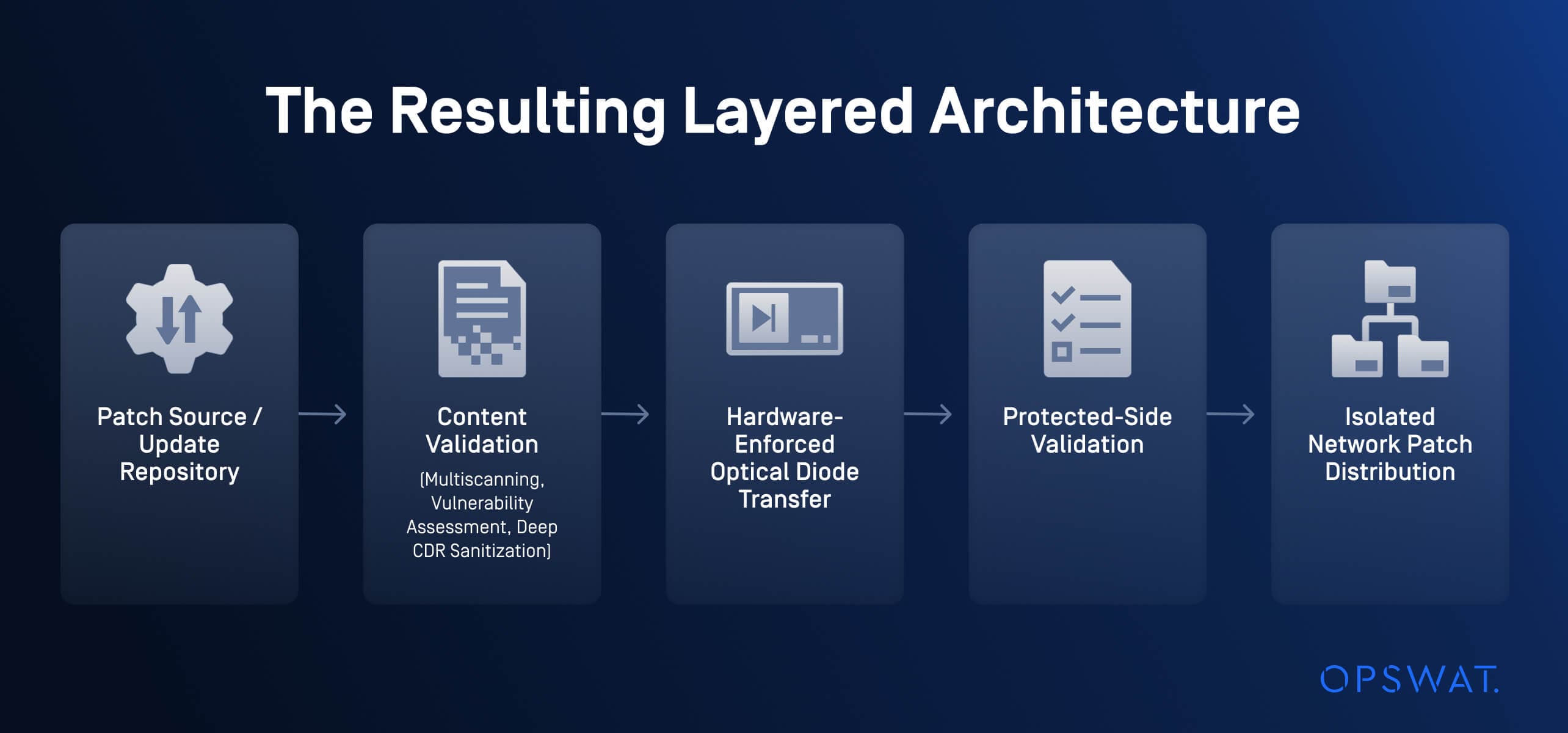
Validating on both sides of the diode matters. The low-side check prevents obviously bad files from ever reaching the boundary, and the high-side check verifies the integrity of what actually arrived before it is released into the protected network's patch distribution process. Logging the outcome of each step on both sides gives the environment a record that covers network control and the file. This is useful when the organization needs to demonstrate the process to an auditor or accreditation body.
Applications Across Critical Infrastructure Sectors
Hardware-enforced unidirectional dataflow with content validation can support a range of secure patch-delivery scenarios:
- Energy and utilities: Deliver verified Windows, Linux, and OEM/ICS vendor patches into substation, generation, and water/wastewater control networks without extending internet connectivity to them, as part of a broader patch management strategy
- Manufacturing and industrial OT: Keep engineering workstations and control system software up to date, as seen in pharmaceutical and biotech production environments
- Government and defense: Apply vendor security updates to classified or mission systems while preserving the one-way boundary required for accreditation
- Regulated critical infrastructure operators: Build a repeatable, auditable patch-delivery process that supports evidence requirements under frameworks such as NERC CIP, IEC 62443, and NIS2
- Segregated and air-gapped network: Replace ad hoc removable-media update transfers with a controlled, logged, hardware-enforced pathway for patch and update content
Talk to an expert today to learn how MetaDefender Optical Diode and MetaDefender Diode X can deliver hardware-enforced unidirectional data transfer with content inspection to help secure patch management in your air-gapped and OT networks.