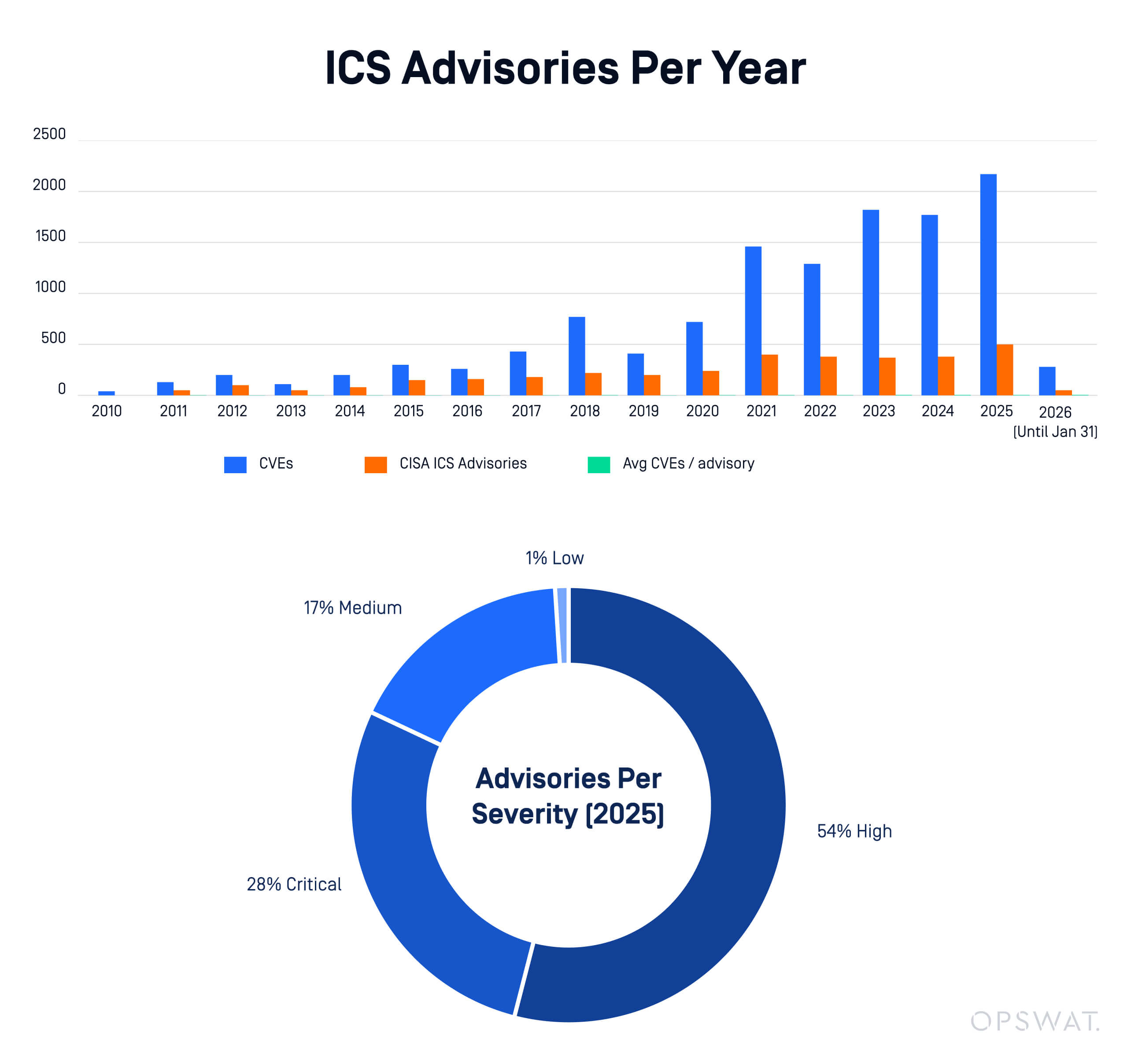
The volume of vulnerabilities is reaching a record high. Between March 2010 and January 2026, CISA published 3,637 ICS advisories covering 12174 vulnerabilities across 2783 products from 689 vendors. The year 2025 alone saw 508 advisories, making it the first year CISA has ever crossed the 500-advisory mark. These advisories included 2155 CVEs, averaging 4.2 vulnerabilities per advisory.
Severity rates are also on the rise. The average CVSS score for ICS advisories crossed 8.0 for the first time in 2024 and held there through 2025. Of all advisories published last year, 82% were rated high or critical, up from 75% across all historical advisories. These are serious, exploitable vulnerabilities in the systems that run power grids, water treatment plants, manufacturing lines, and transportation networks.
Exploitation Happening Faster Than Patching Can Keep Up
One of the most alarming trends in 2026 is the shrinking window between disclosure and exploitation. Threat actors are now attempting exploitation within 24 hours of a CISA advisory being published. This creates a near-impossible race in OT environments, as patching often requires maintenance windows, vendor coordination, and significant operational planning.
It would be logical to conclude that we should patch as quickly as possible; however, that is not the reality when dealing with critical, real-time production systems designed to operate 24/7.
Exposure Management is Where Asset Visibility meets Action
To effectively respond to the growing number of vulnerabilities, security teams' efforts shouldn’t stop at identifying them as soon as they are discovered. It is critical for security teams to also identify the exposure, understand the attack vectors, and be aware of the steps a threat actors need to execute to exploit the vulnerability.
When risk is identified, organizations are left with risks outside the tolerable profile. These risks include regulatory, financial, reputational, and safety risks. Patching may be one option, but it is not always feasible in OT environments.
The key point here is that exploitation happens where opportunity meets vulnerability. If the opportunity is removed, the exposure is reduced, and the risk can be effectively mitigated. Understanding the exposure level of an asset with a vulnerability and removing that exposure can be almost as effective as patching. These controls can often be implemented without disrupting operations or introducing additional risk to the underlying industrial process.
How MetaDefender OT Security™ Addresses the Gap
MetaDefender OT Security is purpose-built for the realities described above. It provides continuous asset discovery across critical OT/ICS networks. It identifies devices, protocols, firmware versions, and communication patterns deep within the OT network.
Against that asset baseline, MetaDefender OT Security automatically maps known vulnerabilities, including those tracked in the ICS-CERT and CISA advisories, to the specific devices in your environment. When a new advisory is released, organizations must be able to quickly determine whether they are affected and where the exposure exists.
Physical and logical network communication maps provide the dependency and exposure mapping required to effectively respond. This includes identifying devices such as firewalls, routers, and switches that could be configured to detect or prevent exposure through additional hardening.
Since patching is the most robust way to resolve an open vulnerability, OPSWAT also provides assured offline patching solutions to support patching where required, streamlining the patching process to keep patching windows to a minimum.
Request a demo to see how OPSWAT can give you visibility, vulnerability intelligence, and threat detection across your entire industrial environment.