Overview
Deep CDR™ Technology (Content Disarm and Reconstruction) technology is a market leader with superior features like multi-level recursive processing, accuracy of file regeneration, and support for 100+ file types. We provide in-depth views of what is being sanitized and how - enabling you to make informed choices and define configurations to meet your use case. We deliver safe-to-consume files with 100% of threats eliminated within milliseconds, so your workflow is not interrupted.
Release Highlights
Significant Deep CDR™ Technology Linux performance boost
Release version 6.0 comes with notable improvements with a focus on Linux. A brand-new architecture was created to optimize data sanitization workflows and improve processing speed for Linux. We started making use of the new architecture from version 5.12 onwards applying for a few file types, such as csv, sfx, jww. The architecture change has been completed in version 6.0, so users now see enhanced processing time with all supported file formats. The below figure shows remarkable performance advancements owing to the new architecture of Deep CDR™ Technology Linux. (Deep CDR™ Technology performance test results)

Additionally, over 200 new file formats are now supported for conversion on Linux, including txt, mht, dcm, wdp, cur, ico, 3d files, vdx, vtx, vsx, vstx, vssx, vstm, vssm, etc.
Allowlist hyperlinks
Despite hyperlinks’ centrality to the user experience, connecting pages and sites with a single click, they could be a high-risk attack vector. In previous versions, to ensure that all potential threats in files were eliminated before reaching the users, hyperlinks were removed during Deep CDR™ Technology process by default.
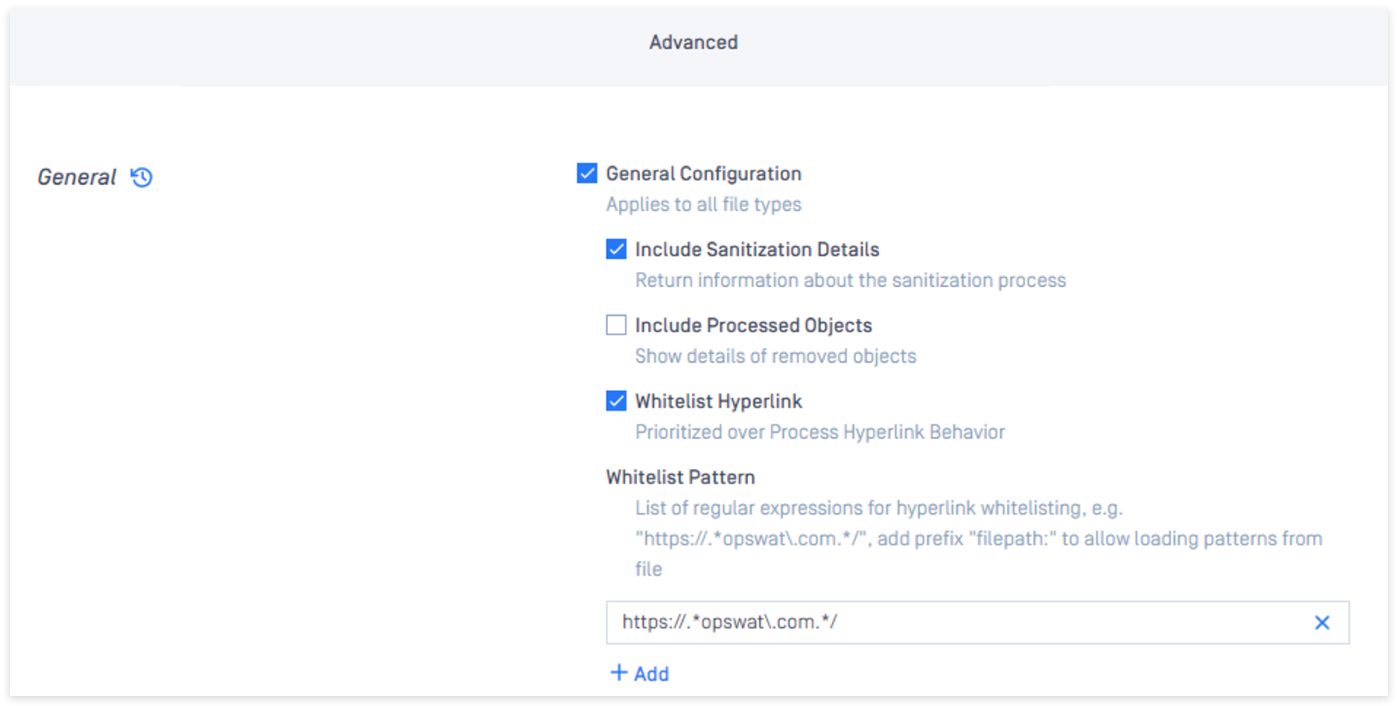
However, we understand that usable hyperlinks are essential and important for some businesses. Thus, this version introduces a flexible configuration enabling administrators to allowlist hyperlinks or domains that they deem safe.
Many new file types are officially supported
Seventeen beta-labeled file formats, added in the earlier versions, are formally supported in Deep CDR™ Technology v6.0 and later with assured quality and stability (for both Windows and Linux).
- Microsoft Visio files: vsdx, vsdm, vssx, vssm, vstx, vstm
- Image & video files: jpx, mpeg (MPEG-2 Video)
- Drawing & design files: dxf, dwf, dcm, 3ds, dae, drc, rvm, u3d
- Webpage archive files: mht
In 2021, we successfully beta tested 52 file types and officially delivered them to users. We’re continuously enriching Deep CDR™ Technology supported file formats to better meet our customers’ requirements and security posture. If any specific file type is essential to your use case, please feel free to send us a request.
As with every release, we’ve continued to tweak performance and introduced a variety of minor fixes to further enhance processing performance. For more detail on our recent release please view our release notes.
For further information about Deep CDR™ Technology and how this will benefit your cybersecurity profile, please visit opswat.com/technologies/data-sanitization or get in touch with us.