- What Is Advanced File Transfer and Why Does It Matter for Enterprise Security?
- How Does Zero-Trust Transform Managed File Transfer Security?
- What Are the Business and Security Benefits of Zero-Trust Managed File Transfer?
- What Should CISOs Look for When Evaluating Zero-Trust Managed File Transfer Solutions?
- How Can Enterprises Implement Zero-Trust Managed File Transfer Workflows Successfully?
- FAQs
- Is Your Organization Equipped with Advanced File Transfer Security?
What Is Advanced File Transfer and Why Does It Matter for Enterprise Security?
Advanced file transfer refers to the evolution of traditional managed file transfer systems into security-first, policy-driven platforms that protect sensitive data amid modern cyberthreats, hybrid architectures, and increasingly complex compliance rules. For security-first CISOs, advanced file transfer means moving sensitive files and enterprise data securely, verifiably, and with Zero-Trust enforcement.
Modern enterprises exchange an average of 2.5 petabytes of data monthly across cloud services, remote teams, global subsidiaries, and supply chain partners. Every one of these transfers represents a potential attack vector.
As ransomware groups and nation-state actors weaponize files, with file-based attacks increasing 47% year-over-year according to recent threat intelligence, attackers exploit traditional protocols and trust-based models.
Advanced file transfer matters because it fills a dangerous gap in enterprise security: the intersection between trusted internal networks, critical infrastructure systems, and high-value data flows. Without Zero-Trust controls, these transfers become blind spots that adversaries can exploit.
How Do Security and Compliance Requirements Shape Enterprise File Transfer Needs?
Security and compliance requirements have fundamentally redefined file transfer expectations. Regulations such as GDPR, HIPAA, PCI DSS, SOX, and sector-specific frameworks impose strict rules on how sensitive data must be transferred, validated, logged, retained, and monitored. Each mandates:
- Encryption in transit and at rest
- RBAC (role-based access control)
- Verifiable audit trails
- Incident reporting and response
- Assurance that data was neither altered nor accessed improperly
Non-compliance can lead to severe financial and reputational consequences. For example, GDPR violations can result in fines up to 4% of annual global turnover or €20 million, whichever is higher. Breaches involving unprotected file transfers have resulted in penalties exceeding $50 million in healthcare and financial services sectors, along with litigation and regulatory investigations.
For CISOs responsible for safeguarding regulated data, traditional MFT tools built primarily for securing the transfer, not the file, leave too many gaps to meet modern standards. According to NIST guidance on secure file transfer, transport-layer security alone is insufficient without content-level validation and continuous verification.
What Are the Most Common Risks Associated with Traditional File Transfer Protocols?
Legacy file transfer mechanisms such as FTP, SFTP, and FTPS were never designed for the dynamic, distributed, threat-heavy environments CISOs face today. Their vulnerabilities include:
- Implicit trust between senders, servers, and receivers, no continuous verification
- Static credentials easily stolen through phishing or credential stuffing
- Insufficient authentication and limited MFA support
- Weak integrity and validation checks, allowing tampered or weaponized files to pass undetected
- Limited logging, hindering forensic investigations and audit readiness
- No built-in malware or threat inspection
- Perimeter-based protection, which becomes ineffective in multi-cloud and remote-work environments because network boundaries no longer exist to define trusted zones
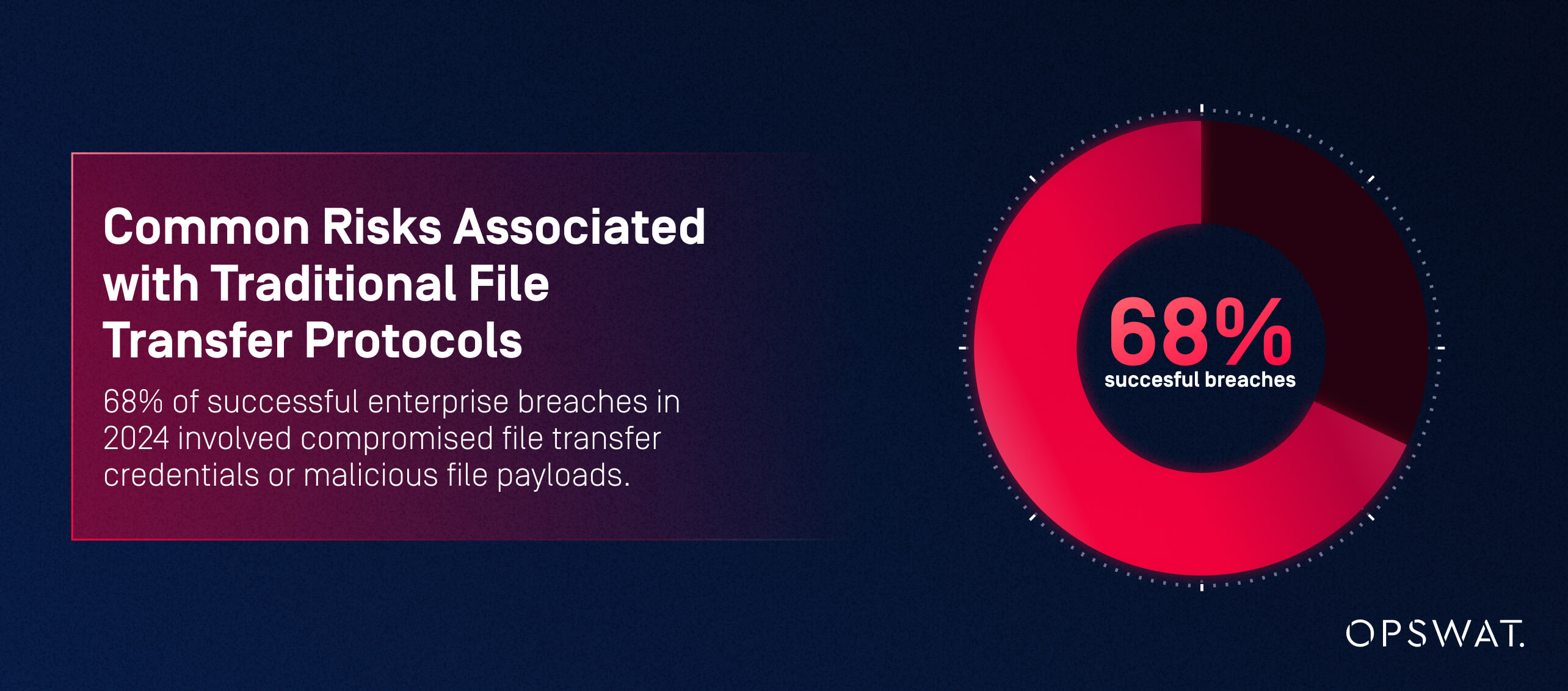
These weaknesses create a high-risk environment where attackers rely on file-based payloads, credential compromise, and supply-chain infiltration to access enterprise systems. According to recent threat intelligence, 68% of successful enterprise breaches in 2024 involved compromised file transfer credentials or malicious file payloads.
Which Use Cases Drive the Need for Advanced File Transfer in Critical Infrastructure?
Critical infrastructure operators face unique operational and regulatory demands. Their file transfers often span segmented networks, OT/ICS environments, cross-border regulatory zones, contractors, and cloud resources. Common drivers include:
- Interdepartmental exchange of sensitive data, requiring strict access controls and auditability
- Cross-border transfers, where data residency laws impose strict movement constraints
- Cloud migration and modernization, which dissolve traditional network boundaries
- IT–OT file exchange, where compromised files can directly impact physical equipment
- Third-party and vendor integration, which accounted for 62% of supply-chain breaches in 2024 according to recent security research, including high-profile incidents such as the SolarWinds compromise
- High-volume automated workflows, where human error can create massive exposure
These scenarios demand an advanced file transfer strategy built on Zero-Trust principles, including continuous verification, policy-driven automation, and file-level threat prevention.
How Does Zero-Trust Transform Managed File Transfer Security?
Whereas traditional MFT models rely on perimeter-based controls and implicit trust once access is granted, Zero-Trust eliminates trust altogether. Every user, device, system, workflow step, and file event must be validated continuously.
In the context of advanced file transfer, Zero-Trust is not simply an add-on security feature; it is an architectural shift. It reframes file movement as a high-risk operation that requires verification, least privilege, ongoing monitoring, and a deep understanding of the file itself, not just its transport metadata.
What Are the Key Zero-Trust Principles Relevant to File Transfer?
According to NIST Special Publication 800-207, Zero-Trust architecture includes the following core principles, which directly apply to secure file transfer:
- Least Privilege – Access is tightly restricted; users and systems only receive permissions necessary for specific file operations.
- Continuous Verification – Authentication and authorization do not end at login; every transfer step is revalidated.
- Micro-Segmentation – Isolates workloads, servers, and network zones so file transfers cannot act as lateral movement paths.
- Assume Breach – Every file is treated as potentially malicious and must undergo content-level inspection and validation.
- Contextual Access Decisions – Policies adapt based on user behavior, device identity, file risk scores, and environmental signals.
When applied to MFT, these principles directly counter modern threat vectors, from weaponized documents to compromised user credentials to insider misuse.
How Does Zero-Trust Compare to Traditional File Transfer Security Models?
Traditional MFT models rely heavily on network perimeters, authentication checkpoints, and trust-based communication between systems. Once inside the perimeter or logged in successfully, file transfers often proceed without deeper scrutiny. This model fails in cloud, multi-network, and remote environments where perimeter boundaries no longer exist.
| Traditional Model | Zero-Trust MFT Model |
|---|---|
| Trust is granted at login | Trust is never granted—validation is continuous |
| Credentials = access | Credentials + device + context + file validation |
| Perimeter defenses | Micro-segmentation and internal verification |
| Assumes internal users are safe | Assumes all users and systems may be compromised |
| Limited visibility | Full auditability and real-time monitoring |
Zero-Trust closes the security gaps that traditional MFT leaves exposed.
How Can Zero-Trust Be Embedded Architecturally in MFT Solutions?
A true Zero-Trust MFT architecture must be foundational rather than an afterthought. It should include:
- Multi-layered identity verification (IAM, MFA, behavioral analytics)
- File-level threat inspection, not just perimeter or transport security
- CDR (Content Disarm and Reconstruction), multi-engine malware scanning, and file type verification
- Policy-driven workflows that enforce access, routing, and transformation rules
- Network micro-segmentation between file servers, endpoints, and applications
- Centralized auditability across all transfer events
- Real-time monitoring and anomaly detection
What Are the Business and Security Benefits of Zero-Trust Managed File Transfer?
For CISOs, Zero-Trust MFT provides measurable impact across security posture, compliance alignment, and operational efficiency.
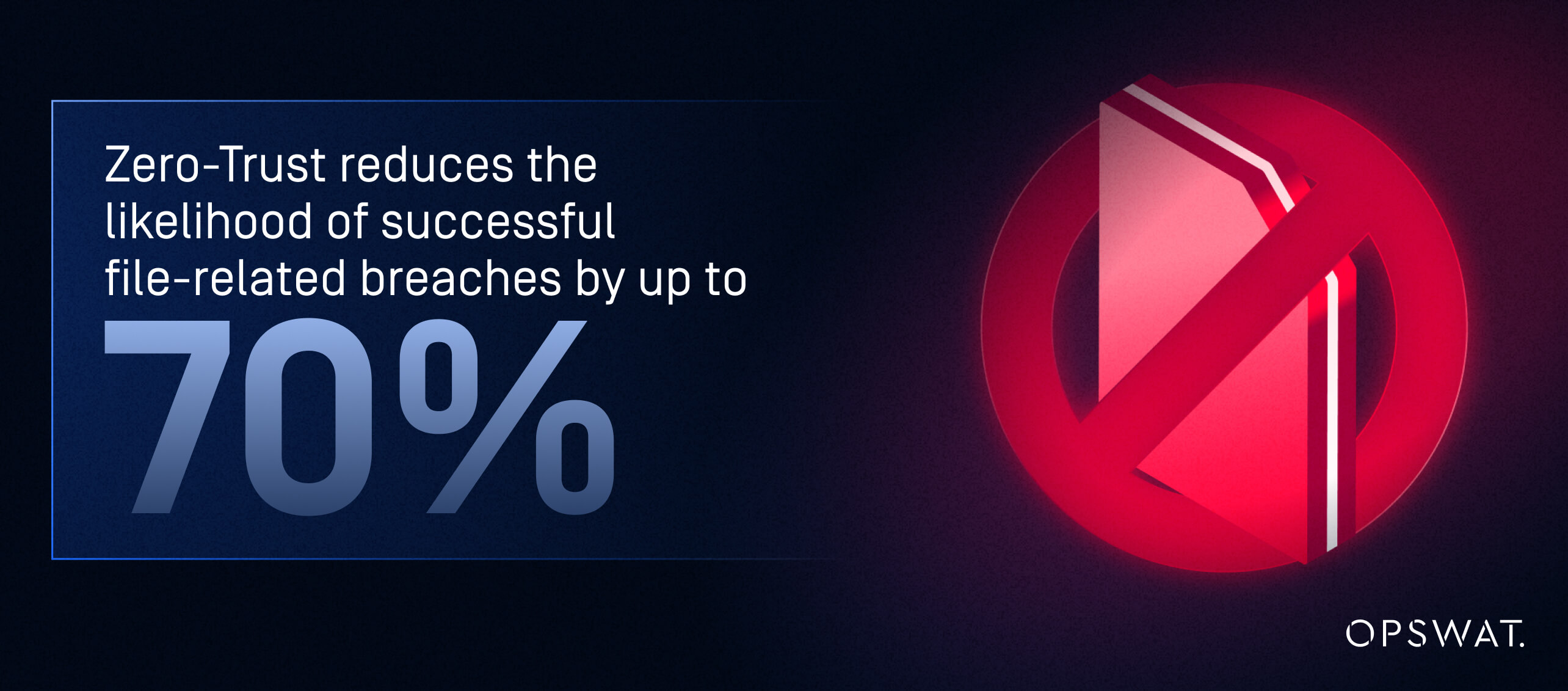
By eliminating implicit trust and enforcing file-level validation, Zero-Trust reduces the likelihood of successful file-related breaches by up to 70% according to organizations that have implemented comprehensive Zero-Trust MFT architectures, while also decreasing data leakage incidents and compliance failures.
Organizations gain:
- Stronger protection against ransomware and supply-chain attacks
- Demonstrable compliance with regulatory frameworks
- Greater operational resilience through automation and continuous verification
- Reduced risk from insiders and compromised accounts
- Lower incident response and forensic investigation burden
Ultimately, Zero-Trust MFT offers a defensible strategy CISOs can present to boards, auditors, and regulators because it aligns with NIST SP 800-207, addresses specific GDPR Article 32 technical requirements, and provides documented compliance with industry-recognized security standards.
How Does Zero-Trust MFT Reduce the Risk of Data Breaches and Insider Threats?
Zero-Trust directly counters the two most common breach vectors in file transfer workflows: unauthorized access and malicious files. By requiring continuous verification and enforcing micro-segmentation, attackers cannot use compromised credentials or internal systems to traverse environments. Every access request, even from known users, is evaluated in context.
Furthermore, Zero-Trust MFT solutions that include integrated threat prevention (such as multiscanning, sandboxing, or CDR) block malicious files before they reach downstream systems. This is particularly valuable against phishing payloads, weaponized documents, and zero-day exploits.
Even insider threats, intentional or accidental, are constrained because permissions, file operations, and anomalies are tightly monitored and logged.
What Compliance and Audit Advantages Does Zero-Trust Provide for Regulated Enterprises?
Compliance frameworks increasingly require more than transport encryption. They mandate proof of controlled access, visibility into file movement, validated integrity of exchanged data, and systemic protections against unauthorized access.
Zero-Trust MFT enhances compliance by providing:
- Verifiable audit trails
- Centralized policy enforcement
- Documented access restrictions
- Automated verification and logging of file events
- Immutable logs for regulated investigations
Frameworks such as GDPR, HIPAA, PCI DSS, SOX, and NIST emphasize exactly these requirements. Zero-Trust provides the architectural rigor CISOs need to confidently satisfy auditors and regulators.
How Does Zero-Trust Enable Secure Automation and Scalability in File Transfers?
Automation is essential for reducing human error, eliminating manual workflows, and supporting high-volume enterprise data exchange. Yet automation without Zero-Trust can amplify risk. A compromised account or misconfigured script can expose terabytes of sensitive data.
Zero-Trust MFT solves this by:
- Enforcing policies programmatically across automated steps
- Validating files and users at every workflow stage
- Detecting anomalies in automated transfer patterns
- Scaling horizontally across hybrid/cloud architectures without widening trust boundaries
Enterprises gain both speed and security, allowing for resilient, scalable, policy-driven automation.
What Should CISOs Look for When Evaluating Zero-Trust Managed File Transfer Solutions?
Evaluating Zero-Trust MFT platforms requires careful analysis of architecture, controls, integrations, and verifiability. Many solutions claim Zero-Trust alignment but deliver only superficial enhancements. CISOs must distinguish between true Zero-Trust design and marketing claims.
Which Security Features Are Essential in a Zero-Trust MFT Platform?
A mature Zero-Trust MFT solution should include:
- Granular, context-aware policy controls
- Continuous authentication and authorization
- Integrated threat detection (malware scanning, sandboxing, CDR)
- File-type verification and content integrity checks
- Micro-segmentation and isolated transfer zones
- Encrypted storage and transport
- Alignment with NIST Special Publication 800-207 Zero-Trust architecture principles
These capabilities work together to eliminate implicit trust and ensure that every file transfer is validated, safe, and compliant.
How Can CISOs Assess Auditability, Monitoring, and Reporting Capabilities?
Visibility is one of the defining characteristics of Zero-Trust. CISOs should evaluate whether an MFT solution provides:
- Real-time monitoring of file flows
- Centralized dashboards with drill-down capabilities
- Immutable, timestamped logs
- Event correlation with SIEM tools
- Automated compliance reporting
- Forensic-level detail around user activity, file integrity, and transfer success/failure
Best-in-class platforms allow CISOs to answer: who accessed what, when, from where, and under what risk context, instantly and confidently.
What Integration Capabilities Support Seamless Adoption in Hybrid and Cloud Environments?
Zero-Trust MFT must seamlessly integrate with:
- IAM platforms (Azure AD, Okta, Ping)
- SIEM and log management tools (Splunk, Sentinel)
- DLP and data governance systems
- Cloud environments (AWS, Azure, GCP)
- Legacy on-prem systems like ERP, CRM, and custom applications
APIs, event hooks, workflow orchestration features, and connector libraries determine how effectively MFT fits into existing security ecosystems.
How to Identify True Zero-Trust Architecture Versus Marketing Hype?
CISOs should watch for red flags:
- Zero-Trust claims limited to MFA or encryption
- No file-level inspection or threat prevention
- Dependence on third-party tools and technologies for core security
- Limited logging or opaque audit trails
- Static trust zones with no micro-segmentation
A simple checklist helps validate authenticity:
True Zero-Trust MFT must include:
- Continuous verification
- Least privilege enforcement
- Micro-segmentation
- File-level threat validation
- Contextual policy decisions
- Comprehensive visibility
Without these architectural elements, Zero-Trust is just a label.
How Can Enterprises Implement Zero-Trust Managed File Transfer Workflows Successfully?
Successful Zero-Trust MFT adoption requires a structured, phased implementation strategy spanning 6-12 months that aligns security, operations, compliance, and infrastructure teams through defined milestones and measurable outcomes.
What Are the Key Steps to Integrate Zero-Trust MFT Into Existing Security Infrastructure?
A structured approach includes:
- Assessment – Map current file flows, trust boundaries, credential usage, and risk exposure points. This includes identifying where shared credentials, static keys, or implicit trust may exist across push/pull workflows.
- Stakeholder Alignment – Bring together IT, security, compliance, and operational teams to align on Zero-Trust principles, authentication requirements, and ownership of credentials and access policies.
- Architecture Design – Define Zero-Trust policies, segmentation, IAM integration, and workflow routing. At this stage, it’s critical to design strong authentication mechanisms into file transfers (including certificate-based authentication, SSH key management, and API key controls) to ensure identity is verified for every transaction, not just every user.
- Credential & Authentication Hardening – Replace embedded or shared credentials with centrally managed, user-scoped authentication methods. Zero-Trust MFT platforms support secure storage and use of SSH keys, certificates (e.g., for SharePoint Online™), and MFT API keys. Features like MyKeys (a credential management capability in MetaDefender MFT that securely stores and manages authentication credentials) ensure that API-based Push/Pull jobs can still meet multi-factor authentication (MFA) requirements
- Pilot Deployment – Start with a high-value, high-risk use case, such as external data exchanges or automated workflows that require privileged access. Validate that credential handling, MFA enforcement, and policy controls operate as expected under real conditions.
- Phased Rollout – Expand to additional workflows, departments, and environments while standardizing credential usage and eliminating legacy authentication practices.
- SIEM, IAM & DLP Integration – Ensure cohesive visibility and governance by integrating authentication events, credential usage, and file transfer activity into existing monitoring and access management systems.
- Continuous Optimization – Continuously review policies, credential lifecycles, and authentication methods as user behavior, integrations, and threat landscapes evolve.
How to Automate and Orchestrate Secure File Transfers at Scale?
Policy-driven automation ensures that file transfers remain consistent, compliant, and secure even as data volumes grow. Key components include:
- Workflow templates for common transfer patterns
- Conditional logic for routing and transformation
- Automated threat scanning and file integrity checks
- Exception handling and retry mechanisms
- Event-driven triggers and API-based orchestration
Automation reduces human error, accelerates secure data exchange, and ensures repeatability across distributed environments.
What Are the Most Common Challenges in Deploying Zero-Trust MFT and How Can They Be Overcome?
CISOs commonly confront:
- Cultural resistance to new controls and restrictions
- Legacy dependencies that lack modern integration points
- Misconfigured IAM or over-privileged accounts
- Unclear data ownership or workflow ownership
- Fragmented toolsets that complicate centralization
Mitigation strategies include:
- Executive-backed change management
- Strong governance and cross-functional ownership
- Phased rollouts with measurable improvements
- Vendor support and guided onboarding
- Continuous training and policy refinement
Zero-Trust succeeds when it is adopted as a holistic, organization-wide strategy.
FAQs
What are the main security features to look for in advanced file transfer solutions?
Look for continuous verification, least privilege enforcement, integrated threat inspection, micro-segmentation, and verifiable audit trails.
How does MFT differ from traditional protocols like FTP, SFTP, or FTPS in terms of compliance and auditing?
MFT provides centralized governance, auditability, fine-grained controls, and policy-driven enforcement—capabilities legacy protocols lack.
Which advanced file transfer platforms offer the best integration capabilities?
Platforms with rich API ecosystems, SIEM/IAM integrations, cloud-native connectors, and workflow automation provide the strongest flexibility.
What are best practices for automating secure file transfers?
Use policy-driven workflows, continuous file validation, conditional routing, and event-driven orchestration to minimize manual risk.
How do advanced file transfer solutions support compliance?
They enforce encryption, maintain immutable audit logs, restrict access, validate file integrity, and support regulatory reporting.
What are key considerations for scaling advanced file transfer?
Look for horizontal scalability, micro-segmented architectures, automated load handling, and cloud-native deployment options.
How can organizations monitor and audit file transfers?
Use platforms offering real-time dashboards, immutable logs, SIEM integrations, user activity monitoring, and risk scoring.
What are the most common challenges in deploying advanced file transfer systems?
Integration complexity, inadequate change management, legacy system constraints, and superficial Zero-Trust implementations.
Is Your Organization Equipped with Advanced File Transfer Security?
As modern enterprises face rising cyber threats, stricter regulatory oversight, and increasingly complex digital ecosystems, Zero-Trust has become essential—not optional—for securing advanced file transfers. Traditional MFT models cannot keep pace with today’s adversaries. Only Zero-Trust MFT delivers the continuous verification, micro-segmentation, and file-level threat prevention needed to safeguard sensitive data in motion.
MetaDefender Managed File Transfer™ is OPSWAT’s managed file transfer (MFT) solution that brings Zero-Trust principles to life across every file, workflow, and transfer.
Secure your data at every step. Request a MetaDefender Managed File Transfer demo today.