
Move files across a one-way security boundary using MetaDefender Storage Security on both sides of an OPSWAT NetWall diode. The diode transfers files over SMB; MDSS accesses each SMB share by mounting it as an NFS storage unit.
Overview
A data diode enforces one-way data flow: traffic goes from the low side (source) to the high side (destination) and never back. This physical isolation is why diodes protect critical environments — there is no return path, and no delivery acknowledgement.
How It Works (Concepts & Architecture)
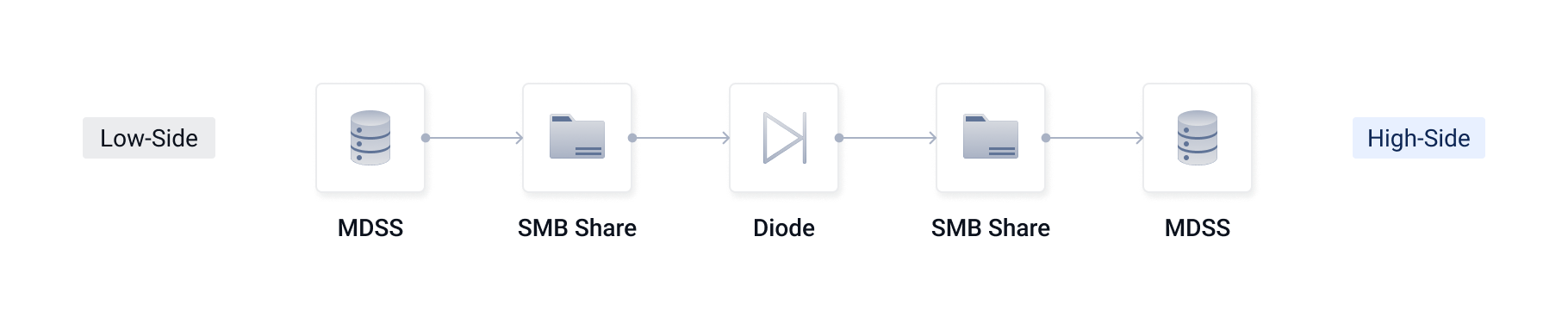
The architecture is symmetric. The diode owns the cross-boundary mechanics over SMB; MDSS reads and writes its share through an NFS mount of that same SMB share. Complete flow:
Low-side MDSS pulls from a source storage (SharePoint, S3, or any integrated storage), scans/remediates, and writes approved files to the low-side share.
The NetWall diode polls that share over SMB, transmits each file across the optical link, and writes it to the high-side share.
High-side MDSS reads the high-side share, scans/remediates, and forwards files to the destination.
The diode is the SMB client on both sides and owns all cross-boundary mechanics: polling, transfer, and cleanup. MDSS only writes to the low-side share and reads from the high-side share, treating each as an ordinary NFS storage unit.
SMB vs FTP
SMB is recommended. It multiplexes transfers, sustains higher bandwidth, and has sub-second timestamps that MDSS uses to detect when a file is fully written. NetWall's native FTP transport is supported but under increased concurrent load the FTP channel resets without self-recovery.
Requirements
An OPSWAT NetWall diode configured for native SMB file transfer. Set up the share on the diode per the NetWall Windows file share guide.
Two SMB shares, one per side, reachable by the diode and the local MDSS host. Any standards-compliant SMB server works (e.g. Samba).
Two MDSS instances, one per side, see Planning your deployment. Low-side MDSS reaches the source storage; high-side MDSS reaches the destination.
The diode speaks SMB, but MDSS connects to each share as an NFS storage unit: mount the SMB share on the MDSS host, then add it to MDSS as NFS. Do this on both sides:
Throughput is bounded by the diode license tier (e.g. 100 Mbps; gigabit raises file transfer to 500 Mbps) and by disk I/O on the shares.
Set Up the Low Side (Sender)
Mount the SMB share into low-side MDSS and add it as a NFS storage unit (see Requirements).
Create a workflow whose copy or move destination is that storage unit.
Start a scan on the desired storage unit with that workflow. Files are written to the share, and the diode polls them automatically.
Set Up the High Side (Receiver)
Mount the SMB share into high-side MDSS as an NFS storage unit (see Requirements).
Set the discovery debounce environment variable so MDSS never scans a file the diode is still writing; it skips any file modified within the window:
NFS_DISCOVERY_DEBOUNCE_TIME_SECONDS=3030s suits typical files; raise it for large files that take longer to cross the link.Create a workflow whose copy or move destination is your target storage (e.g. SharePoint)
Start a real-time (RTP) scan on the storage unit with that workflow. As the diode writes files in, MDSS discovers, scans, and forwards them.
Monitor
MDSS surfaces progress only for running scans, the low-side scans and the high-side RTP scan, from the UI.
Use the diode's own monitoring for transfer status, queue depth, and channel health across the link.
There is no delivery acknowledgement back to the low side. End-to-end reconciliation means comparing source vs. destination inventories.
Troubleshooting
Files get scanned mid-write, or scans come back partial. MDSS picked up a file before the diode finished writing it. Bump NFS_DISCOVERY_DEBOUNCE_TIME_SECONDS past how long your biggest file takes to cross.
Transfers die after the first 10–15 files. This shows up on old SMB servers (Samba 4.12.x). Upgrade to a modern version, if it is not an option, turning off oplocks and leases helps but the real fix is the newer server.
Low-side share keeps filling up. The diode is supposed to delete each file once it's across. If files pile up, check that its account can actually delete on the share and that it's still polling.
Files vanish under heavy load. When the destination can't keep up with the incoming rate, the high-side diode buffers to disk. Once that buffer is full, new files are dropped — silently, because a diode has no way to tell the sender to slow down. Give the destination enough headroom, cap per-file size, and split very large files on the source side.
Limitations
No delivery confirmation. A diode has no return channel, so a full high-side buffer drops files silently. Size the destination and diode disk for peak load.
Retransmit on HA failover. NetWall supports active/standby HA, but if the active high-side node fails with files still buffered, those files are lost and must be re-sent from the source today a manual reprocess. Plan source-side retention.
FTP is supported but not recommended. channel resets under concurrent load and timestamps are minute-resolution. Use SMB.