
V 3.6.0
Release date: 30 September 2026
Added concurrent scanning, significantly increasing throughput on multi-core systems with no change to verdicts, with the largest gains on Android APK files.
Added a configurable limit on simultaneous resource-intensive scans to keep memory usage stable under heavy load.
Added a unique rule identifier to rule-based, signature and reputation detections, shown in the reported threat name.
Updated the detection database format. This engine version requires a matching database version, and incompatible databases are now rejected cleanly at startup.
Improved startup performance, with lower memory usage, faster startup and a significantly smaller detection database.
Improved scan time on very large files while maintaining full detection coverage.
Improved resilience against malformed files, eliminating hangs and crashes and reducing memory usage when processing them.
Improved PDF detection accuracy.
Fixed a crash when scanning certain malformed Windows executables, which left the file without a verdict.
Fixed a detection gap on certain Windows executables carrying multiple digital signatures.
Fixed validly signed large Windows executables being treated as unsigned.
Fixed a lost verdict when certain files containing malicious embedded content were rescanned.
Fixed false positives on legitimate legacy Windows applications, certain PDF files and other files identified in the field.
V 3.5.0
Release date: 31 August 2026
Added analysis and detection for additional image formats (JP2, EXR, PSD, PCX, TGA, DDS), covering common image-based attack techniques, initially in monitoring mode.
Added recognition of archive and container formats so they are handled correctly:
7Z, RAR, GZ, BZ2, XZ, CAB, PKG/XAR, RPM, DEB, TAR, DMG and ZIP
ODT, ODS, ODP, ODG, OTT, OTS, OTP, EPUB, APPX, MSIX, ASICE, XPS, OXPS, HWPX, PBIX, PBIVIZ, THMX, VSDX, VSTX and TDSX
Added recognition of legacy Visio (VSD, VST, VSS), Publisher (PUB) and Project (MPP) files, and distinguished Word templates (DOT) from documents.
Added malicious macro detection for Excel binary workbooks (XLSB), matching existing coverage for other macro-enabled Excel formats.
Added deeper analysis of .NET applications, including detection of obfuscated or packed files.
Added HTML file detection, including analysis of embedded content.
Added optional detection of hidden data appended to PNG and JPEG images, disabled by default.
Enabled machine-learning detection for Office documents (DOCX, XLSX, PPTX).
Updated the script detection model.
Improved Android APK analysis, including more reliable handling of malformed or obfuscated packages.
Improved performance when running multiple scans in parallel.
Improved XML file detection, including support for additional encodings and formats.
Improved performance of repeated scans of the same file.
Fixed scan failures on certain PDF files, such as those produced by print or mail systems.
Fixed false positives on plain-text emails containing PDF-like text.
Fixed Java class files being misidentified as macOS executables.
Fixed inconsistent threat names on some detections.
Fixed false positives and slow scans on certain large Microsoft installers and redistributables.
Fixed false positives on large animated GIF images.
Fixed an issue where scanned files could remain locked after scanning, which could prevent drives from being unmounted.
V 3.4.3
Release date: 17 August 2026
Added detection of malicious macros in Office documents (DOCM, XLSM, PPTM) and legacy Office files.
Added detection of malicious scripts embedded in PDF documents.
Added scanning of Outlook MSG email bodies for malicious content.
Added detection of malicious scripts embedded in SVG files.
Added support for macro-enabled and template PowerPoint files:
PPTM, POTM, PPSM, PPAM
Added reputation-based detection of known malicious and phishing URLs, IP addresses and domains.
Added new detection rules for malicious HTML content.
Added configurable control over which files extracted from containers are deep-scanned.
Updated detection models for Android APK and PDF files with improved accuracy.
Improved engine startup time and memory usage.
V 3.4.2
Release date: 13 August 2026
Added support for scanning Android APK files, alongside existing support for Windows, Linux, PDF and Office files.
Added detection of malicious content in EML email bodies, along with support for scanning standalone script and text files.
Improved protection of the detection database, which is now encrypted at rest.
Updated the detection database.
Fixed an issue where macro-based detection did not apply to macro-enabled Word documents (DOCM and DOTM).
V 3.4.1
Release date: 06 August 2026
Added detection of malicious content hidden inside image files, targeting image-poisoning campaigns.
Added malicious macro detection for Excel files:
XLSM, XLTX, XLTM, XLAM
Added new behavioral detection rules for Windows executables.
Improved accuracy on Office documents by reducing false positives on legitimate files.
Fixed a crash that could occur when the engine shut down.
Fixed an issue in version 3.4.0 where macOS executables received no verdict.
Fixed an issue where detection database packages for versions 3.4.0 and 3.4.1 could not be uploaded to MetaDefender Core v5.19.0 and v5.20.0.
V 3.4.0
Release date: 03 August 2026
Enabled signature, heuristic and rule-based detection for Windows, Linux and macOS executables, PDF, Office and image files.
Added optional deep inspection of Windows, Linux and macOS executables, disabled by default with no performance impact when off.
Added scanning support for macOS archive containers that were previously not scanned.
Added detection of malicious scripts hidden in image metadata.
Fixed certain valid BMP images being rejected as an unknown file type.
Fixed Java archive (.jar) files that cannot be extracted, including encrypted ones, being reported as malicious; they are now reported as unsupported.
V 3.3.3
Release date: 28 June 2026
Added content-based video file recognition.
Supported formats: MP4, AVI, MKV, MOV, WebM, FLV, WMV
V 3.3.2
Release date: 21 June 2026
Added recognition of audio files.
Fixed an engine startup failure on MetaDefender Core v5.18.0 in certain virtualized environments.
V 3.3.1
Release date: 16 June 2026
Improved file type recognition for Adobe Illustrator (.ai) files.
Improved scanning performance for Office documents.
Fixed an issue where reputation-based detection failed to start on Linux.
V 3.3.0
Release date: 9 June 2026
Added multi-layered detection for image files used as attack vectors.
Machine-learning detection for images is enabled in Deflection mode and disabled in Detection mode.
Added detection of suspicious, malformed or malicious Office documents (DOCX, XLSX, PPTX).
Added analysis of Android APK files to support machine-learning detection.
V 3.2.3
Release date: 27 May 2026
Added support for legacy Office files (.doc, .xls, .ppt) and Outlook messages (.msg), including those containing macros, with safe handling of malformed files.
V 3.2.2
Release date: 20 May 2026
Added analysis of links found in PDF, Office and EML files.
Fixed file type recognition failures on certain macOS executables.
Fixed an issue where scanned files remained locked for several minutes after scanning, preventing drives from being unmounted.
V 3.2.1
Release date: 11 May 2026
Added more precise recognition of executable types, so installers, firmware and similar files are routed to the appropriate engines instead of being scanned as standard executables.
Added support for additional Linux file types.
Updated detection capabilities for Windows, Linux, macOS and PDF files.
Removed Office and image files from detection.
Fixed an issue where scanning certain Linux files could exhaust system memory.
Fixed a scan-time slowdown when scanning SD cards over USB on MetaDefender Smart Touch.
V 3.2.0
Release date: 04 May 2026
Added recognition of email (EML) files so they are analyzed instead of skipped.
Added recognition of legacy Office documents (DOC, XLS, PPT) and Outlook messages (.msg).
Added recognition of Android APK files.
Added image scanning with settings configurable per scanning profile.
Supported formats: JPG/JPEG, PNG, WEBP, GIF
Added per-document-type settings for DOCX, XLSX and PPTX files.
Added analysis of links embedded in files.
Added support for older CPUs on Linux and Windows, selected automatically at startup.
Added support for 32-bit deployments.
Improved compatibility with older Linux distributions.
Improved performance under high parallel scan load.
Fixed a false positive where a third-party antivirus flagged a file in the engine package.
V 3.1.4
Release date: 27 April 2026
Fixed a false positive on a legitimate Windows utility bundled with third-party industrial software.
V 3.1.3
Release date: 14 April 2026
Fixed a scan hang and high memory usage on certain malformed PDF files.
Fixed false positives on certain legitimate Windows and macOS files, including installers and developer tools.
V 3.0.1
Release date: 31 March 2026
Fixed files not being scanned when their paths contained forward slashes.
Fixed an engine crash during batch scanning.
Improved detection reliability for Windows executables.
V 3.0.0
Release date: 23 March 2026
Release type: MAJOR
General Access release of Predictive Alin AI for customer-facing enterprise use.
Reputation integration to improve deflection decisions for known good and known bad files.
File type detection optimized for malware screening workflows across:
Executables: PE, ELF, Mach-O
Documents: PDF
File parsing for PE, ELF, Mach-O, and PDF to extract structural signals used as context for ML inference.
Integration availability:
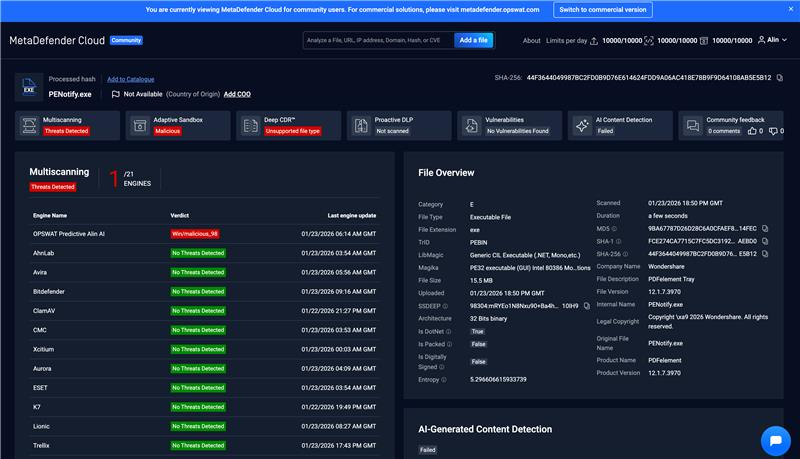
MetaDefender Cloud - Predictive Alin AI runs inline as part of the MetaScan package.
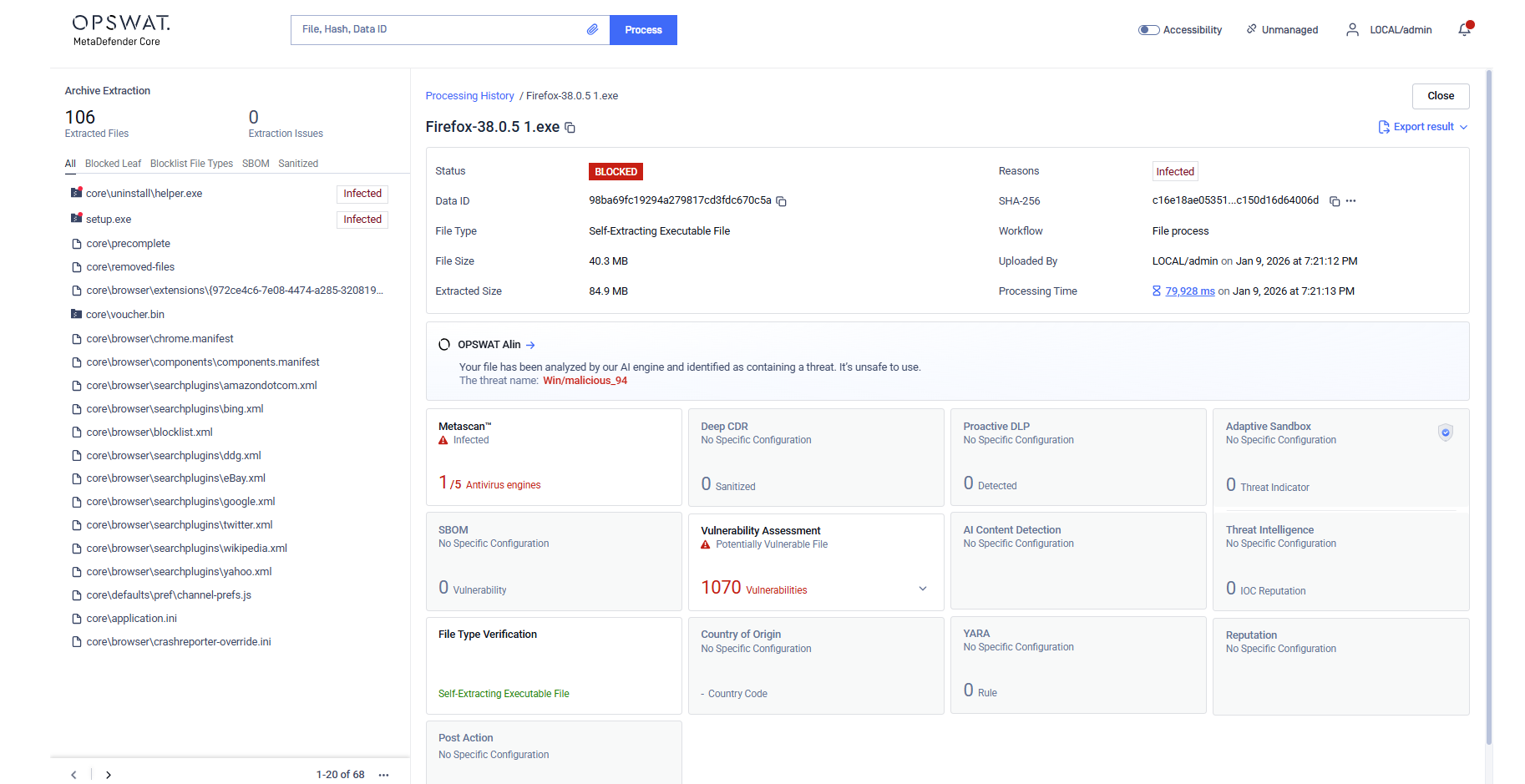
MetaDefender Core - Predictive Alin AI runs inline as part of the MetaScan package on Linux and Windows.
Standardized engine verdict codes: Reference: https://www.opswat.com/docs/mdcloud/integrations/description-on-scan-result-codes
0 - No Threat Detected
1 - Infected: The file was analyzed and determined to be malicious.
10 - Not Scanned: The file was not analyzed (for example, due to size limits or an internal processing error).
23 - Unsupported File Format: The file type is not currently supported by the engine.
Threat detection naming convention for policy integration:
Format: <platform>/malicious_<threat_confidence>
Platform mapping:
Windows - PE-based executables
Linux - ELF-based binaries
Darwin - Mach-O-based binaries
Generic - non-platform-specific formats such as PDF
Examples:
PE: Windows/malicious_99
ELF: Unix/malicious_99
Mach-O: MacOS/malicious_99
PDF: Generic/malicious_99
Known considerations
This is the first General Access release. Establish an initial operational baseline before tightening policy.
Malicious naming outputs are standardized for policy integration and should be interpreted alongside the broader security context.
Introduction
Predictive Alin AI 3.0.0 marks the General Access release of OPSWAT’s proprietary machine learning-driven malware detection engine, purpose-built for high-speed, pre-execution protection in modern, high-throughput environments.
What This Means for MetaDefender Customers?
Predictive Alin AI is fully integrated into the MetaDefender platform and accessible across all products and environments, available in both cloud and on-premises environments, supporting Windows and Linux operating systems
Predictive Alin AI operates in parallel to MetaScan to enhance detection coverage via machine learning algorithms enhanced by MetaDefender Aether’s dynamic analysis, for reduced false positives and zero-day detection
Predictive Alin AI targets the primary malware entry points, with extensive support for executable formats and PDF files, where most modern threats originate.
How Is Predictive Alin AI Continuously Improving?
Predictive Alin AI has a documented Machine Learning pipeline lifecycle concept for transparency, including:
Data ingestion and normalization controls (hashing, deduplication, validation)
Labeling and enrichment through MetaDefender Aether using multi-source evidence (static characteristics, dynamic analysis context, consensus-oriented verdict context, and threat intelligence enrichment)
Training, evaluation, and quality gating against false-positive benchmarks before promotion
Continuous refresh and monitoring to adapt to malware evolution
Key Benefits
Fast, pre-execution malware detection (P99 under 100ms) to enable allow, block, and quarantine decisions at scale.
Faster scan times for high-volume workflows while improving accuracy and reducing false positives (0.1% False Positive Rate and over 90% accurcacy across the board)
Extensive support for executable formats (PE, ELF, Mach-O) plus PDF for common document-borne threats.
Available as a custom engine in MetaDefender Cloud and MetaDefender Core.
Next Steps to Upgrade:
Customers currently using MetaDefender products can add Predictive Alin AI to unlock high-speed, machine learning–based detection for pre-execution threats while retaining familiar multiscanning capabilities. To discuss upgrade options or transition planning, please contact your OPSWAT representative.
Predictive Alin AI reflects where we’re heading with pre-execution malware detection: faster decisions, better accuracy, and the ability to handle high-volume environments without added complexity.
Compatibility
Platforms: Windows, Linux